


Details
| Stereochemistry | ACHIRAL |
| Molecular Formula | C15H8F7NO3 |
| Molecular Weight | 383.2177 |
| Optical Activity | NONE |
| Defined Stereocenters | 0 / 0 |
| E/Z Centers | 0 |
| Charge | 0 |
SHOW SMILES / InChI
SMILES
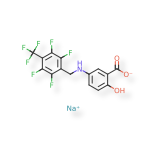
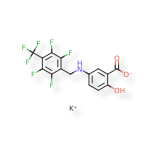
OC(=O)C1=CC(NCC2=C(F)C(F)=C(C(F)=C2F)C(F)(F)F)=CC=C1O
InChI
InChIKey=HABROHXUHNHQMY-UHFFFAOYSA-N
InChI=1S/C15H8F7NO3/c16-10-7(11(17)13(19)9(12(10)18)15(20,21)22)4-23-5-1-2-8(24)6(3-5)14(25)26/h1-3,23-24H,4H2,(H,25,26)
| Molecular Formula | C15H8F7NO3 |
| Molecular Weight | 383.2177 |
| Charge | 0 |
| Count |
|
| Stereochemistry | ACHIRAL |
| Additional Stereochemistry | No |
| Defined Stereocenters | 0 / 0 |
| E/Z Centers | 0 |
| Optical Activity | NONE |
Approval Year
PubMed
| Title | Date | PubMed |
|---|---|---|
| Neu2000, an NR2B-selective, moderate NMDA receptor antagonist and potent spin trapping molecule for stroke. | 2010-11 |
|
| The functional and neuroprotective actions of Neu2000, a dual-acting pharmacological agent, in the treatment of acute spinal cord injury. | 2010-01 |
|
| The novel NMDA receptor antagonist, 2-hydroxy-5-(2,3,5,6-tetrafluoro-4-trifluoromethyl-benzylamino)-benzoic acid, is a gating modifier in cultured mouse cortical neurons. | 2009-06 |
|
| Marked prevention of ischemic brain injury by Neu2000, an NMDA antagonist and antioxidant derived from aspirin and sulfasalazine. | 2007-06 |
|
| Concurrent administration of Neu2000 and lithium produces marked improvement of motor neuron survival, motor function, and mortality in a mouse model of amyotrophic lateral sclerosis. | 2007-04 |
| Substance Class |
Chemical
Created
by
admin
on
Edited
Mon Mar 31 22:28:51 GMT 2025
by
admin
on
Mon Mar 31 22:28:51 GMT 2025
|
| Record UNII |
TP6PKI8CQP
|
| Record Status |
Validated (UNII)
|
| Record Version |
|
-
Download
| Name | Type | Language | ||
|---|---|---|---|---|
|
Preferred Name | English | ||
|
Official Name | English | ||
|
Code | English | ||
|
Systematic Name | English | ||
|
Systematic Name | English | ||
|
Common Name | English |
| Code System | Code | Type | Description | ||
|---|---|---|---|---|---|
|
NEU-2000
Created by
admin on Mon Mar 31 22:28:51 GMT 2025 , Edited by admin on Mon Mar 31 22:28:51 GMT 2025
|
PRIMARY | CAS Number: 640290-67-1; Synonyms: Neu-2000, Neu-2000-KL | ||
|
300000010842
Created by
admin on Mon Mar 31 22:28:51 GMT 2025 , Edited by admin on Mon Mar 31 22:28:51 GMT 2025
|
PRIMARY | |||
|
C174917
Created by
admin on Mon Mar 31 22:28:51 GMT 2025 , Edited by admin on Mon Mar 31 22:28:51 GMT 2025
|
PRIMARY | |||
|
640290-67-1
Created by
admin on Mon Mar 31 22:28:51 GMT 2025 , Edited by admin on Mon Mar 31 22:28:51 GMT 2025
|
PRIMARY | |||
|
9951955
Created by
admin on Mon Mar 31 22:28:51 GMT 2025 , Edited by admin on Mon Mar 31 22:28:51 GMT 2025
|
PRIMARY | |||
|
TP6PKI8CQP
Created by
admin on Mon Mar 31 22:28:51 GMT 2025 , Edited by admin on Mon Mar 31 22:28:51 GMT 2025
|
PRIMARY | |||
|
10970
Created by
admin on Mon Mar 31 22:28:51 GMT 2025 , Edited by admin on Mon Mar 31 22:28:51 GMT 2025
|
PRIMARY |
| Related Record | Type | Details | ||
|---|---|---|---|---|
|
SALT/SOLVATE -> PARENT | |||
|
TARGET -> INHIBITOR |
|
||
|
SALT/SOLVATE -> PARENT |

| Related Record | Type | Details | ||
|---|---|---|---|---|
|
ACTIVE MOIETY |
Neu2000 is a dual-acting neuroprotective agent that functions both as a noncompetitive N-methyl-d-aspartate (NMDA) receptor antagonist and a free radical scavenger. In the present study, we investigated the scavenging activity of Neu2000 on various classes of reactive oxygen species and reactive nitrogen species (ROS/RNS) as well as its efficacy for reducing free radicals and oxidative stress/damage induced in spinal cord mitochondrial preparations. Neu2000 exerted scavenging activity against superoxide, nitric oxide, and hydroxyl radicals, and efficiently scavenged peroxynitrite. In the mitochondrial studies, Neu2000 markedly inhibited ROS/RNS and hydrogen peroxide levels following antimycin treatment. The results of the present study demonstrate that Neu2000 possesses potent in vitro antioxidant activity due, most likely, to its active phenoxy group.
|
