


Details
| Stereochemistry | ABSOLUTE |
| Molecular Formula | C13H20N2O2.C5H7NO3 |
| Molecular Weight | 365.4241 |
| Optical Activity | UNSPECIFIED |
| Defined Stereocenters | 1 / 1 |
| E/Z Centers | 0 |
| Charge | 0 |
SHOW SMILES / InChI
SMILES
OC(=O)[C@@H]1CCC(=O)N1.CCN(CC)CCOC(=O)C2=CC=C(N)C=C2
InChI
InChIKey=CTURZEPMXLXYMZ-HVDRVSQOSA-N
InChI=1S/C13H20N2O2.C5H7NO3/c1-3-15(4-2)9-10-17-13(16)11-5-7-12(14)8-6-11;7-4-2-1-3(6-4)5(8)9/h5-8H,3-4,9-10,14H2,1-2H3;3H,1-2H2,(H,6,7)(H,8,9)/t;3-/m.0/s1
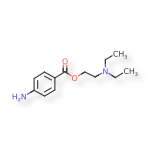
| Molecular Formula | C13H20N2O2 |
| Molecular Weight | 236.3101 |
| Charge | 0 |
| Count |
|
| Stereochemistry | ACHIRAL |
| Additional Stereochemistry | No |
| Defined Stereocenters | 0 / 0 |
| E/Z Centers | 0 |
| Optical Activity | NONE |
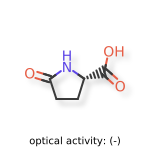
| Molecular Formula | C5H7NO3 |
| Molecular Weight | 129.114 |
| Charge | 0 |
| Count |
|
| Stereochemistry | ABSOLUTE |
| Additional Stereochemistry | No |
| Defined Stereocenters | 1 / 1 |
| E/Z Centers | 0 |
| Optical Activity | UNSPECIFIED |
Procaine is an anesthetic agent indicated for production of local or regional anesthesia, particularly for oral surgery. Procaine (like cocaine) has the advantage of constricting blood vessels which reduces bleeding, unlike other local anesthetics like lidocaine. Procaine is an ester anesthetic. It is metabolized in the plasma by the enzyme pseudocholinesterase through hydrolysis into para-aminobenzoic acid (PABA), which is then excreted by the kidneys into the urine. Procaine acts mainly by inhibiting sodium influx through voltage gated sodium channels in the neuronal cell membrane of peripheral nerves. When the influx of sodium is interrupted, an action potential cannot arise and signal conduction is thus inhibited. The receptor site is thought to be located at the cytoplasmic (inner) portion of the sodium channel. Procaine has also been shown to bind or antagonize the function of N-methyl-D-aspartate (NMDA) receptors as well as nicotinic acetylcholine receptors and the serotonin receptor-ion channel complex.
Originator
Approval Year
Targets
| Primary Target | Pharmacology | Condition | Potency |
|---|---|---|---|
| 60.0 nM [IC50] | |||
Target ID: CHEMBL2362997 |
50.0 µM [IC50] | ||
Target ID: CHEMBL2411 |
1.7 µM [Kd] |
Conditions
| Condition | Modality | Targets | Highest Phase | Product |
|---|---|---|---|---|
| Primary | Procaine Approved UseProcaine is a local anesthetic. Procaine causes loss of feeling (numbness) of skin and mucous membranes.
Procaine is used as an injection during surgery and other medical and dental procedures. Launch Date1972 |
Cmax
| Value | Dose | Co-administered | Analyte | Population |
|---|---|---|---|---|
12 μg/mL EXPERIMENT https://pubmed.ncbi.nlm.nih.gov/573562/ |
60 mg/kg single, intravenous dose: 60 mg/kg route of administration: Intravenous experiment type: SINGLE co-administered: |
PROCAINE plasma | Homo sapiens population: UNHEALTHY age: ADULT sex: FEMALE food status: UNKNOWN |
AUC
| Value | Dose | Co-administered | Analyte | Population |
|---|---|---|---|---|
12.5 μg × min/mL EXPERIMENT https://pubmed.ncbi.nlm.nih.gov/573562/ |
60 mg/kg single, intravenous dose: 60 mg/kg route of administration: Intravenous experiment type: SINGLE co-administered: |
PROCAINE plasma | Homo sapiens population: UNHEALTHY age: ADULT sex: FEMALE food status: UNKNOWN |
T1/2
| Value | Dose | Co-administered | Analyte | Population |
|---|---|---|---|---|
8.3 min EXPERIMENT https://pubmed.ncbi.nlm.nih.gov/573562/ |
60 mg/kg single, intravenous dose: 60 mg/kg route of administration: Intravenous experiment type: SINGLE co-administered: |
PROCAINE plasma | Homo sapiens population: UNHEALTHY age: ADULT sex: FEMALE food status: UNKNOWN |
Doses
| Dose | Population | Adverse events |
|---|---|---|
50 mg 1 times / day multiple, oral Studied dose Dose: 50 mg, 1 times / day Route: oral Route: multiple Dose: 50 mg, 1 times / day Sources: |
healthy, 72.8 |
Disc. AE: Systemic lupus erythematosus synd... AEs leading to discontinuation/dose reduction: Systemic lupus erythematosus synd (0.84%) Sources: |
AEs
| AE | Significance | Dose | Population |
|---|---|---|---|
| Systemic lupus erythematosus synd | 0.84% Disc. AE |
50 mg 1 times / day multiple, oral Studied dose Dose: 50 mg, 1 times / day Route: oral Route: multiple Dose: 50 mg, 1 times / day Sources: |
healthy, 72.8 |
PubMed
| Title | Date | PubMed |
|---|---|---|
| Liver preservation with HTK: salutary effect of hypothermic aerobiosis by either gaseous oxygen or machine perfusion. | 2002-06 |
|
| Interaction of monosulfonate tetraphenyl porphyrin, a competitive inhibitor, with acetylcholinesterase. | 2002-06 |
|
| [Magnetically-guided anesthetics based on highly dispersed iron powders coated by polyacrylamide]. | 2002-04-24 |
|
| Activation of in vitro matured pig oocytes using activators of inositol triphosphate or ryanodine receptors. | 2002-04-15 |
|
| Oxybuprocaine induces a false-positive response in immunochromatographic SAS Adeno Test. | 2002-04 |
|
| Intrapericardial procaine affects volume expansion-induced fos immunoreactivity in unanesthetized rats. | 2002-04 |
|
| [Increase in brain activity of the carp Cyprinus carpio during visual deafferentation]. | 2002-03-20 |
|
| Allergy to local anaesthetics in dentistry. Myth or reality? | 2002-03-13 |
|
| [Investigation on the mechanisms of leukocyte alteration in patients with intolerance to some drugs (with novocaine as a model)]. | 2002-03-08 |
|
| [Allergic alteration of leukocytes in patients with drug intolerance]. | 2002-03-02 |
|
| Non-surgical management of rectal tears in two mares. | 2002-03 |
|
| Biochemical and morphological changes in pancreas stored under hypothermic conditions. | 2002-03 |
|
| Resonance Rayleigh scattering technology as a new method for the determination of the inclusion constant of beta-cyclodextrin. | 2002-02 |
|
| Clinical issues in the prophylaxis, diagnosis, and treatment of anthrax. | 2002-02 |
|
| [Tumescent technique for local anesthesia]. | 2002-02 |
|
| Effect of cholesterol liposomes on calcium mobilization in muscle cells from the rabbit sphincter of Oddi. | 2002-02 |
|
| Ionic basis of the resting membrane potential and action potential in the pharyngeal muscle of Caenorhabditis elegans. | 2002-02 |
|
| Recurrent corneal ulceration as late complication of toxic keratitis. | 2002-02 |
|
| Chloroprocaine is less painful than lidocaine for skin infiltration anesthesia. | 2002-02 |
|
| The inhibition of the N-methyl-D-aspartate receptor channel by local anesthetics in mouse CA1 pyramidal neurons. | 2002-02 |
|
| Ligand-dependent activation of the melanocortin 5 receptor: cAMP production and ryanodine receptor-dependent elevations of [Ca(2+)](I). | 2002-01-18 |
|
| Improved right heart function after myocardial preservation with 2,3-butanedione 2-monoxime in a porcine model of allogenic heart transplantation. | 2002-01 |
|
| Short-acting peribulbar anesthesia with 2-chloroprocaine. | 2002-01 |
|
| From the Centers for Disease Control and Prevention. Recommendations for antimicrobial prophylaxis for children and breastfeeding mothers and treatment of children with anthrax. | 2001-12-05 |
|
| Local anesthetics noncompetitively inhibit function of four distinct nicotinic acetylcholine receptor subtypes. | 2001-12 |
|
| Update: Interim recommendations for antimicrobial prophylaxis for children and breastfeeding mothers and treatment of children with anthrax. | 2001-11-16 |
|
| Santayana's prophecy fulfilled. | 2001-11-15 |
|
| Release of non-neuronal acetylcholine from the isolated human placenta is mediated by organic cation transporters. | 2001-11 |
|
| [Treatment of animals with acute and/or chronic complaints by electric stimulation therapy]. | 2001-10-15 |
|
| [Interactions of histamine and glucocorticoids with nerve structures of respiration passages]. | 2001-10 |
|
| [Infusion therapy with procaine in acute tinnitus]. | 2001-10 |
|
| Optimisation and validation of a capillary electrophoresis method for the simultaneous determination of diazepam and otilonium bromide. | 2001-10 |
|
| [Myasthenia gravis]. | 2001-10 |
|
| Properties of Ca(2+) release induced by clofibric acid from the sarcoplasmic reticulum of mouse skeletal muscle fibres. | 2001-10 |
|
| Cembranoid and long-chain alkanol sites on the nicotinic acetylcholine receptor and their allosteric interaction. | 2001-09-18 |
|
| Common solvent toxicity: autoxidation of respiratory redox-cyclers enforced by membrane derangement. | 2001-09-04 |
|
| Role of the dopamine transporter and the sodium channel in the cocaine-like discriminative stimulus effects of local anesthetics in rats. | 2001-09 |
|
| Evidence that spinal segmental nitric oxide mediates tachyphylaxis to peripheral local anesthetic nerve block. | 2001-09 |
|
| Topical anesthesia with or without propofol sedation versus retrobulbar/peribulbar anesthesia for cataract extraction: prospective randomized trial. | 2001-09 |
|
| From cocaine to ropivacaine: the history of local anesthetic drugs. | 2001-08 |
|
| Supraventricular ectopics and supraventricular tachycardia following injection of subconjunctival Mydricaine No. 2. | 2001-08 |
|
| Calcification in the planula and polyp of the hydroid Hydractinia symbiolongicarpus (Cnidaria, Hydrozoa). | 2001-08 |
|
| Effect of sub-Tenon's and peribulbar anesthesia on intraocular pressure and ocular pulse amplitude. | 2001-08 |
|
| Determination of apparent binding constants of drugs by capillary electrophoresis using beta-cyclodextrin as ligand and three different linear plotting methods. | 2001-07-27 |
|
| Ion-transfer voltammetry of local anesthetics at an organic solvent/water interface and pharmacological activity vs. ion partition coefficient relationship. | 2001-01 |
|
| [Drug allergy among patients suffering from nasal polyps]. | 2001 |
|
| Pathways involved in RGD-mediated calcium transients in mature bovine oocytes. | 2001 |
|
| Swelling of capillary endothelial cells and cardiomyocytes in the ischaemic myocardium of artificially arrested canine hearts. | 2001 |
|
| Effect of posterior hypothalamic injection of procaine on the hippocampal theta rhythm in freely moving cats. | 2001 |
|
| [Prognosis and criteria of recovered motility of one of the vocal cords in the middle position as a result cordectomy]. | 2001 |
Sample Use Guides
Adults
Local or Regional Anesthesia
Local Infiltration
Usually, 350–600 mg, administered as diluted solution (i.e., 140–240 mL of a 0.25% solution or 70–120 mL of a 0.5% solution)
Peripheral Nerve Block
Up to 1 g, administered undiluted (i.e., 100 mL of a 1% injection) or as diluted solution (i.e., 200 mL of a 0.5% solution).
For local infiltration or peripheral nerve block, inject slowly and avoid rapid injection of large volumes; when feasible, administer in fractional (incremental) doses. For subarachnoid (spinal) block, use 2-mL single-dose ampuls containing procaine hydrochloride 10% only.c d Position patient properly prior to spinal anesthesia.
Route of Administration:
Other
| Substance Class |
Chemical
Created
by
admin
on
Edited
Mon Mar 31 17:46:20 GMT 2025
by
admin
on
Mon Mar 31 17:46:20 GMT 2025
|
| Record UNII |
W84930057W
|
| Record Status |
Validated (UNII)
|
| Record Version |
|
-
Download
| Name | Type | Language | ||
|---|---|---|---|---|
|
Common Name | English | ||
|
Preferred Name | English | ||
|
Common Name | English | ||
|
Systematic Name | English | ||
|
Systematic Name | English | ||
|
Systematic Name | English |
| Code System | Code | Type | Description | ||
|---|---|---|---|---|---|
|
44148136
Created by
admin on Mon Mar 31 17:46:20 GMT 2025 , Edited by admin on Mon Mar 31 17:46:20 GMT 2025
|
PRIMARY | |||
|
241-201-5
Created by
admin on Mon Mar 31 17:46:20 GMT 2025 , Edited by admin on Mon Mar 31 17:46:20 GMT 2025
|
PRIMARY | |||
|
DTXSID60937984
Created by
admin on Mon Mar 31 17:46:20 GMT 2025 , Edited by admin on Mon Mar 31 17:46:20 GMT 2025
|
PRIMARY | |||
|
10248-52-9
Created by
admin on Mon Mar 31 17:46:20 GMT 2025 , Edited by admin on Mon Mar 31 17:46:20 GMT 2025
|
NON-SPECIFIC STOICHIOMETRY | |||
|
W84930057W
Created by
admin on Mon Mar 31 17:46:20 GMT 2025 , Edited by admin on Mon Mar 31 17:46:20 GMT 2025
|
PRIMARY | |||
|
17140-49-7
Created by
admin on Mon Mar 31 17:46:20 GMT 2025 , Edited by admin on Mon Mar 31 17:46:20 GMT 2025
|
PRIMARY |
| Related Record | Type | Details | ||
|---|---|---|---|---|
|
|
PARENT -> SALT/SOLVATE | |||
|
|
PARENT -> SALT/SOLVATE |
| Related Record | Type | Details | ||
|---|---|---|---|---|
|
|
ACTIVE MOIETY |