


Details
| Stereochemistry | ACHIRAL |
| Molecular Formula | C18H24N4O |
| Molecular Weight | 312.4094 |
| Optical Activity | UNSPECIFIED |
| Defined Stereocenters | 3 / 3 |
| E/Z Centers | 0 |
| Charge | 0 |
SHOW SMILES / InChI
SMILES
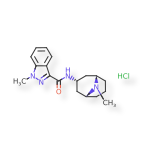
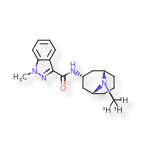
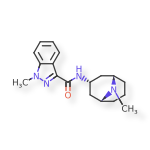
CN1N=C(C(=O)N[C@@H]2C[C@@H]3CCC[C@H](C2)N3C)C4=C1C=CC=C4
InChI
InChIKey=MFWNKCLOYSRHCJ-BTTYYORXSA-N
InChI=1S/C18H24N4O/c1-21-13-6-5-7-14(21)11-12(10-13)19-18(23)17-15-8-3-4-9-16(15)22(2)20-17/h3-4,8-9,12-14H,5-7,10-11H2,1-2H3,(H,19,23)/t12-,13+,14-
| Molecular Formula | C18H24N4O |
| Molecular Weight | 312.4094 |
| Charge | 0 |
| Count |
|
| Stereochemistry | ABSOLUTE |
| Additional Stereochemistry | No |
| Defined Stereocenters | 3 / 3 |
| E/Z Centers | 0 |
| Optical Activity | UNSPECIFIED |
DescriptionSources: http://www.drugbank.ca/drugs/DB00889Curator's Comment: Description was created based on several sources, including http://www.accessdata.fda.gov/drugsatfda_docs/label/2016/022445s000lbl.pdf
Sources: http://www.drugbank.ca/drugs/DB00889
Curator's Comment: Description was created based on several sources, including http://www.accessdata.fda.gov/drugsatfda_docs/label/2016/022445s000lbl.pdf
Granisetron is a selective inhibitor of type 3 serotonergic (5-HT3) receptors. The drug is structurally and pharmacologically related to ondansetron, another selective inhibitor of 5-HT3 receptors. The serontonin 5-HT3 receptors are located on the nerve terminals of the vagus in the periphery, and centrally in the chemoreceptor trigger zone of the area postrema. The temporal relationship between the emetogenic action of emetogenic drugs and the release of serotonin, as well as the efficacy of antiemetic agents suggest that chemotherapeutic agents release serotonin from the enterochromaffin cells of the small intestine by causing degenerative changes in the GI tract. The serotonin then stimulates the vagal and splanchnic nerve receptors that project to the medullary vomiting center, as well as the 5-HT3 receptors in the area postrema, thus initiating the vomiting reflex, causing nausea and vomiting. Granisetron is a potent, selective antagonist of 5-HT3 receptors. The antiemetic activity of the drug is brought about through the inhibition of 5-HT3 receptors present both centrally (medullary chemoreceptor zone) and peripherally (GI tract). This inhibition of 5-HT3 receptors in turn inhibits the visceral afferent stimulation of the vomiting center, likely indirectly at the level of the area postrema, as well as through direct inhibition of serotonin activity within the area postrema and the chemoreceptor trigger zone. Granisetron is used for the prevention of nausea and vomiting associated with initial and repeat courses of emetogenic cancer therapy (including high dose cisplatin), postoperation, and radiation (including total body irradiation and daily fractionated abdominal radiation).
Approval Year
Targets
| Primary Target | Pharmacology | Condition | Potency |
|---|---|---|---|
Target ID: CHEMBL1899 Sources: http://www.drugbank.ca/drugs/DB00889 |
1.45 nM [Ki] |
Conditions
| Condition | Modality | Targets | Highest Phase | Product |
|---|---|---|---|---|
| Secondary | SUSTOL Approved UseSUSTOL is a serotonin-3 (5-HT3) receptor antagonist indicated in combination with other antiemetics in adults for the prevention of acute and delayed nausea and vomiting associated with initial and repeat courses of moderately emetogenic chemotherapy (MEC) or anthracycline and cyclophosphamide (AC) combination chemotherapy regimens. Launch Date1992 |
Cmax
| Value | Dose | Co-administered | Analyte | Population |
|---|---|---|---|---|
4.948 ng/mL EXPERIMENT https://www.ncbi.nlm.nih.gov/pubmed/22452942 |
10 μg/kg bw single, intravenous dose: 10 μg/kg bw route of administration: Intravenous experiment type: SINGLE co-administered: |
GRANISETRON plasma | Homo sapiens population: HEALTHY age: ADULT sex: FEMALE / MALE food status: UNKNOWN |
AUC
| Value | Dose | Co-administered | Analyte | Population |
|---|---|---|---|---|
36.87 ng × h/mL EXPERIMENT https://www.ncbi.nlm.nih.gov/pubmed/22452942 |
10 μg/kg bw single, intravenous dose: 10 μg/kg bw route of administration: Intravenous experiment type: SINGLE co-administered: |
GRANISETRON plasma | Homo sapiens population: HEALTHY age: ADULT sex: FEMALE / MALE food status: UNKNOWN |
T1/2
| Value | Dose | Co-administered | Analyte | Population |
|---|---|---|---|---|
5 h EXPERIMENT https://www.ncbi.nlm.nih.gov/pubmed/22452942 |
10 μg/kg bw single, intravenous dose: 10 μg/kg bw route of administration: Intravenous experiment type: SINGLE co-administered: |
GRANISETRON plasma | Homo sapiens population: HEALTHY age: ADULT sex: FEMALE / MALE food status: UNKNOWN |
Doses
| Dose | Population | Adverse events |
|---|---|---|
2 mg 2 times / day multiple, oral Highest studied dose Dose: 2 mg, 2 times / day Route: oral Route: multiple Dose: 2 mg, 2 times / day Sources: |
unhealthy, 50.6 years (range: 23-76 years) Health Status: unhealthy Age Group: 50.6 years (range: 23-76 years) Sex: M+F Sources: |
Other AEs: Constipation, Headache... Other AEs: Constipation (27.5%) Sources: Headache (17.6%) Leukopenia (15%) Asthenia (6.9%) Abdominal pain (9%) Decreased appetite (5.6%) Anemia (1.3%) Diarrhea (4.3%) Abnormal liver function tests (2.6%) Alopecia (3%) Pain (0.4%) |
160 ug/kg single, intravenous Highest studied dose Dose: 160 ug/kg Route: intravenous Route: single Dose: 160 ug/kg Sources: |
unhealthy, 54 |
Other AEs: Headache, Constipation... Other AEs: Headache (13.9%) Sources: Constipation (4.2%) Somnolence (2.4%) Dizziness (1.2%) Dyspepsia (1.8%) Back pain (3%) |
15 mg single, subcutaneous Highest studied dose Dose: 15 mg Route: subcutaneous Route: single Dose: 15 mg Sources: |
unhealthy, 64.3 |
Other AEs: Constipation, Diarrhea... Other AEs: Constipation (23.1%) Sources: Diarrhea (15.4%) Headache (30.8%) Fatigue (15.4%) Anorexia (15.4%) Weight loss (7.7%) Dizziness (7.7%) Neutropenia (15.4%) Mucosal inflammation (15.4%) Dyspnea (7.7%) Insomnia (7.7%) Thrombocytopenia (7.7%) Injection site bruising (7.7%) Pain injection site (2.2%) |
1 mg single, intravenous Recommended Dose: 1 mg Route: intravenous Route: single Dose: 1 mg Sources: |
unhealthy Health Status: unhealthy Sources: |
Other AEs: Pain, Constipation... Other AEs: Pain (10.1%) Sources: Constipation (9.4%) Anemia (9.4%) Headache (8.6%) Fever (7.9%) Abdominal pain (6%) Hepatic enzymes increased (5.6%) Insomnia (4.9%) Bradycardia (4.5%) Dizziness (4.1%) Leukocytosis (3.7%) Anxiety (3.4%) Hypotension (3.4%) Diarrhea (3.4%) Flatulence (3%) Infection (3%) Dyspepsia (3%) Hypertension (2.6%) Urinary tract infection (2.6%) Oliguria (2.2%) Coughing (2.2%) |
40 ug/kg single, intravenous Recommended Dose: 40 ug/kg Route: intravenous Route: single Dose: 40 ug/kg Sources: |
unhealthy Health Status: unhealthy Sources: |
Other AEs: Headache, Asthenia... Other AEs: Headache (14%) Sources: Asthenia (5%) Somnolence (4%) Diarrhea (4%) Constipation (3%) |
AEs
| AE | Significance | Dose | Population |
|---|---|---|---|
| Pain | 0.4% | 2 mg 2 times / day multiple, oral Highest studied dose Dose: 2 mg, 2 times / day Route: oral Route: multiple Dose: 2 mg, 2 times / day Sources: |
unhealthy, 50.6 years (range: 23-76 years) Health Status: unhealthy Age Group: 50.6 years (range: 23-76 years) Sex: M+F Sources: |
| Anemia | 1.3% | 2 mg 2 times / day multiple, oral Highest studied dose Dose: 2 mg, 2 times / day Route: oral Route: multiple Dose: 2 mg, 2 times / day Sources: |
unhealthy, 50.6 years (range: 23-76 years) Health Status: unhealthy Age Group: 50.6 years (range: 23-76 years) Sex: M+F Sources: |
| Leukopenia | 15% | 2 mg 2 times / day multiple, oral Highest studied dose Dose: 2 mg, 2 times / day Route: oral Route: multiple Dose: 2 mg, 2 times / day Sources: |
unhealthy, 50.6 years (range: 23-76 years) Health Status: unhealthy Age Group: 50.6 years (range: 23-76 years) Sex: M+F Sources: |
| Headache | 17.6% | 2 mg 2 times / day multiple, oral Highest studied dose Dose: 2 mg, 2 times / day Route: oral Route: multiple Dose: 2 mg, 2 times / day Sources: |
unhealthy, 50.6 years (range: 23-76 years) Health Status: unhealthy Age Group: 50.6 years (range: 23-76 years) Sex: M+F Sources: |
| Abnormal liver function tests | 2.6% | 2 mg 2 times / day multiple, oral Highest studied dose Dose: 2 mg, 2 times / day Route: oral Route: multiple Dose: 2 mg, 2 times / day Sources: |
unhealthy, 50.6 years (range: 23-76 years) Health Status: unhealthy Age Group: 50.6 years (range: 23-76 years) Sex: M+F Sources: |
| Constipation | 27.5% | 2 mg 2 times / day multiple, oral Highest studied dose Dose: 2 mg, 2 times / day Route: oral Route: multiple Dose: 2 mg, 2 times / day Sources: |
unhealthy, 50.6 years (range: 23-76 years) Health Status: unhealthy Age Group: 50.6 years (range: 23-76 years) Sex: M+F Sources: |
| Alopecia | 3% | 2 mg 2 times / day multiple, oral Highest studied dose Dose: 2 mg, 2 times / day Route: oral Route: multiple Dose: 2 mg, 2 times / day Sources: |
unhealthy, 50.6 years (range: 23-76 years) Health Status: unhealthy Age Group: 50.6 years (range: 23-76 years) Sex: M+F Sources: |
| Diarrhea | 4.3% | 2 mg 2 times / day multiple, oral Highest studied dose Dose: 2 mg, 2 times / day Route: oral Route: multiple Dose: 2 mg, 2 times / day Sources: |
unhealthy, 50.6 years (range: 23-76 years) Health Status: unhealthy Age Group: 50.6 years (range: 23-76 years) Sex: M+F Sources: |
| Decreased appetite | 5.6% | 2 mg 2 times / day multiple, oral Highest studied dose Dose: 2 mg, 2 times / day Route: oral Route: multiple Dose: 2 mg, 2 times / day Sources: |
unhealthy, 50.6 years (range: 23-76 years) Health Status: unhealthy Age Group: 50.6 years (range: 23-76 years) Sex: M+F Sources: |
| Asthenia | 6.9% | 2 mg 2 times / day multiple, oral Highest studied dose Dose: 2 mg, 2 times / day Route: oral Route: multiple Dose: 2 mg, 2 times / day Sources: |
unhealthy, 50.6 years (range: 23-76 years) Health Status: unhealthy Age Group: 50.6 years (range: 23-76 years) Sex: M+F Sources: |
| Abdominal pain | 9% | 2 mg 2 times / day multiple, oral Highest studied dose Dose: 2 mg, 2 times / day Route: oral Route: multiple Dose: 2 mg, 2 times / day Sources: |
unhealthy, 50.6 years (range: 23-76 years) Health Status: unhealthy Age Group: 50.6 years (range: 23-76 years) Sex: M+F Sources: |
| Dizziness | 1.2% | 160 ug/kg single, intravenous Highest studied dose Dose: 160 ug/kg Route: intravenous Route: single Dose: 160 ug/kg Sources: |
unhealthy, 54 |
| Dyspepsia | 1.8% | 160 ug/kg single, intravenous Highest studied dose Dose: 160 ug/kg Route: intravenous Route: single Dose: 160 ug/kg Sources: |
unhealthy, 54 |
| Headache | 13.9% | 160 ug/kg single, intravenous Highest studied dose Dose: 160 ug/kg Route: intravenous Route: single Dose: 160 ug/kg Sources: |
unhealthy, 54 |
| Somnolence | 2.4% | 160 ug/kg single, intravenous Highest studied dose Dose: 160 ug/kg Route: intravenous Route: single Dose: 160 ug/kg Sources: |
unhealthy, 54 |
| Back pain | 3% | 160 ug/kg single, intravenous Highest studied dose Dose: 160 ug/kg Route: intravenous Route: single Dose: 160 ug/kg Sources: |
unhealthy, 54 |
| Constipation | 4.2% | 160 ug/kg single, intravenous Highest studied dose Dose: 160 ug/kg Route: intravenous Route: single Dose: 160 ug/kg Sources: |
unhealthy, 54 |
| Anorexia | 15.4% | 15 mg single, subcutaneous Highest studied dose Dose: 15 mg Route: subcutaneous Route: single Dose: 15 mg Sources: |
unhealthy, 64.3 |
| Diarrhea | 15.4% | 15 mg single, subcutaneous Highest studied dose Dose: 15 mg Route: subcutaneous Route: single Dose: 15 mg Sources: |
unhealthy, 64.3 |
| Fatigue | 15.4% | 15 mg single, subcutaneous Highest studied dose Dose: 15 mg Route: subcutaneous Route: single Dose: 15 mg Sources: |
unhealthy, 64.3 |
| Mucosal inflammation | 15.4% | 15 mg single, subcutaneous Highest studied dose Dose: 15 mg Route: subcutaneous Route: single Dose: 15 mg Sources: |
unhealthy, 64.3 |
| Neutropenia | 15.4% | 15 mg single, subcutaneous Highest studied dose Dose: 15 mg Route: subcutaneous Route: single Dose: 15 mg Sources: |
unhealthy, 64.3 |
| Pain injection site | 2.2% | 15 mg single, subcutaneous Highest studied dose Dose: 15 mg Route: subcutaneous Route: single Dose: 15 mg Sources: |
unhealthy, 64.3 |
| Constipation | 23.1% | 15 mg single, subcutaneous Highest studied dose Dose: 15 mg Route: subcutaneous Route: single Dose: 15 mg Sources: |
unhealthy, 64.3 |
| Headache | 30.8% | 15 mg single, subcutaneous Highest studied dose Dose: 15 mg Route: subcutaneous Route: single Dose: 15 mg Sources: |
unhealthy, 64.3 |
| Dizziness | 7.7% | 15 mg single, subcutaneous Highest studied dose Dose: 15 mg Route: subcutaneous Route: single Dose: 15 mg Sources: |
unhealthy, 64.3 |
| Dyspnea | 7.7% | 15 mg single, subcutaneous Highest studied dose Dose: 15 mg Route: subcutaneous Route: single Dose: 15 mg Sources: |
unhealthy, 64.3 |
| Injection site bruising | 7.7% | 15 mg single, subcutaneous Highest studied dose Dose: 15 mg Route: subcutaneous Route: single Dose: 15 mg Sources: |
unhealthy, 64.3 |
| Insomnia | 7.7% | 15 mg single, subcutaneous Highest studied dose Dose: 15 mg Route: subcutaneous Route: single Dose: 15 mg Sources: |
unhealthy, 64.3 |
| Thrombocytopenia | 7.7% | 15 mg single, subcutaneous Highest studied dose Dose: 15 mg Route: subcutaneous Route: single Dose: 15 mg Sources: |
unhealthy, 64.3 |
| Weight loss | 7.7% | 15 mg single, subcutaneous Highest studied dose Dose: 15 mg Route: subcutaneous Route: single Dose: 15 mg Sources: |
unhealthy, 64.3 |
| Pain | 10.1% | 1 mg single, intravenous Recommended Dose: 1 mg Route: intravenous Route: single Dose: 1 mg Sources: |
unhealthy Health Status: unhealthy Sources: |
| Coughing | 2.2% | 1 mg single, intravenous Recommended Dose: 1 mg Route: intravenous Route: single Dose: 1 mg Sources: |
unhealthy Health Status: unhealthy Sources: |
| Oliguria | 2.2% | 1 mg single, intravenous Recommended Dose: 1 mg Route: intravenous Route: single Dose: 1 mg Sources: |
unhealthy Health Status: unhealthy Sources: |
| Hypertension | 2.6% | 1 mg single, intravenous Recommended Dose: 1 mg Route: intravenous Route: single Dose: 1 mg Sources: |
unhealthy Health Status: unhealthy Sources: |
| Urinary tract infection | 2.6% | 1 mg single, intravenous Recommended Dose: 1 mg Route: intravenous Route: single Dose: 1 mg Sources: |
unhealthy Health Status: unhealthy Sources: |
| Dyspepsia | 3% | 1 mg single, intravenous Recommended Dose: 1 mg Route: intravenous Route: single Dose: 1 mg Sources: |
unhealthy Health Status: unhealthy Sources: |
| Flatulence | 3% | 1 mg single, intravenous Recommended Dose: 1 mg Route: intravenous Route: single Dose: 1 mg Sources: |
unhealthy Health Status: unhealthy Sources: |
| Infection | 3% | 1 mg single, intravenous Recommended Dose: 1 mg Route: intravenous Route: single Dose: 1 mg Sources: |
unhealthy Health Status: unhealthy Sources: |
| Anxiety | 3.4% | 1 mg single, intravenous Recommended Dose: 1 mg Route: intravenous Route: single Dose: 1 mg Sources: |
unhealthy Health Status: unhealthy Sources: |
| Diarrhea | 3.4% | 1 mg single, intravenous Recommended Dose: 1 mg Route: intravenous Route: single Dose: 1 mg Sources: |
unhealthy Health Status: unhealthy Sources: |
| Hypotension | 3.4% | 1 mg single, intravenous Recommended Dose: 1 mg Route: intravenous Route: single Dose: 1 mg Sources: |
unhealthy Health Status: unhealthy Sources: |
| Leukocytosis | 3.7% | 1 mg single, intravenous Recommended Dose: 1 mg Route: intravenous Route: single Dose: 1 mg Sources: |
unhealthy Health Status: unhealthy Sources: |
| Dizziness | 4.1% | 1 mg single, intravenous Recommended Dose: 1 mg Route: intravenous Route: single Dose: 1 mg Sources: |
unhealthy Health Status: unhealthy Sources: |
| Bradycardia | 4.5% | 1 mg single, intravenous Recommended Dose: 1 mg Route: intravenous Route: single Dose: 1 mg Sources: |
unhealthy Health Status: unhealthy Sources: |
| Insomnia | 4.9% | 1 mg single, intravenous Recommended Dose: 1 mg Route: intravenous Route: single Dose: 1 mg Sources: |
unhealthy Health Status: unhealthy Sources: |
| Hepatic enzymes increased | 5.6% | 1 mg single, intravenous Recommended Dose: 1 mg Route: intravenous Route: single Dose: 1 mg Sources: |
unhealthy Health Status: unhealthy Sources: |
| Abdominal pain | 6% | 1 mg single, intravenous Recommended Dose: 1 mg Route: intravenous Route: single Dose: 1 mg Sources: |
unhealthy Health Status: unhealthy Sources: |
| Fever | 7.9% | 1 mg single, intravenous Recommended Dose: 1 mg Route: intravenous Route: single Dose: 1 mg Sources: |
unhealthy Health Status: unhealthy Sources: |
| Headache | 8.6% | 1 mg single, intravenous Recommended Dose: 1 mg Route: intravenous Route: single Dose: 1 mg Sources: |
unhealthy Health Status: unhealthy Sources: |
| Anemia | 9.4% | 1 mg single, intravenous Recommended Dose: 1 mg Route: intravenous Route: single Dose: 1 mg Sources: |
unhealthy Health Status: unhealthy Sources: |
| Constipation | 9.4% | 1 mg single, intravenous Recommended Dose: 1 mg Route: intravenous Route: single Dose: 1 mg Sources: |
unhealthy Health Status: unhealthy Sources: |
| Headache | 14% | 40 ug/kg single, intravenous Recommended Dose: 40 ug/kg Route: intravenous Route: single Dose: 40 ug/kg Sources: |
unhealthy Health Status: unhealthy Sources: |
| Constipation | 3% | 40 ug/kg single, intravenous Recommended Dose: 40 ug/kg Route: intravenous Route: single Dose: 40 ug/kg Sources: |
unhealthy Health Status: unhealthy Sources: |
| Diarrhea | 4% | 40 ug/kg single, intravenous Recommended Dose: 40 ug/kg Route: intravenous Route: single Dose: 40 ug/kg Sources: |
unhealthy Health Status: unhealthy Sources: |
| Somnolence | 4% | 40 ug/kg single, intravenous Recommended Dose: 40 ug/kg Route: intravenous Route: single Dose: 40 ug/kg Sources: |
unhealthy Health Status: unhealthy Sources: |
| Asthenia | 5% | 40 ug/kg single, intravenous Recommended Dose: 40 ug/kg Route: intravenous Route: single Dose: 40 ug/kg Sources: |
unhealthy Health Status: unhealthy Sources: |
Overview
| CYP3A4 | CYP2C9 | CYP2D6 | hERG |
|---|---|---|---|
OverviewOther
| Other Inhibitor | Other Substrate | Other Inducer |
|---|---|---|
Drug as victim
| Target | Modality | Activity | Metabolite | Clinical evidence |
|---|---|---|---|---|
| likely | ||||
| likely | ||||
| likely | ||||
| likely | ||||
| likely | ||||
| likely | ||||
| likely | ||||
| likely | ||||
| likely | ||||
| major | unknown (co-administration study) Comment: Administration of intravenous granisetron hydrochloride with phenobarbital, an enzyme inducer, resulted in a 25% increase in total plasma clearance of granisetron. The clinical significance of this interaction is not known. Page: 113.0 |
|||
| minor | unknown (co-administration study) Comment: the potential for an in vivo pharmacokinetic interaction with ketoconazole is not known; Administration of intravenous granisetron hydrochloride with phenobarbital, an enzyme inducer, resulted in a 25% increase in total plasma clearance of granisetron. The clinical significance of this interaction is not known. Page: 113.0 |
|||
| no | ||||
| no | ||||
| no | ||||
| no |
Tox targets
| Target | Modality | Activity | Metabolite | Clinical evidence |
|---|---|---|---|---|
PubMed
| Title | Date | PubMed |
|---|---|---|
| Pharmacological characterization of the 5-HT1A, 5-HT2 and 5-HT3 receptors in the bovine ciliary muscle. | 2003-03-07 |
|
| Survival with dacarbazine and fotemustine in newly diagnosed glioblastoma multiforme. | 2003-02-24 |
|
| Severe pruritus in a haemodialysed patient: dramatic improvement with granisetron. | 2003-02 |
|
| Effects on muscle pain by intramuscular injection of granisetron in patients with fibromyalgia. | 2003-02 |
|
| A randomized double-blind trial to compare the clinical efficacy of granisetron with metoclopramide, both combined with dexamethasone in the prophylaxis of chemotherapy-induced delayed emesis. | 2003-02 |
|
| Granisetron: relating pharmacology to clinical efficacy. | 2003-02 |
|
| Feasibility of combination chemotherapy with cisplatin and etoposide for haemodialysis patients with lung cancer. | 2003-01-13 |
|
| Granisetron plus dexamethasone versus granisetron alone in the prevention of vomiting induced by conditioning for stem cell transplantation: a prospective randomized study. | 2003-01 |
|
| Comparison of granisetron and granisetron plus dexamethasone for the prevention of postoperative nausea and vomiting after laparoscopic cholecystectomy. | 2003-01 |
|
| Analysis of purinergic and cholinergic fast synaptic transmission to identified myenteric neurons. | 2003 |
|
| Combination therapy with granisetron, methylprednisolone and droperidol as an antiemetic prophylaxis in CDDP-induced delayed emesis for gynecologic cancer. | 2003 |
|
| Triplet chemotherapy with vinorelbine, gemcitabine, and cisplatin for advanced non-small cell lung cancer: a phase II study. | 2002-12-02 |
|
| Comparison of granisetron with granisetron plus droperidol combination prophylaxis in post-operative nausea and vomiting after laparoscopic cholecystectomy. | 2002-11-27 |
|
| Compatibility and stability of 5-HT3 receptor antagonists: a pharmacology review. | 2002-11-15 |
|
| Treatment of vomiting after paediatric strabismus surgery with granisetron, droperidol, and metoclopramide. | 2002-11-09 |
|
| 5-HT3-receptor antagonists and the cytochrome P450 system: clinical implications. | 2002-11-06 |
|
| Phase I study of docetaxel in combination with cyclophosphamide as first-line chemotherapy for metastatic breast cancer. | 2002-11-04 |
|
| Comparative study of low-dose oral granisetron plus dexamethasone and high-dose metoclopramide plus dexamethasone in prevention of nausea and vomiting induced by CHOP-therapy in young patients with non-Hodgkin's lymphoma. | 2002-11 |
|
| Oral granisetron revisited. | 2002-11 |
|
| Motilin regulates interdigestive gastric blood flow in dogs. | 2002-11 |
|
| The effect of serotonin and serotonin receptor antagonists on motion sickness in Suncus murinus. | 2002-11 |
|
| Irinotecan, cisplatin and mitomycin in inoperable gastro-oesophageal and pancreatic cancers - a new active regimen. | 2002-10-07 |
|
| Prophylactic antiemetic efficacy of granisetron or ramosetron in patients undergoing thyroidectomy. | 2002-10 |
|
| [Nausea disintegrating buccal tablet in the prevention of gastrointestinal reaction induced by anticancer drugs]. | 2002-09 |
|
| In vivo assessment of acceleration of motor activity associated with acetylcholine release via 5-hydroxytryptamine4 receptor in dog intestine. | 2002-09 |
|
| A 'modified de Gramont' regimen of fluorouracil, alone and with oxaliplatin, for advanced colorectal cancer. | 2002-08-12 |
|
| Ramosetron for the prevention of cisplatin-induced acute emesis: a prospective randomized comparison with granisetron. | 2002-08-09 |
|
| 5-Hydroxytryptamine receptors, especially the 5-HT4 receptor, in guinea pig urinary bladder. | 2002-08 |
|
| Ondansetron but not granisetron affect cell volume regulation and potassium ion transport of glioma cells treated with estramustine phosphate. | 2002-08 |
|
| Progress in preventing chemotherapy-induced nausea and vomiting. | 2002-08 |
|
| Impaired gastrocolonic response and peristaltic reflex in slow-transit constipation: role of 5-HT(3) pathways. | 2002-08 |
|
| Irinotecan pharmacokinetics-pharmacodynamics: the clinical relevance of prolonged exposure to SN-38. | 2002-07-15 |
|
| Antiemetic effects of granisetron, droperidol and dexamethasone in otologic surgery. | 2002-07 |
|
| ATP as a putative sensory mediator: activation of intrinsic sensory neurons of the myenteric plexus via P2X receptors. | 2002-06-15 |
|
| Identification of critical residues in loop E in the 5-HT3ASR binding site. | 2002-06-13 |
|
| Functional group interactions of a 5-HT3R antagonist. | 2002-06-13 |
|
| Laxative and anti-diarrheal activity of polycarbophil in mice and rats. | 2002-06 |
|
| Involvement of serotonin and nitric oxide in endotoxin-induced gastric motility changes in conscious rats. | 2002-06 |
|
| ATP and 5-HT are the principal neurotransmitters in the descending excitatory reflex pathway of the guinea-pig ileum. | 2002-06 |
|
| Effectiveness of serotonin-receptor antagonist antiemetic therapy over successive courses of carboplatin-based chemotherapy. | 2002-06 |
|
| Granisetron vs ondansetron: is it a question of duration of 5-HT3 receptor blockade? | 2002-05-20 |
|
| A phase I trial of weekly gemcitabine and concurrent radiotherapy in patients with locally advanced pancreatic cancer. | 2002-05-20 |
|
| A dose-finding study of carboplatin-epirubicin-docetaxel in advanced epithelial ovarian cancer. | 2002-05-06 |
|
| Gateways to clinical trials. | 2002-05 |
|
| Comparison of granisetron and ramosetron for the prevention of nausea and vomiting after thyroidectomy. | 2002-05 |
|
| Sensitization of enteric reflexes in the rat colon in vitro. | 2002-04-18 |
|
| Preoperative oral granisetron for the prevention of vomiting following paediatric surgery. | 2002-03 |
|
| Ramosetron, a 5-HT3 receptor antagonist for the control of nausea and vomiting. | 2002-02 |
|
| Effects of lerisetron, a new 5-HT3 receptor antagonist, on ipecacuanha-induced emesis in healthy volunteers. | 2002 |
|
| Effects of ondansetron, granisetron, ramosetron, and azasetron on human neutrophil functions. | 2002 |
Patents
Sample Use Guides
IV: 10 mcg/kg over 5 minutes, beginning 30 minutes before initiation of chemotherapy.
Orally: 2 mg, given up to 1 hour before chemotherapy, or 1 mg twice a day (the first dose is given up to 1 hour before chemotherapy, and the second dose is given 12 hours later).
Granisetron transdermal system: Apply a single patch to the upper outer arm a minimum of 24 hours before chemotherapy. The patch may be applied up to a maximum of 48 hours before chemotherapy as appropriate. Remove the patch a minimum of 24 hours after completion of chemotherapy. The patch can be worn for up to 7 days depending on the duration of the chemotherapy regimen. Granisetron transdermal system is a 52 cm2 patch containing 34.3 mg of granisetron. The patch releases 3.1 mg of granisetron per 24 hours for up to 7 days.
Route of Administration:
Other
| Substance Class |
Chemical
Created
by
admin
on
Edited
Mon Mar 31 18:13:11 GMT 2025
by
admin
on
Mon Mar 31 18:13:11 GMT 2025
|
| Record UNII |
WZG3J2MCOL
|
| Record Status |
Validated (UNII)
|
| Record Version |
|
-
Download
| Name | Type | Language | ||
|---|---|---|---|---|
|
Preferred Name | English | ||
|
Official Name | English | ||
|
Common Name | English | ||
|
Common Name | English | ||
|
Code | English | ||
|
Code | English | ||
|
Common Name | English | ||
|
Common Name | English | ||
|
Common Name | English | ||
|
Code | English | ||
|
Common Name | English | ||
|
Common Name | English | ||
|
Common Name | English | ||
|
Code | English | ||
|
Common Name | English | ||
|
Code | English | ||
|
Common Name | English | ||
|
Common Name | English | ||
|
Brand Name | English |
| Classification Tree | Code System | Code | ||
|---|---|---|---|---|
|
NCI_THESAURUS |
C94726
Created by
admin on Mon Mar 31 18:13:11 GMT 2025 , Edited by admin on Mon Mar 31 18:13:11 GMT 2025
|
||
|
NCI_THESAURUS |
C267
Created by
admin on Mon Mar 31 18:13:11 GMT 2025 , Edited by admin on Mon Mar 31 18:13:11 GMT 2025
|
||
|
NDF-RT |
N0000175817
Created by
admin on Mon Mar 31 18:13:11 GMT 2025 , Edited by admin on Mon Mar 31 18:13:11 GMT 2025
|
||
|
WHO-VATC |
QA04AA02
Created by
admin on Mon Mar 31 18:13:11 GMT 2025 , Edited by admin on Mon Mar 31 18:13:11 GMT 2025
|
||
|
LIVERTOX |
467
Created by
admin on Mon Mar 31 18:13:11 GMT 2025 , Edited by admin on Mon Mar 31 18:13:11 GMT 2025
|
||
|
WHO-ATC |
A04AA02
Created by
admin on Mon Mar 31 18:13:11 GMT 2025 , Edited by admin on Mon Mar 31 18:13:11 GMT 2025
|
||
|
NDF-RT |
N0000175818
Created by
admin on Mon Mar 31 18:13:11 GMT 2025 , Edited by admin on Mon Mar 31 18:13:11 GMT 2025
|
||
|
EMA ASSESSMENT REPORTS |
SANCUSO (AUTHORIZED: VOMITTING)
Created by
admin on Mon Mar 31 18:13:11 GMT 2025 , Edited by admin on Mon Mar 31 18:13:11 GMT 2025
|
| Code System | Code | Type | Description | ||
|---|---|---|---|---|---|
|
6230
Created by
admin on Mon Mar 31 18:13:11 GMT 2025 , Edited by admin on Mon Mar 31 18:13:11 GMT 2025
|
PRIMARY | |||
|
DB00889
Created by
admin on Mon Mar 31 18:13:11 GMT 2025 , Edited by admin on Mon Mar 31 18:13:11 GMT 2025
|
PRIMARY | |||
|
m5842
Created by
admin on Mon Mar 31 18:13:11 GMT 2025 , Edited by admin on Mon Mar 31 18:13:11 GMT 2025
|
PRIMARY | Merck Index | ||
|
109889-09-0
Created by
admin on Mon Mar 31 18:13:11 GMT 2025 , Edited by admin on Mon Mar 31 18:13:11 GMT 2025
|
PRIMARY | |||
|
DTXSID0023111
Created by
admin on Mon Mar 31 18:13:11 GMT 2025 , Edited by admin on Mon Mar 31 18:13:11 GMT 2025
|
PRIMARY | |||
|
WZG3J2MCOL
Created by
admin on Mon Mar 31 18:13:11 GMT 2025 , Edited by admin on Mon Mar 31 18:13:11 GMT 2025
|
PRIMARY | |||
|
CHEMBL289469
Created by
admin on Mon Mar 31 18:13:11 GMT 2025 , Edited by admin on Mon Mar 31 18:13:11 GMT 2025
|
PRIMARY | |||
|
DD-30
Created by
admin on Mon Mar 31 18:13:11 GMT 2025 , Edited by admin on Mon Mar 31 18:13:11 GMT 2025
|
PRIMARY | |||
|
2300
Created by
admin on Mon Mar 31 18:13:11 GMT 2025 , Edited by admin on Mon Mar 31 18:13:11 GMT 2025
|
PRIMARY | |||
|
100000084258
Created by
admin on Mon Mar 31 18:13:11 GMT 2025 , Edited by admin on Mon Mar 31 18:13:11 GMT 2025
|
PRIMARY | |||
|
D017829
Created by
admin on Mon Mar 31 18:13:11 GMT 2025 , Edited by admin on Mon Mar 31 18:13:11 GMT 2025
|
PRIMARY | |||
|
C62031
Created by
admin on Mon Mar 31 18:13:11 GMT 2025 , Edited by admin on Mon Mar 31 18:13:11 GMT 2025
|
PRIMARY | |||
|
124998-65-8
Created by
admin on Mon Mar 31 18:13:11 GMT 2025 , Edited by admin on Mon Mar 31 18:13:11 GMT 2025
|
NON-SPECIFIC STEREOCHEMISTRY | |||
|
GRANISETRON
Created by
admin on Mon Mar 31 18:13:11 GMT 2025 , Edited by admin on Mon Mar 31 18:13:11 GMT 2025
|
PRIMARY | |||
|
WZG3J2MCOL
Created by
admin on Mon Mar 31 18:13:11 GMT 2025 , Edited by admin on Mon Mar 31 18:13:11 GMT 2025
|
PRIMARY | |||
|
1298092
Created by
admin on Mon Mar 31 18:13:11 GMT 2025 , Edited by admin on Mon Mar 31 18:13:11 GMT 2025
|
PRIMARY | |||
|
SUB07964MIG
Created by
admin on Mon Mar 31 18:13:11 GMT 2025 , Edited by admin on Mon Mar 31 18:13:11 GMT 2025
|
PRIMARY | |||
|
5537
Created by
admin on Mon Mar 31 18:13:11 GMT 2025 , Edited by admin on Mon Mar 31 18:13:11 GMT 2025
|
PRIMARY | |||
|
1329
Created by
admin on Mon Mar 31 18:13:11 GMT 2025 , Edited by admin on Mon Mar 31 18:13:11 GMT 2025
|
PRIMARY | |||
|
26237
Created by
admin on Mon Mar 31 18:13:11 GMT 2025 , Edited by admin on Mon Mar 31 18:13:11 GMT 2025
|
PRIMARY | RxNorm |
| Related Record | Type | Details | ||
|---|---|---|---|---|
|
|
SALT/SOLVATE -> PARENT | |||
|
LABELED -> NON-LABELED |
|
||
|
BINDER->LIGAND |
BINDING
|
||
|
EXCRETED UNCHANGED |
Based on a study with intravenous injection, approximately 12% of the dose is excreted unchanged in the urine of healthy subjects in 48 hours.
AMOUNT EXCRETED
URINE
|
||
|
|
TARGET -> INHIBITOR |
IC50
|


| Related Record | Type | Details | ||
|---|---|---|---|---|
|
METABOLITE ACTIVE -> PARENT |
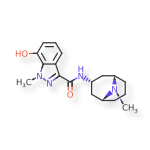
After both oral and intravenous administration, the metabolite is present at about 10% of that of the parent (Clarke et al., 1994; Boppana, 1995). Assuming similar free fractions, it can be estimated that the metabolite would contribute about 20% of the activity of the parent.
|
| Related Record | Type | Details | ||
|---|---|---|---|---|
|
IMPURITY -> PARENT |
CHROMATOGRAPHIC PURITY (HPLC/UV)
USP
|
||
|
IMPURITY -> PARENT |
CHROMATOGRAPHIC PURITY (HPLC/UV)
USP
|
||
|
IMPURITY -> PARENT |
CHROMATOGRAPHIC PURITY (HPLC/UV)
USP
|
||
|
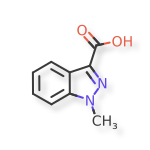
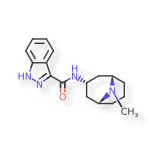
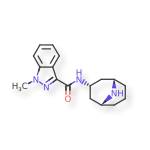
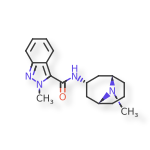
IMPURITY -> PARENT |
CHROMATOGRAPHIC PURITY (HPLC/UV)
USP
|
| Related Record | Type | Details | ||
|---|---|---|---|---|
|
|
ACTIVE MOIETY |
| Name | Property Type | Amount | Referenced Substance | Defining | Parameters | References |
|---|---|---|---|---|---|---|
| Biological Half-life | PHARMACOKINETIC |
|
|
|||
| Volume of Distribution | PHARMACOKINETIC |
|
|
|||
| Tmax | PHARMACOKINETIC |
|
following patch application |
|
||