


Details
| Stereochemistry | ACHIRAL |
| Molecular Formula | C27H29N5O6S |
| Molecular Weight | 551.614 |
| Optical Activity | NONE |
| Defined Stereocenters | 0 / 0 |
| E/Z Centers | 0 |
| Charge | 0 |
SHOW SMILES / InChI
SMILES
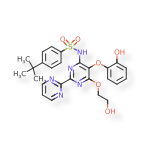
COC1=C(OC2=C(OCCO)N=C(N=C2NS(=O)(=O)C3=CC=C(C=C3)C(C)(C)C)C4=NC=CC=N4)C=CC=C1
InChI
InChIKey=GJPICJJJRGTNOD-UHFFFAOYSA-N
InChI=1S/C27H29N5O6S/c1-27(2,3)18-10-12-19(13-11-18)39(34,35)32-23-22(38-21-9-6-5-8-20(21)36-4)26(37-17-16-33)31-25(30-23)24-28-14-7-15-29-24/h5-15,33H,16-17H2,1-4H3,(H,30,31,32)
| Molecular Formula | C27H29N5O6S |
| Molecular Weight | 551.614 |
| Charge | 0 |
| Count |
|
| Stereochemistry | ACHIRAL |
| Additional Stereochemistry | No |
| Defined Stereocenters | 0 / 0 |
| E/Z Centers | 0 |
| Optical Activity | NONE |
Bosentan is a dual endothelin receptor antagonist important in the treatment of pulmonary artery hypertension (PAH). It is licensed in the United States, the European Union and other countries by Actelion Pharmaceuticals for the management of PAH under the trade name Tracleer®. Bosentan is used to treat pulmonary hypertension by blocking the action of endothelin molecules that would otherwise promote narrowing of the blood vessels and lead to high blood pressure. Bosentan competitively antagonizes the binding of 125I-labeled ET-1 to human vascular smooth muscle cells (predominantly
ETA receptors) with an inhibition constant (Ki )
of 4.7 nM and to human placenta membranes (predominantly
ETB receptors) with a Ki of 95 nM. Furthermore,
bosentan is specific for endothelin receptors and
does not interfere with the binding of a variety of peptides,
neurotransmitters, growth factors, or eicosanoids to their
receptors.
Originator
Approval Year
Targets
| Primary Target | Pharmacology | Condition | Potency |
|---|---|---|---|
Target ID: CHEMBL2096678 |
|||
| 4.7 nM [Ki] | |||
| 95.0 nM [Ki] |
Conditions
| Condition | Modality | Targets | Highest Phase | Product |
|---|---|---|---|---|
| Primary | TRACLEER Approved UseTracleer is an endothelin receptor antagonist indicated for the treatment of pulmonary arterial hypertension (PAH) (WHO Group 1) to improve exercise ability and to decrease clinical worsening. Studies establishing effectiveness included predominantly patients with NYHA Functional Class II-IV symptoms and etiologies of idiopathic or heritable PAH (60%), PAH associated with connective tissue diseases (21%), and PAH associated with congenital heart disease with left-to-right shunts (18%) (1.1). Considerations for use: Consider whether benefits offset the risk of hepatotoxicity in WHO Class II patients. Early hepatotoxicity may preclude future use as disease progresses (1.1). 1.1 Pulmonary Arterial Hypertension Tracleer® is indicated for the treatment of pulmonary arterial hypertension (PAH) (WHO Group 1) to improve exercise ability and to decrease clinical worsening. Studies establishing effectiveness included predominantly patients with NYHA Functional Class II-IV symptoms and etiologies of idiopathic or heritable PAH (60%), PAH associated with connective tissue diseases (21%), and PAH associated with congenital heart disease with left-to-right shunts (18%) [see Clinical Studies (14.1) Launch Date2001 |
PubMed
| Title | Date | PubMed |
|---|---|---|
| Bosentan (Tracleer) for pulmonary arterial hypertension. | 2002-04-01 |
|
| In vivo and in vitro studies exploring the pharmacokinetic interaction between bosentan, a dual endothelin receptor antagonist, and glyburide. | 2002-04 |
|
| Combined inhibition of neutral endopeptidase with angiotensin converting enzyme or endothelin converting enzyme in experimental diabetes. | 2002-04 |
|
| Treatment of primary pulmonary hypertension -- the next generation. | 2002-03-21 |
|
| Bosentan therapy for pulmonary arterial hypertension. | 2002-03-21 |
|
| Bosentan enters market with risk management program. | 2002-03-15 |
|
| [Bosentan in pulmonary hypertension]. | 2002-03 |
|
| Chronic endothelin receptor blockade prevents renal vasoconstriction and sodium retention in rats with chronic heart failure. | 2002-03 |
|
| Influence of food intake and formulation on the pharmacokinetics and metabolism of bosentan, a dual endothelin receptor antagonist. | 2002-03 |
|
| Crosstalk of endothelin-1 and platelet-derived growth factor in cardiac allograft arteriosclerosis. | 2002-02-20 |
|
| Tracleer (bosentan). | 2002-02-01 |
|
| Tracleer. Tablets ease symptoms of rare lung disorder. | 2002-02 |
|
| Medical management of primary pulmonary hypertension. | 2002-02 |
|
| Endothelin antagonists and heart failure. | 2002-02 |
|
| [Physical endurance improves markedly. New therapy approach in pulmonary hypertension]. | 2002-01-17 |
|
| [The effects of endothelin blockade on renal expression of angiotensin II type 1 receptor in diabetic hypertensive rats]. | 2002-01-10 |
|
| Human endothelin subtype A receptor enhancement during tissue culture via de novo transcription. | 2002-01 |
|
| Direct left ventricular wall stretch activates GATA4 binding in perfused rat heart: involvement of autocrine/paracrine pathways. | 2002-01 |
|
| Endothelin is an important determinant of renal function in a rat model of acute liver and renal failure. | 2002-01 |
|
| Hyperhexosemia induced functional and structural changes in the kidneys: role of endothelins. | 2002-01 |
|
| Naftidrofuryl exerts antiserotonergic but no endothelin-receptor blocking effects in AS4.1 cells, juxtaglomerular cells and isolated perfused rat kidneys. | 2002-01 |
|
| Growth factors in idiopathic pulmonary fibrosis: relative roles. | 2002 |
|
| Endothelin-1, a regulator of angiogenesis in the chick chorioallantoic membrane. | 2001-12-12 |
|
| Coronary and aortic vasoreactivity protection with endothelin receptor antagonist, bosentan, after ischemia and hypoxia in aged rats. | 2001-12-07 |
|
| Endothelin blockade in angiotensin II hypertension: prevention and treatment studies in the rat. | 2001-12 |
|
| Small bowel review: diseases of the small intestine. | 2001-12 |
|
| Pulmonary hypertension associated with COPD. | 2001-12 |
|
| Angiotensin II activates collagen type I gene in the renal cortex and aorta of transgenic mice through interaction with endothelin and TGF-beta. | 2001-12 |
|
| Role of endogenous endothelin on coronary reflow after cardioplegic arrest. | 2001-12 |
|
| Endothelin antagonist reduces hemodynamic responses to vasopressin in DOCA-salt hypertension. | 2001-12 |
|
| Endothelin resets renal blood flow autoregulatory efficiency during acute blockade of NO in the rat. | 2001-12 |
|
| [Effects of the dual endothelin-receptor antagonist bosentan in patients with pulmonary hypertension: a randomized placebo-controlled study]. | 2001-11 |
|
| Rationale and perspective of endothelin-1 antagonism in acute heart failure. | 2001-11 |
|
| Effects of the endothelin receptor antagonist bosentan on cardiac performance during porcine endotoxin shock. | 2001-11 |
|
| Renal tubulointerstitial damage caused by persistent proteinuria is attenuated in AT1-deficient mice: role of endothelin-1. | 2001-11 |
|
| Endothelin-1 decreases glutamate uptake in primary cultured rat astrocytes. | 2001-11 |
|
| Endothelin receptor blockade in congestive heart failure. | 2001-10-30 |
|
| Potent and selective ET-A antagonists. 1. Syntheses and structure-activity relationships of N-(6-(2-(aryloxy)ethoxy)-4-pyrimidinyl)sulfonamide derivatives. | 2001-10-11 |
|
| Report from the 93rd Cardiovascular and Renal Drugs Advisory Committee Meeting, August 9-10, 2001. | 2001-10-09 |
|
| Effects of the dual endothelin-receptor antagonist bosentan in patients with pulmonary hypertension: a randomised placebo-controlled study. | 2001-10-06 |
|
| Endothelin-receptor antagonists in pulmonary hypertension. | 2001-10-06 |
|
| Endothelin receptor blockade and nitric oxide bioactivity. | 2001-10 |
|
| Chronic blockade of endothelin receptors improves ischemia-induced angiogenesis in rat hindlimbs through activation of vascular endothelial growth factor-no pathway. | 2001-10 |
|
| Endothelin mediates phospholipase C stimulation in the proximal tubule during initiation of compensatory renal growth in adult rats. | 2001-10 |
|
| Endothelin involvement in respiratory centre activity. | 2001-09 |
|
| Ovarian hormones modulate endothelin-1 vascular reactivity and mRNA expression in DOCA-salt hypertensive rats. | 2001-09 |
|
| New pharmacological strategies for the treatment of heart failure. | 2001-07 |
|
| Influence of several methodological procedures utilized to obtain in vitro vascular preparations on endothelial activity. | 2001 |
|
| Current management of primary pulmonary hypertension. | 2001 |
|
| Pharmacological regulation of postischemic sinusoidal diameters in rats--a new approach for reducing hepatic ischemia/reperfusion injury. | 2001 |
Sample Use Guides
Initiate at 62.5 mg twice daily with or without food for 4 weeks,
and then increase to 125 mg twice daily
Route of Administration:
Oral
In Vitro Use Guide
Curator's Comment: In vitro, bosentan inhibits the contractions of isolated rat trachea induced by
ET-1 in a concentration-dependent manner (1-100 uM). https://www.ncbi.nlm.nih.gov/pubmed/18729040
Competition studies show that, in the absence of human serum albumin, the IC50 value of Bosentan was 5.7 nM. Addition of increasing doses of human serum albumin incrementally decreased the potency of Bosentan to 122.7 nM.
| Substance Class |
Chemical
Created
by
admin
on
Edited
Mon Mar 31 18:09:13 GMT 2025
by
admin
on
Mon Mar 31 18:09:13 GMT 2025
|
| Record UNII |
XUL93R30K2
|
| Record Status |
Validated (UNII)
|
| Record Version |
|
-
Download
| Name | Type | Language | ||
|---|---|---|---|---|
|
Common Name | English | ||
|
Preferred Name | English | ||
|
Common Name | English | ||
|
Common Name | English | ||
|
Common Name | English | ||
|
Common Name | English | ||
|
Systematic Name | English |
| Classification Tree | Code System | Code | ||
|---|---|---|---|---|
|
NDF-RT |
N0000175581
Created by
admin on Mon Mar 31 18:09:13 GMT 2025 , Edited by admin on Mon Mar 31 18:09:13 GMT 2025
|
||
|
NDF-RT |
N0000175364
Created by
admin on Mon Mar 31 18:09:13 GMT 2025 , Edited by admin on Mon Mar 31 18:09:13 GMT 2025
|
||
|
WHO-ATC |
C02KX01
Created by
admin on Mon Mar 31 18:09:13 GMT 2025 , Edited by admin on Mon Mar 31 18:09:13 GMT 2025
|
| Code System | Code | Type | Description | ||
|---|---|---|---|---|---|
|
C81107
Created by
admin on Mon Mar 31 18:09:13 GMT 2025 , Edited by admin on Mon Mar 31 18:09:13 GMT 2025
|
PRIMARY | |||
|
147536-97-8
Created by
admin on Mon Mar 31 18:09:13 GMT 2025 , Edited by admin on Mon Mar 31 18:09:13 GMT 2025
|
PRIMARY | |||
|
m2625
Created by
admin on Mon Mar 31 18:09:13 GMT 2025 , Edited by admin on Mon Mar 31 18:09:13 GMT 2025
|
PRIMARY | Merck Index | ||
|
SUB05877MIG
Created by
admin on Mon Mar 31 18:09:13 GMT 2025 , Edited by admin on Mon Mar 31 18:09:13 GMT 2025
|
PRIMARY | |||
|
SUB25414
Created by
admin on Mon Mar 31 18:09:13 GMT 2025 , Edited by admin on Mon Mar 31 18:09:13 GMT 2025
|
PRIMARY | |||
|
51450
Created by
admin on Mon Mar 31 18:09:13 GMT 2025 , Edited by admin on Mon Mar 31 18:09:13 GMT 2025
|
PRIMARY | |||
|
DTXSID7046627
Created by
admin on Mon Mar 31 18:09:13 GMT 2025 , Edited by admin on Mon Mar 31 18:09:13 GMT 2025
|
PRIMARY | |||
|
DB00559
Created by
admin on Mon Mar 31 18:09:13 GMT 2025 , Edited by admin on Mon Mar 31 18:09:13 GMT 2025
|
PRIMARY | |||
|
XUL93R30K2
Created by
admin on Mon Mar 31 18:09:13 GMT 2025 , Edited by admin on Mon Mar 31 18:09:13 GMT 2025
|
PRIMARY | |||
|
XUL93R30K2
Created by
admin on Mon Mar 31 18:09:13 GMT 2025 , Edited by admin on Mon Mar 31 18:09:13 GMT 2025
|
PRIMARY | |||
|
1468845
Created by
admin on Mon Mar 31 18:09:13 GMT 2025 , Edited by admin on Mon Mar 31 18:09:13 GMT 2025
|
PRIMARY | RxNorm | ||
|
104865
Created by
admin on Mon Mar 31 18:09:13 GMT 2025 , Edited by admin on Mon Mar 31 18:09:13 GMT 2025
|
PRIMARY | |||
|
100000085262
Created by
admin on Mon Mar 31 18:09:13 GMT 2025 , Edited by admin on Mon Mar 31 18:09:13 GMT 2025
|
PRIMARY | |||
|
7195
Created by
admin on Mon Mar 31 18:09:13 GMT 2025 , Edited by admin on Mon Mar 31 18:09:13 GMT 2025
|
PRIMARY |
| Related Record | Type | Details | ||
|---|---|---|---|---|
|
EXCRETED UNCHANGED |
INTRAVENOUS ADMINISTRATION
AMOUNT EXCRETED
URINE
|
||
|
EXCRETED UNCHANGED |
ORAL ADMINISTRATION
AMOUNT EXCRETED
FECAL
|
||
|
METABOLIC ENZYME -> SUBSTRATE |
MAJOR
|
||
|
|
SALT/SOLVATE -> PARENT | |||
|
METABOLIC ENZYME -> SUBSTRATE |
MAJOR
|
||
|
SOLVATE->ANHYDROUS | |||
|
BINDER->LIGAND |
BINDING
|
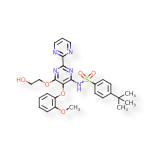

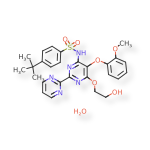

| Related Record | Type | Details | ||
|---|---|---|---|---|
|
METABOLITE ACTIVE -> PARENT |
Major metabolite.
MAJOR
FECAL; PLASMA; URINE
|
||
|
|
METABOLITE -> PARENT | |||
|
METABOLITE -> PARENT |
Minor metabolite.
MINOR
FECAL; PLASMA; URINE
|
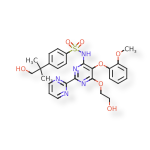
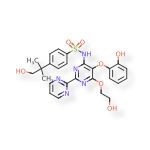
| Related Record | Type | Details | ||
|---|---|---|---|---|
|
|
ACTIVE MOIETY |
| Name | Property Type | Amount | Referenced Substance | Defining | Parameters | References |
|---|---|---|---|---|---|---|
| Volume of Distribution | PHARMACOKINETIC |
|
|
|||
| Tmax | PHARMACOKINETIC |
|
ORAL ADMINISTRATION |
|
||
| Biological Half-life | PHARMACOKINETIC |
|
|
|||