


Details
| Stereochemistry | RACEMIC |
| Molecular Formula | C18H28N2O |
| Molecular Weight | 288.4277 |
| Optical Activity | ( + / - ) |
| Defined Stereocenters | 0 / 1 |
| E/Z Centers | 0 |
| Charge | 0 |
SHOW SMILES / InChI
SMILES
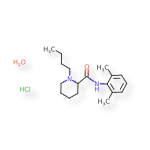
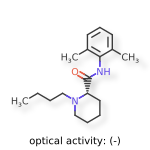
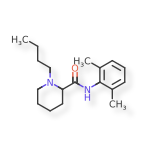
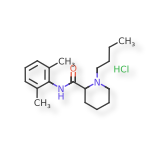
CCCCN1CCCCC1C(=O)NC2=C(C)C=CC=C2C
InChI
InChIKey=LEBVLXFERQHONN-UHFFFAOYSA-N
InChI=1S/C18H28N2O/c1-4-5-12-20-13-7-6-11-16(20)18(21)19-17-14(2)9-8-10-15(17)3/h8-10,16H,4-7,11-13H2,1-3H3,(H,19,21)
| Molecular Formula | C18H28N2O |
| Molecular Weight | 288.4277 |
| Charge | 0 |
| Count |
|
| Stereochemistry | RACEMIC |
| Additional Stereochemistry | No |
| Defined Stereocenters | 0 / 1 |
| E/Z Centers | 0 |
| Optical Activity | ( + / - ) |
DescriptionCurator's Comment: description was created based on several sources, including
https://www.ncbi.nlm.nih.gov/pubmed/11895133
Curator's Comment: description was created based on several sources, including
https://www.ncbi.nlm.nih.gov/pubmed/11895133
Bupivacaine is a widely used local anesthetic agent. Bupivacaine is often administered by spinal injection prior to total hip arthroplasty. It is also commonly injected into surgical wound sites to reduce pain for up to 20 hours after surgery. In comparison to other local anesthetics it has a long duration of action. It is also the most toxic to the heart when administered in large doses. Bupivacaine blocks the generation and the conduction of nerve impulses, presumably by increasing the threshold for electrical excitation in the nerve, by slowing the propagation of the nerve impulse, and by reducing the rate of rise of the action potential. Bupivacaine binds to the intracellular portion of sodium channels and blocks sodium influx into nerve cells, which prevents depolarization. In general, the progression of anesthesia is related to the diameter, myelination and conduction velocity of affected nerve fibers. The analgesic effects of bupivicaine are thought to potentially be due to its binding to the prostaglandin E2 receptors, subtype EP1 (PGE2EP1), which inhibits the production of prostaglandins, thereby reducing fever, inflammation, and hyperalgesia. Bupivacaine sometimes used in combination with epinephrine to prevent systemic absorption and extend the duration of action.
Approval Year
Targets
| Primary Target | Pharmacology | Condition | Potency |
|---|---|---|---|
Target ID: CHEMBL2072 |
Conditions
| Condition | Modality | Targets | Highest Phase | Product |
|---|---|---|---|---|
| Primary | EXPAREL Approved UseBupivacaine Hydrochloride is indicated for the production of local or regional anesthesia or analgesia for surgery, dental and oral surgery procedures, diagnostic and therapeutic procedures, and for obstetrical procedures. Only the 0.25% and 0.5% concentrations are indicated for obstetrical anesthesia. (See WARNINGS .) Experience with nonobstetrical surgical procedures in pregnant patients is not sufficient to recommend use of 0.75% concentration of Bupivacaine Hydrochloride in these patients. Bupivacaine Hydrochloride is not recommended for intravenous regional anesthesia (Bier Block). (See WARNINGS .) The routes of administration and indicated Bupivacaine Hydrochloride concentrations are: • local infiltration 0.25% • peripheral nerve block 0.25% and 0.5% • retrobulbar block 0.75% • sympathetic block 0.25% • lumbar epidural 0.25%, 0.5%, and 0.75% (0.75% not for obstetrical anesthesia) • caudal 0.25% and 0.5% • epidural test dose 0.5% with epinephrine 1:200,000 • dental blocks 0.5% with epinephrine 1:200,000 (See DOSAGE AND ADMINISTRATION for additional information.) Standard textbooks should be consulted to determine the accepted procedures and techniques for the administration of Bupivacaine Hydrochloride. Launch Date2011 |
Cmax
| Value | Dose | Co-administered | Analyte | Population |
|---|---|---|---|---|
952 ng/mL EXPERIMENT https://pubmed.ncbi.nlm.nih.gov/25776489/ |
75 mg single, epidural dose: 75 mg route of administration: Epidural experiment type: SINGLE co-administered: |
BUPIVACAINE plasma | Homo sapiens population: UNHEALTHY age: ADULT sex: FEMALE / MALE food status: UNKNOWN |
|
810 ng/mL EXPERIMENT https://pubmed.ncbi.nlm.nih.gov/25776489/ |
75 mg single, epidural dose: 75 mg route of administration: Epidural experiment type: SINGLE co-administered: |
BUPIVACAINE plasma | Homo sapiens population: UNHEALTHY age: ADULT sex: FEMALE / MALE food status: UNKNOWN |
AUC
| Value | Dose | Co-administered | Analyte | Population |
|---|---|---|---|---|
3868 ng × h/mL EXPERIMENT https://pubmed.ncbi.nlm.nih.gov/25776489/ |
75 mg single, epidural dose: 75 mg route of administration: Epidural experiment type: SINGLE co-administered: |
BUPIVACAINE plasma | Homo sapiens population: UNHEALTHY age: ADULT sex: FEMALE / MALE food status: UNKNOWN |
|
4096 ng × h/mL EXPERIMENT https://pubmed.ncbi.nlm.nih.gov/25776489/ |
75 mg single, epidural dose: 75 mg route of administration: Epidural experiment type: SINGLE co-administered: |
BUPIVACAINE plasma | Homo sapiens population: UNHEALTHY age: ADULT sex: FEMALE / MALE food status: UNKNOWN |
T1/2
| Value | Dose | Co-administered | Analyte | Population |
|---|---|---|---|---|
3.9 h EXPERIMENT https://pubmed.ncbi.nlm.nih.gov/25776489/ |
75 mg single, epidural dose: 75 mg route of administration: Epidural experiment type: SINGLE co-administered: |
BUPIVACAINE plasma | Homo sapiens population: UNHEALTHY age: ADULT sex: FEMALE / MALE food status: UNKNOWN |
|
2.7 h EXPERIMENT https://pubmed.ncbi.nlm.nih.gov/25776489/ |
75 mg single, epidural dose: 75 mg route of administration: Epidural experiment type: SINGLE co-administered: |
BUPIVACAINE plasma | Homo sapiens population: UNHEALTHY age: ADULT sex: FEMALE / MALE food status: UNKNOWN |
|
7.7 h EXPERIMENT https://pubmed.ncbi.nlm.nih.gov/3344993/ |
2.5 mg/kg single, caudal dose: 2.5 mg/kg route of administration: Caudal experiment type: SINGLE co-administered: |
BUPIVACAINE blood | Homo sapiens population: UNHEALTHY age: NEWBORN sex: UNKNOWN food status: UNKNOWN |
Funbound
| Value | Dose | Co-administered | Analyte | Population |
|---|---|---|---|---|
16% EXPERIMENT https://pubmed.ncbi.nlm.nih.gov/3344993/ |
2.5 mg/kg single, caudal dose: 2.5 mg/kg route of administration: Caudal experiment type: SINGLE co-administered: |
BUPIVACAINE blood | Homo sapiens population: UNHEALTHY age: NEWBORN sex: UNKNOWN food status: UNKNOWN |
PubMed
| Title | Date | PubMed |
|---|---|---|
| Low-dose spinal anesthesia for cesarean delivery: Have we gone too far? | 2001-03-17 |
|
| Endoscopic technique with ultrasound imaging for neurolytic celiac plexus block. | 2001-03-17 |
|
| Assessment of wound infiltration with bupivacaine in women undergoing day-case gynecological laparoscopy. | 2001-03-17 |
|
| Postoperative narcotic requirement after microscopic lumbar discectomy is not affected by intraoperative ketorolac or bupivacaine. | 2001-03-15 |
|
| Discomfort with fine-needle aspiration cytology of the breast. | 2001-03-10 |
|
| Characterization of TASK-4, a novel member of the pH-sensitive, two-pore domain potassium channel family. | 2001-03-09 |
|
| Randomized clinical trial of local bupivacaine perfusion versus parenteral morphine infusion for pain relief after laparotomy. | 2001-03 |
|
| Functional characterisation of human TASK-3, an acid-sensitive two-pore domain potassium channel. | 2001-03 |
|
| Corneal sensation after topical anesthesia. | 2001-03 |
|
| Epidural analgesia in the dog and cat. | 2001-03 |
|
| Continuous epidural infusion: human vigilance is essential. | 2001-03 |
|
| Safety and efficacy of peribulbar block as adjunct to general anaesthesia for paediatric ophthalmic surgery. | 2001-03 |
|
| A comparison of ropivacaine and bupivacaine for cervical plexus block. | 2001-03 |
|
| The addition of morphine prolongs fentanyl-bupivacaine spinal analgesia for the relief of labor pain. | 2001-03 |
|
| Correction factor for comparisons between levobupivacaine and racemic bupivacaine. | 2001-02-15 |
|
| Clonidine in preterm-infant caudal anesthesia may be responsible for postoperative apnea. | 2001-02-15 |
|
| Axillary brachial plexus block with patient controlled analgesia for complex regional pain syndrome type I: a case report. | 2001-02-15 |
|
| Intrathecal low-dose bupivacaine versus lidocaine for in vitro fertilization procedures. | 2001-02-15 |
|
| Combined spinal and epidural anesthesia with low doses of intrathecal bupivacaine in women with severe preeclampsia: a preliminary report. | 2001-02-15 |
|
| Spinal anesthesia with hypobaric bupivacaine for knee arthroscopies: effect of posture on motor block. | 2001-02-15 |
|
| Femoral nerve block with 0.25% or 0.5% bupivacaine improves postoperative analgesia following outpatient arthroscopic anterior cruciate ligament repair. | 2001-02-15 |
|
| Comparison of technical and block characteristics of different combined spinal and epidural anesthesia techniques. | 2001-02-15 |
|
| Selective ulnar nerve localization is not essential for axillary brachial plexus block using a multiple nerve stimulation technique. | 2001-02-15 |
|
| Postoperative sleep disturbance: influences of opioids and pain in humans. | 2001-02-01 |
|
| Evidence that postoperative pain is a mediator of the tumor-promoting effects of surgery in rats. | 2001-02-01 |
|
| Patient-controlled spinal analgesia for labour and caesarean delivery. | 2001-02 |
|
| Pediatric caudal block with mepivacaine, bupivacaine or a mixture of both drugs: requirement for postoperative analgesia and plasma concentration of local anesthetics. | 2001-02 |
|
| [Bupivacaine in continuous epidural infusion using a portable mechanical devise for postoperative analgesia after surgery for hernia of the lumbar disk]. | 2001-02 |
|
| [A case of cardiac arrest with coronary artery spasm during lumbar epidural anesthesia]. | 2001-02 |
|
| [Anesthetic management for the correction of pectus excavatum using pectus bar under video-assistance]. | 2001-02 |
|
| Endoscopic ultrasound-guided celiac plexus block for managing abdominal pain associated with chronic pancreatitis: a prospective single center experience. | 2001-02 |
|
| A randomized prospective comparative study of general versus epidural anesthesia for transcervical hysteroscopic endometrial resection. | 2001-02 |
|
| Can anesthesiologic strategies for caesarean section influence newborn jaundice? A retrospective and prospective study. | 2001-02 |
|
| Bilateral paravertebral block: a satisfactory alternative for labour analgesia. | 2001-02 |
|
| Timing of pre-emptive tenoxicam is important for postoperative analgesia. | 2001-02 |
|
| Subarachnoid sufentanil for early postoperative pain management in orthopedic patients: a placebo-controlled, double-blind study using spinal microcatheters. | 2001-02 |
|
| Epidural fentanyl markedly improves thoracic epidural analgesia in a low-dose infusion of bupivacaine, adrenaline and fentanyl. A randomized, double-blind crossover study with and without fentanyl. | 2001-02 |
|
| Irreversible block of human heart (hH1) sodium channels by the plant alkaloid lappaconitine. | 2001-02 |
|
| Effects of bupivacaine and a novel local anesthetic, IQB-9302, on human cardiac K+ channels. | 2001-02 |
|
| Direct cardiac effects of intracoronary bupivacaine, levobupivacaine and ropivacaine in the sheep. | 2001-02 |
|
| [Infiltration of the surgical wound with local anesthetic for postoperative analgesia in patients operated on for lumbar disc herniation. Comparative study of ropivacaine and bupivacaine]. | 2001-01 |
|
| [Practice and complications of spinal anesthesia in African tropical countries]. | 2001-01 |
|
| [Spinal anesthesia for cesarean section]. | 2001-01 |
|
| A randomised controlled trial of epidural compared with non-epidural analgesia in labour. | 2001-01 |
|
| Epidural naloxone reduces intestinal hypomotility but not analgesia of epidural morphine. | 2001-01 |
|
| [Low concentration/high volume is more effective than high concentration/low volume for postoperative continuous epidural analgesia with the combination of bupivacaine and fentanyl]. | 2001-01 |
|
| Survey of 1057 patients receiving postoperative patient-controlled epidural analgesia. | 2001-01 |
|
| High-dose intrathecal diamorphine for analgesia after Caesarean section. | 2001-01 |
|
| Stress-induced osteolysis of distal clavicle: imaging patterns and treatment using CT-guided injection. | 2001 |
|
| Etidocaine, bupivacaine, and lidocaine seizure thresholds in monkeys. | 1975-04 |
Sample Use Guides
single-dose administration only. maximum dosage of EXPAREL ((Bupivacaine Liposome Injectable Suspension) should not exceed 266 mg (20 mL, 1.3% of undiluted drug).
Route of Administration:
Intravascular
| Substance Class |
Chemical
Created
by
admin
on
Edited
Mon Mar 31 17:35:50 GMT 2025
by
admin
on
Mon Mar 31 17:35:50 GMT 2025
|
| Record UNII |
Y8335394RO
|
| Record Status |
Validated (UNII)
|
| Record Version |
|
-
Download
| Related Record | Type |
|---|
| Name | Type | Language | ||
|---|---|---|---|---|
|
Preferred Name | English | ||
|
Official Name | English | ||
|
Common Name | English | ||
|
Common Name | English | ||
|
Code | English | ||
|
Code | English | ||
|
Common Name | English | ||
|
Common Name | English | ||
|
Code | English | ||
|
Common Name | English | ||
|
Common Name | English | ||
|
Systematic Name | English | ||
|
Common Name | English | ||
|
Brand Name | English | ||
|
Common Name | English | ||
|
Common Name | English | ||
|
Code | English | ||
|
Common Name | English | ||
|
Code | English | ||
|
Brand Name | English |
| Classification Tree | Code System | Code | ||
|---|---|---|---|---|
|
NDF-RT |
N0000007681
Created by
admin on Mon Mar 31 17:35:50 GMT 2025 , Edited by admin on Mon Mar 31 17:35:50 GMT 2025
|
||
|
NDF-RT |
N0000175976
Created by
admin on Mon Mar 31 17:35:50 GMT 2025 , Edited by admin on Mon Mar 31 17:35:50 GMT 2025
|
||
|
FDA ORPHAN DRUG |
237207
Created by
admin on Mon Mar 31 17:35:50 GMT 2025 , Edited by admin on Mon Mar 31 17:35:50 GMT 2025
|
||
|
WHO-VATC |
QN01BB01
Created by
admin on Mon Mar 31 17:35:50 GMT 2025 , Edited by admin on Mon Mar 31 17:35:50 GMT 2025
|
||
|
WHO-VATC |
QN01BB51
Created by
admin on Mon Mar 31 17:35:50 GMT 2025 , Edited by admin on Mon Mar 31 17:35:50 GMT 2025
|
||
|
NDF-RT |
N0000175682
Created by
admin on Mon Mar 31 17:35:50 GMT 2025 , Edited by admin on Mon Mar 31 17:35:50 GMT 2025
|
||
|
NCI_THESAURUS |
C245
Created by
admin on Mon Mar 31 17:35:50 GMT 2025 , Edited by admin on Mon Mar 31 17:35:50 GMT 2025
|
||
|
WHO-ATC |
N01BB51
Created by
admin on Mon Mar 31 17:35:50 GMT 2025 , Edited by admin on Mon Mar 31 17:35:50 GMT 2025
|
||
|
WHO-ATC |
N01BB01
Created by
admin on Mon Mar 31 17:35:50 GMT 2025 , Edited by admin on Mon Mar 31 17:35:50 GMT 2025
|
||
|
WHO-ESSENTIAL MEDICINES LIST |
1.2
Created by
admin on Mon Mar 31 17:35:50 GMT 2025 , Edited by admin on Mon Mar 31 17:35:50 GMT 2025
|
| Code System | Code | Type | Description | ||
|---|---|---|---|---|---|
|
218-553-3
Created by
admin on Mon Mar 31 17:35:50 GMT 2025 , Edited by admin on Mon Mar 31 17:35:50 GMT 2025
|
ALTERNATIVE | |||
|
2180-92-9
Created by
admin on Mon Mar 31 17:35:50 GMT 2025 , Edited by admin on Mon Mar 31 17:35:50 GMT 2025
|
SUPERSEDED | |||
|
2474
Created by
admin on Mon Mar 31 17:35:50 GMT 2025 , Edited by admin on Mon Mar 31 17:35:50 GMT 2025
|
PRIMARY | |||
|
m2769
Created by
admin on Mon Mar 31 17:35:50 GMT 2025 , Edited by admin on Mon Mar 31 17:35:50 GMT 2025
|
PRIMARY | Merck Index | ||
|
1815
Created by
admin on Mon Mar 31 17:35:50 GMT 2025 , Edited by admin on Mon Mar 31 17:35:50 GMT 2025
|
PRIMARY | |||
|
Bupivacaine
Created by
admin on Mon Mar 31 17:35:50 GMT 2025 , Edited by admin on Mon Mar 31 17:35:50 GMT 2025
|
PRIMARY | |||
|
253-911-2
Created by
admin on Mon Mar 31 17:35:50 GMT 2025 , Edited by admin on Mon Mar 31 17:35:50 GMT 2025
|
PRIMARY | |||
|
Y8335394RO
Created by
admin on Mon Mar 31 17:35:50 GMT 2025 , Edited by admin on Mon Mar 31 17:35:50 GMT 2025
|
PRIMARY | |||
|
C62011
Created by
admin on Mon Mar 31 17:35:50 GMT 2025 , Edited by admin on Mon Mar 31 17:35:50 GMT 2025
|
PRIMARY | |||
|
38396-39-3
Created by
admin on Mon Mar 31 17:35:50 GMT 2025 , Edited by admin on Mon Mar 31 17:35:50 GMT 2025
|
PRIMARY | |||
|
Y8335394RO
Created by
admin on Mon Mar 31 17:35:50 GMT 2025 , Edited by admin on Mon Mar 31 17:35:50 GMT 2025
|
PRIMARY | |||
|
D002045
Created by
admin on Mon Mar 31 17:35:50 GMT 2025 , Edited by admin on Mon Mar 31 17:35:50 GMT 2025
|
PRIMARY | |||
|
ZZ-05
Created by
admin on Mon Mar 31 17:35:50 GMT 2025 , Edited by admin on Mon Mar 31 17:35:50 GMT 2025
|
PRIMARY | |||
|
CHEMBL1098
Created by
admin on Mon Mar 31 17:35:50 GMT 2025 , Edited by admin on Mon Mar 31 17:35:50 GMT 2025
|
PRIMARY | |||
|
7790
Created by
admin on Mon Mar 31 17:35:50 GMT 2025 , Edited by admin on Mon Mar 31 17:35:50 GMT 2025
|
PRIMARY | |||
|
DB00297
Created by
admin on Mon Mar 31 17:35:50 GMT 2025 , Edited by admin on Mon Mar 31 17:35:50 GMT 2025
|
PRIMARY | |||
|
2397
Created by
admin on Mon Mar 31 17:35:50 GMT 2025 , Edited by admin on Mon Mar 31 17:35:50 GMT 2025
|
PRIMARY | |||
|
77431
Created by
admin on Mon Mar 31 17:35:50 GMT 2025 , Edited by admin on Mon Mar 31 17:35:50 GMT 2025
|
PRIMARY | |||
|
BUPIVACAINE
Created by
admin on Mon Mar 31 17:35:50 GMT 2025 , Edited by admin on Mon Mar 31 17:35:50 GMT 2025
|
PRIMARY | |||
|
100000088449
Created by
admin on Mon Mar 31 17:35:50 GMT 2025 , Edited by admin on Mon Mar 31 17:35:50 GMT 2025
|
PRIMARY | |||
|
DTXSID2022703
Created by
admin on Mon Mar 31 17:35:50 GMT 2025 , Edited by admin on Mon Mar 31 17:35:50 GMT 2025
|
PRIMARY | |||
|
3215
Created by
admin on Mon Mar 31 17:35:50 GMT 2025 , Edited by admin on Mon Mar 31 17:35:50 GMT 2025
|
PRIMARY | |||
|
2279
Created by
admin on Mon Mar 31 17:35:50 GMT 2025 , Edited by admin on Mon Mar 31 17:35:50 GMT 2025
|
PRIMARY | |||
|
432
Created by
admin on Mon Mar 31 17:35:50 GMT 2025 , Edited by admin on Mon Mar 31 17:35:50 GMT 2025
|
PRIMARY | |||
|
SUB05983MIG
Created by
admin on Mon Mar 31 17:35:50 GMT 2025 , Edited by admin on Mon Mar 31 17:35:50 GMT 2025
|
PRIMARY |
| Related Record | Type | Details | ||
|---|---|---|---|---|
|
METABOLIC ENZYME -> SUBSTRATE |
MINOR
|
||
|
|
SALT/SOLVATE -> PARENT |
|
||
|
|
ENANTIOMER -> RACEMATE |
|
||
|
EXCRETED UNCHANGED |
URINE
|
||
|
|
SUB_CONCEPT->SUBSTANCE |
|
||
|
|
SALT/SOLVATE -> PARENT |
|
||
|
|
ENANTIOMER -> RACEMATE |
|
||
|
METABOLIC ENZYME -> SUBSTRATE |
MINOR
|
||
|
BINDER->LIGAND |
BINDING
|
||
|
METABOLIC ENZYME -> SUBSTRATE |
MAJOR
|


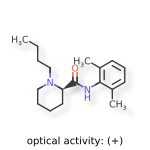

| Related Record | Type | Details | ||
|---|---|---|---|---|
|
METABOLITE -> PARENT |
MAJOR
|
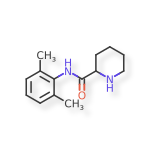
| Related Record | Type | Details | ||
|---|---|---|---|---|
|
PARENT -> IMPURITY |
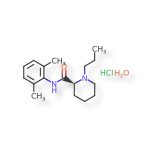
| Related Record | Type | Details | ||
|---|---|---|---|---|
|
|
ACTIVE MOIETY |
|
| Name | Property Type | Amount | Referenced Substance | Defining | Parameters | References |
|---|---|---|---|---|---|---|
| Tmax | PHARMACOKINETIC |
|
After injection of Bupivacaine Hydrochloride for caudal, epidural, or peripheral nerve block in man |
|
||
| Biological Half-life | PHARMACOKINETIC |
|
|
|||
| Biological Half-life | PHARMACOKINETIC |
|
|
|||