


Details
| Stereochemistry | ABSOLUTE |
| Molecular Formula | C16H17N2O4S.Na |
| Molecular Weight | 356.372 |
| Optical Activity | UNSPECIFIED |
| Defined Stereocenters | 3 / 3 |
| E/Z Centers | 0 |
| Charge | 0 |
SHOW SMILES / InChI
SMILES
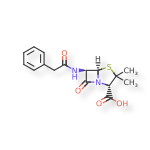
[Na+].CC1(C)S[C@@H]2[C@H](NC(=O)CC3=CC=CC=C3)C(=O)N2[C@H]1C([O-])=O
InChI
InChIKey=FCPVYOBCFFNJFS-LQDWTQKMSA-M
InChI=1S/C16H18N2O4S.Na/c1-16(2)12(15(21)22)18-13(20)11(14(18)23-16)17-10(19)8-9-6-4-3-5-7-9;/h3-7,11-12,14H,8H2,1-2H3,(H,17,19)(H,21,22);/q;+1/p-1/t11-,12+,14-;/m1./s1
| Molecular Formula | C16H17N2O4S |
| Molecular Weight | 333.382 |
| Charge | -1 |
| Count |
|
| Stereochemistry | ABSOLUTE |
| Additional Stereochemistry | No |
| Defined Stereocenters | 3 / 3 |
| E/Z Centers | 0 |
| Optical Activity | UNSPECIFIED |
| Molecular Formula | Na |
| Molecular Weight | 22.98976928 |
| Charge | 1 |
| Count |
|
| Stereochemistry | ACHIRAL |
| Additional Stereochemistry | No |
| Defined Stereocenters | 0 / 0 |
| E/Z Centers | 0 |
| Optical Activity | NONE |
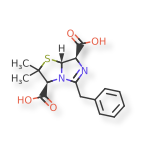
Penicillin G, also known as benzylpenicillin, is a penicillin derivative commonly used in the form of its sodium or potassium salts in the treatment of a variety of infections. It is effective against most gram-positive bacteria and against gram-negative cocci. It is administered intravenously or intramuscularly due to poor oral absorption. Penicillin G may also be used in some cases as prophylaxis against susceptible organisms. Microbiology Penicillin G is bactericidal against penicillin-susceptible microorganisms during the stage of active multiplication. It acts by inhibiting biosynthesis of cell-wall mucopeptide. It is not active against the penicillinase-producing bacteria, which include many strains of staphylococci. Penicillin G is highly active in vitro against staphylococci (except penicillinase-producing strains), streptococci (groups A, B, C, G, H, L and M), pneumococci and Neisseria meningitidis. Other organisms susceptible in vitro to penicillin G are Neisseria gonorrhoeae, Corynebacterium diphtheriae, Bacillus anthracis, clostridia, Actinomyces species, Spirillum minus, Streptobacillus monillformis, Listeria monocytogenes, and leptospira; Treponema pallidum is extremely susceptible. Adverse effects can include hypersensitivity reactions including urticaria, fever, joint pains, rashes, angioedema, anaphylaxis, serum sickness-like reaction.
CNS Activity
Approval Year
Targets
| Primary Target | Pharmacology | Condition | Potency |
|---|---|---|---|
Target ID: CHEMBL2354204 |
Conditions
| Condition | Modality | Targets | Highest Phase | Product |
|---|---|---|---|---|
| Curative | PENICILLIN G SODIUM Approved UsePenicillin G Sodium for Injection, USP is indicated in the treatment of serious infections caused by susceptible strains of the designated microorganisms. Appropriate culture and susceptibility tests should be done before treatment in order to isolate and identify organisms causing infection and to determine their susceptibility to penicillin G. Therapy with Penicillin G Sodium for Injection, USP may be initiated before results of such tests are known when there is reason to believe the infection may involve any of the organisms listed below, however, once these results become available, appropriate therapy should be continued Launch Date2001 |
|||
| Curative | PENICILLIN G SODIUM Approved UsePenicillin G Sodium for Injection, USP is indicated in the treatment of serious infections caused by susceptible strains of the designated microorganisms. Appropriate culture and susceptibility tests should be done before treatment in order to isolate and identify organisms causing infection and to determine their susceptibility to penicillin G. Therapy with Penicillin G Sodium for Injection, USP may be initiated before results of such tests are known when there is reason to believe the infection may involve any of the organisms listed below, however, once these results become available, appropriate therapy should be continued Launch Date2001 |
|||
| Curative | PENICILLIN G SODIUM Approved UsePenicillin G Sodium for Injection, USP is indicated in the treatment of serious infections caused by susceptible strains of the designated microorganisms. Appropriate culture and susceptibility tests should be done before treatment in order to isolate and identify organisms causing infection and to determine their susceptibility to penicillin G. Therapy with Penicillin G Sodium for Injection, USP may be initiated before results of such tests are known when there is reason to believe the infection may involve any of the organisms listed below, however, once these results become available, appropriate therapy should be continued Launch Date2001 |
|||
| Primary | PENICILLIN G SODIUM Approved UsePenicillin G Sodium for Injection, USP is indicated in the treatment of serious infections caused by susceptible strains of the designated microorganisms. Appropriate culture and susceptibility tests should be done before treatment in order to isolate and identify organisms causing infection and to determine their susceptibility to penicillin G. Therapy with Penicillin G Sodium for Injection, USP may be initiated before results of such tests are known when there is reason to believe the infection may involve any of the organisms listed below, however, once these results become available, appropriate therapy should be continued Launch Date2001 |
|||
| Primary | PENICILLIN G SODIUM Approved UsePenicillin G Sodium for Injection, USP is indicated in the treatment of serious infections caused by susceptible strains of the designated microorganisms. Appropriate culture and susceptibility tests should be done before treatment in order to isolate and identify organisms causing infection and to determine their susceptibility to penicillin G. Therapy with Penicillin G Sodium for Injection, USP may be initiated before results of such tests are known when there is reason to believe the infection may involve any of the organisms listed below, however, once these results become available, appropriate therapy should be continued Launch Date2001 |
Cmax
| Value | Dose | Co-administered | Analyte | Population |
|---|---|---|---|---|
400 μg/mL |
5000000 unit single, intravenous dose: 5000000 unit route of administration: Intravenous experiment type: SINGLE co-administered: |
PENICILLIN G serum | Homo sapiens population: UNHEALTHY age: UNKNOWN sex: UNKNOWN food status: UNKNOWN |
T1/2
| Value | Dose | Co-administered | Analyte | Population |
|---|---|---|---|---|
4.1 day EXPERIMENT https://pubmed.ncbi.nlm.nih.gov/21991307/ |
1200000 unit single, intramuscular dose: 1200000 unit route of administration: Intramuscular experiment type: SINGLE co-administered: |
PENICILLIN G serum | Homo sapiens population: HEALTHY age: ADULT sex: MALE food status: UNKNOWN |
Funbound
| Value | Dose | Co-administered | Analyte | Population |
|---|---|---|---|---|
65% EXPERIMENT https://pubmed.ncbi.nlm.nih.gov/8218695/ |
12000000 unit 1 times / day steady-state, intravenous dose: 12000000 unit route of administration: Intravenous experiment type: STEADY-STATE co-administered: |
PENICILLIN G plasma | Homo sapiens population: UNHEALTHY age: ADULT sex: FEMALE / MALE food status: UNKNOWN |
|
40% |
PENICILLIN G serum | Homo sapiens population: UNKNOWN age: UNKNOWN sex: UNKNOWN food status: UNKNOWN |
Overview
| CYP3A4 | CYP2C9 | CYP2D6 | hERG |
|---|---|---|---|
OverviewOther
| Other Inhibitor | Other Substrate | Other Inducer |
|---|---|---|
Drug as perpetrator
| Target | Modality | Activity | Metabolite | Clinical evidence |
|---|---|---|---|---|
| no | ||||
Page: 6.0 |
yes [IC50 102 uM] | |||
| yes [IC50 25 uM] |
Drug as victim
| Target | Modality | Activity | Metabolite | Clinical evidence |
|---|---|---|---|---|
Page: 4.0 |
yes | |||
| yes |
PubMed
| Title | Date | PubMed |
|---|---|---|
| High-performance thin-layer chromatography-bioautography for multiple antibiotic residues in cow's milk. | 2003-02-05 |
|
| Benzylpenicillin differentially conjugates to IFN-gamma, TNF-alpha, IL-1beta, IL-4 and IL-13 but selectively reduces IFN-gamma activity. | 2003-02 |
|
| Insights into the acylation mechanism of class A beta-lactamases from molecular dynamics simulations of the TEM-1 enzyme complexed with benzylpenicillin. | 2003-01-22 |
|
| Cysteine is exported from the Escherichia coli cytoplasm by CydDC, an ATP-binding cassette-type transporter required for cytochrome assembly. | 2002-12-20 |
|
| Amoxicillin-induced exanthema in young adults with infectious mononucleosis: demonstration of drug-specific lymphocyte reactivity. | 2002-12 |
|
| Acyl-intermediate structures of the extended-spectrum class A beta-lactamase, Toho-1, in complex with cefotaxime, cephalothin, and benzylpenicillin. | 2002-11-29 |
|
| beta-Lactam allergenic determinants: fine structural recognition of a cross-reacting determinant on benzylpenicillin and cephalothin. | 2002-11 |
|
| Minimum inhibitory concentrations of 20 antimicrobial agents against Staphylococcus aureus isolated from bovine intramammary infections in Japan. | 2002-11 |
|
| Quality control of antibiotics before the implementation of an STD program in Northern Myanmar. | 2002-11 |
|
| Mechanism of the reduced elimination clearance of benzylpenicillin from cerebrospinal fluid in rats with intracisternal administration of lipopolysaccharide. | 2002-11 |
|
| [Antimicrobial susceptibility of Streptococcus pneumoniae and Haemophilus influenzae isolated in major hospitals in Nagano Prefecture]. | 2002-10 |
|
| Fatal outcome from meningococcal disease--an association with meningococcal phenotype but not with reduced susceptibility to benzylpenicillin. | 2002-10 |
|
| Role of blood-brain barrier organic anion transporter 3 (OAT3) in the efflux of indoxyl sulfate, a uremic toxin: its involvement in neurotransmitter metabolite clearance from the brain. | 2002-10 |
|
| Modulation of GABA(A) receptor-mediated currents by benzophenone derivatives in isolated rat Purkinje neurones. | 2002-09 |
|
| Liquid chromatographic determination of ampicillin residues in porcine muscle tissue by a multipenicillin analytical method: European Collaborative Study. | 2002-08-16 |
|
| [Use of antibiotics in general practice and at the Clinic for Infectious Diseases]. | 2002-08-13 |
|
| Immunoglobulin E binding determinants on beta-lactam drugs. | 2002-08 |
|
| The 2.4-A crystal structure of the penicillin-resistant penicillin-binding protein PBP5fm from Enterococcus faecium in complex with benzylpenicillin. | 2002-07 |
|
| Improved brain delivery of benzylpenicillin with a peptide-vector-mediated strategy. | 2002-06 |
|
| Primary (isolated) meningococcal pericarditis. | 2002-06 |
|
| Major role of organic anion transporter 3 in the transport of indoxyl sulfate in the kidney. | 2002-05 |
|
| Expression and functional characterization of rat organic anion transporter 3 (rOat3) in the choroid plexus. | 2002-05 |
|
| 3: Community-acquired pneumonia. | 2002-04-01 |
|
| Gateways to Clinical Trials. | 2002-04 |
|
| [The Pneumococcal Observatory for the Central Region, 1 April 1999 to 31 March 2000]. | 2002-04 |
|
| [Allergic alteration of leukocytes in patients with drug intolerance]. | 2002-03-02 |
|
| Fatality after an injection of Bicillin into the tonsillar fossa during an adenotonsillectomy. | 2002-03 |
|
| Characterization of specific IgE response in vitro against protein and drug allergens using atopic and normal donors. | 2002-03 |
|
| Evaluation of the new VITEK 2 system for determination of the susceptibility of clinical isolates of Streptococcus pneumoniae. | 2002-03 |
|
| Functional involvement of rat organic anion transporter 3 (rOat3; Slc22a8) in the renal uptake of organic anions. | 2002-03 |
|
| Chloramphenicol versus benzylpenicillin and gentamicin for the treatment of severe pneumonia in children in Papua New Guinea: a randomised trial. | 2002-02-09 |
|
| Overexpression, purification and biochemical characterization of a class A high-molecular-mass penicillin-binding protein (PBP), PBP1* and its soluble derivative from Mycobacterium tuberculosis. | 2002-02-01 |
|
| [Post-marketing surveillance of antibacterial activities of cefozopran against various clinical isolates--I. Gram-positive bacteria]. | 2002-02 |
|
| Controlled administration of penicillin to patients with a positive history but negative skin and specific serum IgE tests. | 2002-02 |
|
| [Maximum residue levels (MRL's) of veterinary medicines in relation to food safety. MRL's really do matter--the Benzaprocpen case]. | 2002-01-01 |
|
| Comparative in vitro activity of 16 antimicrobial agents against Actinobacillus pleuropneumoniae. | 2002-01 |
|
| Natural antibiotic susceptibility and biochemical profiles of Yersinia enterocolitica-like strains: Y. bercovieri, Y. mollaretii, Y. aldovae and 'Y. ruckeri'. | 2002-01 |
|
| [Benzylpenicillin efficacy for neutropenic infection prophylaxis in patients with cancer and postcytostatic neutropenia]. | 2002 |
|
| Treatment of amatoxin poisoning: 20-year retrospective analysis. | 2002 |
|
| Antibiotics differ in their tendency to cause infusion phlebitis: a prospective observational study. | 2002 |
|
| Treatment of latent syphilis in HIV-infected patients with 10 d of benzylpenicillin G benethamine: a prospective study in Maputo, Mozambique. | 2002 |
|
| [Difficulties with using T lymphocyte culture as a method for diagnosing allergies to benzylpenicillin]. | 2002 |
|
| Biochemical characterization of a novel extended-spectrum beta-lactamase from Pseudomonas aeruginosa 802. | 2002 |
|
| Substrate binding and catalytic mechanism of class B beta-lactamases: a molecular modelling study. | 2001-12 |
|
| Gradient diffusion antibiotic susceptibility testing of potentially probiotic lactobacilli. | 2001-12 |
|
| [Treatment of acute bacterial meningitis]. | 2001-11-20 |
|
| [The use of veterinary drugs during pregnancy of the dog]. | 2001-11-15 |
|
| Selection of metalloenzymes by catalytic activity using phage display and catalytic elution. | 2001-04-02 |
|
| Marked differences in antibiotic use and resistance between university hospitals in Vilnius, Lithuania, and Huddinge, Sweden. | 2001 |
|
| [Penicillin induced haemolytic anaemia. Communication of a case (author's transl)]. | 1975 |
Sample Use Guides
Serious infections due to susceptible strains of streptococci (including
S. pneumoniae): 5 to 24 million units/day depending on the infection and its severity administered in equally divided doses every 4 to 6 hours
Anthrax: Minimum of 8 million units/day in divided doses every 6 hours. Higher doses may be required depending on susceptibility of organism
Actinomycosis: 1 to 6 million units/day
Diphtheria (adjunctive therapy to antitoxin and for the prevention of the carrier state): 2 to 3 million units/day in divided doses for 10 to 12 days
Listeria infections, Meningitis: 15 to 20 million units/day for 2 weeks
Route of Administration:
Other
It was studied the antioxidant activity of penicillin G (PG) through its reactivity towards reactive oxygen species (superoxide anion radical, O2•̅; hydroxyl radical, HO• ; peroxyl radical, ROO• ; hydrogen peroxide, H2 O2 ; DPPH• ) using various in vitro antioxidant assays with chemiluminescence (CL) and spectrophotometry as measurement techniques. In hydroxyl radical assays , PG was found to inhibit the CL signal arising from the Fenton-like reaction in a dose-dependent manner with IC50 = 0.480 ± 0.020 mM. The highest reactivity of PG among the tested penicillins towards the HO radical was confirmed in the deoxyribose degradation assay.
| Substance Class |
Chemical
Created
by
admin
on
Edited
Mon Mar 31 17:50:18 GMT 2025
by
admin
on
Mon Mar 31 17:50:18 GMT 2025
|
| Record UNII |
YS5LY7JF4N
|
| Record Status |
Validated (UNII)
|
| Record Version |
|
-
Download
| Name | Type | Language | ||
|---|---|---|---|---|
|
Common Name | English | ||
|
Preferred Name | English | ||
|
Common Name | English | ||
|
Common Name | English | ||
|
Common Name | English | ||
|
Common Name | English | ||
|
Common Name | English | ||
|
Common Name | English | ||
|
Common Name | English | ||
|
Common Name | English | ||
|
Common Name | English | ||
|
Code | English | ||
|
Common Name | English | ||
|
Common Name | English | ||
|
Common Name | English | ||
|
Common Name | English | ||
|
Common Name | English | ||
|
Systematic Name | English | ||
|
Common Name | English | ||
|
Common Name | English | ||
|
Common Name | English | ||
|
Common Name | English | ||
|
Common Name | English | ||
|
Common Name | English | ||
|
Common Name | English | ||
|
Common Name | English | ||
|
Common Name | English | ||
|
Common Name | English |
| Classification Tree | Code System | Code | ||
|---|---|---|---|---|
|
NCI_THESAURUS |
C1500
Created by
admin on Mon Mar 31 17:50:18 GMT 2025 , Edited by admin on Mon Mar 31 17:50:18 GMT 2025
|
| Code System | Code | Type | Description | ||
|---|---|---|---|---|---|
|
SUB13038MIG
Created by
admin on Mon Mar 31 17:50:18 GMT 2025 , Edited by admin on Mon Mar 31 17:50:18 GMT 2025
|
PRIMARY | |||
|
9900
Created by
admin on Mon Mar 31 17:50:18 GMT 2025 , Edited by admin on Mon Mar 31 17:50:18 GMT 2025
|
PRIMARY | RxNorm | ||
|
PENICILLIN G SODIUM
Created by
admin on Mon Mar 31 17:50:18 GMT 2025 , Edited by admin on Mon Mar 31 17:50:18 GMT 2025
|
PRIMARY | Description: A white or almost white, crystalline powder; odourless or with a faint characteristic odour. Solubility: Soluble in about 0.5 part of water; practically insoluble in ether R. Category: Antibiotic. Storage: Benzylpenicillin sodium should be kept in a tightly closed container, protected from light, and stored at a temperature notexceeding 25?C. Labelling: The designation sterile Benzylpenicillin sodium indicates that the substance complies with the additional requirementsfor sterile Benzylpenicillin sodium and may be used for parenteral administration or for other sterile applications. Additional information: Benzylpenicillin sodium is hygroscopic; it is readily decomposed by acid, alkalis and oxidizing agents.Even in the absence of light, Benzylpenicillin sodium is gradually degraded on exposure to a humid atmosphere, thedecomposition being faster at higher temperatures. Definition: Benzylpenicillin sodium contains not less than 96.0% and not more than 102.0% of C16H17N2NaO4S, calculated withreference to the dried substance. | ||
|
CHEMBL29
Created by
admin on Mon Mar 31 17:50:18 GMT 2025 , Edited by admin on Mon Mar 31 17:50:18 GMT 2025
|
PRIMARY | |||
|
m8473
Created by
admin on Mon Mar 31 17:50:18 GMT 2025 , Edited by admin on Mon Mar 31 17:50:18 GMT 2025
|
PRIMARY | Merck Index | ||
|
69-57-8
Created by
admin on Mon Mar 31 17:50:18 GMT 2025 , Edited by admin on Mon Mar 31 17:50:18 GMT 2025
|
PRIMARY | |||
|
23668834
Created by
admin on Mon Mar 31 17:50:18 GMT 2025 , Edited by admin on Mon Mar 31 17:50:18 GMT 2025
|
PRIMARY | |||
|
51765
Created by
admin on Mon Mar 31 17:50:18 GMT 2025 , Edited by admin on Mon Mar 31 17:50:18 GMT 2025
|
PRIMARY | |||
|
DBSALT000726
Created by
admin on Mon Mar 31 17:50:18 GMT 2025 , Edited by admin on Mon Mar 31 17:50:18 GMT 2025
|
PRIMARY | |||
|
YS5LY7JF4N
Created by
admin on Mon Mar 31 17:50:18 GMT 2025 , Edited by admin on Mon Mar 31 17:50:18 GMT 2025
|
PRIMARY | |||
|
402815
Created by
admin on Mon Mar 31 17:50:18 GMT 2025 , Edited by admin on Mon Mar 31 17:50:18 GMT 2025
|
PRIMARY | |||
|
C28865
Created by
admin on Mon Mar 31 17:50:18 GMT 2025 , Edited by admin on Mon Mar 31 17:50:18 GMT 2025
|
PRIMARY | |||
|
1502701
Created by
admin on Mon Mar 31 17:50:18 GMT 2025 , Edited by admin on Mon Mar 31 17:50:18 GMT 2025
|
PRIMARY | |||
|
YS5LY7JF4N
Created by
admin on Mon Mar 31 17:50:18 GMT 2025 , Edited by admin on Mon Mar 31 17:50:18 GMT 2025
|
PRIMARY | |||
|
200-710-2
Created by
admin on Mon Mar 31 17:50:18 GMT 2025 , Edited by admin on Mon Mar 31 17:50:18 GMT 2025
|
PRIMARY | |||
|
DTXSID6040581
Created by
admin on Mon Mar 31 17:50:18 GMT 2025 , Edited by admin on Mon Mar 31 17:50:18 GMT 2025
|
PRIMARY | |||
|
100000091609
Created by
admin on Mon Mar 31 17:50:18 GMT 2025 , Edited by admin on Mon Mar 31 17:50:18 GMT 2025
|
PRIMARY |
| Related Record | Type | Details | ||
|---|---|---|---|---|
|
|
PARENT -> SALT/SOLVATE |
| Related Record | Type | Details | ||
|---|---|---|---|---|
|
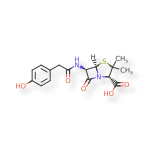
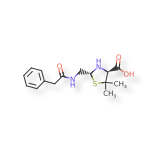
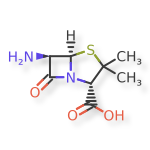
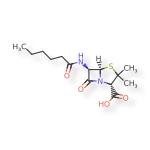
IMPURITY -> PARENT |
CHROMATOGRAPHIC PURITY (HPLC/UV)
EP
|
||
|
IMPURITY -> PARENT |
CHROMATOGRAPHIC PURITY (HPLC/UV)
EP
|
||
|
IMPURITY -> PARENT |
CHROMATOGRAPHIC PURITY (HPLC/UV)
EP
|
||
|
IMPURITY -> PARENT |
CHROMATOGRAPHIC PURITY (HPLC/UV)
EP
|
||
|
IMPURITY -> PARENT |
CHROMATOGRAPHIC PURITY (HPLC/UV)
EP
|
||
|
IMPURITY -> PARENT |
CHROMATOGRAPHIC PURITY (HPLC/UV)
EP
|
||
|
IMPURITY -> PARENT |
CHROMATOGRAPHIC PURITY (HPLC/UV)
EP
|
||
|
IMPURITY -> PARENT |
CHROMATOGRAPHIC PURITY (HPLC/UV)
EP
|
||
|
IMPURITY -> PARENT |
CHROMATOGRAPHIC PURITY (HPLC/UV)
EP
|

| Related Record | Type | Details | ||
|---|---|---|---|---|
|
ACTIVE MOIETY |
http://apps.who.int/phint/pdf/b/Jb.6.1.54.pdf
|