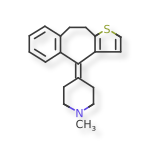
Details
| Stereochemistry | ACHIRAL |
| Molecular Formula | C19H21NS |
| Molecular Weight | 295.442 |
| Optical Activity | NONE |
| Defined Stereocenters | 0 / 0 |
| E/Z Centers | 0 |
| Charge | 0 |
SHOW SMILES / InChI
SMILES
CN1CCC(CC1)=C2C3=C(CCC4=CC=CC=C24)SC=C3
InChI
InChIKey=FIADGNVRKBPQEU-UHFFFAOYSA-N
InChI=1S/C19H21NS/c1-20-11-8-15(9-12-20)19-16-5-3-2-4-14(16)6-7-18-17(19)10-13-21-18/h2-5,10,13H,6-9,11-12H2,1H3
| Molecular Formula | C19H21NS |
| Molecular Weight | 295.442 |
| Charge | 0 |
| Count |
|
| Stereochemistry | ACHIRAL |
| Additional Stereochemistry | No |
| Defined Stereocenters | 0 / 0 |
| E/Z Centers | 0 |
| Optical Activity | NONE |
DescriptionCurator's Comment: description was created based on several sources, including
https://www.drugs.com/uk/sanomigran-1-5mg-tablets-leaflet.html | https://www.drugs.com/uk/pizotifen-0-5mg-tablets-leaflet.html | https://www.ncbi.nlm.nih.gov/pubmed/24189186
Curator's Comment: description was created based on several sources, including
https://www.drugs.com/uk/sanomigran-1-5mg-tablets-leaflet.html | https://www.drugs.com/uk/pizotifen-0-5mg-tablets-leaflet.html | https://www.ncbi.nlm.nih.gov/pubmed/24189186
Pizotifen (INN) or pizotyline (USAN), trade name Sandomigran, is a benzocycloheptene-based drug used as a medicine, primarily as a preventative to reduce the frequency of recurrent migraine headaches. Pizotifen is a serotonin antagonist acting mainly at the 5-HT2A and 5HT2C receptors. It also has some activity as an antihistamine as well as some anticholinergic activity. The main medical use for pizotifen is for the prevention of vascular headache including migraine and cluster headache. Pizotifen is one of a range of medications used for this purpose, other options include propranolol, topiramate, valproic acid and amitriptyline. While pizotifen is reasonably effective, its use is limited by side effects, principally drowsiness and weight gain, and it is usually not the first choice medicine for preventing migraines, instead being used as an alternative when other drugs have failed to be effective. It is not effective in relieving migraine attacks once in progress. Pizotifen has also been reported as highly effective in a severe case of erythromelalgia, a rare neurovascular disease that is sometimes refractory to the other drugs named above. Side effects include sedation, dry mouth, drowsiness, increased appetite and weight gain. Occasionally it may cause nausea, headaches, or dizziness. In rare cases, anxiety, aggression and depression may also occur. Pizotifen is well absorbed from the gastro-intestinal tract, peak plasma concentrations occurring approximately 5 hours after oral administration. The absorption of pizotifen is fast (absorption half life 0.5 to 0.8 hours) and nearly complete (80%). Over 90% is bound to plasma proteins. Pizotifen undergoes extensive metabolism. Over half of a dose is excreted in the urine, chiefly as metabolites; a significant proportion is excreted in the faeces. The primary metabolite of pizotifen (N-glucuronide conjugate) has a long elimination half-life of about 23 hours.
Approval Year
Targets
| Primary Target | Pharmacology | Condition | Potency |
|---|---|---|---|
Target ID: CHEMBL1833 |
2.0 nM [Ki] | ||
Target ID: CHEMBL225 |
1.4 nM [Ki] | ||
Target ID: CHEMBL224 |
7.5 nM [Ki] | ||
Target ID: CHEMBL3155 |
25.0 nM [Ki] |
Conditions
| Condition | Modality | Targets | Highest Phase | Product |
|---|---|---|---|---|
| Primary | Sandomigran Approved UseUnknown |
|||
| Primary | Sandomigran Approved UseUnknown |
|||
| Primary | Sandomigran Approved UseUnknown |
Cmax
| Value | Dose | Co-administered | Analyte | Population |
|---|---|---|---|---|
5 ng/mL |
1 mg single, oral dose: 1 mg route of administration: Oral experiment type: SINGLE co-administered: |
PIZOTYLINE plasma | Homo sapiens population: UNKNOWN age: ADULT sex: UNKNOWN food status: UNKNOWN |
|
14 ng/mL |
1 mg 3 times / day steady-state, oral dose: 1 mg route of administration: Oral experiment type: STEADY-STATE co-administered: |
PIZOTYLINE plasma | Homo sapiens population: UNKNOWN age: ADULT sex: UNKNOWN food status: UNKNOWN |
T1/2
| Value | Dose | Co-administered | Analyte | Population |
|---|---|---|---|---|
23 h |
1 mg single, oral dose: 1 mg route of administration: Oral experiment type: SINGLE co-administered: |
PIZOTYLINE plasma | Homo sapiens population: UNKNOWN age: ADULT sex: UNKNOWN food status: UNKNOWN |
Funbound
| Value | Dose | Co-administered | Analyte | Population |
|---|---|---|---|---|
9% |
1 mg single, oral dose: 1 mg route of administration: Oral experiment type: SINGLE co-administered: |
PIZOTYLINE plasma | Homo sapiens population: UNKNOWN age: ADULT sex: UNKNOWN food status: UNKNOWN |
Doses
| Dose | Population | Adverse events |
|---|---|---|
0.5 mg 3 times / day multiple, oral Studied dose Dose: 0.5 mg, 3 times / day Route: oral Route: multiple Dose: 0.5 mg, 3 times / day Sources: |
unhealthy, ADULT Health Status: unhealthy Age Group: ADULT Sex: M+F Food Status: UNKNOWN Sources: |
Disc. AE: Weight gain, Sleepiness... AEs leading to discontinuation/dose reduction: Weight gain Sources: Sleepiness |
1 mg 3 times / day multiple, oral Studied dose Dose: 1 mg, 3 times / day Route: oral Route: multiple Dose: 1 mg, 3 times / day Sources: |
unhealthy, ADULT Health Status: unhealthy Age Group: ADULT Sex: M+F Food Status: UNKNOWN Sources: |
Disc. AE: Weight gain, Depression... AEs leading to discontinuation/dose reduction: Weight gain (11.1%) Sources: Depression (7.4%) Hunger abnormal (3.7%) Confusion (3.7%) |
AEs
| AE | Significance | Dose | Population |
|---|---|---|---|
| Sleepiness | Disc. AE | 0.5 mg 3 times / day multiple, oral Studied dose Dose: 0.5 mg, 3 times / day Route: oral Route: multiple Dose: 0.5 mg, 3 times / day Sources: |
unhealthy, ADULT Health Status: unhealthy Age Group: ADULT Sex: M+F Food Status: UNKNOWN Sources: |
| Weight gain | Disc. AE | 0.5 mg 3 times / day multiple, oral Studied dose Dose: 0.5 mg, 3 times / day Route: oral Route: multiple Dose: 0.5 mg, 3 times / day Sources: |
unhealthy, ADULT Health Status: unhealthy Age Group: ADULT Sex: M+F Food Status: UNKNOWN Sources: |
| Weight gain | 11.1% Disc. AE |
1 mg 3 times / day multiple, oral Studied dose Dose: 1 mg, 3 times / day Route: oral Route: multiple Dose: 1 mg, 3 times / day Sources: |
unhealthy, ADULT Health Status: unhealthy Age Group: ADULT Sex: M+F Food Status: UNKNOWN Sources: |
| Confusion | 3.7% Disc. AE |
1 mg 3 times / day multiple, oral Studied dose Dose: 1 mg, 3 times / day Route: oral Route: multiple Dose: 1 mg, 3 times / day Sources: |
unhealthy, ADULT Health Status: unhealthy Age Group: ADULT Sex: M+F Food Status: UNKNOWN Sources: |
| Hunger abnormal | 3.7% Disc. AE |
1 mg 3 times / day multiple, oral Studied dose Dose: 1 mg, 3 times / day Route: oral Route: multiple Dose: 1 mg, 3 times / day Sources: |
unhealthy, ADULT Health Status: unhealthy Age Group: ADULT Sex: M+F Food Status: UNKNOWN Sources: |
| Depression | 7.4% Disc. AE |
1 mg 3 times / day multiple, oral Studied dose Dose: 1 mg, 3 times / day Route: oral Route: multiple Dose: 1 mg, 3 times / day Sources: |
unhealthy, ADULT Health Status: unhealthy Age Group: ADULT Sex: M+F Food Status: UNKNOWN Sources: |
Overview
| CYP3A4 | CYP2C9 | CYP2D6 | hERG |
|---|---|---|---|
OverviewOther
| Other Inhibitor | Other Substrate | Other Inducer |
|---|---|---|
Drug as perpetrator
| Target | Modality | Activity | Metabolite | Clinical evidence |
|---|---|---|---|---|
| no [IC50 >10 uM] | ||||
| no [IC50 >10 uM] | ||||
| no [IC50 >10 uM] | ||||
| no | ||||
| yes [Activation 28.1838 uM] | ||||
| yes [IC50 1.2589 uM] | ||||
| yes [IC50 3.9811 uM] |
Drug as victim
| Target | Modality | Activity | Metabolite | Clinical evidence |
|---|---|---|---|---|
Page: 16 | 146 |
inconclusive | |||
| yes | ||||
| yes | ||||
| yes |
Tox targets
| Target | Modality | Activity | Metabolite | Clinical evidence |
|---|---|---|---|---|
PubMed
| Title | Date | PubMed |
|---|---|---|
| Validation and application of reversed phase high-performance liquid chromatographic method for quantification of pizotifen malate in pharmaceutical solid dosage formulations. | 2010-10 |
|
| New methods for diagnosis and treatment of vestibular diseases. | 2010-08-09 |
|
| Fulminant hepatitis possibly related to pizotifen therapy. | 2010-06-24 |
|
| P3MC: a double blind parallel group randomised placebo controlled trial of Propranolol and Pizotifen in preventing migraine in children. | 2010-06-16 |
|
| Prescribing for migraine with the focus on selective 5HT1-receptor agonists: a pharmacy database analysis. | 2010-05 |
|
| Prophylaxis of migraine headache. | 2010-04-20 |
|
| Recent concepts on cyclic vomiting syndrome in children. | 2010-04 |
|
| Cluster headache. | 2010-02-09 |
|
| Potential contribution of prescription practices to the emergence and spread of chloroquine resistance in south-west Nigeria: caution in the use of artemisinin combination therapy. | 2009-12-30 |
|
| What happens to new-onset headache in children that present to primary care? A case-cohort study using electronic primary care records. | 2009-12 |
|
| Treatment of primary headache in children: a multicenter hospital-based study in France. | 2009-12 |
|
| 5-Hydroxytryptamine Receptor Subtypes and their Modulators with Therapeutic Potentials. | 2009-06 |
|
| Migraine headache in children. | 2009-01-13 |
|
| Prophylaxis of migraine: general principles and patient acceptance. | 2008-12 |
|
| Drug use in children: cohort study in three European countries. | 2008-11-24 |
|
| Optimizing prophylactic treatment of migraine: Subtypes and patient matching. | 2008-10 |
|
| Stages of motor output reorganization after hemispheric stroke suggested by longitudinal studies of cortical physiology. | 2008-08 |
|
| Cluster headache. | 2008-07-23 |
|
| Weight gain with pizotifen therapy. | 2008-07 |
|
| Pizotifen relieves acute migraine symptoms. | 2008-03-01 |
|
| Cluster headache. | 2008-02-15 |
|
| Pharmacological interventions for recurrent abdominal pain (RAP) and irritable bowel syndrome (IBS) in childhood. | 2008-01-23 |
|
| Update on the prophylaxis of migraine. | 2008-01 |
|
| [Confusional syndrome caused by pizotifen]. | 2007-10-19 |
|
| Migraine associated vertigo. | 2007-09 |
|
| Management of migraine in Australian general practice. | 2007-08-06 |
|
| Pediatric migraine: pharmacologic agents for prophylaxis. | 2007-07 |
|
| Recommendations for the management of migraine in paediatric patients. | 2007-04 |
|
| The Effect of Paroxetine on the Reduction of Migraine Frequency is Independent of Its Anxiolytic Effect. | 2006-12 |
|
| Evaluation of guided imagery as treatment for recurrent abdominal pain in children: a randomized controlled trial. | 2006-11-08 |
|
| Pharmacological prevention of migraine: to be considered case by case. | 2006-10 |
|
| Anatomical alterations of the visual motion processing network in migraine with and without aura. | 2006-10 |
|
| Topiramate in the prevention of migraine: a review of its efficacy, tolerability, and acceptability. | 2006-09 |
|
| Topiramate for migraine prophylaxis. | 2006-08 |
|
| Which therapy for which patient? | 2006-05 |
|
| Potential vascular alpha1-adrenoceptor blocking properties of an array of 5-HT receptor ligands in the rat. | 2006-03-27 |
|
| Adult abdominal migraine: a new syndrome or sporadic feature of migraine headache? A case report. | 2006-01 |
|
| Cyclic Vomiting Syndrome in 41 adults: the illness, the patients, and problems of management. | 2005-12-21 |
|
| Raynaud phenomena and migraine in two children: inclusion within a family of related disorders. | 2005-12 |
|
| Pizotyline effectively attenuates the stimulus effects of N-methyl-3,4-methylenedioxyamphetamine (MDMA). | 2005-10 |
|
| Weight variations in the prophylactic therapy of primary headaches: 6-month follow-up. | 2005-09 |
|
| Anticipatory nausea in cyclical vomiting. | 2005-03-24 |
|
| Serotonin2C receptor blockade and thermoregulation during exercise in the heat. | 2005-03 |
|
| Use of intravenous midazolam and clonidine in cyclical vomiting syndrome: a case report. | 2005-01 |
|
| Practice parameter: pharmacological treatment of migraine headache in children and adolescents: report of the American Academy of Neurology Quality Standards Subcommittee and the Practice Committee of the Child Neurology Society. | 2004-12-28 |
|
| Agonist activity of antimigraine drugs at recombinant human 5-HT1A receptors: potential implications for prophylactic and acute therapy. | 1997-06 |
|
| The role of the central serotonergic system in pilocarpine-induced seizures: receptor mechanisms. | 1989-11 |
|
| Arterial complications of migraine treatment with methysergide and parenteral ergotamine. | 1982-07-24 |
|
| Effects of chronic treatment with antidepressants on aggressiveness induced by clonidine in mice. | 1982 |
|
| Comparative trial of serotonin antagonists in the management of migraine. | 1970-05-09 |
Patents
Sample Use Guides
1.5mg daily (one 1.5mg tablet at night or 0.5mg tablets three times daily).
Route of Administration:
Oral
HEK293-EBNA cell was used as the gene transferring cell. Cultured HEK293-EBNA cells expressing human 5-HT2B receptor were washed with PBS(-). The cells were scraped in the presence of PBS(-), and the cells were recovered by centrifugation (1000 rpm, 10 min, 4 OC). They were homogenized using Polytron (PTA 10-TS) in the presence of 5 mM Tris-HCl (pH 7.4) buffer and centrifuged (40,000 xg. 10 min, 4 OC). They were suspended using a homogenizer in the presence of 50 mM Tris–HCl (pH 7.4) buffer. They were subjected to centrifugation (40,000 xg, 10 min, 4 OC), suspended in 50 mM Tris–HCl (pH 7.4) and stored at 80 0C. A total volume of 500 mkL containing 50 mM Tris–HCl–4 mM CaCl2 (pH 7.4) buffer, the human 5-HT2B receptor expressing HEK293-EBNA cell membrane preparation and a radio ligand [3H] Mesulergine (3.1 TBq/mmol) was incubated at 25 OC for 1 h. The Pizotifen was dissolved in 100% DMSO and diluted to respective concentrations.
| Substance Class |
Chemical
Created
by
admin
on
Edited
Mon Mar 31 18:40:14 GMT 2025
by
admin
on
Mon Mar 31 18:40:14 GMT 2025
|
| Record UNII |
0BY8440V3N
|
| Record Status |
Validated (UNII)
|
| Record Version |
|
-
Download
| Name | Type | Language | ||
|---|---|---|---|---|
|
Official Name | English | ||
|
Preferred Name | English | ||
|
Common Name | English | ||
|
Code | English | ||
|
Common Name | English | ||
|
Common Name | English | ||
|
Common Name | English | ||
|
Brand Name | English | ||
|
Systematic Name | English | ||
|
Systematic Name | English | ||
|
Common Name | English |
| Classification Tree | Code System | Code | ||
|---|---|---|---|---|
|
WHO-ATC |
N02CX01
Created by
admin on Mon Mar 31 18:40:14 GMT 2025 , Edited by admin on Mon Mar 31 18:40:14 GMT 2025
|
||
|
NCI_THESAURUS |
C66885
Created by
admin on Mon Mar 31 18:40:14 GMT 2025 , Edited by admin on Mon Mar 31 18:40:14 GMT 2025
|
||
|
WHO-VATC |
QN02CX01
Created by
admin on Mon Mar 31 18:40:14 GMT 2025 , Edited by admin on Mon Mar 31 18:40:14 GMT 2025
|
| Code System | Code | Type | Description | ||
|---|---|---|---|---|---|
|
93
Created by
admin on Mon Mar 31 18:40:14 GMT 2025 , Edited by admin on Mon Mar 31 18:40:14 GMT 2025
|
PRIMARY | |||
|
100000092611
Created by
admin on Mon Mar 31 18:40:14 GMT 2025 , Edited by admin on Mon Mar 31 18:40:14 GMT 2025
|
PRIMARY | |||
|
DB06153
Created by
admin on Mon Mar 31 18:40:14 GMT 2025 , Edited by admin on Mon Mar 31 18:40:14 GMT 2025
|
PRIMARY | |||
|
50213
Created by
admin on Mon Mar 31 18:40:14 GMT 2025 , Edited by admin on Mon Mar 31 18:40:14 GMT 2025
|
PRIMARY | |||
|
D010918
Created by
admin on Mon Mar 31 18:40:14 GMT 2025 , Edited by admin on Mon Mar 31 18:40:14 GMT 2025
|
PRIMARY | |||
|
27400
Created by
admin on Mon Mar 31 18:40:14 GMT 2025 , Edited by admin on Mon Mar 31 18:40:14 GMT 2025
|
PRIMARY | |||
|
8373
Created by
admin on Mon Mar 31 18:40:14 GMT 2025 , Edited by admin on Mon Mar 31 18:40:14 GMT 2025
|
PRIMARY | RxNorm | ||
|
C87214
Created by
admin on Mon Mar 31 18:40:14 GMT 2025 , Edited by admin on Mon Mar 31 18:40:14 GMT 2025
|
PRIMARY | |||
|
2220
Created by
admin on Mon Mar 31 18:40:14 GMT 2025 , Edited by admin on Mon Mar 31 18:40:14 GMT 2025
|
PRIMARY | |||
|
PIZOTIFEN
Created by
admin on Mon Mar 31 18:40:14 GMT 2025 , Edited by admin on Mon Mar 31 18:40:14 GMT 2025
|
PRIMARY | |||
|
DTXSID6023490
Created by
admin on Mon Mar 31 18:40:14 GMT 2025 , Edited by admin on Mon Mar 31 18:40:14 GMT 2025
|
PRIMARY | |||
|
50212
Created by
admin on Mon Mar 31 18:40:14 GMT 2025 , Edited by admin on Mon Mar 31 18:40:14 GMT 2025
|
PRIMARY | |||
|
15574-96-6
Created by
admin on Mon Mar 31 18:40:14 GMT 2025 , Edited by admin on Mon Mar 31 18:40:14 GMT 2025
|
PRIMARY | |||
|
239-632-9
Created by
admin on Mon Mar 31 18:40:14 GMT 2025 , Edited by admin on Mon Mar 31 18:40:14 GMT 2025
|
PRIMARY | |||
|
SUB09954MIG
Created by
admin on Mon Mar 31 18:40:14 GMT 2025 , Edited by admin on Mon Mar 31 18:40:14 GMT 2025
|
PRIMARY | |||
|
2693
Created by
admin on Mon Mar 31 18:40:14 GMT 2025 , Edited by admin on Mon Mar 31 18:40:14 GMT 2025
|
PRIMARY | |||
|
m8899
Created by
admin on Mon Mar 31 18:40:14 GMT 2025 , Edited by admin on Mon Mar 31 18:40:14 GMT 2025
|
PRIMARY | Merck Index | ||
|
0BY8440V3N
Created by
admin on Mon Mar 31 18:40:14 GMT 2025 , Edited by admin on Mon Mar 31 18:40:14 GMT 2025
|
PRIMARY | |||
|
CHEMBL294951
Created by
admin on Mon Mar 31 18:40:14 GMT 2025 , Edited by admin on Mon Mar 31 18:40:14 GMT 2025
|
PRIMARY |
| Related Record | Type | Details | ||
|---|---|---|---|---|
|
TARGET -> INHIBITOR |
|
||
|
|
SALT/SOLVATE -> PARENT | |||
|
|
SALT/SOLVATE -> PARENT | |||
|
|
TARGET -> INHIBITOR |
|

| Related Record | Type | Details | ||
|---|---|---|---|---|
|
|
ACTIVE MOIETY |