


Details
| Stereochemistry | RACEMIC |
| Molecular Formula | C20H21FN2O |
| Molecular Weight | 324.3919 |
| Optical Activity | ( + / - ) |
| Defined Stereocenters | 0 / 1 |
| E/Z Centers | 0 |
| Charge | 0 |
SHOW SMILES / InChI
SMILES
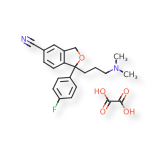
CN(C)CCCC1(OCC2=CC(=CC=C12)C#N)C3=CC=C(F)C=C3
InChI
InChIKey=WSEQXVZVJXJVFP-UHFFFAOYSA-N
InChI=1S/C20H21FN2O/c1-23(2)11-3-10-20(17-5-7-18(21)8-6-17)19-9-4-15(13-22)12-16(19)14-24-20/h4-9,12H,3,10-11,14H2,1-2H3
| Molecular Formula | C20H21FN2O |
| Molecular Weight | 324.3919 |
| Charge | 0 |
| Count |
|
| Stereochemistry | RACEMIC |
| Additional Stereochemistry | No |
| Defined Stereocenters | 0 / 1 |
| E/Z Centers | 0 |
| Optical Activity | ( + / - ) |
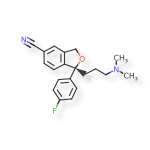
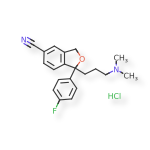
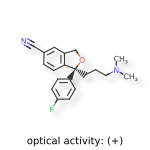
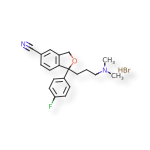
Citalopram (brand names: Celexa, Cipramil, and others) is an antidepressant drug of the selective serotonin reuptake inhibitor (SSRI) class. It has U.S. Food and Drug Administration approval to treat major depression,[2]which it received in 1998, and is prescribed off-label for other conditions. In Australia, the UK, Germany, Portugal, Poland, and most European countries, it is licensed for depressive episodes and panic disorder with or without agoraphobia. In Spain, it is also used for obsessive-compulsive disorder. Citalopram HBr is a racemic bicyclic phthalane derivative designated (±)-1-(3-dimethylaminopropyl)-1-(4-fluorophenyl)-1,3-dihydroisobenzofuran-5carbonitrile, HBr. The mechanism of action of citalopram HBr as an antidepressant is presumed to be linked to potentiation of serotonergic activity in the central nervous system (CNS) resulting from its inhibition of CNS neuronal reuptake of serotonin (5-HT). In vitro and in vivo studies in animals suggest that citalopram is a highly selective serotonin reuptake inhibitor (SSRI) with minimal effects on norepinephrine (NE) and dopamine (DA) neuronal reuptake. The single-and multiple-dose pharmacokinetics of citalopram are linear and dose-proportional in a dose range of 10-60 mg/day. Biotransformation of citalopram is mainly hepatic, with a mean terminal half-life of about 35 hours.
Originator
Sources: https://lakemedelsverket.se/LMF/Lakemedelsinformation/?nplid=19980626000180Bigler, Allan J., et al. 'Quantitative structure-activity-relationships in a series of selective 5-HT uptake inhibitors.' EUROPEAN JOURNAL OF MEDICINAL CHEMISTRY 12.3 (1977): 289-295.
Approval Year
Targets
| Primary Target | Pharmacology | Condition | Potency |
|---|---|---|---|
Target ID: CHEMBL228 |
|||
Target ID: CHEMBL228 |
0.78 nM [Ki] |
Conditions
| Condition | Modality | Targets | Highest Phase | Product |
|---|---|---|---|---|
| Primary | CELEXA Approved UseCitalopram HBr is indicated for the treatment of depression. The efficacy of citalopram HBr in the treatment of depression was established in 4 to 6 week, controlled trials of outpatients whose diagnosis corresponded most closely to the DSM-III and DSM-III-R category of major depressive disorder (see CLINICAL PHARMACOLOGY ). A major depressive episode (DSM-IV) implies a prominent and relatively persistent (nearly every day for at least 2 weeks) depressed or dysphoric mood that usually interferes with daily functioning, and includes at least five of the following nine symptoms: depressed mood, loss of interest in usual activities, significant change in weight and/or appetite, insomnia or hypersomnia, psychomotor agitation or retardation, increased fatigue, feelings of guilt or worthlessness, slowed thinking or impaired concentration, a suicide attempt or suicidal ideation. The antidepressant action of citalopram HBr in hospitalized depressed patients has not been adequately studied. The efficacy of citalopram HBr in maintaining an antidepressant response for up to 24 weeks following 6 to 8 weeks of acute treatment was demonstrated in two placebo-controlled trials (see CLINICAL PHARMACOLOGY ). Nevertheless, the physician who elects to use citalopram HBr for extended periods should periodically re-evaluate the long-term usefulness of the drug for the individual patient. Launch Date1998 |
|||
| Primary | Celexa Approved UseINDICATIONS AND USAGE. Celexa (citalopram HBr) is indicated for the treatment of depression. Launch Date1998 |
Cmax
| Value | Dose | Co-administered | Analyte | Population |
|---|---|---|---|---|
10.6 ng/mL |
10 mg single, oral dose: 10 mg route of administration: Oral experiment type: SINGLE co-administered: |
CITALOPRAM plasma | Homo sapiens population: HEALTHY age: ADULT sex: FEMALE / MALE food status: FASTED |
|
21.7 ng/mL |
20 mg single, oral dose: 20 mg route of administration: Oral experiment type: SINGLE co-administered: |
CITALOPRAM plasma | Homo sapiens population: HEALTHY age: ADULT sex: FEMALE / MALE food status: FASTED |
|
43.7 ng/mL |
40 mg single, oral dose: 40 mg route of administration: Oral experiment type: SINGLE co-administered: |
CITALOPRAM plasma | Homo sapiens population: HEALTHY age: ADULT sex: FEMALE / MALE food status: FASTED |
|
65.6 ng/mL |
60 mg single, oral dose: 60 mg route of administration: Oral experiment type: SINGLE co-administered: |
CITALOPRAM plasma | Homo sapiens population: HEALTHY age: ADULT sex: FEMALE / MALE food status: FASTED |
|
3.2 ng/mL |
20 mg single, oral dose: 20 mg route of administration: Oral experiment type: SINGLE co-administered: |
DESMETHYLCITALOPRAM plasma | Homo sapiens population: HEALTHY age: ADULT sex: FEMALE / MALE food status: FASTED |
|
6.1 ng/mL |
40 mg single, oral dose: 40 mg route of administration: Oral experiment type: SINGLE co-administered: |
DESMETHYLCITALOPRAM plasma | Homo sapiens population: HEALTHY age: ADULT sex: FEMALE / MALE food status: FASTED |
|
8.5 ng/mL |
60 mg single, oral dose: 60 mg route of administration: Oral experiment type: SINGLE co-administered: |
DESMETHYLCITALOPRAM plasma | Homo sapiens population: HEALTHY age: ADULT sex: FEMALE / MALE food status: FASTED |
AUC
| Value | Dose | Co-administered | Analyte | Population |
|---|---|---|---|---|
533.2 ng × h/mL |
10 mg single, oral dose: 10 mg route of administration: Oral experiment type: SINGLE co-administered: |
CITALOPRAM plasma | Homo sapiens population: HEALTHY age: ADULT sex: FEMALE / MALE food status: FASTED |
|
1010.4 ng × h/mL |
20 mg single, oral dose: 20 mg route of administration: Oral experiment type: SINGLE co-administered: |
CITALOPRAM plasma | Homo sapiens population: HEALTHY age: ADULT sex: FEMALE / MALE food status: FASTED |
|
2070.3 ng × h/mL |
40 mg single, oral dose: 40 mg route of administration: Oral experiment type: SINGLE co-administered: |
CITALOPRAM plasma | Homo sapiens population: HEALTHY age: ADULT sex: FEMALE / MALE food status: FASTED |
|
2946.5 ng × h/mL |
60 mg single, oral dose: 60 mg route of administration: Oral experiment type: SINGLE co-administered: |
CITALOPRAM plasma | Homo sapiens population: HEALTHY age: ADULT sex: FEMALE / MALE food status: FASTED |
|
204.5 ng × h/mL |
20 mg single, oral dose: 20 mg route of administration: Oral experiment type: SINGLE co-administered: |
DESMETHYLCITALOPRAM plasma | Homo sapiens population: HEALTHY age: ADULT sex: FEMALE / MALE food status: FASTED |
|
843.7 ng × h/mL |
40 mg single, oral dose: 40 mg route of administration: Oral experiment type: SINGLE co-administered: |
DESMETHYLCITALOPRAM plasma | Homo sapiens population: HEALTHY age: ADULT sex: FEMALE / MALE food status: FASTED |
|
1153.2 ng × h/mL |
60 mg single, oral dose: 60 mg route of administration: Oral experiment type: SINGLE co-administered: |
DESMETHYLCITALOPRAM plasma | Homo sapiens population: HEALTHY age: ADULT sex: FEMALE / MALE food status: FASTED |
T1/2
| Value | Dose | Co-administered | Analyte | Population |
|---|---|---|---|---|
36.3 h |
10 mg single, oral dose: 10 mg route of administration: Oral experiment type: SINGLE co-administered: |
CITALOPRAM plasma | Homo sapiens population: HEALTHY age: ADULT sex: FEMALE / MALE food status: FASTED |
|
38.5 h |
20 mg single, oral dose: 20 mg route of administration: Oral experiment type: SINGLE co-administered: |
CITALOPRAM plasma | Homo sapiens population: HEALTHY age: ADULT sex: FEMALE / MALE food status: FASTED |
|
40 h |
40 mg single, oral dose: 40 mg route of administration: Oral experiment type: SINGLE co-administered: |
CITALOPRAM plasma | Homo sapiens population: HEALTHY age: ADULT sex: FEMALE / MALE food status: FASTED |
|
39.5 h |
60 mg single, oral dose: 60 mg route of administration: Oral experiment type: SINGLE co-administered: |
CITALOPRAM plasma | Homo sapiens population: HEALTHY age: ADULT sex: FEMALE / MALE food status: FASTED |
|
79.3 h |
40 mg single, oral dose: 40 mg route of administration: Oral experiment type: SINGLE co-administered: |
DESMETHYLCITALOPRAM plasma | Homo sapiens population: HEALTHY age: ADULT sex: FEMALE / MALE food status: FASTED |
|
77.5 h |
60 mg single, oral dose: 60 mg route of administration: Oral experiment type: SINGLE co-administered: |
DESMETHYLCITALOPRAM plasma | Homo sapiens population: HEALTHY age: ADULT sex: FEMALE / MALE food status: FASTED |
Funbound
| Value | Dose | Co-administered | Analyte | Population |
|---|---|---|---|---|
18% |
10 mg single, oral dose: 10 mg route of administration: Oral experiment type: SINGLE co-administered: |
CITALOPRAM plasma | Homo sapiens population: HEALTHY age: ADULT sex: FEMALE / MALE food status: FASTED |
|
18% |
20 mg single, oral dose: 20 mg route of administration: Oral experiment type: SINGLE co-administered: |
CITALOPRAM plasma | Homo sapiens population: HEALTHY age: ADULT sex: FEMALE / MALE food status: FASTED |
|
18% |
40 mg single, oral dose: 40 mg route of administration: Oral experiment type: SINGLE co-administered: |
CITALOPRAM plasma | Homo sapiens population: HEALTHY age: ADULT sex: FEMALE / MALE food status: FASTED |
|
18% |
60 mg single, oral dose: 60 mg route of administration: Oral experiment type: SINGLE co-administered: |
CITALOPRAM plasma | Homo sapiens population: HEALTHY age: ADULT sex: FEMALE / MALE food status: FASTED |
|
26% |
20 mg single, oral dose: 20 mg route of administration: Oral experiment type: SINGLE co-administered: |
DESMETHYLCITALOPRAM plasma | Homo sapiens population: HEALTHY age: ADULT sex: FEMALE / MALE food status: FASTED |
|
26% |
40 mg single, oral dose: 40 mg route of administration: Oral experiment type: SINGLE co-administered: |
DESMETHYLCITALOPRAM plasma | Homo sapiens population: HEALTHY age: ADULT sex: FEMALE / MALE food status: FASTED |
|
26% |
60 mg single, oral dose: 60 mg route of administration: Oral experiment type: SINGLE co-administered: |
DESMETHYLCITALOPRAM plasma | Homo sapiens population: HEALTHY age: ADULT sex: FEMALE / MALE food status: FASTED |
Doses
| Dose | Population | Adverse events |
|---|---|---|
800 mg single, oral Overdose |
unknown, 14 years |
Other AEs: Dizziness, Drowsiness... Other AEs: Dizziness (mild, 1 patient) Sources: Drowsiness (mild, 1 patient) |
80 mg 1 times / day steady, oral Studied dose Dose: 80 mg, 1 times / day Route: oral Route: steady Dose: 80 mg, 1 times / day Sources: |
unhealthy, 18-66 years Health Status: unhealthy Age Group: 18-66 years Sex: M+F Sources: |
Disc. AE: Asthenia, Nausea... AEs leading to discontinuation/dose reduction: Asthenia (1%) Sources: Nausea (4%) Dry mouth (1%) Vomiting (1%) Dizziness (2%) Insomnia (3%) Somnolence (2%) Agitation (1%) |
760 mg single, oral Overdose |
unknown, 25 years |
Other AEs: Seizures, Tachycardia... Other AEs: Seizures (1 patient) Sources: Tachycardia (1 patient) Neuromuscular disorders NEC (1 patient) Hyperthermia (severe, 1 patient) |
360 mg 1 times / day multiple, oral Highest studied dose Dose: 360 mg, 1 times / day Route: oral Route: multiple Dose: 360 mg, 1 times / day Sources: |
unhealthy, adult |
|
2800 mg single, oral Overdose Dose: 2800 mg Route: oral Route: single Dose: 2800 mg Sources: |
unknown Health Status: unknown Sources: |
Other AEs: Dizziness, Sweating... Other AEs: Dizziness (grade 5) Sources: Sweating Nausea Vomiting Tremor Somnolence Sinus tachycardia |
AEs
| AE | Significance | Dose | Population |
|---|---|---|---|
| Dizziness | mild, 1 patient | 800 mg single, oral Overdose |
unknown, 14 years |
| Drowsiness | mild, 1 patient | 800 mg single, oral Overdose |
unknown, 14 years |
| Agitation | 1% Disc. AE |
80 mg 1 times / day steady, oral Studied dose Dose: 80 mg, 1 times / day Route: oral Route: steady Dose: 80 mg, 1 times / day Sources: |
unhealthy, 18-66 years Health Status: unhealthy Age Group: 18-66 years Sex: M+F Sources: |
| Asthenia | 1% Disc. AE |
80 mg 1 times / day steady, oral Studied dose Dose: 80 mg, 1 times / day Route: oral Route: steady Dose: 80 mg, 1 times / day Sources: |
unhealthy, 18-66 years Health Status: unhealthy Age Group: 18-66 years Sex: M+F Sources: |
| Dry mouth | 1% Disc. AE |
80 mg 1 times / day steady, oral Studied dose Dose: 80 mg, 1 times / day Route: oral Route: steady Dose: 80 mg, 1 times / day Sources: |
unhealthy, 18-66 years Health Status: unhealthy Age Group: 18-66 years Sex: M+F Sources: |
| Vomiting | 1% Disc. AE |
80 mg 1 times / day steady, oral Studied dose Dose: 80 mg, 1 times / day Route: oral Route: steady Dose: 80 mg, 1 times / day Sources: |
unhealthy, 18-66 years Health Status: unhealthy Age Group: 18-66 years Sex: M+F Sources: |
| Dizziness | 2% Disc. AE |
80 mg 1 times / day steady, oral Studied dose Dose: 80 mg, 1 times / day Route: oral Route: steady Dose: 80 mg, 1 times / day Sources: |
unhealthy, 18-66 years Health Status: unhealthy Age Group: 18-66 years Sex: M+F Sources: |
| Somnolence | 2% Disc. AE |
80 mg 1 times / day steady, oral Studied dose Dose: 80 mg, 1 times / day Route: oral Route: steady Dose: 80 mg, 1 times / day Sources: |
unhealthy, 18-66 years Health Status: unhealthy Age Group: 18-66 years Sex: M+F Sources: |
| Insomnia | 3% Disc. AE |
80 mg 1 times / day steady, oral Studied dose Dose: 80 mg, 1 times / day Route: oral Route: steady Dose: 80 mg, 1 times / day Sources: |
unhealthy, 18-66 years Health Status: unhealthy Age Group: 18-66 years Sex: M+F Sources: |
| Nausea | 4% Disc. AE |
80 mg 1 times / day steady, oral Studied dose Dose: 80 mg, 1 times / day Route: oral Route: steady Dose: 80 mg, 1 times / day Sources: |
unhealthy, 18-66 years Health Status: unhealthy Age Group: 18-66 years Sex: M+F Sources: |
| Neuromuscular disorders NEC | 1 patient | 760 mg single, oral Overdose |
unknown, 25 years |
| Seizures | 1 patient | 760 mg single, oral Overdose |
unknown, 25 years |
| Tachycardia | 1 patient | 760 mg single, oral Overdose |
unknown, 25 years |
| Hyperthermia | severe, 1 patient | 760 mg single, oral Overdose |
unknown, 25 years |
| Nausea | 2800 mg single, oral Overdose Dose: 2800 mg Route: oral Route: single Dose: 2800 mg Sources: |
unknown Health Status: unknown Sources: |
|
| Sinus tachycardia | 2800 mg single, oral Overdose Dose: 2800 mg Route: oral Route: single Dose: 2800 mg Sources: |
unknown Health Status: unknown Sources: |
|
| Somnolence | 2800 mg single, oral Overdose Dose: 2800 mg Route: oral Route: single Dose: 2800 mg Sources: |
unknown Health Status: unknown Sources: |
|
| Sweating | 2800 mg single, oral Overdose Dose: 2800 mg Route: oral Route: single Dose: 2800 mg Sources: |
unknown Health Status: unknown Sources: |
|
| Tremor | 2800 mg single, oral Overdose Dose: 2800 mg Route: oral Route: single Dose: 2800 mg Sources: |
unknown Health Status: unknown Sources: |
|
| Vomiting | 2800 mg single, oral Overdose Dose: 2800 mg Route: oral Route: single Dose: 2800 mg Sources: |
unknown Health Status: unknown Sources: |
|
| Dizziness | grade 5 | 2800 mg single, oral Overdose Dose: 2800 mg Route: oral Route: single Dose: 2800 mg Sources: |
unknown Health Status: unknown Sources: |
PubMed
| Title | Date | PubMed |
|---|---|---|
| Binding characteristics of selective serotonin reuptake inhibitors with relation to emission tomography studies. | 2001-09-01 |
|
| Distribution of serotonin, its metabolites and 5-HT transporters in the neostriatum of Lurcher and weaver mutant mice. | 2001-09 |
|
| Relationship between central serotonergic neurotransmission and reduction in alcohol intake by citalopram. | 2001-08-01 |
|
| S33005, a novel ligand at both serotonin and norepinephrine transporters: II. Behavioral profile in comparison with venlafaxine, reboxetine, citalopram, and clomipramine. | 2001-08 |
|
| S33005, a novel ligand at both serotonin and norepinephrine transporters: I. Receptor binding, electrophysiological, and neurochemical profile in comparison with venlafaxine, reboxetine, citalopram, and clomipramine. | 2001-08 |
|
| Escitalopram (S-citalopram) and its metabolites in vitro: cytochromes mediating biotransformation, inhibitory effects, and comparison to R-citalopram. | 2001-08 |
|
| Down-regulation of the rat serotonin transporter upon exposure to a selective serotonin reuptake inhibitor. | 2001-07-20 |
|
| Rapid response to low dose citalopram in pathological crying. | 2001-07-13 |
|
| Citalopram in refractory obsessive-compulsive disorder: an open study. | 2001-07 |
|
| Behavioral and neurochemical effects of anpirtoline and citalopram in isolated and group housed mice. | 2001-07 |
|
| Citalopram for OCD and Tourette's syndrome. | 2001-07 |
|
| Trichotillomania associated with dementia: a case report. | 2001-06-28 |
|
| QTc interval prolongation associated with citalopram overdose: a case report and literature review. | 2001-06-08 |
|
| Involvement of adenosine in the effect of antidepressants on glutamate and aspartate release in the rat prefrontal cortex. | 2001-06 |
|
| Citalopram versus nortriptyline in late-life depression: a 12-week randomized single-blind study. | 2001-06 |
|
| The 35% CO2 hyperreactivity and clinical symptomatology in patients with panic disorder after 1 week of treatment with citalopram: an open study. | 2001-06 |
|
| Chronic effects of triiodothyronine in combination with imipramine on 5-HT transporter, 5-HT(1A) and 5-HT(2A) receptors in adult rat brain. | 2001-06 |
|
| Does interaction between zinc and glutamate system play a significant role in the mechanism of antidepressant action? | 2001-05-24 |
|
| Rapid determination of citalopram in human plasma by high-performance liquid chromatography. | 2001-05-05 |
|
| A comparison of citalopram and paroxetine in the treatment of panic disorder: a randomized, single-blind study. | 2001-05 |
|
| Risk profile of SSrIs in elderly depressive patients with co-morbid physical illness. | 2001-05 |
|
| Low-dose citalopram as a 5-HT neuroendocrine probe. | 2001-05 |
|
| Does mirtazapine have a more rapid onset than SSRIs? | 2001-05 |
|
| Escitalopram (S-enantiomer of citalopram): clinical efficacy and onset of action predicted from a rat model. | 2001-05 |
|
| Alzheimer's disease and related disorders. | 2001-05 |
|
| On-line extraction using an alkyl-diol silica precolumn for racemic citalopram and its metabolites in plasma. Results compared with solid-phase extraction methodology. | 2001-04-05 |
|
| Involvement of 5-HT1A and 5-HT1B receptors for citalopram-induced hypothermia in the rat. | 2001-04 |
|
| The effects of amitriptyline, citalopram and reboxetine on autonomic nervous system. A randomised placebo-controlled study on healthy volunteers. | 2001-04 |
|
| Citalopram: a comprehensive review. | 2001-04 |
|
| Are newer antidepressants really "better tolerated"? | 2001-04 |
|
| Involvement of 5-HT(2C) receptors in the anti-immobility effects of antidepressants in the forced swimming test in mice. | 2001-04 |
|
| In vivo steady-state pharmacokinetic outcome following clinical and toxic doses of racemic citalopram to rats. | 2001-04 |
|
| Prophylactic effect of citalopram in unipolar, recurrent depression: placebo-controlled study of maintenance therapy. | 2001-04 |
|
| Differential effects of fluvoxamine and other antidepressants on the biotransformation of melatonin. | 2001-04 |
|
| Effect on sexual function of long-term treatment with selective serotonin reuptake inhibitors in depressed patients treated in primary care. | 2001-04 |
|
| [Behavioral and neurochemical study on the mechanism of the anxiolytic effect of a selective serotonin reuptake inhibitor, a selective serotonin1A agonist and lithium carbonate]. | 2001-03 |
|
| Neonatal withdrawal syndrome after in utero exposure to selective serotonin reuptake inhibitors. | 2001-03 |
|
| Are there differences in the use of selective serotonin reuptake inhibitors and tricyclic antidepressants? A prescription database study. | 2001-03 |
|
| Citalopram in mentally retarded patients with depression: a long-term clinical investigation. | 2001-03 |
|
| A fatal case of serotonin syndrome after combined moclobemide-citalopram intoxication. | 2001-03 |
|
| Pharmacological treatment of childhood obsessive-compulsive disorder: from theory to practice. | 2001-03 |
|
| Lack of citalopram effect on oral digoxin pharmacokinetics. | 2001-03 |
|
| [Depression and anxiety in the elderly still underdiagnosed. SSRI preparations in conjunction with psychotherapy provide effective treatment]. | 2001-02-21 |
|
| Some behavioural effects of antidepressant drugs are time-dependent. | 2001-02 |
|
| Mood and behavioural disorders following traumatic brain injury: clinical evaluation and pharmacological management. | 2001-02 |
|
| Too much hypothalamic serotonin transporter is bad for your mood. | 2001-01 |
|
| Following long-term training with citalopram, both mirtazapine and mianserin block its discriminative stimulus properties in rats. | 2001-01 |
|
| A retrospective study of citalopram in adolescents with depression. | 2001 |
|
| Selective serotonin reuptake inhibitors for late-life depression: a comparative review. | 2001 |
|
| First experiences in combination therapy using olanzapine with SSRIs (citalopram, paroxetine) in delusional depression. | 2001 |
Sample Use Guides
Initial Treatment Celexa (citalopram HBr) should be administered at an initial dose of 20 mg once daily, with an increase to a maximum dose of 40 mg/day at an interval of no less than one week. Doses above 40 mg/day are not recommended due to the risk of QT prolongation. Additionally, the only study pertinent to dose response for effectiveness did not demonstrate an advantage for the 60 mg/day dose over the 40 mg/day dose. Special Populations 20 mg/day is the maximum recommended dose for patients who are greater than 60 years of age, patients with hepatic impairment, and for CYP2C19 poor metabolizers or those patients taking cimetidine or another CYP2C19 inhibitor.
Route of Administration:
Oral
It was investigated the mechanisms of cytotoxic effects of in vitro and in vivo citalopram treatment on liver and the following cytolethal events. For in vitro experiments, freshly isolated rat hepatocytes were exposed to citalopram along with/without various agents. In the in vitro experiments, citalopram (500 µM) exposure demonstrated cell death, a marked elevation in ROS formation, mitochondrial potential collapse, lysosomal membrane leakiness, glutathione (GSH) depletion and lipid peroxidation. In vivo biochemistry panel assays for liver enzymes function (AST, ALT and GGTP) and histological examination confirmed citalopram (20 mg/kg)-induced damage. Citalopram-induced oxidative stress cytotoxicity markers were significantly prevented by antioxidants, ROS scavengers, MPT pore sealing agents, endocytosis inhibitors, ATP generators and CYP inhibitors.
| Substance Class |
Chemical
Created
by
admin
on
Edited
Mon Mar 31 18:29:36 GMT 2025
by
admin
on
Mon Mar 31 18:29:36 GMT 2025
|
| Record UNII |
0DHU5B8D6V
|
| Record Status |
Validated (UNII)
|
| Record Version |
|
-
Download
| Name | Type | Language | ||
|---|---|---|---|---|
|
Official Name | English | ||
|
Preferred Name | English | ||
|
Common Name | English | ||
|
Common Name | English | ||
|
Common Name | English | ||
|
Common Name | English | ||
|
Common Name | English | ||
|
Common Name | English | ||
|
Common Name | English |
| Classification Tree | Code System | Code | ||
|---|---|---|---|---|
|
LIVERTOX |
212
Created by
admin on Mon Mar 31 18:29:36 GMT 2025 , Edited by admin on Mon Mar 31 18:29:36 GMT 2025
|
||
|
NCI_THESAURUS |
C265
Created by
admin on Mon Mar 31 18:29:36 GMT 2025 , Edited by admin on Mon Mar 31 18:29:36 GMT 2025
|
||
|
NCI_THESAURUS |
C94725
Created by
admin on Mon Mar 31 18:29:36 GMT 2025 , Edited by admin on Mon Mar 31 18:29:36 GMT 2025
|
||
|
WHO-VATC |
QN06AB04
Created by
admin on Mon Mar 31 18:29:36 GMT 2025 , Edited by admin on Mon Mar 31 18:29:36 GMT 2025
|
||
|
NDF-RT |
N0000175696
Created by
admin on Mon Mar 31 18:29:36 GMT 2025 , Edited by admin on Mon Mar 31 18:29:36 GMT 2025
|
||
|
WHO-ATC |
N06AB04
Created by
admin on Mon Mar 31 18:29:36 GMT 2025 , Edited by admin on Mon Mar 31 18:29:36 GMT 2025
|
||
|
NDF-RT |
N0000000109
Created by
admin on Mon Mar 31 18:29:36 GMT 2025 , Edited by admin on Mon Mar 31 18:29:36 GMT 2025
|
| Code System | Code | Type | Description | ||
|---|---|---|---|---|---|
|
Citalopram
Created by
admin on Mon Mar 31 18:29:36 GMT 2025 , Edited by admin on Mon Mar 31 18:29:36 GMT 2025
|
PRIMARY | |||
|
261-891-1
Created by
admin on Mon Mar 31 18:29:36 GMT 2025 , Edited by admin on Mon Mar 31 18:29:36 GMT 2025
|
PRIMARY | |||
|
4138
Created by
admin on Mon Mar 31 18:29:36 GMT 2025 , Edited by admin on Mon Mar 31 18:29:36 GMT 2025
|
PRIMARY | |||
|
59729-33-8
Created by
admin on Mon Mar 31 18:29:36 GMT 2025 , Edited by admin on Mon Mar 31 18:29:36 GMT 2025
|
PRIMARY | |||
|
2556
Created by
admin on Mon Mar 31 18:29:36 GMT 2025 , Edited by admin on Mon Mar 31 18:29:36 GMT 2025
|
PRIMARY | RxNorm | ||
|
CITALOPRAM
Created by
admin on Mon Mar 31 18:29:36 GMT 2025 , Edited by admin on Mon Mar 31 18:29:36 GMT 2025
|
PRIMARY | |||
|
3723
Created by
admin on Mon Mar 31 18:29:36 GMT 2025 , Edited by admin on Mon Mar 31 18:29:36 GMT 2025
|
PRIMARY | |||
|
663
Created by
admin on Mon Mar 31 18:29:36 GMT 2025 , Edited by admin on Mon Mar 31 18:29:36 GMT 2025
|
PRIMARY | |||
|
2771
Created by
admin on Mon Mar 31 18:29:36 GMT 2025 , Edited by admin on Mon Mar 31 18:29:36 GMT 2025
|
PRIMARY | |||
|
0DHU5B8D6V
Created by
admin on Mon Mar 31 18:29:36 GMT 2025 , Edited by admin on Mon Mar 31 18:29:36 GMT 2025
|
PRIMARY | |||
|
SUB07485MIG
Created by
admin on Mon Mar 31 18:29:36 GMT 2025 , Edited by admin on Mon Mar 31 18:29:36 GMT 2025
|
PRIMARY | |||
|
D015283
Created by
admin on Mon Mar 31 18:29:36 GMT 2025 , Edited by admin on Mon Mar 31 18:29:36 GMT 2025
|
PRIMARY | |||
|
100000091311
Created by
admin on Mon Mar 31 18:29:36 GMT 2025 , Edited by admin on Mon Mar 31 18:29:36 GMT 2025
|
PRIMARY | |||
|
DTXSID8022826
Created by
admin on Mon Mar 31 18:29:36 GMT 2025 , Edited by admin on Mon Mar 31 18:29:36 GMT 2025
|
PRIMARY | |||
|
m3587
Created by
admin on Mon Mar 31 18:29:36 GMT 2025 , Edited by admin on Mon Mar 31 18:29:36 GMT 2025
|
PRIMARY | Merck Index | ||
|
C61680
Created by
admin on Mon Mar 31 18:29:36 GMT 2025 , Edited by admin on Mon Mar 31 18:29:36 GMT 2025
|
PRIMARY | |||
|
0DHU5B8D6V
Created by
admin on Mon Mar 31 18:29:36 GMT 2025 , Edited by admin on Mon Mar 31 18:29:36 GMT 2025
|
PRIMARY | |||
|
CHEMBL549
Created by
admin on Mon Mar 31 18:29:36 GMT 2025 , Edited by admin on Mon Mar 31 18:29:36 GMT 2025
|
PRIMARY | |||
|
7547
Created by
admin on Mon Mar 31 18:29:36 GMT 2025 , Edited by admin on Mon Mar 31 18:29:36 GMT 2025
|
PRIMARY | |||
|
DB00215
Created by
admin on Mon Mar 31 18:29:36 GMT 2025 , Edited by admin on Mon Mar 31 18:29:36 GMT 2025
|
PRIMARY |
| Related Record | Type | Details | ||
|---|---|---|---|---|
|
|
ENANTIOMER -> RACEMATE |
|
||
|
|
SALT/SOLVATE -> PARENT |
|
||
|
|
ENANTIOMER -> RACEMATE |
|
||
|
METABOLIC ENZYME -> SUBSTRATE |
IN VITRO
|
||
|
METABOLIC ENZYME -> SUBSTRATE |
IN VITRO
|
||
|
|
SALT/SOLVATE -> PARENT |
|
||
|
TRANSPORTER -> SUBSTRATE |
in vitro ER in the MDCK-MDR1 cell line from National Institutes of Health. Weak substrate in-vivo.
EFFLUX RATIO
|
||
|
TARGET -> INHIBITOR |
BINDING
IC50
|
||
|
BINDER->LIGAND |
BINDING
|
||
|
|
SALT/SOLVATE -> PARENT |
|


| Related Record | Type | Details | ||
|---|---|---|---|---|
|
METABOLITE INACTIVE -> PARENT |
|
||
|
|
METABOLITE -> PARENT |
|
||
|
METABOLITE INACTIVE -> PARENT |
|
||
|
METABOLITE INACTIVE -> PARENT |
|
||
|
METABOLITE INACTIVE -> PARENT |
|

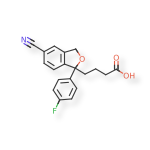
| Related Record | Type | Details | ||
|---|---|---|---|---|
|
IMPURITY -> PARENT |
|
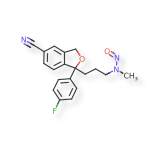
| Related Record | Type | Details | ||
|---|---|---|---|---|
|
|
ACTIVE MOIETY |
|
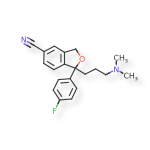
| Name | Property Type | Amount | Referenced Substance | Defining | Parameters | References |
|---|---|---|---|---|---|---|
| Biological Half-life | PHARMACOKINETIC |
|
|
|||
| Volume of Distribution | PHARMACOKINETIC |
|
|
|||