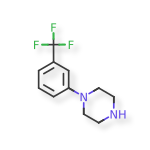
Details
| Stereochemistry | ACHIRAL |
| Molecular Formula | C11H13F3N2 |
| Molecular Weight | 230.2295 |
| Optical Activity | NONE |
| Defined Stereocenters | 0 / 0 |
| E/Z Centers | 0 |
| Charge | 0 |
SHOW SMILES / InChI
SMILES
FC(F)(F)C1=CC=CC(=C1)N2CCNCC2
InChI
InChIKey=KKIMDKMETPPURN-UHFFFAOYSA-N
InChI=1S/C11H13F3N2/c12-11(13,14)9-2-1-3-10(8-9)16-6-4-15-5-7-16/h1-3,8,15H,4-7H2
| Molecular Formula | C11H13F3N2 |
| Molecular Weight | 230.2295 |
| Charge | 0 |
| Count |
|
| Stereochemistry | ACHIRAL |
| Additional Stereochemistry | No |
| Defined Stereocenters | 0 / 0 |
| E/Z Centers | 0 |
| Optical Activity | NONE |
Trifluoromethylphenylpiperazine (TFMPP) acts on serotonin receptors 5-HT1A, 5-HT1B, 5-HT1D, 5-HT2A and 5-HT2C and functions as a full agonist at all sites except the 5-HT2A receptor, where it acts as a weak partial agonist or antagonist. In addition, TFMPP binds to the sodium-dependent serotonin transporter, SERT and evokes the release of serotonin. Besides was shown, that the N-Benzylpiperazine/TFMPP combination produced effects, which crudely mimic those of MDMA, commonly known as ecstasy. The neurophysiological effects of TFMPP in humans was also studied and was shown that TFMPP may affect transmitter systems involved in speeding of interhemispheric communication in the male brain.
Approval Year
Targets
| Primary Target | Pharmacology | Condition | Potency |
|---|---|---|---|
Target ID: P08908 Gene ID: 3350.0 Gene Symbol: HTR1A Target Organism: Homo sapiens (Human) |
288.0 nM [Ki] | ||
Target ID: P28222 Gene ID: 3351.0 Gene Symbol: HTR1B Target Organism: Homo sapiens (Human) |
132.0 nM [Ki] | ||
Target ID: P28221 Gene ID: 3352.0 Gene Symbol: HTR1D Target Organism: Homo sapiens (Human) |
282.0 nM [Ki] | ||
Target ID: P28223 Gene ID: 3356.0 Gene Symbol: HTR2A Target Organism: Homo sapiens (Human) |
269.0 nM [Ki] | ||
Target ID: P28335 Gene ID: 3358.0 Gene Symbol: HTR2C Target Organism: Homo sapiens (Human) |
62.0 nM [Ki] | ||
Target ID: P31645 Gene ID: 6532.0 Gene Symbol: SLC6A4 Target Organism: Homo sapiens (Human) |
121.0 nM [EC50] |
Conditions
| Condition | Modality | Targets | Highest Phase | Product |
|---|---|---|---|---|
Sample Use Guides
Healthy, right-handed males (age: 25 ± 5.6 years) were given placebo (n = 15) or TFMPP (0.94 mg/kg, oral, n = 15) and tested both pre- and 2 h post-drug administration
Route of Administration:
Oral
It was investigated the cytotoxic effects of mixtures of N-Benzylpiperazine (BZP) and 1-(3-trifluoromethylphenyl)piperazine (TFMPP) in vitro. Human-derived HepaRG cells and primary rat hepatocytes were exposed to the drugs, individually or combined at different mixture ratios, and cytotoxicity was assessed by the MTT assay. It was observed that primary rat hepatocytes are more sensitive than HepaRG cells to the toxicity of BZP (EC50 2.20 and 6.60 mM, respectively) and TFMPP (EC50 0.14 and 0.45 mM, respectively). For all BZP-TFMPP combinations tested, CA was the most appropriate model to predict the mixture effects. TFMPP proved to act additively with BZP to produce significant hepatotoxicity (p < 0.01).
| Substance Class |
Chemical
Created
by
admin
on
Edited
Mon Mar 31 18:58:49 GMT 2025
by
admin
on
Mon Mar 31 18:58:49 GMT 2025
|
| Record UNII |
25R3ONU51C
|
| Record Status |
Validated (UNII)
|
| Record Version |
|
-
Download
| Name | Type | Language | ||
|---|---|---|---|---|
|
Preferred Name | English | ||
|
Systematic Name | English | ||
|
Code | English | ||
|
Common Name | English | ||
|
Systematic Name | English | ||
|
Systematic Name | English | ||
|
Common Name | English | ||
|
Code | English | ||
|
Systematic Name | English | ||
|
Systematic Name | English | ||
|
Systematic Name | English |
| Classification Tree | Code System | Code | ||
|---|---|---|---|---|
|
WIKIPEDIA |
Designer-drugs-Trifluoromethylphenylpiperazine
Created by
admin on Mon Mar 31 18:58:49 GMT 2025 , Edited by admin on Mon Mar 31 18:58:49 GMT 2025
|
| Code System | Code | Type | Description | ||
|---|---|---|---|---|---|
|
83536
Created by
admin on Mon Mar 31 18:58:49 GMT 2025 , Edited by admin on Mon Mar 31 18:58:49 GMT 2025
|
PRIMARY | |||
|
DTXSID10165876
Created by
admin on Mon Mar 31 18:58:49 GMT 2025 , Edited by admin on Mon Mar 31 18:58:49 GMT 2025
|
PRIMARY | |||
|
15532-75-9
Created by
admin on Mon Mar 31 18:58:49 GMT 2025 , Edited by admin on Mon Mar 31 18:58:49 GMT 2025
|
PRIMARY | |||
|
239-574-4
Created by
admin on Mon Mar 31 18:58:49 GMT 2025 , Edited by admin on Mon Mar 31 18:58:49 GMT 2025
|
PRIMARY | |||
|
128882
Created by
admin on Mon Mar 31 18:58:49 GMT 2025 , Edited by admin on Mon Mar 31 18:58:49 GMT 2025
|
PRIMARY | |||
|
4296
Created by
admin on Mon Mar 31 18:58:49 GMT 2025 , Edited by admin on Mon Mar 31 18:58:49 GMT 2025
|
PRIMARY | |||
|
TRIFLUOROMETHYLPHENYLPIPERAZINE
Created by
admin on Mon Mar 31 18:58:49 GMT 2025 , Edited by admin on Mon Mar 31 18:58:49 GMT 2025
|
PRIMARY | |||
|
C018406
Created by
admin on Mon Mar 31 18:58:49 GMT 2025 , Edited by admin on Mon Mar 31 18:58:49 GMT 2025
|
PRIMARY | |||
|
25R3ONU51C
Created by
admin on Mon Mar 31 18:58:49 GMT 2025 , Edited by admin on Mon Mar 31 18:58:49 GMT 2025
|
PRIMARY |
| Related Record | Type | Details | ||
|---|---|---|---|---|
|
|
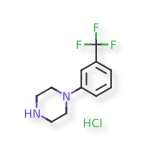
SALT/SOLVATE -> PARENT |
| Related Record | Type | Details | ||
|---|---|---|---|---|
|
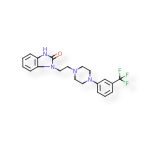
PARENT -> METABOLITE |
MAJOR
URINE
|
| Related Record | Type | Details | ||
|---|---|---|---|---|
|
|
ACTIVE MOIETY |