


Details
| Stereochemistry | ACHIRAL |
| Molecular Formula | C20H21F3N4O |
| Molecular Weight | 390.4021 |
| Optical Activity | NONE |
| Defined Stereocenters | 0 / 0 |
| E/Z Centers | 0 |
| Charge | 0 |
SHOW SMILES / InChI
SMILES
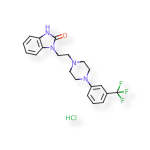
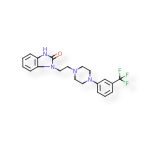
FC(F)(F)C1=CC=CC(=C1)N2CCN(CCN3C(=O)NC4=C3C=CC=C4)CC2
InChI
InChIKey=PPRRDFIXUUSXRA-UHFFFAOYSA-N
InChI=1S/C20H21F3N4O/c21-20(22,23)15-4-3-5-16(14-15)26-11-8-25(9-12-26)10-13-27-18-7-2-1-6-17(18)24-19(27)28/h1-7,14H,8-13H2,(H,24,28)
| Molecular Formula | C20H21F3N4O |
| Molecular Weight | 390.4021 |
| Charge | 0 |
| Count |
|
| Stereochemistry | ACHIRAL |
| Additional Stereochemistry | No |
| Defined Stereocenters | 0 / 0 |
| E/Z Centers | 0 |
| Optical Activity | NONE |
DescriptionCurator's Comment: Description was created based on several sources, including https://www.drugbank.ca/drugs/DB04908
Curator's Comment: Description was created based on several sources, including https://www.drugbank.ca/drugs/DB04908
Flibanserin is the first drug to be approved for hypoactive sexual desire disorder (HSDD) in premenopausal women by the FDA in August 2015. It was originally developed as an antidepressant medication by Boehringer Ingelheim, but showed lack of efficacy in trials and was further developed as a hypoactive sexual disorder drug by Sprout Pharmaceuticals. Flibanserin's mechanism of action is attributed to its high affinity for 5-HTA1 and 5-HTA2 receptors, displaying agonist activity on 5-HTA1 and antagonist on 5-HTA2, resulting in lowering of serotonin in the brain as well as an effect on increasing norepinephrine and dopamine neurotransmitters. Flibansetrin has high affinity for serotonin receptors in the brain: it acts as an agonist on 5-HT1A and an antagonist on 5-HT2A. In vivo, flibanserin binds equally to 5-HT1A and 5-HT2A receptors. However, under higher levels of brain 5-HT (i.e., under stress), flibanserin may occupy 5-HT2A receptors in higher proportion than 5-HT(1A) receptors. It may also moderately antagonize D4 (dopamine) receptors and 5-HT2B and 5-HTB2C. Its action on neurotransmitter receptors may contribute to reduction in serotonin levels and increase in dopamine and norepinephrine levels, all of which may play part in reward processing. Flibanserin is sold under the trade name Addyi and indicated for the treatment of premenopausal women with acquired, generalized hypoactive sexual desire disorder (HSDD) as characterized by low sexual desire that causes marked distress or interpersonal difficulty.
CNS Activity
Approval Year
Targets
| Primary Target | Pharmacology | Condition | Potency |
|---|---|---|---|
| 7.31 null [pKi] | |||
| 4.0 nM [EC50] | |||
| 115.0 nM [Ki] |
Conditions
| Condition | Modality | Targets | Highest Phase | Product |
|---|---|---|---|---|
| Primary | ADDYI Approved UseADDYI is indicated for the treatment of premenopausal women with acquired, generalized hypoactive sexual desire disorder (HSDD), as characterized by low sexual desire that causes marked distress or interpersonal difficulty and is NOT due to: •A co-existing medical or psychiatric condition, •Problems within the relationship, or •The effects of a medication or other drug substance. Acquired HSDD refers to HSDD that develops in a patient who previously had no problems with sexual desire. Generalized HSDD refers to HSDD that occurs regardless of the type of stimulation, situation or partner. Limitations of Use •ADDYI is not indicated for the treatment of HSDD in postmenopausal women or in men. •ADDYI is not indicated to enhance sexual performance. ADDYI is indicated for the treatment of premenopausal women with acquired, generalized hypoactive sexual desire disorder (HSDD) as characterized by low sexual desire that causes marked distress or interpersonal difficulty and is NOT due to: •A co-existing medical or psychiatric condition, •Problems within the relationship, or •The effects of a medication or other drug substance. (1) Limitations of Use: •ADDYI is not indicated for the treatment of HSDD in postmenopausal women or in men. (1) •ADDYI is not indicated to enhance sexual performance. (1) Launch Date2015 |
Cmax
| Value | Dose | Co-administered | Analyte | Population |
|---|---|---|---|---|
419 ng/mL |
100 mg single, oral dose: 100 mg route of administration: Oral experiment type: SINGLE co-administered: |
FLIBANSERIN plasma | Homo sapiens population: HEALTHY age: ADULT sex: FEMALE food status: UNKNOWN |
AUC
| Value | Dose | Co-administered | Analyte | Population |
|---|---|---|---|---|
2160 ng × h/mL |
100 mg 1 times / day multiple, oral dose: 100 mg route of administration: Oral experiment type: MULTIPLE co-administered: |
FLIBANSERIN plasma | Homo sapiens population: HEALTHY age: ADULT sex: FEMALE food status: UNKNOWN |
|
1543 ng × h/mL |
100 mg single, oral dose: 100 mg route of administration: Oral experiment type: SINGLE co-administered: |
FLIBANSERIN plasma | Homo sapiens population: HEALTHY age: ADULT sex: FEMALE food status: UNKNOWN |
T1/2
| Value | Dose | Co-administered | Analyte | Population |
|---|---|---|---|---|
11 h |
100 mg single, oral dose: 100 mg route of administration: Oral experiment type: SINGLE co-administered: |
FLIBANSERIN plasma | Homo sapiens population: HEALTHY age: ADULT sex: FEMALE food status: UNKNOWN |
Funbound
| Value | Dose | Co-administered | Analyte | Population |
|---|---|---|---|---|
2% |
100 mg single, oral dose: 100 mg route of administration: Oral experiment type: SINGLE co-administered: |
FLIBANSERIN plasma | Homo sapiens population: HEALTHY age: ADULT sex: FEMALE food status: UNKNOWN |
Doses
| Dose | Population | Adverse events |
|---|---|---|
600 mg single, oral |
unknown, 2 yeras |
Other AEs: Seizures... |
100 mg 1 times / day steady, oral Recommended Dose: 100 mg, 1 times / day Route: oral Route: steady Dose: 100 mg, 1 times / day Sources: |
unhealthy, 36 years (range: 18-56 years) Health Status: unhealthy Age Group: 36 years (range: 18-56 years) Sex: F Sources: |
Disc. AE: Dizziness, Nausea... AEs leading to discontinuation/dose reduction: Dizziness (1.7%) Sources: Nausea (1.2%) Insomnia (1.1%) Somnolence (1.1%) Anxiety (1%) |
250 mg 1 times / day steady, oral MTD Dose: 250 mg, 1 times / day Route: oral Route: steady Dose: 250 mg, 1 times / day Sources: |
unhealthy Health Status: unhealthy Sex: F Sources: |
Other AEs: Dizziness, Nausea... Other AEs: Dizziness (83%) Sources: Nausea (67%) Somnolence (83%) |
100 mg 1 times / day multiple, oral Recommended Dose: 100 mg, 1 times / day Route: oral Route: multiple Dose: 100 mg, 1 times / day Sources: |
unhealthy Health Status: unhealthy Sex: M+F Sources: |
Other AEs: Hypotension, Syncope... Other AEs: Hypotension (severe) Sources: Syncope |
20 mg single, intravenous Dose: 20 mg Route: intravenous Route: single Dose: 20 mg Sources: |
healthy |
AEs
| AE | Significance | Dose | Population |
|---|---|---|---|
| Seizures | 1 patient | 600 mg single, oral |
unknown, 2 yeras |
| Anxiety | 1% Disc. AE |
100 mg 1 times / day steady, oral Recommended Dose: 100 mg, 1 times / day Route: oral Route: steady Dose: 100 mg, 1 times / day Sources: |
unhealthy, 36 years (range: 18-56 years) Health Status: unhealthy Age Group: 36 years (range: 18-56 years) Sex: F Sources: |
| Insomnia | 1.1% Disc. AE |
100 mg 1 times / day steady, oral Recommended Dose: 100 mg, 1 times / day Route: oral Route: steady Dose: 100 mg, 1 times / day Sources: |
unhealthy, 36 years (range: 18-56 years) Health Status: unhealthy Age Group: 36 years (range: 18-56 years) Sex: F Sources: |
| Somnolence | 1.1% Disc. AE |
100 mg 1 times / day steady, oral Recommended Dose: 100 mg, 1 times / day Route: oral Route: steady Dose: 100 mg, 1 times / day Sources: |
unhealthy, 36 years (range: 18-56 years) Health Status: unhealthy Age Group: 36 years (range: 18-56 years) Sex: F Sources: |
| Nausea | 1.2% Disc. AE |
100 mg 1 times / day steady, oral Recommended Dose: 100 mg, 1 times / day Route: oral Route: steady Dose: 100 mg, 1 times / day Sources: |
unhealthy, 36 years (range: 18-56 years) Health Status: unhealthy Age Group: 36 years (range: 18-56 years) Sex: F Sources: |
| Dizziness | 1.7% Disc. AE |
100 mg 1 times / day steady, oral Recommended Dose: 100 mg, 1 times / day Route: oral Route: steady Dose: 100 mg, 1 times / day Sources: |
unhealthy, 36 years (range: 18-56 years) Health Status: unhealthy Age Group: 36 years (range: 18-56 years) Sex: F Sources: |
| Nausea | 67% | 250 mg 1 times / day steady, oral MTD Dose: 250 mg, 1 times / day Route: oral Route: steady Dose: 250 mg, 1 times / day Sources: |
unhealthy Health Status: unhealthy Sex: F Sources: |
| Dizziness | 83% | 250 mg 1 times / day steady, oral MTD Dose: 250 mg, 1 times / day Route: oral Route: steady Dose: 250 mg, 1 times / day Sources: |
unhealthy Health Status: unhealthy Sex: F Sources: |
| Somnolence | 83% | 250 mg 1 times / day steady, oral MTD Dose: 250 mg, 1 times / day Route: oral Route: steady Dose: 250 mg, 1 times / day Sources: |
unhealthy Health Status: unhealthy Sex: F Sources: |
| Syncope | 100 mg 1 times / day multiple, oral Recommended Dose: 100 mg, 1 times / day Route: oral Route: multiple Dose: 100 mg, 1 times / day Sources: |
unhealthy Health Status: unhealthy Sex: M+F Sources: |
|
| Hypotension | severe | 100 mg 1 times / day multiple, oral Recommended Dose: 100 mg, 1 times / day Route: oral Route: multiple Dose: 100 mg, 1 times / day Sources: |
unhealthy Health Status: unhealthy Sex: M+F Sources: |
Overview
| CYP3A4 | CYP2C9 | CYP2D6 | hERG |
|---|---|---|---|
OverviewOther
| Other Inhibitor | Other Substrate | Other Inducer |
|---|---|---|
Drug as perpetrator
| Target | Modality | Activity | Metabolite | Clinical evidence |
|---|---|---|---|---|
| no | ||||
| yes [Ki 6.4 uM] | ||||
| yes [Ki 7.5 uM] | ||||
| yes | yes (co-administration study) Comment: Digoxin exposure increased by 46%, 62% and 96% for Cmax, AUC0-t, and AUC0-inf, respectively, following multiple doses of flibanserin 100 mg co-administered with a single dose of digoxin 0.5 mg. A 96% increase in digoxin AUC suggests flibanserin is a P-gp inhibitor. Sources: https://www.accessdata.fda.gov/drugsatfda_docs/nda/2015/022526Orig1s000ClinPharmR.pdf#page=71 Page: 71.0 |
Drug as victim
| Target | Modality | Activity | Metabolite | Clinical evidence |
|---|---|---|---|---|
| likely | ||||
| major | yes (co-administration study) Comment: In a pharmacokinetic drug interaction study of 50 mg flibanserin and 400 mg ketoconazole, a strong CYP3A4 inhibitor, syncope occurred in 1/24 (4%) healthy subjects treated with concomitant flibanserin and ketoconazole, 1/24 (4%) receiving flibanserin alone, and no subjects receiving ketoconazole alone. In this study, the concomitant use of flibanserin and ketoconazole increased flibanserin exposure 4.5-fold Sources: https://www.accessdata.fda.gov/drugsatfda_docs/nda/2015/022526Orig1s000ClinPharmR.pdf#page=44 Page: 44.0 |
|||
| poor | ||||
| poor | ||||
| poor | ||||
| poor | no (co-administration study) Comment: A study comparing flibanserin exposure in CYP2C9 poor metabolizers to CYP2C9 extensive metabolizers was conducted in lieu of a drug interaction study with ADDYI and a strong CYP2C9 inhibitor. In 8 women who were poor metabolizers of CYP2C9, Cmax and AUC0-inf of flibanserin 100 mg once daily decreased 23% and 18%, compared to exposures among 8 extensive metabolizers of CYP2C9. Sources: https://www.accessdata.fda.gov/drugsatfda_docs/nda/2015/022526Orig1s000ClinPharmR.pdf#page=44 Page: 44.0 |
|||
| poor | no (co-administration study) Comment: Paroxetine is a strong CYP2D6 inhibitor. In a study of 19 healthy male and female subjects, flibanserin exposure decreased by approximately 4% when flibanserin 50 mg twice daily was given with paroxetine compared to flibanserin alone. Paroxetine was dosed at 20 mg once daily for 3 days followed by 40 mg once daily for 7 days. Sources: https://www.accessdata.fda.gov/drugsatfda_docs/nda/2015/022526Orig1s000ClinPharmR.pdf#page=44 Page: 44.0 |
|||
| yes | ||||
| yes | ||||
| yes | yes (pharmacogenomic study) Comment: In a pharmacogenomic study of 100 mg ADDYI in subjects who were poor or extensive CYP2C19 metabolizers, syncope occurred in 1/9 (11%) subjects who were CYP2C19 poor metabolizers (this subject had a 3.2 fold higher flibanserin exposure compared to CYP2C19 extensive metabolizers) compared to no such adverse reactions in subjects who were CYP2C19 extensive metabolizers Sources: https://www.accessdata.fda.gov/drugsatfda_docs/nda/2015/022526Orig1s000ClinPharmR.pdf#page=44 Page: 44.0 |
Tox targets
| Target | Modality | Activity | Metabolite | Clinical evidence |
|---|---|---|---|---|
PubMed
| Title | Date | PubMed |
|---|---|---|
| Flibanserin: First Global Approval. | 2015-10 |
|
| Mechanism of action of flibanserin, a multifunctional serotonin agonist and antagonist (MSAA), in hypoactive sexual desire disorder. | 2015-02 |
|
| Consultation corner. The latest on female sexual health. | 2010-11 |
|
| [The abandonment of the development of flibanserin]. | 2010-10-27 |
|
| Boehringer Ingelheim withdraws libido drug for women. | 2010-10-12 |
|
| Do drugs have a role in turning indifference into passion? | 2010-10-05 |
|
| Flibanserin: initial evidence of efficacy on sexual dysfunction, in patients with major depressive disorder. | 2010-10 |
|
| [When women complain about lacking libido. The problem with the desire]. | 2010-09-02 |
|
| Flibanserin: a potential treatment for Hypoactive Sexual Desire Disorder in premenopausal women. | 2010-09 |
|
| Predicting in vivo absorption behavior of oral modified release dosage forms containing pH-dependent poorly soluble drugs using a novel pH-adjusted biphasic in vitro dissolution test. | 2010-09 |
|
| Management of hypoactive sexual desire disorder in women: current and emerging therapies. | 2010-08-09 |
|
| Dysfunctional women remain unsexed. | 2010-08 |
|
| [Normality of the female libido? (2)]. | 2010-07-14 |
|
| Drug for low sexual desire carries significant harms, FDA advisers find. | 2010-07-07 |
|
| [Normality of the female libido (1)]. | 2010-06-30 |
|
| Flibanserin, a drug intended for treatment of hypoactive sexual desire disorder in pre-menopausal women, affects spontaneous motor activity and brain neurochemistry in female rats. | 2010-06 |
|
| FDA advisers to assess drug for low sexual desire in women. | 2010-05-25 |
|
| Involvement of serotonin receptor subtypes in the antidepressant-like effect of TRIM in the rat forced swimming test. | 2010-05 |
|
| Acute and repeated flibanserin administration in female rats modulates monoamines differentially across brain areas: a microdialysis study. | 2010-05 |
|
| A new strategy for antidepressant prescription. | 2010 |
|
| Modifying 5-HT1A Receptor Gene Expression as a New Target for Antidepressant Therapy. | 2010 |
|
| Gateways to clinical trials. | 2009-05 |
|
| Agonist and antagonist properties of antipsychotics at human dopamine D4.4 receptors: G-protein activation and K+ channel modulation in transfected cells. | 2008-05 |
|
| Redistribution of the water channel protein aquaporin-4 and the K+ channel protein Kir4.1 differs in low- and high-grade human brain tumors. | 2005-04 |
|
| Association of the C(-1019)G 5-HT1A functional promoter polymorphism with antidepressant response. | 2004-12 |
|
| Predicting the precipitation of poorly soluble weak bases upon entry in the small intestine. | 2004-01 |
|
| Flibanserin, a potential antidepressant drug, lowers 5-HT and raises dopamine and noradrenaline in the rat prefrontal cortex dialysate: role of 5-HT(1A) receptors. | 2003-08 |
|
| Region-dependent effects of flibanserin and buspirone on adenylyl cyclase activity in the human brain. | 2002-06 |
|
| Forecasting the oral absorption behavior of poorly soluble weak bases using solubility and dissolution studies in biorelevant media. | 2002-03 |
|
| Pharmacology of flibanserin. | 2002 |
|
| Mechanism of action of flibanserin in the learned helplessness paradigm in rats. | 2001-12-14 |
|
| Further characterisation of potential antidepressant action of flibanserin. | 2001-12 |
|
| Lack of interaction between flibanserin and antidepressants in inducing serotonergic syndrome in rats. | 2001-03 |
|
| Ex vivo binding of flibanserin to serotonin 5-HT1A and 5-HT2A receptors. | 2001-02 |
|
| Anti-anhedonic actions of the novel serotonergic agent flibanserin, a potential rapidly-acting antidepressant. | 1997-12-11 |
Sample Use Guides
Recommended dosage is 100 mg taken once daily at bedtime, discontinue treatment after 8 weeks if no improvement
Route of Administration:
Oral
| Substance Class |
Chemical
Created
by
admin
on
Edited
Mon Mar 31 18:04:19 GMT 2025
by
admin
on
Mon Mar 31 18:04:19 GMT 2025
|
| Record UNII |
37JK4STR6Z
|
| Record Status |
Validated (UNII)
|
| Record Version |
|
-
Download
| Name | Type | Language | ||
|---|---|---|---|---|
|
Official Name | English | ||
|
Preferred Name | English | ||
|
Systematic Name | English | ||
|
Code | English | ||
|
Systematic Name | English | ||
|
Code | English | ||
|
Code | English | ||
|
Brand Name | English | ||
|
Common Name | English | ||
|
Common Name | English | ||
|
Common Name | English | ||
|
Common Name | English | ||
|
Code | English | ||
|
Common Name | English | ||
|
Common Name | English |
| Classification Tree | Code System | Code | ||
|---|---|---|---|---|
|
WHO-ATC |
G02CX02
Created by
admin on Mon Mar 31 18:04:19 GMT 2025 , Edited by admin on Mon Mar 31 18:04:19 GMT 2025
|
||
|
NCI_THESAURUS |
C66885
Created by
admin on Mon Mar 31 18:04:19 GMT 2025 , Edited by admin on Mon Mar 31 18:04:19 GMT 2025
|
| Code System | Code | Type | Description | ||
|---|---|---|---|---|---|
|
90865
Created by
admin on Mon Mar 31 18:04:19 GMT 2025 , Edited by admin on Mon Mar 31 18:04:19 GMT 2025
|
PRIMARY | |||
|
m5402
Created by
admin on Mon Mar 31 18:04:19 GMT 2025 , Edited by admin on Mon Mar 31 18:04:19 GMT 2025
|
PRIMARY | Merck Index | ||
|
C80769
Created by
admin on Mon Mar 31 18:04:19 GMT 2025 , Edited by admin on Mon Mar 31 18:04:19 GMT 2025
|
PRIMARY | |||
|
8182
Created by
admin on Mon Mar 31 18:04:19 GMT 2025 , Edited by admin on Mon Mar 31 18:04:19 GMT 2025
|
PRIMARY | |||
|
CHEMBL231068
Created by
admin on Mon Mar 31 18:04:19 GMT 2025 , Edited by admin on Mon Mar 31 18:04:19 GMT 2025
|
PRIMARY | |||
|
1665509
Created by
admin on Mon Mar 31 18:04:19 GMT 2025 , Edited by admin on Mon Mar 31 18:04:19 GMT 2025
|
PRIMARY | RxNorm | ||
|
5022
Created by
admin on Mon Mar 31 18:04:19 GMT 2025 , Edited by admin on Mon Mar 31 18:04:19 GMT 2025
|
PRIMARY | |||
|
37JK4STR6Z
Created by
admin on Mon Mar 31 18:04:19 GMT 2025 , Edited by admin on Mon Mar 31 18:04:19 GMT 2025
|
PRIMARY | |||
|
KK-10
Created by
admin on Mon Mar 31 18:04:19 GMT 2025 , Edited by admin on Mon Mar 31 18:04:19 GMT 2025
|
PRIMARY | |||
|
167933-07-5
Created by
admin on Mon Mar 31 18:04:19 GMT 2025 , Edited by admin on Mon Mar 31 18:04:19 GMT 2025
|
PRIMARY | |||
|
37JK4STR6Z
Created by
admin on Mon Mar 31 18:04:19 GMT 2025 , Edited by admin on Mon Mar 31 18:04:19 GMT 2025
|
PRIMARY | |||
|
C098107
Created by
admin on Mon Mar 31 18:04:19 GMT 2025 , Edited by admin on Mon Mar 31 18:04:19 GMT 2025
|
PRIMARY | |||
|
DB04908
Created by
admin on Mon Mar 31 18:04:19 GMT 2025 , Edited by admin on Mon Mar 31 18:04:19 GMT 2025
|
PRIMARY | |||
|
N0000185503
Created by
admin on Mon Mar 31 18:04:19 GMT 2025 , Edited by admin on Mon Mar 31 18:04:19 GMT 2025
|
PRIMARY | P-Glycoprotein Inhibitors [MoA] | ||
|
100000081014
Created by
admin on Mon Mar 31 18:04:19 GMT 2025 , Edited by admin on Mon Mar 31 18:04:19 GMT 2025
|
PRIMARY | |||
|
6918248
Created by
admin on Mon Mar 31 18:04:19 GMT 2025 , Edited by admin on Mon Mar 31 18:04:19 GMT 2025
|
PRIMARY | |||
|
7512
Created by
admin on Mon Mar 31 18:04:19 GMT 2025 , Edited by admin on Mon Mar 31 18:04:19 GMT 2025
|
PRIMARY | |||
|
FLIBANSERIN
Created by
admin on Mon Mar 31 18:04:19 GMT 2025 , Edited by admin on Mon Mar 31 18:04:19 GMT 2025
|
PRIMARY | |||
|
DTXSID30168445
Created by
admin on Mon Mar 31 18:04:19 GMT 2025 , Edited by admin on Mon Mar 31 18:04:19 GMT 2025
|
PRIMARY | |||
|
SUB07644MIG
Created by
admin on Mon Mar 31 18:04:19 GMT 2025 , Edited by admin on Mon Mar 31 18:04:19 GMT 2025
|
PRIMARY |
| Related Record | Type | Details | ||
|---|---|---|---|---|
|
METABOLIC ENZYME -> SUBSTRATE |
MINOR
|
||
|
METABOLIC ENZYME -> SUBSTRATE | |||
|
METABOLIC ENZYME -> SUBSTRATE |
MINOR
|
||
|
METABOLIC ENZYME -> SUBSTRATE |
MINOR
|
||
|
|
SALT/SOLVATE -> PARENT |
|
||
|
METABOLIC ENZYME -> SUBSTRATE |
MINOR
|
||
|
BINDER->LIGAND |
BINDING
|
||
|
|
TARGET -> INHIBITOR |
|
||
|
TARGET -> AGONIST |
Ki
|


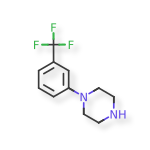
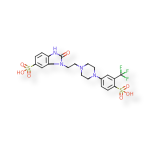
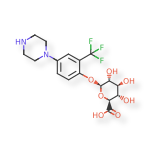
| Related Record | Type | Details | ||
|---|---|---|---|---|
|
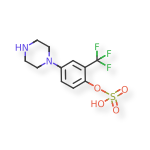
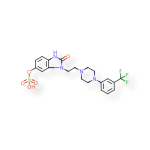
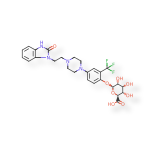
METABOLITE -> PARENT |
MAJOR
URINE
|
||
|
METABOLITE -> PARENT |
MAJOR
|
||
|
METABOLITE -> PARENT |
MAJOR
|
||
|
METABOLITE -> PARENT |
MAJOR
URINE
|
||
|
METABOLITE -> PARENT |
MAJOR
|
||
|
METABOLITE -> PARENT |
MAJOR
|
| Related Record | Type | Details | ||
|---|---|---|---|---|
|
|
ACTIVE MOIETY |
|
| Name | Property Type | Amount | Referenced Substance | Defining | Parameters | References |
|---|---|---|---|---|---|---|
| Tmax | PHARMACOKINETIC |
|
SINGLE DOSE |
|
||
| ORAL BIOAVAILABILITY | PHARMACOKINETIC |
|
SINGLE DOSE |
|
||
| Biological Half-life | PHARMACOKINETIC |
|
SINGLE DOSE |
|
||