


Details
| Stereochemistry | ABSOLUTE |
| Molecular Formula | C24H32O4S |
| Molecular Weight | 416.573 |
| Optical Activity | UNSPECIFIED |
| Defined Stereocenters | 7 / 7 |
| E/Z Centers | 0 |
| Charge | 0 |
SHOW SMILES / InChI
SMILES
CC(=O)S[C@@H]1CC2=CC(=O)CC[C@]2(C)[C@H]3CC[C@@]4(C)[C@@H](CC[C@@]45CCC(=O)O5)[C@H]13
InChI
InChIKey=LXMSZDCAJNLERA-ZHYRCANASA-N
InChI=1S/C24H32O4S/c1-14(25)29-19-13-15-12-16(26)4-8-22(15,2)17-5-9-23(3)18(21(17)19)6-10-24(23)11-7-20(27)28-24/h12,17-19,21H,4-11,13H2,1-3H3/t17-,18-,19+,21+,22-,23-,24+/m0/s1
| Molecular Formula | C24H32O4S |
| Molecular Weight | 416.573 |
| Charge | 0 |
| Count |
|
| Stereochemistry | ABSOLUTE |
| Additional Stereochemistry | No |
| Defined Stereocenters | 7 / 7 |
| E/Z Centers | 0 |
| Optical Activity | UNSPECIFIED |
DescriptionSources: http://www.drugbank.ca/drugs/DB00421Curator's Comment: Description was created based on several sources, including
http://www.accessdata.fda.gov/drugsatfda_docs/label/2014/012151s072lbl.pdf
Sources: http://www.drugbank.ca/drugs/DB00421
Curator's Comment: Description was created based on several sources, including
http://www.accessdata.fda.gov/drugsatfda_docs/label/2014/012151s072lbl.pdf
Spironolactone is a synthetic 17-lactone steroid which is a renal competitive aldosterone antagonist in a class of pharmaceuticals called potassium-sparing diuretics. On its own, spironolactone is only a weak diuretic, but it can be combined with other diuretics. Due to its anti-androgen effect, it can also be used to treat hirsutism, and is a common component in hormone therapy for male-to-female transgendered people. Spironolactone inhibits the effect of aldosterone by competing for intracellular aldosterone receptor in the distal tubule cells. This increases the secretion of water and sodium, while decreasing the excretion of potassium. Spironolactone has a fairly slow onset of action, taking several days to develop and similarly the effect diminishes slowly. Spironolactone is a specific pharmacologic antagonist of aldosterone, acting primarily through competitive binding of receptors at the aldosterone-dependent sodium-potassium exchange site in the distal convoluted renal tubule. Spironolactone causes increased amounts of sodium and water to be excreted, while potassium is retained. Spironolactone acts both as a diuretic and as an antihypertensive drug by this mechanism. It may be given alone or with other diuretic agents which act more proximally in the renal tubule. Aldosterone interacts with a cytoplasmic mineralocorticoid receptor to enhance the expression of the Na+, K+-ATPase and the Na+ channel involved in a Na+ K+ transport in the distal tubule . Spironolactone bind to this mineralcorticoid receptor, blocking the actions of aldosterone on gene expression. Aldosterone is a hormone; its primary function is to retain sodium and excrete potassium in the kidneys. Spironolactone is used primarily to treat low-renin hypertension, hypokalemia, and Conn's syndrome.
CNS Activity
Approval Year
Targets
| Primary Target | Pharmacology | Condition | Potency |
|---|---|---|---|
Target ID: CHEMBL1994 |
11.0 nM [IC50] | ||
Target ID: CHEMBL1871 Sources: http://www.drugbank.ca/drugs/DB00421 |
120.0 nM [IC50] | ||
Target ID: CHEMBL208 Sources: http://www.drugbank.ca/drugs/DB00421 |
650.0 nM [IC50] | ||
Target ID: CHEMBL2034 Sources: http://www.drugbank.ca/drugs/DB00421 |
1.4 µM [IC50] |
Conditions
| Condition | Modality | Targets | Highest Phase | Product |
|---|---|---|---|---|
| Primary | ALDACTONE Approved UseALDACTONE (spironolactone) is indicated in the management of:
Primary hyperaldosteronism for:
Establishing the diagnosis of primary hyperaldosteronism by therapeutic trial.
Short-term preoperative treatment of patients with primary hyperaldosteronism.
Long-term maintenance therapy for patients with discrete aldosterone-producing adrenal
adenomas who are judged to be poor operative risks or who decline surgery.
Long-term maintenance therapy for patients with bilateral micro or macronodular adrenal
hyperplasia (idiopathic hyperaldosteronism).
Edematous conditions for patients with:
Congestive heart failure: For the management of edema and sodium retention when the
patient is only partially responsive to, or is intolerant of, other therapeutic measures.
ALDACTONE is also indicated for patients with congestive heart failure taking digitalis
when other therapies are considered inappropriate.
Cirrhosis of the liver accompanied by edema and/or ascites: Aldosterone levels may
be exceptionally high in this condition. ALDACTONE is indicated for maintenance
therapy together with bed rest and the restriction of fluid and sodium.
Nephrotic syndrome: For nephrotic patients when treatment of the underlying disease,
restriction of fluid and sodium intake, and the use of other diuretics do not provide an
adequate response.
Essential hypertension
ALDACTONE is indicated for the treatment of hypertension, to lower blood pressure.
Lowering blood pressure reduces the risk of fatal and nonfatal cardiovascular events,
primarily strokes and myocardial infarctions. These benefits have been seen in controlled
trials of antihypertensive drugs from a wide variety of pharmacologic classes.
Control of high blood pressure should be part of comprehensive cardiovascular risk
management, including, as appropriate, lipid control, diabetes management,
antithrombotic therapy, smoking cessation, exercise, and limited sodium intake. Many
patients will require more than one drug to achieve blood pressure goals. For specific
advice on goals and management, see published guidelines, such as those of the National
High Blood Pressure Education Program’s Joint National Committee on Prevention,
Detection, Evaluation, and Treatment of High Blood Pressure (JNC).
Hypokalemia
For the treatment of patients with hypokalemia when other measures are considered
inappropriate or inadequate. ALDACTONE is also indicated for the prophylaxis of
hypokalemia in patients taking digitalis when other measures are considered inadequate
or inappropriate.
Severe heart failure (NYHA class III – IV)
To increase survival, and to reduce the need for hospitalization for heart failure when
used in addition to standard therapy. Launch Date1960 |
|||
| Primary | ALDACTONE Approved UseALDACTONE (spironolactone) is indicated in the management of:
Primary hyperaldosteronism for:
Establishing the diagnosis of primary hyperaldosteronism by therapeutic trial.
Short-term preoperative treatment of patients with primary hyperaldosteronism.
Long-term maintenance therapy for patients with discrete aldosterone-producing adrenal
adenomas who are judged to be poor operative risks or who decline surgery.
Long-term maintenance therapy for patients with bilateral micro or macronodular adrenal
hyperplasia (idiopathic hyperaldosteronism).
Edematous conditions for patients with:
Congestive heart failure: For the management of edema and sodium retention when the
patient is only partially responsive to, or is intolerant of, other therapeutic measures.
ALDACTONE is also indicated for patients with congestive heart failure taking digitalis
when other therapies are considered inappropriate.
Cirrhosis of the liver accompanied by edema and/or ascites: Aldosterone levels may
be exceptionally high in this condition. ALDACTONE is indicated for maintenance
therapy together with bed rest and the restriction of fluid and sodium.
Nephrotic syndrome: For nephrotic patients when treatment of the underlying disease,
restriction of fluid and sodium intake, and the use of other diuretics do not provide an
adequate response.
Essential hypertension
ALDACTONE is indicated for the treatment of hypertension, to lower blood pressure.
Lowering blood pressure reduces the risk of fatal and nonfatal cardiovascular events,
primarily strokes and myocardial infarctions. These benefits have been seen in controlled
trials of antihypertensive drugs from a wide variety of pharmacologic classes.
Control of high blood pressure should be part of comprehensive cardiovascular risk
management, including, as appropriate, lipid control, diabetes management,
antithrombotic therapy, smoking cessation, exercise, and limited sodium intake. Many
patients will require more than one drug to achieve blood pressure goals. For specific
advice on goals and management, see published guidelines, such as those of the National
High Blood Pressure Education Program’s Joint National Committee on Prevention,
Detection, Evaluation, and Treatment of High Blood Pressure (JNC).
Hypokalemia
For the treatment of patients with hypokalemia when other measures are considered
inappropriate or inadequate. ALDACTONE is also indicated for the prophylaxis of
hypokalemia in patients taking digitalis when other measures are considered inadequate
or inappropriate.
Severe heart failure (NYHA class III – IV)
To increase survival, and to reduce the need for hospitalization for heart failure when
used in addition to standard therapy. Launch Date1960 |
|||
| Primary | ALDACTONE Approved UseALDACTONE (spironolactone) is indicated in the management of:
Primary hyperaldosteronism for:
Establishing the diagnosis of primary hyperaldosteronism by therapeutic trial.
Short-term preoperative treatment of patients with primary hyperaldosteronism.
Long-term maintenance therapy for patients with discrete aldosterone-producing adrenal
adenomas who are judged to be poor operative risks or who decline surgery.
Long-term maintenance therapy for patients with bilateral micro or macronodular adrenal
hyperplasia (idiopathic hyperaldosteronism).
Edematous conditions for patients with:
Congestive heart failure: For the management of edema and sodium retention when the
patient is only partially responsive to, or is intolerant of, other therapeutic measures.
ALDACTONE is also indicated for patients with congestive heart failure taking digitalis
when other therapies are considered inappropriate.
Cirrhosis of the liver accompanied by edema and/or ascites: Aldosterone levels may
be exceptionally high in this condition. ALDACTONE is indicated for maintenance
therapy together with bed rest and the restriction of fluid and sodium.
Nephrotic syndrome: For nephrotic patients when treatment of the underlying disease,
restriction of fluid and sodium intake, and the use of other diuretics do not provide an
adequate response.
Essential hypertension
ALDACTONE is indicated for the treatment of hypertension, to lower blood pressure.
Lowering blood pressure reduces the risk of fatal and nonfatal cardiovascular events,
primarily strokes and myocardial infarctions. These benefits have been seen in controlled
trials of antihypertensive drugs from a wide variety of pharmacologic classes.
Control of high blood pressure should be part of comprehensive cardiovascular risk
management, including, as appropriate, lipid control, diabetes management,
antithrombotic therapy, smoking cessation, exercise, and limited sodium intake. Many
patients will require more than one drug to achieve blood pressure goals. For specific
advice on goals and management, see published guidelines, such as those of the National
High Blood Pressure Education Program’s Joint National Committee on Prevention,
Detection, Evaluation, and Treatment of High Blood Pressure (JNC).
Hypokalemia
For the treatment of patients with hypokalemia when other measures are considered
inappropriate or inadequate. ALDACTONE is also indicated for the prophylaxis of
hypokalemia in patients taking digitalis when other measures are considered inadequate
or inappropriate.
Severe heart failure (NYHA class III – IV)
To increase survival, and to reduce the need for hospitalization for heart failure when
used in addition to standard therapy. Launch Date1960 |
Cmax
| Value | Dose | Co-administered | Analyte | Population |
|---|---|---|---|---|
47.4 ng/mL EXPERIMENT https://pubmed.ncbi.nlm.nih.gov/18488807 |
100 mg single, oral dose: 100 mg route of administration: Oral experiment type: SINGLE co-administered: |
SPIRONOLACTONE plasma | Homo sapiens population: HEALTHY age: ADULT sex: MALE food status: FASTED |
AUC
| Value | Dose | Co-administered | Analyte | Population |
|---|---|---|---|---|
150.41 ng × h/mL EXPERIMENT https://pubmed.ncbi.nlm.nih.gov/18488807 |
100 mg single, oral dose: 100 mg route of administration: Oral experiment type: SINGLE co-administered: |
SPIRONOLACTONE plasma | Homo sapiens population: HEALTHY age: ADULT sex: MALE food status: FASTED |
T1/2
| Value | Dose | Co-administered | Analyte | Population |
|---|---|---|---|---|
2.37 h EXPERIMENT https://pubmed.ncbi.nlm.nih.gov/18488807 |
100 mg single, oral dose: 100 mg route of administration: Oral experiment type: SINGLE co-administered: |
SPIRONOLACTONE plasma | Homo sapiens population: HEALTHY age: ADULT sex: MALE food status: FASTED |
|
1.4 h |
unknown |
SPIRONOLACTONE plasma | Homo sapiens population: UNKNOWN age: UNKNOWN sex: UNKNOWN food status: UNKNOWN |
Funbound
| Value | Dose | Co-administered | Analyte | Population |
|---|---|---|---|---|
10% |
unknown |
SPIRONOLACTONE plasma | Homo sapiens population: UNKNOWN age: UNKNOWN sex: UNKNOWN food status: UNKNOWN |
PubMed
| Title | Date | PubMed |
|---|---|---|
| Effect of a selective aldosterone receptor antagonist in myocardial infarction. | 2001-08 |
|
| Aldosterone induces angiotensin-converting-enzyme gene expression in cultured neonatal rat cardiocytes. | 2001-07-10 |
|
| Psychological stress increases hippocampal mineralocorticoid receptor levels: involvement of corticotropin-releasing hormone. | 2001-07-01 |
|
| Genotype/phenotype observations in African Americans with Bartter syndrome. | 2001-07 |
|
| Reversal of cardiac and renal fibrosis by pirfenidone and spironolactone in streptozotocin-diabetic rats. | 2001-07 |
|
| Loop diuretic infusion increases thiazide-sensitive Na(+)/Cl(-)-cotransporter abundance: role of aldosterone. | 2001-07 |
|
| Primary aldosteronism: a practical approach to diagnosis and treatment. | 2001-06-21 |
|
| Circadian variation in the effects of aldosterone blockade on heart rate variability and QT dispersion in congestive heart failure. | 2001-06-01 |
|
| Expression of the 11beta-hydroxysteroid dehydrogenase type II enzyme in breast tumors and modulation of activity and cell growth in PMC42 cells. | 2001-06-01 |
|
| Clinical, biochemical and molecular genetic data in five children with Gitelman's syndrome. | 2001-06 |
|
| Disappearance of spironolactone-induced gynecomastia with triamteren. | 2001-06 |
|
| Determination and characterization of diuretics in human urine by liquid chromatography coupled to pneumatically assisted electrospray ionization mass spectrometry. | 2001-06 |
|
| [Evidence based medical treatment of heart failure]. | 2001-06 |
|
| Guidelines for management of patients with chronic heart failure in Australia. | 2001-05-07 |
|
| Fatal portal hypertension, liver failure, and mitochondrial dysfunction after HIV-1 nucleoside analogue-induced hepatitis and lactic acidaemia. | 2001-05-05 |
|
| Adrenocorticosteroid receptor blockade and excitotoxic challenge regulate adrenocorticosteroid receptor mRNA levels in hippocampus. | 2001-05-01 |
|
| Angiotensin receptor blockers and aldosterone antagonists in chronic heart failure. | 2001-05 |
|
| [Secondary hypertension]. | 2001-05 |
|
| Diane 35 and spironolactone combination in the treatment of hirsutism. | 2001-05 |
|
| Breed and heterotic effects on postweaning traits in Altex and New Zealand White straightbred and crossbred rabbits. | 2001-05 |
|
| Effects of canrenone on aorta and right ventricle of the rat. | 2001-05 |
|
| The spironolactone renaissance. | 2001-05 |
|
| Effects of albumin/furosemide mixtures on responses to furosemide in hypoalbuminemic patients. | 2001-05 |
|
| Antimineralocorticoid 11beta-substituted spirolactones exhibit androgen receptor agonistic activity: a structure function study. | 2001-05 |
|
| Life-threatening hyperkalemia during combined therapy with angiotensin-converting enzyme inhibitors and spironolactone: an analysis of 25 cases. | 2001-04-15 |
|
| Reducing readmissions for congestive heart failure. | 2001-04-15 |
|
| [What is the role of hormonal treatments in acne?]. | 2001-04 |
|
| Aldosteronoma in a dog with polyuria as the leading symptom. | 2001-04 |
|
| Population-based investigation of relative clearance of digoxin in Japanese neonates and infants by multiple-trough screen analysis. | 2001-04 |
|
| Glucocorticoid and mineralocorticoid receptors are involved in the facilitation of anxiety-like response induced by restraint. | 2001-04 |
|
| Factors influencing the prediction of steady state concentrations of digoxin. | 2001-04 |
|
| [Biological factors influencing response to diuretics in patients with cirrhosis and ascites]. | 2001-03 |
|
| High serum level of procollagen type III amino-terminal peptide contributes to the efficacy of spironolactone and angiotensin-converting enzyme inhibitor therapy on left ventricular hypertrophy in essential hypertensive patients. | 2001-03 |
|
| Heart biometry and allometry in rats submitted to nitric oxide synthesis blockade and treatment with antihypertensive drugs. | 2001-03 |
|
| Long-term efficacy of torsemide compared with frusemide in cirrhotic patients with ascites. | 2001-03 |
|
| [Effect of aldosterone on the secretion of endothelin by ventricular fibroblasts]. | 2001-02 |
|
| A very short synthesis of steroids from 1,3-butadiene and benzocyclobutenes. | 2001-01-12 |
|
| [Cosmetics--European Parliament demands marketing prohibition]. | 2001 |
|
| [Animal experimentation and animal rights. Evangelical Academy Bad Boll, March 23-25, 2001]. | 2001 |
|
| [Symposium "The dignity of animals--significance in the enrichment of human life". Basle, March 15-16, 2001]. | 2001 |
|
| [White Paper of the Commission of European Community--strategy for a future chemicals policy]. | 2001 |
|
| [Permanent embryonic mouse germ cell-lines, an in vitro alternative to in vivo germ cell mutagenicity tests]. | 2001 |
|
| Prediction of embryotoxic effects of valproic acid-derivatives with molecular in vitro methods. | 2001 |
|
| [In vitro methods for phototoxicity and photocarcinogenicity testing of drugs]. | 2001 |
|
| [Report on the ICCVAM workshop on in vitro methods for assessing acute systemic toxicity]. | 2001 |
|
| Internet laboratory for predicting harmful effects triggered by drugs and chemicals. Concept and call for co-operation. | 2001 |
|
| [Replacement of the pyrogen-test as batch control test for the biological substances aprotinin and urokinase]. | 2001 |
|
| Reconstructed skin equivalents for assessing percutaneous drug absorption from pharmaceutical formulations. | 2001 |
|
| The suitability of hepatocyte culture models to study various aspects of drug metabolism. | 2001 |
|
| A risk-benefit assessment of pharmacological therapies for hirsutism. | 2001 |
Sample Use Guides
Usual Adult Dose for Edema
25 to 200 mg/day orally in 1 or 2 divided doses.
Usual Adult Dose for Hypertension
25 to 200 mg/day orally in 1 or 2 divided doses.
Usual Adult Dose for Hypokalemia
25 to 200 mg/day orally in 1 or 2 divided doses.
Usual Adult Dose for Primary Hyperaldosteronism Diagnosis
100 to 400 mg/day orally in 1 or 2 divided doses.
Usual Adult Dose for Hirsutism
50 to 200 mg/day orally in 1 or 2 divided doses.
Usual Adult Dose for Congestive Heart Failure
25 mg/day orally. Increase or decrease based on response and evidence of hyperkalemia.
Usual Adult Dose for Primary Hyperaldosteronism
Initial dose: 100 mg orally once a day. This dosage may be divided into two daily doses, and increased as tolerated every two to three days to a maximum recommended total daily dose of 400 mg.
Route of Administration:
Oral
| Substance Class |
Chemical
Created
by
admin
on
Edited
Wed Apr 02 08:33:25 GMT 2025
by
admin
on
Wed Apr 02 08:33:25 GMT 2025
|
| Record UNII |
27O7W4T232
|
| Record Status |
Validated (UNII)
|
| Record Version |
|
-
Download
| Name | Type | Language | ||
|---|---|---|---|---|
|
Official Name | English | ||
|
Preferred Name | English | ||
|
Common Name | English | ||
|
Common Name | English | ||
|
Common Name | English | ||
|
Brand Name | English | ||
|
Common Name | English | ||
|
Brand Name | English | ||
|
Common Name | English | ||
|
Common Name | English | ||
|
Common Name | English | ||
|
Common Name | English | ||
|
Common Name | English | ||
|
Common Name | English | ||
|
Code | English | ||
|
Brand Name | English | ||
|
Common Name | English | ||
|
Common Name | English | ||
|
Common Name | English | ||
|
Common Name | English | ||
|
Common Name | English | ||
|
Common Name | English | ||
|
Common Name | English | ||
|
Common Name | English | ||
|
Code | English | ||
|
Common Name | English |
| Classification Tree | Code System | Code | ||
|---|---|---|---|---|
|
WHO-ESSENTIAL MEDICINES LIST |
16
Created by
admin on Wed Apr 02 08:33:25 GMT 2025 , Edited by admin on Wed Apr 02 08:33:25 GMT 2025
|
||
|
EMA VETERINARY ASSESSMENT REPORTS |
SPIRONOLACTONE CEVA [AUTHORIZED]
Created by
admin on Wed Apr 02 08:33:25 GMT 2025 , Edited by admin on Wed Apr 02 08:33:25 GMT 2025
|
||
|
NDF-RT |
N0000011310
Created by
admin on Wed Apr 02 08:33:25 GMT 2025 , Edited by admin on Wed Apr 02 08:33:25 GMT 2025
|
||
|
FDA ORPHAN DRUG |
430614
Created by
admin on Wed Apr 02 08:33:25 GMT 2025 , Edited by admin on Wed Apr 02 08:33:25 GMT 2025
|
||
|
IARC | Spironolactone | ||
|
LIVERTOX |
NBK547921
Created by
admin on Wed Apr 02 08:33:25 GMT 2025 , Edited by admin on Wed Apr 02 08:33:25 GMT 2025
|
||
|
NCI_THESAURUS |
C49186
Created by
admin on Wed Apr 02 08:33:25 GMT 2025 , Edited by admin on Wed Apr 02 08:33:25 GMT 2025
|
||
|
WHO-ATC |
C03DA01
Created by
admin on Wed Apr 02 08:33:25 GMT 2025 , Edited by admin on Wed Apr 02 08:33:25 GMT 2025
|
||
|
NDF-RT |
N0000175557
Created by
admin on Wed Apr 02 08:33:25 GMT 2025 , Edited by admin on Wed Apr 02 08:33:25 GMT 2025
|
||
|
EMA VETERINARY ASSESSMENT REPORTS |
CARDALIS (AUTHORISED)
Created by
admin on Wed Apr 02 08:33:25 GMT 2025 , Edited by admin on Wed Apr 02 08:33:25 GMT 2025
|
||
|
WHO-VATC |
QC03DA01
Created by
admin on Wed Apr 02 08:33:25 GMT 2025 , Edited by admin on Wed Apr 02 08:33:25 GMT 2025
|
| Code System | Code | Type | Description | ||
|---|---|---|---|---|---|
|
2475
Created by
admin on Wed Apr 02 08:33:25 GMT 2025 , Edited by admin on Wed Apr 02 08:33:25 GMT 2025
|
PRIMARY | |||
|
27O7W4T232
Created by
admin on Wed Apr 02 08:33:25 GMT 2025 , Edited by admin on Wed Apr 02 08:33:25 GMT 2025
|
PRIMARY | |||
|
DTXSID6034186
Created by
admin on Wed Apr 02 08:33:25 GMT 2025 , Edited by admin on Wed Apr 02 08:33:25 GMT 2025
|
PRIMARY | |||
|
1619006
Created by
admin on Wed Apr 02 08:33:25 GMT 2025 , Edited by admin on Wed Apr 02 08:33:25 GMT 2025
|
PRIMARY | |||
|
52-01-7
Created by
admin on Wed Apr 02 08:33:25 GMT 2025 , Edited by admin on Wed Apr 02 08:33:25 GMT 2025
|
PRIMARY | |||
|
DB00421
Created by
admin on Wed Apr 02 08:33:25 GMT 2025 , Edited by admin on Wed Apr 02 08:33:25 GMT 2025
|
PRIMARY | |||
|
SPIRONOLACTONE
Created by
admin on Wed Apr 02 08:33:25 GMT 2025 , Edited by admin on Wed Apr 02 08:33:25 GMT 2025
|
PRIMARY | |||
|
Spironolactone
Created by
admin on Wed Apr 02 08:33:25 GMT 2025 , Edited by admin on Wed Apr 02 08:33:25 GMT 2025
|
PRIMARY | |||
|
100000092408
Created by
admin on Wed Apr 02 08:33:25 GMT 2025 , Edited by admin on Wed Apr 02 08:33:25 GMT 2025
|
PRIMARY | |||
|
C840
Created by
admin on Wed Apr 02 08:33:25 GMT 2025 , Edited by admin on Wed Apr 02 08:33:25 GMT 2025
|
PRIMARY | |||
|
5833
Created by
admin on Wed Apr 02 08:33:25 GMT 2025 , Edited by admin on Wed Apr 02 08:33:25 GMT 2025
|
PRIMARY | |||
|
3184
Created by
admin on Wed Apr 02 08:33:25 GMT 2025 , Edited by admin on Wed Apr 02 08:33:25 GMT 2025
|
PRIMARY | |||
|
SUB127260
Created by
admin on Wed Apr 02 08:33:25 GMT 2025 , Edited by admin on Wed Apr 02 08:33:25 GMT 2025
|
ALTERNATIVE | |||
|
987
Created by
admin on Wed Apr 02 08:33:25 GMT 2025 , Edited by admin on Wed Apr 02 08:33:25 GMT 2025
|
PRIMARY | |||
|
D013148
Created by
admin on Wed Apr 02 08:33:25 GMT 2025 , Edited by admin on Wed Apr 02 08:33:25 GMT 2025
|
PRIMARY | |||
|
9241
Created by
admin on Wed Apr 02 08:33:25 GMT 2025 , Edited by admin on Wed Apr 02 08:33:25 GMT 2025
|
PRIMARY | |||
|
SPIRONOLACTONE
Created by
admin on Wed Apr 02 08:33:25 GMT 2025 , Edited by admin on Wed Apr 02 08:33:25 GMT 2025
|
PRIMARY | Description: A light yellowish white to light yellowish brown powder; odourless or with a faint characteristic odour. Solubility: Practically insoluble in water; soluble in ethanol (~750 g/l) TS. Category: Diuretic. Storage: Spironolactone should be kept in a well-closed container, protected from light. Additional information: Spironolactone may show preliminary melting at about 135?C, followed by resolidification. Definition: Spironolactone contains not less than 97.0% and not more than 101.5% of C24H32O4S, calculated with reference to the dried substance. | ||
|
SUB10631MIG
Created by
admin on Wed Apr 02 08:33:25 GMT 2025 , Edited by admin on Wed Apr 02 08:33:25 GMT 2025
|
PRIMARY | |||
|
CHEMBL1393
Created by
admin on Wed Apr 02 08:33:25 GMT 2025 , Edited by admin on Wed Apr 02 08:33:25 GMT 2025
|
PRIMARY | |||
|
2875
Created by
admin on Wed Apr 02 08:33:25 GMT 2025 , Edited by admin on Wed Apr 02 08:33:25 GMT 2025
|
PRIMARY | |||
|
150399
Created by
admin on Wed Apr 02 08:33:25 GMT 2025 , Edited by admin on Wed Apr 02 08:33:25 GMT 2025
|
PRIMARY | |||
|
200-133-6
Created by
admin on Wed Apr 02 08:33:25 GMT 2025 , Edited by admin on Wed Apr 02 08:33:25 GMT 2025
|
PRIMARY | |||
|
27O7W4T232
Created by
admin on Wed Apr 02 08:33:25 GMT 2025 , Edited by admin on Wed Apr 02 08:33:25 GMT 2025
|
PRIMARY | |||
|
m10157
Created by
admin on Wed Apr 02 08:33:25 GMT 2025 , Edited by admin on Wed Apr 02 08:33:25 GMT 2025
|
PRIMARY | Merck Index | ||
|
9997
Created by
admin on Wed Apr 02 08:33:25 GMT 2025 , Edited by admin on Wed Apr 02 08:33:25 GMT 2025
|
PRIMARY | RxNorm |
| Related Record | Type | Details | ||
|---|---|---|---|---|
|
LABELED -> NON-LABELED |
|
||
|
BINDER->LIGAND |
|
||
|
TARGET->PARTIAL ANTAGONIST |
BINDING
|
||
|
TARGET -> INHIBITOR |
Is a prodrug that Inhibits through active metabolites.
|



| Related Record | Type | Details | ||
|---|---|---|---|---|
|
METABOLITE ACTIVE -> PRODRUG | |||
|
METABOLITE ACTIVE -> PRODRUG |
MAJOR
PLASMA
|
||
|
METABOLITE -> PARENT | |||
|
METABOLITE ACTIVE -> PRODRUG |
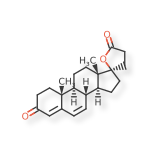
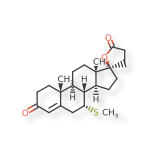
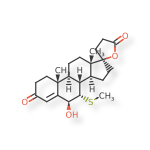
The pharmacological activity of spironolactone metabolites in man is not known. However, in the adrenalectomized rat the antimineralocorticoid activities of the metabolites C, TMS, and HTMS, relative to spironolactone, were 1.10, 1.28, and 0.32, respectively.
|
||
|
METABOLITE ACTIVE -> PRODRUG |
Has in vitro activity
|
||
|
METABOLITE ACTIVE -> PARENT | |||
|
METABOLITE -> PARENT |

| Related Record | Type | Details | ||
|---|---|---|---|---|
|
IMPURITY -> PARENT |
CHROMATOGRAPHIC PURITY (HPLC/UV)
EP
|
||
|
IMPURITY -> PARENT |
CHROMATOGRAPHIC PURITY (HPLC/UV)
EP
|
||
|
IMPURITY -> PARENT |
CHROMATOGRAPHIC PURITY (HPLC/UV)
EP
|
||
|
IMPURITY -> PARENT |
CHROMATOGRAPHIC PURITY (HPLC/UV)
EP
|
||
|
IMPURITY -> PARENT |
CHROMATOGRAPHIC PURITY (HPLC/UV)
EP
|
||
|
IMPURITY -> PARENT |
CHROMATOGRAPHIC PURITY (HPLC/UV)
EP
|
||
|
IMPURITY -> PARENT |
CHROMATOGRAPHIC PURITY (HPLC/UV)
EP
|
||
|
IMPURITY -> PARENT |
correction factor: for the calculation of content, multiply the peak area of impurity F by 2.3
CHROMATOGRAPHIC PURITY (HPLC/UV)
EP
|


| Related Record | Type | Details | ||
|---|---|---|---|---|
|
|
ACTIVE MOIETY |
|
| Name | Property Type | Amount | Referenced Substance | Defining | Parameters | References |
|---|---|---|---|---|---|---|
| Biological Half-life | PHARMACOKINETIC |
|
|
|||