


Details
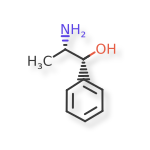
| Stereochemistry | RACEMIC |
| Molecular Formula | C9H13NO |
| Molecular Weight | 151.2056 |
| Optical Activity | ( + / - ) |
| Defined Stereocenters | 2 / 2 |
| E/Z Centers | 0 |
| Charge | 0 |
SHOW SMILES / InChI
SMILES
C[C@H](N)[C@H](O)C1=CC=CC=C1
InChI
InChIKey=DLNKOYKMWOXYQA-CBAPKCEASA-N
InChI=1S/C9H13NO/c1-7(10)9(11)8-5-3-2-4-6-8/h2-7,9,11H,10H2,1H3/t7-,9-/m0/s1
| Molecular Formula | C9H13NO |
| Molecular Weight | 151.2056 |
| Charge | 0 |
| Count |
|
| Stereochemistry | ABSOLUTE |
| Additional Stereochemistry | No |
| Defined Stereocenters | 2 / 2 |
| E/Z Centers | 0 |
| Optical Activity | UNSPECIFIED |
DescriptionSources: https://www.ncbi.nlm.nih.gov/pubmed/8381276 | https://www.google.com/patents/US5260073http://www.sciencedirect.com/science/article/pii/S0099542808601719?via%3DihubCurator's Comment: Description was created based on several sources, including
http://www.druginfosys.com/drug.aspx?drugcode=569&type=1 | https://www.drugs.com/dosage/phenylpropanolamine.html | https://www.petcarerx.com/medication-guides/about-the-proin-dosage-for-urinary-incontinence/1086?page=all | https://www.federalregister.gov/documents/2014/02/20/2014-03596/phenylpropanolamine-withdrawal-of-approval-of-13-new-drug-applications-and-7-abbreviated-new-drug
Sources: https://www.ncbi.nlm.nih.gov/pubmed/8381276 | https://www.google.com/patents/US5260073http://www.sciencedirect.com/science/article/pii/S0099542808601719?via%3Dihub
Curator's Comment: Description was created based on several sources, including
http://www.druginfosys.com/drug.aspx?drugcode=569&type=1 | https://www.drugs.com/dosage/phenylpropanolamine.html | https://www.petcarerx.com/medication-guides/about-the-proin-dosage-for-urinary-incontinence/1086?page=all | https://www.federalregister.gov/documents/2014/02/20/2014-03596/phenylpropanolamine-withdrawal-of-approval-of-13-new-drug-applications-and-7-abbreviated-new-drug
Phenylpropanolamine belongs to the sympathomimetic amine class of drugs and is structurally related to ephedrine. The effects of phenylpropanolamine are largely the result of alpha-adrenergic agonist activity resulting from both direct stimulation of adrenergic receptors and release of neuronal norepinephrine. Phenylpropanolamine is mainly used as a nasal decongestant. Phenylpropanolamine is also used as anorexiant in obesity and to treat urinary incontinence in veteranary. Phenylpropanolamine containing products has been withdrawn by FDA due to the association of phenylpropanolamine use with increased risk of hemorrhagic stroke.
CNS Activity
Approval Year
Targets
| Primary Target | Pharmacology | Condition | Potency |
|---|---|---|---|
Target ID: CHEMBL2094251 |
|||
Target ID: CHEMBL2095203 |
|||
Target ID: CHEMBL319 |
9.8 µM [Ki] | ||
Target ID: CHEMBL315 |
280.0 µM [EC50] | ||
Target ID: CHEMBL326 |
8.4 µM [Ki] |
Conditions
| Condition | Modality | Targets | Highest Phase | Product |
|---|---|---|---|---|
| Primary | Unknown Approved UseUnknown |
|||
| Primary | Unknown Approved UseUnknown |
|||
| Primary | PHENYLPROPANOLAMINE Approved UsePhenylpropanolamine (HCl) is mainly used as a nasal decongestant. Phenylpropanolamine (HCl) is also used as anorexiant in obesity |
|||
| Primary | PHENYLPROPANOLAMINE Approved UsePhenylpropanolamine (HCl) is mainly used as a nasal decongestant. Phenylpropanolamine (HCl) is also used as anorexiant in obesity |
|||
| Primary | CODAMINE Approved UseUnknown Launch Date2000 |
Cmax
| Value | Dose | Co-administered | Analyte | Population |
|---|---|---|---|---|
107 ng/mL EXPERIMENT https://pubmed.ncbi.nlm.nih.gov/11361053/ |
25 mg single, oral dose: 25 mg route of administration: Oral experiment type: SINGLE co-administered: |
PHENYLPROPANOLAMINE plasma | Homo sapiens population: HEALTHY age: ADULT sex: FEMALE / MALE food status: UNKNOWN |
AUC
| Value | Dose | Co-administered | Analyte | Population |
|---|---|---|---|---|
1104 ng × h/mL EXPERIMENT https://pubmed.ncbi.nlm.nih.gov/11361053/ |
25 mg single, oral dose: 25 mg route of administration: Oral experiment type: SINGLE co-administered: |
PHENYLPROPANOLAMINE plasma | Homo sapiens population: HEALTHY age: ADULT sex: FEMALE / MALE food status: UNKNOWN |
T1/2
| Value | Dose | Co-administered | Analyte | Population |
|---|---|---|---|---|
4 h EXPERIMENT https://pubmed.ncbi.nlm.nih.gov/11361053/ |
25 mg single, oral dose: 25 mg route of administration: Oral experiment type: SINGLE co-administered: |
PHENYLPROPANOLAMINE plasma | Homo sapiens population: HEALTHY age: ADULT sex: FEMALE / MALE food status: UNKNOWN |
Doses
| Dose | Population | Adverse events |
|---|---|---|
225 mg single, oral Overdose |
healthy, 14 |
Disc. AE: Cardiomyopathy... AEs leading to discontinuation/dose reduction: Cardiomyopathy Sources: |
25 mg 2 times / day multiple, oral Recommended Dose: 25 mg, 2 times / day Route: oral Route: multiple Dose: 25 mg, 2 times / day Sources: |
healthy, 25 |
Disc. AE: Myocardial infarction... AEs leading to discontinuation/dose reduction: Myocardial infarction Sources: |
2000 mg single, oral Overdose |
unhealthy, 31 |
Disc. AE: Vomiting, Hypertension... AEs leading to discontinuation/dose reduction: Vomiting Sources: Hypertension |
150 mg single, oral Recommended |
healthy, 56 |
Disc. AE: Headache, Vomiting... AEs leading to discontinuation/dose reduction: Headache (severe) Sources: Vomiting Intracranial hemorrhage |
AEs
| AE | Significance | Dose | Population |
|---|---|---|---|
| Cardiomyopathy | Disc. AE | 225 mg single, oral Overdose |
healthy, 14 |
| Myocardial infarction | Disc. AE | 25 mg 2 times / day multiple, oral Recommended Dose: 25 mg, 2 times / day Route: oral Route: multiple Dose: 25 mg, 2 times / day Sources: |
healthy, 25 |
| Hypertension | Disc. AE | 2000 mg single, oral Overdose |
unhealthy, 31 |
| Vomiting | Disc. AE | 2000 mg single, oral Overdose |
unhealthy, 31 |
| Intracranial hemorrhage | Disc. AE | 150 mg single, oral Recommended |
healthy, 56 |
| Vomiting | Disc. AE | 150 mg single, oral Recommended |
healthy, 56 |
| Headache | severe Disc. AE |
150 mg single, oral Recommended |
healthy, 56 |
PubMed
| Title | Date | PubMed |
|---|---|---|
| Targeting oxidative stress in the hypothalamus: the effect of transcription factor STAT3 knockdown on endogenous antioxidants-mediated appetite control. | 2015-01 |
|
| Khat use and neurobehavioral functions: suggestions for future studies. | 2010-12-01 |
|
| Development of a list of potentially inappropriate drugs for the korean elderly using the delphi method. | 2010-12 |
|
| Cystoscopic diagnosis and treatment of ectopic ureters in female dogs: 16 cases (2005-2008). | 2010-07-15 |
|
| Syndrome of inappropriate antidiuretic hormone associated with tolterodine therapy. | 2010-05 |
|
| Ephedra alkaloids inhibit platelet aggregation. | 2010-04 |
|
| Proof of principle: The effect of antimuscarinics on bladder filling sensations in healthy subjects--a placebo controlled double blind investigation using 4 and 8 mg tolterodine extended release. | 2010-03 |
|
| Transdermal delivery of tolterodine by O-acylmenthol: In vitro/in vivo correlation. | 2009-06-05 |
|
| Comparison of fesoterodine and tolterodine in patients with overactive bladder. | 2008-11 |
|
| Extended-release tolterodine with or without tamsulosin in men with lower urinary tract symptoms and overactive bladder: effects on urinary symptoms assessed by the International Prostate Symptom Score. | 2008-11 |
|
| How many drugs for LUTS due to BPH are too many? | 2008-09 |
|
| Transcriptional interruption of cAMP response element binding protein modulates superoxide dismutase and neuropeptide Y-mediated feeding behavior in freely moving rats. | 2008-05 |
|
| Protracted 'pro-addictive' phenotype produced in mice by pre-adolescent phenylpropanolamine. | 2007-08 |
|
| Comparative evaluation of efficacy of use of tamsulosin and/or tolterodine for medical treatment of distal ureteral stones. | 2007-04 |
|
| Treatment of men with lower urinary tract symptoms and overactive bladder. | 2007-03-21 |
|
| Effects of bladder training and/or tolterodine in female patients with overactive bladder syndrome: a prospective, randomized study. | 2006-12 |
|
| Mass spectrometric data characteristics of commonly abused amphetamines with sequential derivatization at two active sites. | 2006-09-12 |
|
| [Comment on the STAR study: Comparison of the efficacy and tolerance of solifenacin and tolterodine retard in the treatment of overactive bladder]. | 2006-07 |
|
| Tolterodine. | 2006-06-21 |
|
| Nighttime dosing with tolterodine reduces overactive bladder-related nocturnal micturitions in patients with overactive bladder and nocturia. | 2006-04 |
|
| Using anticholinergics to treat overactive bladder: the issue of treatment tolerability. | 2006-03 |
|
| Juvenile pig detrusor: effects of propiverine and three of its metabolites. | 2005-11-07 |
|
| Enantiomeric determination of ephedrines and norephedrines by chiral derivatization gas chromatography-mass spectrometry approaches. | 2005-10-15 |
|
| Economic impact of extended-release tolterodine versus immediate- and extended-release oxybutynin among commercially insured persons with overactive bladder. | 2005-07 |
|
| Prediction of genotoxicity of chemical compounds by statistical learning methods. | 2005-06 |
|
| Validation of the urgency perception scale. | 2005-03 |
|
| [Therapy of bladder weakness]. | 2005-01-21 |
|
| Pharmacological management of overactive bladder : a systematic and critical review of published economic evaluations. | 2005 |
|
| Impact of a health education intervention in overactive bladder patients. | 2004-12 |
|
| A validated chiral HPLC method for the enantiomeric separation of tolterodine tartarate. | 2004-09-03 |
|
| Fatal pulmonary arterial hypertension associated with phenylpropanolamine exposure. | 2004-07 |
|
| Intramolecular chiral relay at stereogenic nitrogen. Synthesis and application of a new chiral auxiliary derived from (1R,2S)-norephedrine and acetone. | 2004-02-06 |
|
| Both alpha1-adrenergic and D(1)-dopaminergic neurotransmissions are involved in phenylpropanolamine-mediated feeding suppression in mice. | 2003-08-21 |
|
| Use of Ephedra-containing products and risk for hemorrhagic stroke. | 2003-01-14 |
|
| Simplified bladder training augments the effectiveness of tolterodine in patients with an overactive bladder. | 2003-01 |
|
| Adrenergic drugs for urinary incontinence in adults. | 2003 |
|
| Different responses to drugs against overactive bladder in detrusor muscle of pig, guinea pig and mouse. | 2002-11-01 |
|
| Excretion and detection of cathinone, cathine, and phenylpropanolamine in urine after kath chewing. | 2002-10 |
|
| A randomized controlled trial of tolterodine and oxybutynin on tolerability and clinical efficacy for treating Chinese women with an overactive bladder. | 2002-09 |
|
| Implementation of the Comprehensive Methamphetamine Control Act of 1996; regulation of pseudoephedrine, phenylpropanolamine, and combination ephedrine drug products and reports of certain transactions to nonregulated persons. Final rule. | 2002-03-28 |
|
| Don't be so quick to ban medications. | 2002-01-08 |
|
| Pharmacological properties of A-204176, a novel and selective alpha1A adrenergic agonist, in in vitro and in vivo models of urethral function. | 2001-11-30 |
|
| Tolterodine: an overview. | 2001-11 |
|
| Clarification--Drug risk in patients with glaucoma. | 2001-06-11 |
|
| Tolterodine once-daily: superior efficacy and tolerability in the treatment of the overactive bladder. | 2001-03 |
|
| Dystonic reaction following recommended use of a cold syrup. | 1995-12 |
|
| Phenylpropanolamine-induced psychosis. Potential predisposing factors. | 1994-09 |
|
| Alpha and beta adrenergic receptor involvement in catecholamine-induced growth of gram-negative bacteria. | 1993-01-29 |
|
| Nifedipine therapy of phenylpropanolamine-induced hypertension. | 1987-02 |
|
| Intracranial hemorrhages due to phenylpropanolamine. | 1985-05-01 |
| Substance Class |
Chemical
Created
by
admin
on
Edited
Mon Mar 31 18:17:52 GMT 2025
by
admin
on
Mon Mar 31 18:17:52 GMT 2025
|
| Record UNII |
33RU150WUN
|
| Record Status |
Validated (UNII)
|
| Record Version |
|
-
Download
| Related Record | Type |
|---|
| Name | Type | Language | ||
|---|---|---|---|---|
|
Preferred Name | English | ||
|
Official Name | English | ||
|
Common Name | English | ||
|
Brand Name | English | ||
|
Code | English | ||
|
Common Name | English | ||
|
Common Name | English | ||
|
Common Name | English | ||
|
Common Name | English | ||
|
Common Name | English | ||
|
Common Name | English | ||
|
Common Name | English | ||
|
Common Name | English | ||
|
Common Name | English | ||
|
Common Name | English | ||
|
Common Name | English |
| Classification Tree | Code System | Code | ||
|---|---|---|---|---|
|
WHO-ATC |
R01BA01
Created by
admin on Mon Mar 31 18:17:52 GMT 2025 , Edited by admin on Mon Mar 31 18:17:52 GMT 2025
|
||
|
WHO-VATC |
QR01BA51
Created by
admin on Mon Mar 31 18:17:52 GMT 2025 , Edited by admin on Mon Mar 31 18:17:52 GMT 2025
|
||
|
WHO-VATC |
QR01BA01
Created by
admin on Mon Mar 31 18:17:52 GMT 2025 , Edited by admin on Mon Mar 31 18:17:52 GMT 2025
|
||
|
DEA NO. |
1225
Created by
admin on Mon Mar 31 18:17:52 GMT 2025 , Edited by admin on Mon Mar 31 18:17:52 GMT 2025
|
||
|
WHO-VATC |
QG04BX91
Created by
admin on Mon Mar 31 18:17:52 GMT 2025 , Edited by admin on Mon Mar 31 18:17:52 GMT 2025
|
||
|
WHO-ATC |
R01BA51
Created by
admin on Mon Mar 31 18:17:52 GMT 2025 , Edited by admin on Mon Mar 31 18:17:52 GMT 2025
|
||
|
NCI_THESAURUS |
C87053
Created by
admin on Mon Mar 31 18:17:52 GMT 2025 , Edited by admin on Mon Mar 31 18:17:52 GMT 2025
|
||
|
CFR |
21 CFR 1315.13
Created by
admin on Mon Mar 31 18:17:52 GMT 2025 , Edited by admin on Mon Mar 31 18:17:52 GMT 2025
|
||
|
CFR |
21 CFR 1314.20
Created by
admin on Mon Mar 31 18:17:52 GMT 2025 , Edited by admin on Mon Mar 31 18:17:52 GMT 2025
|
||
|
CFR |
21 CFR 216.24
Created by
admin on Mon Mar 31 18:17:52 GMT 2025 , Edited by admin on Mon Mar 31 18:17:52 GMT 2025
|
||
|
CFR |
21 CFR 520.1760
Created by
admin on Mon Mar 31 18:17:52 GMT 2025 , Edited by admin on Mon Mar 31 18:17:52 GMT 2025
|
| Code System | Code | Type | Description | ||
|---|---|---|---|---|---|
|
CHEMBL61006
Created by
admin on Mon Mar 31 18:17:52 GMT 2025 , Edited by admin on Mon Mar 31 18:17:52 GMT 2025
|
PRIMARY | |||
|
33RU150WUN
Created by
admin on Mon Mar 31 18:17:52 GMT 2025 , Edited by admin on Mon Mar 31 18:17:52 GMT 2025
|
PRIMARY | |||
|
m8687
Created by
admin on Mon Mar 31 18:17:52 GMT 2025 , Edited by admin on Mon Mar 31 18:17:52 GMT 2025
|
PRIMARY | Merck Index | ||
|
PHENYLPROPANOLAMINE
Created by
admin on Mon Mar 31 18:17:52 GMT 2025 , Edited by admin on Mon Mar 31 18:17:52 GMT 2025
|
PRIMARY | |||
|
C29364
Created by
admin on Mon Mar 31 18:17:52 GMT 2025 , Edited by admin on Mon Mar 31 18:17:52 GMT 2025
|
PRIMARY | |||
|
2149
Created by
admin on Mon Mar 31 18:17:52 GMT 2025 , Edited by admin on Mon Mar 31 18:17:52 GMT 2025
|
PRIMARY | |||
|
4955
Created by
admin on Mon Mar 31 18:17:52 GMT 2025 , Edited by admin on Mon Mar 31 18:17:52 GMT 2025
|
PRIMARY | |||
|
14838-15-4
Created by
admin on Mon Mar 31 18:17:52 GMT 2025 , Edited by admin on Mon Mar 31 18:17:52 GMT 2025
|
PRIMARY | |||
|
33RU150WUN
Created by
admin on Mon Mar 31 18:17:52 GMT 2025 , Edited by admin on Mon Mar 31 18:17:52 GMT 2025
|
PRIMARY | |||
|
8175
Created by
admin on Mon Mar 31 18:17:52 GMT 2025 , Edited by admin on Mon Mar 31 18:17:52 GMT 2025
|
PRIMARY | RxNorm | ||
|
SUB09790MIG
Created by
admin on Mon Mar 31 18:17:52 GMT 2025 , Edited by admin on Mon Mar 31 18:17:52 GMT 2025
|
PRIMARY | |||
|
9920
Created by
admin on Mon Mar 31 18:17:52 GMT 2025 , Edited by admin on Mon Mar 31 18:17:52 GMT 2025
|
PRIMARY | |||
|
100000082264
Created by
admin on Mon Mar 31 18:17:52 GMT 2025 , Edited by admin on Mon Mar 31 18:17:52 GMT 2025
|
PRIMARY | |||
|
DTXSID4023466
Created by
admin on Mon Mar 31 18:17:52 GMT 2025 , Edited by admin on Mon Mar 31 18:17:52 GMT 2025
|
PRIMARY | |||
|
8104
Created by
admin on Mon Mar 31 18:17:52 GMT 2025 , Edited by admin on Mon Mar 31 18:17:52 GMT 2025
|
PRIMARY | |||
|
6485
Created by
admin on Mon Mar 31 18:17:52 GMT 2025 , Edited by admin on Mon Mar 31 18:17:52 GMT 2025
|
PRIMARY | |||
|
DB00397
Created by
admin on Mon Mar 31 18:17:52 GMT 2025 , Edited by admin on Mon Mar 31 18:17:52 GMT 2025
|
PRIMARY | |||
|
238-900-2
Created by
admin on Mon Mar 31 18:17:52 GMT 2025 , Edited by admin on Mon Mar 31 18:17:52 GMT 2025
|
PRIMARY |
| Related Record | Type | Details | ||
|---|---|---|---|---|
|
|
SALT/SOLVATE -> PARENT |
|
||
|
|
SALT/SOLVATE -> PARENT |
|
||
|
BINDER->LIGAND |
BINDING
|
||
|
PARENT->PRECURSOR |
|
||
|
|
SALT/SOLVATE -> PARENT |
|
||
|
|
SALT/SOLVATE -> PARENT |
|
||
|
|
ENANTIOMER -> RACEMATE |
|
||
|
|
METABOLIC ENZYME -> INHIBITOR | |||
|
|
SUB_CONCEPT->SUBSTANCE | |||
|
|
ENANTIOMER -> RACEMATE |
|
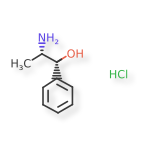
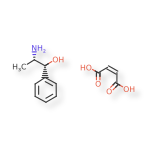

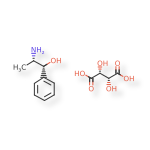
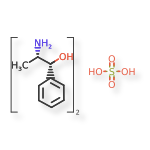
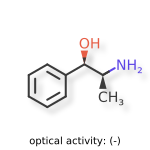


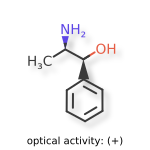
| Related Record | Type | Details | ||
|---|---|---|---|---|
|
|
PARENT -> METABOLITE ACTIVE |
|
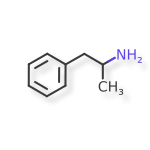
| Related Record | Type | Details | ||
|---|---|---|---|---|
|
|
PARENT -> IMPURITY | |||
|
PARENT -> IMPURITY |
|
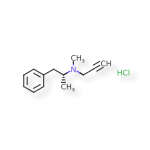
| Related Record | Type | Details | ||
|---|---|---|---|---|
|
|
ACTIVE MOIETY |
|
| Name | Property Type | Amount | Referenced Substance | Defining | Parameters | References |
|---|---|---|---|---|---|---|
| Biological Half-life | PHARMACOKINETIC |
|
|
|||