


Details
| Stereochemistry | RACEMIC |
| Molecular Formula | C9H13N |
| Molecular Weight | 135.2062 |
| Optical Activity | ( + / - ) |
| Defined Stereocenters | 0 / 1 |
| E/Z Centers | 0 |
| Charge | 0 |
SHOW SMILES / InChI
SMILES
CC(N)CC1=CC=CC=C1
InChI
InChIKey=KWTSXDURSIMDCE-UHFFFAOYSA-N
InChI=1S/C9H13N/c1-8(10)7-9-5-3-2-4-6-9/h2-6,8H,7,10H2,1H3
| Molecular Formula | C9H13N |
| Molecular Weight | 135.2062 |
| Charge | 0 |
| Count |
|
| Stereochemistry | RACEMIC |
| Additional Stereochemistry | No |
| Defined Stereocenters | 0 / 1 |
| E/Z Centers | 0 |
| Optical Activity | ( + / - ) |
DescriptionCurator's Comment: description was created based on several sources, including
https://www.caremark.com/portal/asset/FEP_Rationale_Amphetamine.pdf
https://www.ncbi.nlm.nih.gov/pubmed/23539642
http://www.cesar.umd.edu/cesar/drugs/amphetamines.asp
Curator's Comment: description was created based on several sources, including
https://www.caremark.com/portal/asset/FEP_Rationale_Amphetamine.pdf
https://www.ncbi.nlm.nih.gov/pubmed/23539642
http://www.cesar.umd.edu/cesar/drugs/amphetamines.asp
Amphetamine is a potent central nervous system (CNS) stimulant that is used in the treatment of attention deficit hyperactivity disorder (ADHD), narcolepsy, and obesity. Amphetamine was discovered in 1887 and exists as two enantiomers: levoamphetamine and dextroamphetamine. The mode of therapeutic action in ADHD is not known. Amphetamines are thought to block the reuptake of norepinephrine and dopamine into the presynaptic neuron and increase the release of these monoamines into the extraneuronal space. At higher dosages, they cause release of dopamine from the mesocorticolimbic system and the nigrostriatal dopamine systems. Amphetamine may also act as a direct agonist on central 5-HT receptors and may inhibit monoamine oxidase (MAO). In the periphery, amphetamines are believed to cause the release of noradrenaline by acting on the adrenergic nerve terminals and alpha- and beta-receptors. Modulation of serotonergic pathways may contribute to the calming affect. The drug interacts with VMAT enzymes to enhance release of DA and 5-HT from vesicles. It may also directly cause the reversal of DAT and SERT. Several currently prescribed amphetamine formulations contain both enantiomers, including Adderall, Dyanavel XR, and Evekeo, the last of which is racemic amphetamine sulfate. Amphetamine is also prescribed in enantiopure and prodrug form as dextroamphetamine and lisdexamfetamine respectively. Lisdexamfetamine is structurally different from amphetamine, and is inactive until it metabolizes into dextroamphetamine.
CNS Activity
Sources: https://nootropicscity.com/comprehensive-write-amphetamines-adderall-ritalin-vyvanse-concerta/
Curator's Comment: Amphetamines readily cross the blood-brain barrier to reach their primary sites of action in the brain. The acute administration of amphetamine produces a wide range of dose-dependent behavioral changes, including increased arousal or wakefulness, anorexia, hyperactivity, perseverative movements, and, in particular, a state of pleasurable affect, elation, and euphoria, which can lead to the abuse of the drug.
Approval Year
Targets
| Primary Target | Pharmacology | Condition | Potency |
|---|---|---|---|
Target ID: CHEMBL1893 |
|||
Target ID: CHEMBL238 |
Conditions
| Condition | Modality | Targets | Highest Phase | Product |
|---|---|---|---|---|
| Primary | DYANAVEL XR Approved UseINDICATIONS Dextroamphetamine Saccharate, Amphetamine Aspartate, Dextroamphetamine Sulfate and Amphetamine Sulfate Tablets is indicated for the treatment of Attention Deficit Hyperactivity Disorder (ADHD) and Narcolepsy. Attention Deficit Hyperactivity Disorder (ADHD) A diagnosis of Attention Deficit Hyperactivity Disorder (ADHD; DSM-IV®) implies the presence of hyperactive-impulsive or inattentive symptoms that caused impairment and were present before age 7 years. The symptoms must cause clinically significant impairment, e.g., in social, academic, or occupational functioning, and be present in two or more settings, e.g., school (or work) and at home. The symptoms must not be better accounted for by another mental disorder. For the Inattentive Type, at least six of the following symptoms must have persisted for at least 6 months: lack of attention to details/careless mistakes; lack of sustained attention; poor listener; failure to follow through on tasks; poor organization; avoids tasks requiring sustained mental effort; loses things; easily distracted; forgetful. For the Hyperactive-Impulsive Type, at least six of the following symptoms must have persisted for at least 6 months: fidgeting/squirming; leaving seat; inappropriate running/climbing; difficulty with quiet activities; “on the go;” excessive talking; blurting answers; can't wait turn; intrusive. The Combined Type requires both inattentive and hyperactive-impulsive criteria to be met. Special Diagnostic Considerations: Specific etiology of this syndrome is unknown, and there is no single diagnostic test. Adequate diagnosis requires the use not only of medical but of special psychological, educational, and social resources. Learning may or may not be impaired. The diagnosis must be based upon a complete history and evaluation of the child and not solely on the presence of the required number of DSM-IV® characteristics. Need for Comprehensive Treatment Program: Dextroamphetamine Saccharate, Amphetamine Aspartate, Dextroamphetamine Sulfate and Amphetamine Sulfate Tablets is indicated as an integral part of a total treatment program for ADHD that may include other measures (psychological, educational, social) for patients with this syndrome. Drug treatment may not be indicated for all children with this syndrome. Stimulants are not intended for use in the child who exhibits symptoms secondary to environmental factors and/or other primary psychiatric disorders, including psychosis. Appropriate educational placement is essential and psychosocial intervention is often helpful. When remedial measures alone are insufficient, the decision to prescribe stimulant medication will depend upon the physician's assessment of the chronicity and severity of the child's symptoms. Long-Term Use: The effectiveness of Dextroamphetamine Saccharate, Amphetamine Aspartate, Dextroamphetamine Sulfate and Amphetamine Sulfate Tablets for long-term use has not been systematically evaluated in controlled trials. Therefore, the physician who elects to use Dextroamphetamine Saccharate, Amphetamine Aspartate, Dextroamphetamine Sulfate and Amphetamine Sulfate Tablets for extended periods should periodically re-evaluate the long-term usefulness of the drug for the individual patient. Launch Date2015 |
Cmax
| Value | Dose | Co-administered | Analyte | Population |
|---|---|---|---|---|
120 ng/mL EXPERIMENT https://pubmed.ncbi.nlm.nih.gov/28936175/ |
40.3 mg single, oral dose: 40.3 mg route of administration: Oral experiment type: SINGLE co-administered: |
AMPHETAMINE plasma | Homo sapiens population: HEALTHY age: ADULT sex: FEMALE / MALE food status: FASTED |
AUC
| Value | Dose | Co-administered | Analyte | Population |
|---|---|---|---|---|
1727 ng × h/mL EXPERIMENT https://pubmed.ncbi.nlm.nih.gov/28936175/ |
40.3 mg single, oral dose: 40.3 mg route of administration: Oral experiment type: SINGLE co-administered: |
AMPHETAMINE plasma | Homo sapiens population: HEALTHY age: ADULT sex: FEMALE / MALE food status: FASTED |
T1/2
| Value | Dose | Co-administered | Analyte | Population |
|---|---|---|---|---|
7.9 h EXPERIMENT https://pubmed.ncbi.nlm.nih.gov/28936175/ |
40.3 mg single, oral dose: 40.3 mg route of administration: Oral experiment type: SINGLE co-administered: |
AMPHETAMINE plasma | Homo sapiens population: HEALTHY age: ADULT sex: FEMALE / MALE food status: FASTED |
PubMed
| Title | Date | PubMed |
|---|---|---|
| Spatial and temporal profile of haloperidol-induced immediate-early gene expression and phosphoCREB binding in the dorsal and ventral striatum of amphetamine-sensitized rats. | 2002-09-15 |
|
| Effect of amphetamine repeated treatment on the feeding behavior in neuropeptide Y-overexpressing mice. | 2002-09-06 |
|
| Efficacy of Adderall for Attention-Deficit/Hyperactivity Disorder: a meta-analysis. | 2002-09 |
|
| A randomized, double-blind, placebo-controlled, parallel-group study of SLI381 (Adderall XR) in children with attention-deficit/hyperactivity disorder. | 2002-08 |
|
| Spontaneous novelty seeking and amphetamine-induced conditioning and sensitization in adult mice: evidence of dissociation as a function of age at weaning. | 2002-08 |
|
| Synthesis and D(2)-like binding affinity of new derivatives of N-(1-ethyl-2-pyrrolidinylmethyl)-4,5-dihydro-1H-benzo[g]indole-3-carboxamide and related 4H-[1]benzothiopyrano[4,3-b]pyrrole and 5,6-dihydro-4H-benzo[6,7]cyclohepta[b]pyrrole-3-carboxamide analogues. | 2002-08 |
|
| Dopamine transporter-dependent induction of C-Fos in HEK cells. | 2002-07 |
|
| 24-hour ambulatory blood pressure monitoring in male children receiving stimulant therapy. | 2002-06-28 |
|
| CaMKII regulates amphetamine-induced ERK1/2 phosphorylation in striatal neurons. | 2002-06-12 |
|
| Efficacy of Adderall and methylphenidate in attention deficit hyperactivity disorder: a drug-placebo and drug-drug response curve analysis of a naturalistic study. | 2002-06 |
|
| Cocaine and amphetamine attenuate the discriminative stimulus effects of naltrexone in opioid-dependent rhesus monkeys. | 2002-06 |
|
| Serotonin1B receptor ligands in the nucleus accumbens shell do not affect the discriminative stimulus effects of amphetamine in rats. | 2002-05-07 |
|
| The effect of nitrostyrene on cell proliferation and macrophage immune responses. | 2002-05 |
|
| The neurosteroid 3 alpha-hydroxy-5 alpha-pregnan-20-one affects dopamine-mediated behavior in rodents. | 2002-05 |
|
| The effects of delayed rewards, tokens, and stimulant medication on sportsmanlike behavior with ADHD-diagnosed children. | 2002-04 |
|
| Adderall and seizures. | 2002-04 |
|
| Amphetamine salt compound treatment for adults with attention deficit hyperactivity disorder. | 2002-04 |
|
| The ability of amphetamine to evoke arc (Arg 3.1) mRNA expression in the caudate, nucleus accumbens and neocortex is modulated by environmental context. | 2002-03-15 |
|
| Assessment of silver and gold substrates for the detection of amphetamine sulfate by surface enhanced Raman scattering (SERS). | 2002-02 |
|
| Effects of amphetamine on the plus-maze discriminative avoidance task in mice. | 2002-02 |
|
| Cocaine and amphetamine depress striatal GABAergic synaptic transmission through D2 dopamine receptors. | 2002-02 |
|
| Case series: Adderall augmentation of serotonin reuptake inhibitors in childhood-onset obsessive compulsive disorder. | 2002 |
|
| D-amphetamine-induced behavioral sensitization: effect of lesioning dopaminergic terminals in the medial prefrontal cortex, the amygdala and the entorhinal cortex. | 2002 |
|
| Role of hypothalamic neuropeptide Y (NPY) in the change of feeding behavior induced by repeated treatment of amphetamine. | 2001-12-07 |
|
| Developmental aspects of psychostimulant treatment in children and adolescents with attention-deficit/hyperactivity disorder. | 2001-12 |
|
| SLI381: a long-acting psychostimulant preparation for the treatment of attention-deficit hyperactivity disorder. | 2001-11 |
|
| Pharmacotherapies for attention-deficit/hyperactivity disorder: expected-cost analysis. | 2001-11 |
|
| Cholecystokinin2 receptor-deficient mice display altered function of brain dopaminergic system. | 2001-11 |
|
| Double-blind, placebo-controlled study of single-dose amphetamine formulations in ADHD. | 2001-11 |
|
| Changes in the performance of schedule-induced polydipsia (SIP) in rats after arecoline and amphetamine treatments. | 2001-10 |
|
| Maturational increases in c-fos expression in the ascending dopamine systems. | 2001-09-15 |
|
| Differentially altered mGluR1 and mGluR5 mRNA expression in rat caudate nucleus and nucleus accumbens in the development and expression of behavioral sensitization to repeated amphetamine administration. | 2001-09-01 |
|
| Pilot randomized controlled study of dexamphetamine substitution for amphetamine dependence. | 2001-09 |
|
| Stability of Adderall in extemporaneously compounded oral liquids. | 2001-08-01 |
|
| SB-243213; a selective 5-HT2C receptor inverse agonist with improved anxiolytic profile: lack of tolerance and withdrawal anxiety. | 2001-08 |
|
| Attention-deficit/hyperactivity disorder in adults: beyond controversy. | 2001-08 |
|
| Efficacy of a mixed amphetamine salts compound in adults with attention-deficit/hyperactivity disorder. | 2001-08 |
|
| Effects of drugs of abuse on response accuracy and bias under a delayed matching-to-sample procedure in squirrel monkeys. | 2001-07 |
|
| Adderall and the FDA. | 2001-07 |
|
| Evaluation of nigrostriatal dopaminergic function in adult +/+ and +/- BDNF mutant mice. | 2001-07 |
|
| Induction of tolerance to the suppressant effect of the neurotensin analogue NT69L on amphetamine-induced hyperactivity. | 2001-06-22 |
|
| Mutant mice lacking the cholecystokinin2 receptor show a dopamine-dependent hyperactivity and a behavioral sensitization to morphine. | 2001-06-22 |
|
| Acute myocardial infarction caused by amphetamines: a case report and review of the literature. | 2001-06 |
|
| Amphetamine-induced toxicity in dopamine terminals in CD-1 and C57BL/6J mice: complex roles for oxygen-based species and temperature regulation. | 2001 |
|
| Behavioral sensitization in humans. | 2001 |
|
| Efficacy of Adderall and methylphenidate in attention deficit hyperactivity disorder: a reanalysis using drug-placebo and drug-drug response curve methodology. | 2001 |
|
| [Amphetamine-induced psychosis]. | 1998 |
|
| Acute subarachnoid hemorrhage. | 1975-07-07 |
|
| The behavioral pharmacology of butaclamol hydrochloride (AY-23,028), a new potent neuroleptic drug. | 1975-04-30 |
|
| Effect of chronic amphetamine exposure on stereotyped behavior: implications for pathogenesis of l-dopa-induced dyskinesias. | 1975 |
Sample Use Guides
DYANAVEL XR (R (amphetamine) extended-release oral suspension) should be orally administered once daily in the morning with or without food. The dose should be individualized according to the needs and responses of the patient. Before administering the dose, shake the bottle of DYANAVEL XR.
In children 6 years of age and older, start with 2.5 mg or 5 mg once daily in the morning. The dose may be increase
Route of Administration:
Oral
In Vitro Use Guide
Curator's Comment: Amph increases the effects induced by βPEA on the LGC-55, indicating that Amph potentiates the effects generated by the biogenic amine βPEA
β-Phenylethylamine (βPEA) activates the amine-gated chloride channel LGC-55 more efficiently than amphetamine (Amph) (Km = 9 and 152 μm, respectively)
| Substance Class |
Chemical
Created
by
admin
on
Edited
Mon Mar 31 17:36:57 GMT 2025
by
admin
on
Mon Mar 31 17:36:57 GMT 2025
|
| Record UNII |
CK833KGX7E
|
| Record Status |
Validated (UNII)
|
| Record Version |
|
-
Download
| Name | Type | Language | ||
|---|---|---|---|---|
|
Systematic Name | English | ||
|
Preferred Name | English | ||
|
Common Name | English | ||
|
Code | English | ||
|
Brand Name | English | ||
|
Common Name | English | ||
|
Systematic Name | English | ||
|
Common Name | English | ||
|
Brand Name | English | ||
|
Common Name | English | ||
|
Systematic Name | English | ||
|
Systematic Name | English | ||
|
Systematic Name | English | ||
|
Brand Name | English | ||
|
Common Name | English | ||
|
Common Name | English | ||
|
Common Name | English | ||
|
Common Name | English | ||
|
Brand Name | English | ||
|
Brand Name | English | ||
|
Common Name | English | ||
|
Common Name | English | ||
|
Common Name | English |
| Classification Tree | Code System | Code | ||
|---|---|---|---|---|
|
CFR |
21 CFR 250.101
Created by
admin on Mon Mar 31 17:36:57 GMT 2025 , Edited by admin on Mon Mar 31 17:36:57 GMT 2025
|
||
|
LIVERTOX |
50
Created by
admin on Mon Mar 31 17:36:57 GMT 2025 , Edited by admin on Mon Mar 31 17:36:57 GMT 2025
|
||
|
NDF-RT |
N0000175729
Created by
admin on Mon Mar 31 17:36:57 GMT 2025 , Edited by admin on Mon Mar 31 17:36:57 GMT 2025
|
||
|
WHO-VATC |
QN06BA01
Created by
admin on Mon Mar 31 17:36:57 GMT 2025 , Edited by admin on Mon Mar 31 17:36:57 GMT 2025
|
||
|
NCI_THESAURUS |
C47795
Created by
admin on Mon Mar 31 17:36:57 GMT 2025 , Edited by admin on Mon Mar 31 17:36:57 GMT 2025
|
||
|
DEA NO. |
1100
Created by
admin on Mon Mar 31 17:36:57 GMT 2025 , Edited by admin on Mon Mar 31 17:36:57 GMT 2025
|
||
|
WHO-ATC |
N06BA01
Created by
admin on Mon Mar 31 17:36:57 GMT 2025 , Edited by admin on Mon Mar 31 17:36:57 GMT 2025
|
||
|
CFR |
21 CFR 862.3100
Created by
admin on Mon Mar 31 17:36:57 GMT 2025 , Edited by admin on Mon Mar 31 17:36:57 GMT 2025
|
||
|
FDA ORPHAN DRUG |
405313
Created by
admin on Mon Mar 31 17:36:57 GMT 2025 , Edited by admin on Mon Mar 31 17:36:57 GMT 2025
|
||
|
DEA NO. |
7401
Created by
admin on Mon Mar 31 17:36:57 GMT 2025 , Edited by admin on Mon Mar 31 17:36:57 GMT 2025
|
||
|
NDF-RT |
N0000175739
Created by
admin on Mon Mar 31 17:36:57 GMT 2025 , Edited by admin on Mon Mar 31 17:36:57 GMT 2025
|
||
|
CFR |
21 CFR 310.502
Created by
admin on Mon Mar 31 17:36:57 GMT 2025 , Edited by admin on Mon Mar 31 17:36:57 GMT 2025
|
| Code System | Code | Type | Description | ||
|---|---|---|---|---|---|
|
C62006
Created by
admin on Mon Mar 31 17:36:57 GMT 2025 , Edited by admin on Mon Mar 31 17:36:57 GMT 2025
|
PRIMARY | |||
|
27159
Created by
admin on Mon Mar 31 17:36:57 GMT 2025 , Edited by admin on Mon Mar 31 17:36:57 GMT 2025
|
PRIMARY | |||
|
195
Created by
admin on Mon Mar 31 17:36:57 GMT 2025 , Edited by admin on Mon Mar 31 17:36:57 GMT 2025
|
PRIMARY | |||
|
300-62-9
Created by
admin on Mon Mar 31 17:36:57 GMT 2025 , Edited by admin on Mon Mar 31 17:36:57 GMT 2025
|
PRIMARY | |||
|
DTXSID4022600
Created by
admin on Mon Mar 31 17:36:57 GMT 2025 , Edited by admin on Mon Mar 31 17:36:57 GMT 2025
|
PRIMARY | |||
|
D000661
Created by
admin on Mon Mar 31 17:36:57 GMT 2025 , Edited by admin on Mon Mar 31 17:36:57 GMT 2025
|
PRIMARY | |||
|
2679
Created by
admin on Mon Mar 31 17:36:57 GMT 2025 , Edited by admin on Mon Mar 31 17:36:57 GMT 2025
|
PRIMARY | |||
|
3287
Created by
admin on Mon Mar 31 17:36:57 GMT 2025 , Edited by admin on Mon Mar 31 17:36:57 GMT 2025
|
PRIMARY | |||
|
AMPHETAMINE
Created by
admin on Mon Mar 31 17:36:57 GMT 2025 , Edited by admin on Mon Mar 31 17:36:57 GMT 2025
|
PRIMARY | |||
|
m1849
Created by
admin on Mon Mar 31 17:36:57 GMT 2025 , Edited by admin on Mon Mar 31 17:36:57 GMT 2025
|
PRIMARY | Merck Index | ||
|
DB00182
Created by
admin on Mon Mar 31 17:36:57 GMT 2025 , Edited by admin on Mon Mar 31 17:36:57 GMT 2025
|
PRIMARY | |||
|
4804
Created by
admin on Mon Mar 31 17:36:57 GMT 2025 , Edited by admin on Mon Mar 31 17:36:57 GMT 2025
|
PRIMARY | |||
|
3007
Created by
admin on Mon Mar 31 17:36:57 GMT 2025 , Edited by admin on Mon Mar 31 17:36:57 GMT 2025
|
PRIMARY | |||
|
Amphetamine
Created by
admin on Mon Mar 31 17:36:57 GMT 2025 , Edited by admin on Mon Mar 31 17:36:57 GMT 2025
|
PRIMARY | |||
|
377
Created by
admin on Mon Mar 31 17:36:57 GMT 2025 , Edited by admin on Mon Mar 31 17:36:57 GMT 2025
|
PRIMARY | |||
|
CK833KGX7E
Created by
admin on Mon Mar 31 17:36:57 GMT 2025 , Edited by admin on Mon Mar 31 17:36:57 GMT 2025
|
PRIMARY | |||
|
SUB05418MIG
Created by
admin on Mon Mar 31 17:36:57 GMT 2025 , Edited by admin on Mon Mar 31 17:36:57 GMT 2025
|
PRIMARY | |||
|
206-096-2
Created by
admin on Mon Mar 31 17:36:57 GMT 2025 , Edited by admin on Mon Mar 31 17:36:57 GMT 2025
|
PRIMARY | |||
|
CK833KGX7E
Created by
admin on Mon Mar 31 17:36:57 GMT 2025 , Edited by admin on Mon Mar 31 17:36:57 GMT 2025
|
PRIMARY | |||
|
PA 003
Created by
admin on Mon Mar 31 17:36:57 GMT 2025 , Edited by admin on Mon Mar 31 17:36:57 GMT 2025
|
PRIMARY | |||
|
100000087217
Created by
admin on Mon Mar 31 17:36:57 GMT 2025 , Edited by admin on Mon Mar 31 17:36:57 GMT 2025
|
PRIMARY | |||
|
CHEMBL405
Created by
admin on Mon Mar 31 17:36:57 GMT 2025 , Edited by admin on Mon Mar 31 17:36:57 GMT 2025
|
PRIMARY | |||
|
725
Created by
admin on Mon Mar 31 17:36:57 GMT 2025 , Edited by admin on Mon Mar 31 17:36:57 GMT 2025
|
PRIMARY | RxNorm |
| Related Record | Type | Details | ||
|---|---|---|---|---|
|
METABOLIC ENZYME -> INHIBITOR | |||
|
TRANSPORTER -> SUBSTRATE |
|
||
|
|
SALT/SOLVATE -> PARENT |
|
||
|
|
TARGET -> AGONIST |
|
||
|
|
SALT/SOLVATE -> PARENT |
|
||
|
|
SALT/SOLVATE -> PARENT |
|
||
|
|
SALT/SOLVATE -> PARENT |
|
||
|
BINDER->LIGAND |
BINDING
|
||
|
|
SALT/SOLVATE -> PARENT |
|
||
|
|
SALT/SOLVATE -> PARENT |
|
||
|
TRANSPORTER -> SUBSTRATE |
|
||
|
|
SALT/SOLVATE -> PARENT |
|
||
|
TRANSPORTER -> SUBSTRATE |
|
||
|
TARGET -> AGONIST |
|

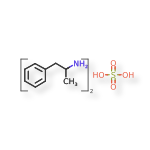
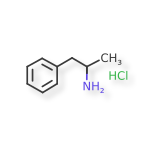
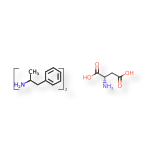
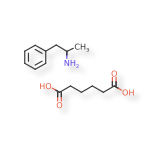


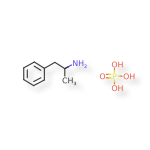
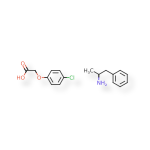
| Related Record | Type | Details | ||
|---|---|---|---|---|
|
|
METABOLITE ACTIVE -> PARENT |
|
||
|
|
METABOLITE -> PARENT |
|
||
|
METABOLITE -> PARENT |
|
||
|
PARENT -> METABOLITE |
|
||
|
METABOLITE -> PARENT |
|
||
|
METABOLITE ACTIVE -> PARENT |
|
||
|
METABOLITE -> PARENT |
|
||
|
METABOLITE -> PARENT |
|
||
|
|
METABOLITE -> PARENT |
|
||
|
METABOLITE -> PARENT | |||
|
PARENT -> METABOLITE ACTIVE |
MAJOR
URINE
|
||
|
METABOLITE -> PARENT |
|
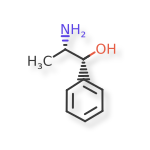
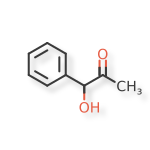


| Related Record | Type | Details | ||
|---|---|---|---|---|
|
IMPURITY -> PARENT |
|
||
|
IMPURITY -> PARENT |
|
||
|
IMPURITY -> PARENT |
|
||
|
IMPURITY -> PARENT |
|
||
|
IMPURITY -> PARENT |
|
||
|
IMPURITY -> PARENT |
|
||
|
PARENT -> IMPURITY |
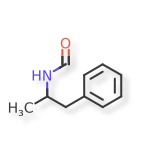
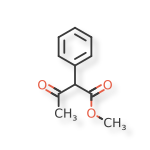
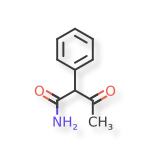
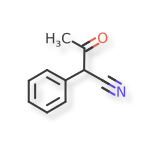
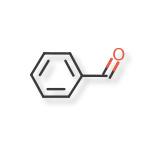
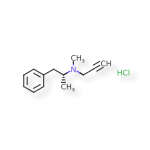
| Related Record | Type | Details | ||
|---|---|---|---|---|
|
|
ACTIVE MOIETY |
|
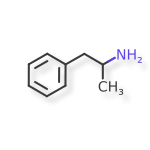
| Name | Property Type | Amount | Referenced Substance | Defining | Parameters | References |
|---|---|---|---|---|---|---|
| Volume of Distribution | PHARMACOKINETIC |
|
|
|||