


Details
| Stereochemistry | RACEMIC |
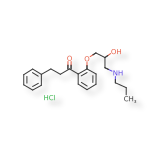
| Molecular Formula | C21H27NO3.ClH |
| Molecular Weight | 377.905 |
| Optical Activity | ( + / - ) |
| Defined Stereocenters | 0 / 1 |
| E/Z Centers | 0 |
| Charge | 0 |
SHOW SMILES / InChI
SMILES
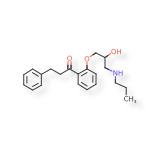
Cl.CCCNCC(O)COC1=CC=CC=C1C(=O)CCC2=CC=CC=C2
InChI
InChIKey=XWIHRGFIPXWGEF-UHFFFAOYSA-N
InChI=1S/C21H27NO3.ClH/c1-2-14-22-15-18(23)16-25-21-11-7-6-10-19(21)20(24)13-12-17-8-4-3-5-9-17;/h3-11,18,22-23H,2,12-16H2,1H3;1H
| Molecular Formula | C21H27NO3 |
| Molecular Weight | 341.444 |
| Charge | 0 |
| Count |
|
| Stereochemistry | RACEMIC |
| Additional Stereochemistry | No |
| Defined Stereocenters | 0 / 1 |
| E/Z Centers | 0 |
| Optical Activity | ( + / - ) |
| Molecular Formula | ClH |
| Molecular Weight | 36.461 |
| Charge | 0 |
| Count |
|
| Stereochemistry | ACHIRAL |
| Additional Stereochemistry | No |
| Defined Stereocenters | 0 / 0 |
| E/Z Centers | 0 |
| Optical Activity | NONE |
DescriptionCurator's Comment: description was created based on several sources, including
https://www.drugbank.ca/drugs/DB01182 | http://reference.medscape.com/drug/rythmol-propafenone-342307 | https://www.drugs.com/pro/propafenone.html | https://www.ncbi.nlm.nih.gov/pubmed/26588045
Curator's Comment: description was created based on several sources, including
https://www.drugbank.ca/drugs/DB01182 | http://reference.medscape.com/drug/rythmol-propafenone-342307 | https://www.drugs.com/pro/propafenone.html | https://www.ncbi.nlm.nih.gov/pubmed/26588045
Propafenone (brand name Rythmol SR or Rytmonorm) is a class 1C anti-arrhythmic medication, which treats illnesses associated with rapid heartbeats such as atrial and ventricular arrhythmias. The electrophysiological effect of propafenone manifests itself in a reduction of upstroke velocity (Phase 0) of the monophasic action potential. In Purkinje fibers, and to a lesser extent myocardial fibers, propafenone reduces the fast inward current carried by sodium ions, which is responsible for the drugs antiarrhythmic actions. Diastolic excitability threshold is increased and effective refractory period prolonged. Propafenone reduces spontaneous automaticity and depresses triggered activity. At very high concentrations in vitro, propafenone can inhibit the slow inward current carried by calcium but this calcium antagonist effect probably does not contribute to antiarrhythmic efficacy. Propafenone is metabolized primarily in the liver. Because of its short half-life, it requires dosing two or three times daily to maintain steady blood levels. The long-term safety of propafenone is unknown. Because it is structurally similar to another anti-arrhythmic medicine, flecainide, similar cautions should be exercised in its use. Flecainide and propafenone, like other antiarrhythmic drugs, have been shown to increase the occurrence of arrhythmias (5.3% for propafenone, Teva physician prescribing information), primarily in patients with underlying heart disease. However, their use in structurally normal hearts is considered safe.
Approval Year
Targets
| Primary Target | Pharmacology | Condition | Potency |
|---|---|---|---|
Target ID: CHEMBL2321615 |
7.6 nM [IC50] | ||
Target ID: CHEMBL2321613 |
5.1 µM [IC50] | ||
Target ID: CHEMBL1980 |
Conditions
| Condition | Modality | Targets | Highest Phase | Product |
|---|---|---|---|---|
| Primary | RYTHMOL Approved UsePropafenone HCl Extended Release Capsules is indicated to prolong the time to recurrence of symptomatic atrial fibrillation (AF) in patients with episodic (most likely paroxysmal or persistent) AF who do not have structural heart disease. Usage Considerations: •The use of propafenone ER capsules in patients with permanent AF or in patients exclusively with atrial flutter or paroxysmal supraventricular tachycardia (PSVT) has not been evaluated. Do not use propafenone ER capsules to control ventricular rate during AF. •Some patients with atrial flutter treated with propafenone have developed 1:1 conduction, producing an increase in ventricular rate. Concomitant treatment with drugs that increase the functional atrioventricular (AV) nodal refractory period is recommended. • The effect of propafenone on mortality has not been determined [see BOXED WARNING Launch Date1989 |
|||
| Primary | RYTHMOL Approved UsePropafenone HCl Extended Release Capsules is indicated to prolong the time to recurrence of symptomatic atrial fibrillation (AF) in patients with episodic (most likely paroxysmal or persistent) AF who do not have structural heart disease. Usage Considerations: •The use of propafenone ER capsules in patients with permanent AF or in patients exclusively with atrial flutter or paroxysmal supraventricular tachycardia (PSVT) has not been evaluated. Do not use propafenone ER capsules to control ventricular rate during AF. •Some patients with atrial flutter treated with propafenone have developed 1:1 conduction, producing an increase in ventricular rate. Concomitant treatment with drugs that increase the functional atrioventricular (AV) nodal refractory period is recommended. • The effect of propafenone on mortality has not been determined [see BOXED WARNING Launch Date1989 |
Cmax
| Value | Dose | Co-administered | Analyte | Population |
|---|---|---|---|---|
189.94 ng/mL EXPERIMENT https://www.ncbi.nlm.nih.gov/pubmed/19402341 |
150 mg single, oral dose: 150 mg route of administration: Oral experiment type: SINGLE co-administered: |
PROPAFENONE plasma | Homo sapiens population: HEALTHY age: ADULT sex: FEMALE / MALE food status: UNKNOWN |
|
314 ng/mL EXPERIMENT https://www.ncbi.nlm.nih.gov/pubmed/3606933 |
300 mg single, oral dose: 300 mg route of administration: Oral experiment type: SINGLE co-administered: |
PROPAFENONE plasma | Homo sapiens population: HEALTHY age: ADULT sex: MALE food status: FASTED |
AUC
| Value | Dose | Co-administered | Analyte | Population |
|---|---|---|---|---|
322.43 ng × h/mL EXPERIMENT https://www.ncbi.nlm.nih.gov/pubmed/19402341 |
150 mg single, oral dose: 150 mg route of administration: Oral experiment type: SINGLE co-administered: |
PROPAFENONE plasma | Homo sapiens population: HEALTHY age: ADULT sex: FEMALE / MALE food status: UNKNOWN |
|
2900 ng × h/mL EXPERIMENT https://www.ncbi.nlm.nih.gov/pubmed/3606933 |
300 mg single, oral dose: 300 mg route of administration: Oral experiment type: SINGLE co-administered: |
PROPAFENONE plasma | Homo sapiens population: HEALTHY age: ADULT sex: MALE food status: FASTED |
T1/2
| Value | Dose | Co-administered | Analyte | Population |
|---|---|---|---|---|
3.61 h EXPERIMENT https://www.ncbi.nlm.nih.gov/pubmed/3606933 |
300 mg single, oral dose: 300 mg route of administration: Oral experiment type: SINGLE co-administered: |
PROPAFENONE plasma | Homo sapiens population: HEALTHY age: ADULT sex: MALE food status: FASTED |
Funbound
| Value | Dose | Co-administered | Analyte | Population |
|---|---|---|---|---|
4.1% EXPERIMENT https://www.ncbi.nlm.nih.gov/pubmed/2753068 |
PROPAFENONE plasma | Homo sapiens population: HEALTHY age: ADULT sex: MALE food status: UNKNOWN |
Doses
| Dose | Population | Adverse events |
|---|---|---|
425 mg 2 times / day multiple, oral Highest studied dose Dose: 425 mg, 2 times / day Route: oral Route: multiple Dose: 425 mg, 2 times / day Sources: |
unhealthy, adult Health Status: unhealthy Age Group: adult Sex: M+F Sources: |
Other AEs: Monocyte count increased, Eosinophil count increased... Other AEs: Monocyte count increased (0.7%) Sources: Eosinophil count increased (0.7%) Platelet count decreased (0.7%) Cardiac failure congestive (1.5%) Coronary artery disease NOS (0.7%) Myocardial infarction (0.7%) Abdominal pain NOS (0.7%) Diarrhea NOS (0.7%) Chest pain (1.5%) Pneumonia NOS (0.7%) Urinary tract infection NOS (0.7%) Prothrombin level decreased (0.7%) Headache (0.7%) Syncope (0.7%) |
AEs
| AE | Significance | Dose | Population |
|---|---|---|---|
| Abdominal pain NOS | 0.7% | 425 mg 2 times / day multiple, oral Highest studied dose Dose: 425 mg, 2 times / day Route: oral Route: multiple Dose: 425 mg, 2 times / day Sources: |
unhealthy, adult Health Status: unhealthy Age Group: adult Sex: M+F Sources: |
| Coronary artery disease NOS | 0.7% | 425 mg 2 times / day multiple, oral Highest studied dose Dose: 425 mg, 2 times / day Route: oral Route: multiple Dose: 425 mg, 2 times / day Sources: |
unhealthy, adult Health Status: unhealthy Age Group: adult Sex: M+F Sources: |
| Diarrhea NOS | 0.7% | 425 mg 2 times / day multiple, oral Highest studied dose Dose: 425 mg, 2 times / day Route: oral Route: multiple Dose: 425 mg, 2 times / day Sources: |
unhealthy, adult Health Status: unhealthy Age Group: adult Sex: M+F Sources: |
| Eosinophil count increased | 0.7% | 425 mg 2 times / day multiple, oral Highest studied dose Dose: 425 mg, 2 times / day Route: oral Route: multiple Dose: 425 mg, 2 times / day Sources: |
unhealthy, adult Health Status: unhealthy Age Group: adult Sex: M+F Sources: |
| Headache | 0.7% | 425 mg 2 times / day multiple, oral Highest studied dose Dose: 425 mg, 2 times / day Route: oral Route: multiple Dose: 425 mg, 2 times / day Sources: |
unhealthy, adult Health Status: unhealthy Age Group: adult Sex: M+F Sources: |
| Monocyte count increased | 0.7% | 425 mg 2 times / day multiple, oral Highest studied dose Dose: 425 mg, 2 times / day Route: oral Route: multiple Dose: 425 mg, 2 times / day Sources: |
unhealthy, adult Health Status: unhealthy Age Group: adult Sex: M+F Sources: |
| Myocardial infarction | 0.7% | 425 mg 2 times / day multiple, oral Highest studied dose Dose: 425 mg, 2 times / day Route: oral Route: multiple Dose: 425 mg, 2 times / day Sources: |
unhealthy, adult Health Status: unhealthy Age Group: adult Sex: M+F Sources: |
| Platelet count decreased | 0.7% | 425 mg 2 times / day multiple, oral Highest studied dose Dose: 425 mg, 2 times / day Route: oral Route: multiple Dose: 425 mg, 2 times / day Sources: |
unhealthy, adult Health Status: unhealthy Age Group: adult Sex: M+F Sources: |
| Pneumonia NOS | 0.7% | 425 mg 2 times / day multiple, oral Highest studied dose Dose: 425 mg, 2 times / day Route: oral Route: multiple Dose: 425 mg, 2 times / day Sources: |
unhealthy, adult Health Status: unhealthy Age Group: adult Sex: M+F Sources: |
| Prothrombin level decreased | 0.7% | 425 mg 2 times / day multiple, oral Highest studied dose Dose: 425 mg, 2 times / day Route: oral Route: multiple Dose: 425 mg, 2 times / day Sources: |
unhealthy, adult Health Status: unhealthy Age Group: adult Sex: M+F Sources: |
| Syncope | 0.7% | 425 mg 2 times / day multiple, oral Highest studied dose Dose: 425 mg, 2 times / day Route: oral Route: multiple Dose: 425 mg, 2 times / day Sources: |
unhealthy, adult Health Status: unhealthy Age Group: adult Sex: M+F Sources: |
| Urinary tract infection NOS | 0.7% | 425 mg 2 times / day multiple, oral Highest studied dose Dose: 425 mg, 2 times / day Route: oral Route: multiple Dose: 425 mg, 2 times / day Sources: |
unhealthy, adult Health Status: unhealthy Age Group: adult Sex: M+F Sources: |
| Cardiac failure congestive | 1.5% | 425 mg 2 times / day multiple, oral Highest studied dose Dose: 425 mg, 2 times / day Route: oral Route: multiple Dose: 425 mg, 2 times / day Sources: |
unhealthy, adult Health Status: unhealthy Age Group: adult Sex: M+F Sources: |
| Chest pain | 1.5% | 425 mg 2 times / day multiple, oral Highest studied dose Dose: 425 mg, 2 times / day Route: oral Route: multiple Dose: 425 mg, 2 times / day Sources: |
unhealthy, adult Health Status: unhealthy Age Group: adult Sex: M+F Sources: |
Overview
| CYP3A4 | CYP2C9 | CYP2D6 | hERG |
|---|---|---|---|
Drug as perpetrator
| Target | Modality | Activity | Metabolite | Clinical evidence |
|---|---|---|---|---|
| yes [IC50 1 uM] | ||||
| yes [IC50 19.9 uM] | ||||
| yes [IC50 21.3 uM] | ||||
| yes [IC50 6.8 uM] | ||||
| yes [Ki 74.2 uM] | ||||
| yes | ||||
| yes |
Drug as victim
| Target | Modality | Activity | Metabolite | Clinical evidence |
|---|---|---|---|---|
| no | ||||
| no | ||||
| yes | ||||
| yes | yes (co-administration study) Comment: amiodarone and tobacco (CYP1A2 inhibitor) can be expected to cause increased plasma levels of propafenone |
|||
| yes | yes (co-administration study) Comment: ketoconazole, erythromycin, saquinavir, and grapefruit juice for (CYP3A4 inhibitors) can be expected to cause increased plasma levels of propafenone; The combination of CYP3A4 inhibition and either CYP2D6 deficiency or CYP2D6 sinhibition with the simultaneous administration of propafenone may significantly increase the concentration of propafenone and thereby increase the risk of proarrhythmia and other adverse event |
|||
| yes | yes (pharmacogenomic study) Comment: Multiple studies have found that genetic variants in the CYP2D6 gene influence the plasma drug levels of propafenone |
Tox targets
| Target | Modality | Activity | Metabolite | Clinical evidence |
|---|---|---|---|---|
PubMed
| Title | Date | PubMed |
|---|---|---|
| High-throughput screening to estimate single or multiple enzymes involved in drug metabolism: microtitre plate assay using a combination of recombinant CYP2D6 and human liver microsomes. | 2003-08 |
|
| A novel two-pore domain K+ channel, TRESK, is localized in the spinal cord. | 2003-07-25 |
|
| Unintentional pediatric overdose of propafenone. | 2003-07-05 |
|
| Class I or class III agents for atrial fibrillation: are asking the right question? | 2003-07 |
|
| Risk factors for recurrence of atrial fibrillation in patients undergoing hybrid therapy for antiarrhythmic drug-induced atrial flutter. | 2003-07 |
|
| [Drug therapy of atrial fibrillation]. | 2003-06-15 |
|
| Amiodarone for pharmacological cardioversion of recent-onset atrial fibrillation. | 2003-06 |
|
| Effects of acute ischemia, early extrabeats and propafenone on complex activation patterns in intact and ischemic canine hearts. | 2003-05-02 |
|
| Pharmacologic and nonpharmacologic options to maintain sinus rhythm: guideline-based and new approaches. | 2003-03-20 |
|
| Old and new antiarrhythmic drugs for converting and maintaining sinus rhythm in atrial fibrillation: comparative efficacy and results of trials. | 2003-03-20 |
|
| Excitable gap composition in the presence of antiarrhythmic drugs in common human atrial flutter. | 2003-03-15 |
|
| Effects of a series of dihydroanthracene derivatives on drug efflux in multidrug resistant cancer cells. | 2003-03 |
|
| Propafenone versus ibutilide for post operative atrial fibrillation following cardiac surgery: neither strategy improves outcomes compared to rate control alone (the PIPAF study). | 2003-03 |
|
| In silico screening with benzofurane- and benzopyrane-type MDR-modulators. | 2003-03 |
|
| Left atrial size after cardioversion for atrial fibrillation: effect of external direct current shock. | 2003-03 |
|
| Effects of propafenone and its main metabolite, 5-hydroxypropafenone, on HERG channels. | 2003-03 |
|
| Molecular site of action of the antiarrhythmic drug propafenone at the voltage-operated potassium channel Kv2.1. | 2003-03 |
|
| [Clinical heart arrest after emergency "direct current" cardioversion of atrial flutter]. | 2003-02-03 |
|
| Propafenone hepatotoxicity: report of two new cases. | 2003-02 |
|
| Oral loading single dose flecainide for pharmacological cardioversion of recent-onset atrial fibrillation. | 2003-02 |
|
| [Hepatic toxicity of propafenone: a case description]. | 2003-01-21 |
|
| New multidrug resistance reversal agents. | 2003-01 |
|
| Stereoselectivity in trans-tramadol metabolism and trans-O-demethyltramadol formation in rat liver microsomes. | 2003-01 |
|
| Long-term follow-up of sudden cardiac arrest survivors and electrophysiologically guided antiarrhythmic therapy. | 2003 |
|
| Electrophysiological mapping and histological examinations of the swine atrium with sustained (> or =24 h) atrial fibrillation: a suitable animal model for studying human atrial fibrillation. | 2003 |
|
| Intracardiac low-energy versus transthoracic high-energy direct-current cardioversion of atrial fibrillation: a randomised comparison. | 2003 |
|
| Lopinavir/ritonavir: a review of its use in the management of HIV infection. | 2003 |
|
| Efficacy and safety of propafenone sustained release in the prophylaxis of symptomatic paroxysmal atrial fibrillation (The European Rythmol/Rytmonorm Atrial Fibrillation Trial [ERAFT] Study). | 2002-12-15 |
|
| [Role amiodarone in sinus rhythm maintenance after successful cardioversion in patients with chronic non-valvular atrial fibrillation]. | 2002-12 |
|
| Similarity based SAR (SIBAR) as tool for early ADME profiling. | 2002-11 |
|
| Effect of CYP2D6*10 genotype on propafenone pharmacodynamics in Chinese patients with ventricular arrhythmia. | 2002-11 |
|
| Human variability in polymorphic CYP2D6 metabolism: is the kinetic default uncertainty factor adequate? | 2002-11 |
|
| New insights into the mechanisms and management of atrial fibrillation. | 2002-10-29 |
|
| Exercise-induced bidirectional ventricular tachycardia with alternating right and left bundle branch block-type patterns--a case report. | 2002-10-09 |
|
| [Recent onset atrial fibrillation at a unit of internal medicine]. | 2002-10 |
|
| Beta-adrenergic stimulation modulates the sodium current block by propafenone in rat ventricular myocardium. | 2002-10 |
|
| Maintaining stability of sinus rhythm in atrial fibrillation: antiarrhythmic drugs versus ablation. | 2002-09 |
|
| Long-term clinical significance of frequent and complex ventricular tachyarrhythmias in trained athletes. | 2002-08-07 |
|
| How to enhance acute outcome of electrical cardioversion by drug therapy: importance of immediate reinitiation of atrial fibrillation. | 2002-08 |
|
| Congenital junctional ectopic tachycardia in children and adolescents: a 20 year experience based study. | 2002-08 |
|
| Propafenone-related cholestatic hepatitis in an elderly patient. | 2002-07 |
|
| [Proarrhythmic effects of propafenone in a woman with hepatopathy: is it always a simple drug in clinical practice?]. | 2002-07 |
|
| Amiodarone reduces procedures and costs related to atrial fibrillation in a controlled clinical trial. | 2002-07 |
|
| [Antiarrhythmic drugs in atrial fibrillation]. | 2002-06-15 |
|
| [Efficacy and tolerance of propafenone after correction of atrial fibrillation: PEPS pharmaco-epidemiologic study]. | 2002-06 |
|
| Paroxysmal supraventricular tachycardia induced by oral stimulation: a case report and review of swallow-induced dysrhythmias. | 2002-05 |
|
| [Pharmacological cardioversion of atrial fibrillation with intravenous and oral propafenone]. | 2002 |
|
| Oral mucosal drug delivery: clinical pharmacokinetics and therapeutic applications. | 2002 |
|
| Impact of stereoselectivity on the pharmacokinetics and pharmacodynamics of antiarrhythmic drugs. | 2002 |
|
| [Clinical and experimental study of effect of yangxin fumai oral liquid in treating patients with extrasystole]. | 2001-02 |
Patents
Sample Use Guides
Initiate therapy with 150 mg given every 8 hours.
As needed, uptitrate in 3-4 days to 225-300 mg every 8 hours
Route of Administration:
Oral
Hela cells were used for activity evaluation. Proliferation percentage was determined by the SRB assay. Cells were incubated with the Propafenone at the concentrations of 0.005-0.2 g/L for 48 h, and the cell proliferation/viability was determined using the survival percentage with the cells treated only with dimethyl sulfoxide (DMSO) at 0.1% as a reference
| Substance Class |
Chemical
Created
by
admin
on
Edited
Mon Mar 31 19:10:27 GMT 2025
by
admin
on
Mon Mar 31 19:10:27 GMT 2025
|
| Record UNII |
33XCH0HOCD
|
| Record Status |
Validated (UNII)
|
| Record Version |
|
-
Download
| Name | Type | Language | ||
|---|---|---|---|---|
|
Official Name | English | ||
|
Preferred Name | English | ||
|
Common Name | English | ||
|
Common Name | English | ||
|
Systematic Name | English | ||
|
Common Name | English | ||
|
Common Name | English | ||
|
Systematic Name | English | ||
|
Common Name | English | ||
|
Common Name | English | ||
|
Code | English | ||
|
Common Name | English | ||
|
Brand Name | English | ||
|
Common Name | English | ||
|
Common Name | English | ||
|
Common Name | English | ||
|
Common Name | English |
| Classification Tree | Code System | Code | ||
|---|---|---|---|---|
|
NCI_THESAURUS |
C47793
Created by
admin on Mon Mar 31 19:10:27 GMT 2025 , Edited by admin on Mon Mar 31 19:10:27 GMT 2025
|
||
|
NCI_THESAURUS |
C93038
Created by
admin on Mon Mar 31 19:10:27 GMT 2025 , Edited by admin on Mon Mar 31 19:10:27 GMT 2025
|
| Code System | Code | Type | Description | ||
|---|---|---|---|---|---|
|
100000091480
Created by
admin on Mon Mar 31 19:10:27 GMT 2025 , Edited by admin on Mon Mar 31 19:10:27 GMT 2025
|
PRIMARY | |||
|
34183-22-7
Created by
admin on Mon Mar 31 19:10:27 GMT 2025 , Edited by admin on Mon Mar 31 19:10:27 GMT 2025
|
PRIMARY | |||
|
33XCH0HOCD
Created by
admin on Mon Mar 31 19:10:27 GMT 2025 , Edited by admin on Mon Mar 31 19:10:27 GMT 2025
|
PRIMARY | |||
|
m9178
Created by
admin on Mon Mar 31 19:10:27 GMT 2025 , Edited by admin on Mon Mar 31 19:10:27 GMT 2025
|
PRIMARY | Merck Index | ||
|
CHEMBL631
Created by
admin on Mon Mar 31 19:10:27 GMT 2025 , Edited by admin on Mon Mar 31 19:10:27 GMT 2025
|
PRIMARY | |||
|
758640
Created by
admin on Mon Mar 31 19:10:27 GMT 2025 , Edited by admin on Mon Mar 31 19:10:27 GMT 2025
|
PRIMARY | |||
|
1570304
Created by
admin on Mon Mar 31 19:10:27 GMT 2025 , Edited by admin on Mon Mar 31 19:10:27 GMT 2025
|
PRIMARY | |||
|
33XCH0HOCD
Created by
admin on Mon Mar 31 19:10:27 GMT 2025 , Edited by admin on Mon Mar 31 19:10:27 GMT 2025
|
PRIMARY | |||
|
C47692
Created by
admin on Mon Mar 31 19:10:27 GMT 2025 , Edited by admin on Mon Mar 31 19:10:27 GMT 2025
|
PRIMARY | |||
|
SUB04077MIG
Created by
admin on Mon Mar 31 19:10:27 GMT 2025 , Edited by admin on Mon Mar 31 19:10:27 GMT 2025
|
PRIMARY | |||
|
8466
Created by
admin on Mon Mar 31 19:10:27 GMT 2025 , Edited by admin on Mon Mar 31 19:10:27 GMT 2025
|
PRIMARY | |||
|
203135
Created by
admin on Mon Mar 31 19:10:27 GMT 2025 , Edited by admin on Mon Mar 31 19:10:27 GMT 2025
|
PRIMARY | RxNorm | ||
|
36708
Created by
admin on Mon Mar 31 19:10:27 GMT 2025 , Edited by admin on Mon Mar 31 19:10:27 GMT 2025
|
PRIMARY | |||
|
DTXSID101017233
Created by
admin on Mon Mar 31 19:10:27 GMT 2025 , Edited by admin on Mon Mar 31 19:10:27 GMT 2025
|
PRIMARY | |||
|
251-867-9
Created by
admin on Mon Mar 31 19:10:27 GMT 2025 , Edited by admin on Mon Mar 31 19:10:27 GMT 2025
|
PRIMARY | |||
|
DBSALT000148
Created by
admin on Mon Mar 31 19:10:27 GMT 2025 , Edited by admin on Mon Mar 31 19:10:27 GMT 2025
|
PRIMARY | |||
|
AA-3
Created by
admin on Mon Mar 31 19:10:27 GMT 2025 , Edited by admin on Mon Mar 31 19:10:27 GMT 2025
|
PRIMARY |
| Related Record | Type | Details | ||
|---|---|---|---|---|
|
|
PARENT -> SALT/SOLVATE | |||
|
BASIS OF STRENGTH->SUBSTANCE |
ASSAY (TITRATION)
USP
|
||
|
BASIS OF STRENGTH->SUBSTANCE |
ASSAY (TITRATION)
EP
|
| Related Record | Type | Details | ||
|---|---|---|---|---|
|
IMPURITY -> PARENT |
CHROMATOGRAPHIC PURITY (HPLC/UV)
EP
|
||
|
|
IMPURITY -> PARENT | |||
|
IMPURITY -> PARENT |
UNSPECIFIED
CHROMATOGRAPHIC PURITY (HPLC/UV)
EP
|
||
|
IMPURITY -> PARENT |
CHROMATOGRAPHIC PURITY (HPLC/UV)
USP
|
||
|
IMPURITY -> PARENT |
CHROMATOGRAPHIC PURITY (HPLC/UV)
EP
|
||
|
IMPURITY -> PARENT |
UNSPECIFIED
CHROMATOGRAPHIC PURITY (HPLC/UV)
EP
|
||
|
IMPURITY -> PARENT |
CHROMATOGRAPHIC PURITY (HPLC/UV)
EP
|
||
|
IMPURITY -> PARENT |
CHROMATOGRAPHIC PURITY (HPLC/UV)
USP
|
||
|
IMPURITY -> PARENT |
|
||
|
IMPURITY -> PARENT |
CHROMATOGRAPHIC PURITY (HPLC/UV)
USP
|
||
|
IMPURITY -> PARENT |
CHROMATOGRAPHIC PURITY (HPLC/UV)
USP
|
||
|
IMPURITY -> PARENT |
CHROMATOGRAPHIC PURITY (HPLC/UV)
USP
|
||
|
IMPURITY -> PARENT |
CHROMATOGRAPHIC PURITY (HPLC/UV)
EP
|
||
|
IMPURITY -> PARENT |
CHROMATOGRAPHIC PURITY (HPLC/UV)
EP
|
||
|
IMPURITY -> PARENT |
UNSPECIFIED
CHROMATOGRAPHIC PURITY (HPLC/UV)
EP
|
| Related Record | Type | Details | ||
|---|---|---|---|---|
|
|
ACTIVE MOIETY |