


Details
| Stereochemistry | ABSOLUTE |
| Molecular Formula | C19H21NO4 |
| Molecular Weight | 327.3743 |
| Optical Activity | ( - ) |
| Defined Stereocenters | 4 / 4 |
| E/Z Centers | 0 |
| Charge | 0 |
SHOW SMILES / InChI
SMILES
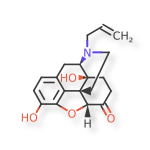
OC1=CC=C2C[C@H]3N(CC=C)CC[C@@]45[C@@H](OC1=C24)C(=O)CC[C@@]35O
InChI
InChIKey=UZHSEJADLWPNLE-GRGSLBFTSA-N
InChI=1S/C19H21NO4/c1-2-8-20-9-7-18-15-11-3-4-12(21)16(15)24-17(18)13(22)5-6-19(18,23)14(20)10-11/h2-4,14,17,21,23H,1,5-10H2/t14-,17+,18+,19-/m1/s1
| Molecular Formula | C19H21NO4 |
| Molecular Weight | 327.3743 |
| Charge | 0 |
| Count |
|
| Stereochemistry | ABSOLUTE |
| Additional Stereochemistry | No |
| Defined Stereocenters | 4 / 4 |
| E/Z Centers | 0 |
| Optical Activity | UNSPECIFIED |
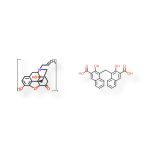
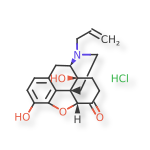
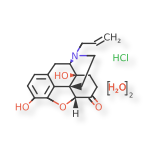
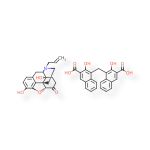
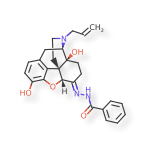
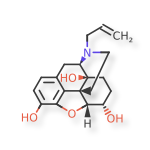
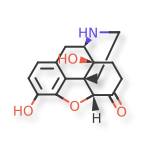
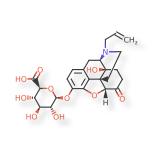
Naloxone, sold under the brand name Narcan among others, is a medication used to block the effects of opioids, especially in overdose. Naloxone has an extremely high affinity for μ-opioid receptors in the central nervous system (CNS). Naloxone is a μ-opioid receptor (MOR) inverse agonist, and its rapid blockade of those receptors often produces rapid onset of withdrawal symptoms. Naloxone also has an antagonist action, though with a lower affinity, at κ- (KOR) and δ-opioid receptors (DOR). If administered in the absence of concomitant opioid use, no functional pharmacological activity occurs (except the inability for the body to combat pain naturally). In contrast to direct opiate agonists, which elicit opiate withdrawal symptoms when discontinued in opiate-tolerant people, no evidence indicates the development of tolerance or dependence on naloxone. The mechanism of action is not completely understood, but studies suggest it functions to produce withdrawal symptoms by competing for opiate receptor sites within the CNS (a competitive antagonist, not a direct agonist), thereby preventing the action of both endogenous and xenobiotic opiates on these receptors without directly producing any effects itself. When administered parenterally (e.g. intravenously or by injection), as is most common, naloxone has a rapid distribution throughout the body. The mean serum half-life has been shown to range from 30 to 81 minutes, shorter than the average half-life of some opiates, necessitating repeat dosing if opioid receptors must be stopped from triggering for an extended period. Naloxone is primarily metabolized by the liver. Its major metabolite is naloxone-3-glucuronide, which is excreted in the urine. Naloxone is useful both in acute opioid overdose and in reducing respiratory or mental depression due to opioids. Whether it is useful in those in cardiac arrest due to an opioid overdose is unclear. Naloxone is poorly absorbed when taken by mouth, so it is commonly combined with a number of oral opioid preparations, including buprenorphine and pentazocine, so that when taken orally, just the opioid has an effect, but if misused by injecting, the naloxone blocks the effect of the opioid. In a meta-analysis of people with shock, including septic, cardiogenic, hemorrhagic, or spinal shock, those who received naloxone had improved blood flow. Naloxone is also experimentally used in the treatment for congenital insensitivity to pain with anhidrosis, an extremely rare disorder (one in 125 million) that renders one unable to feel pain or differentiate temperatures. Naloxone can also be used as an antidote in overdose of clonidine, a medication that lowers blood pressure.
CNS Activity
Approval Year
Targets
| Primary Target | Pharmacology | Condition | Potency |
|---|---|---|---|
Target ID: CHEMBL233 |
7.3 nM [IC50] | ||
Target ID: CHEMBL237 |
49.8 nM [IC50] | ||
Target ID: CHEMBL236 |
138.0 nM [IC50] |
Conditions
| Condition | Modality | Targets | Highest Phase | Product |
|---|---|---|---|---|
| Primary | NARCAN Approved UsePentazocine Hydrochloride and Naloxone Hydrochloride Tablets, USP is indicated for the relief of moderate to severe pain. Pentazocine Hydrochloride and Naloxone Hydrochloride Tablets, USP is indicated for oral use only. Launch Date1971 |
|||
| Primary | NARCAN Approved UsePentazocine Hydrochloride and Naloxone Hydrochloride Tablets, USP is indicated for the relief of moderate to severe pain. Pentazocine Hydrochloride and Naloxone Hydrochloride Tablets, USP is indicated for oral use only. Launch Date1971 |
|||
| Primary | NARCAN Approved UsePentazocine Hydrochloride and Naloxone Hydrochloride Tablets, USP is indicated for the relief of moderate to severe pain. Pentazocine Hydrochloride and Naloxone Hydrochloride Tablets, USP is indicated for oral use only. Launch Date1971 |
Cmax
| Value | Dose | Co-administered | Analyte | Population |
|---|---|---|---|---|
1.09 ng/mL EXPERIMENT https://pubmed.ncbi.nlm.nih.gov/28444856/ |
10 mg/kg single, nasal dose: 10 mg/kg route of administration: Nasal experiment type: SINGLE co-administered: |
NALOXONE plasma | Homo sapiens population: HEALTHY age: ADULT sex: UNKNOWN food status: UNKNOWN |
|
4.83 ng/mL DRUG LABEL https://www.fda.gov/media/95283/download |
4 mg single, nasal dose: 4 mg route of administration: Nasal experiment type: SINGLE co-administered: |
NALOXONE plasma | Homo sapiens population: HEALTHY age: ADULT sex: UNKNOWN food status: UNKNOWN |
|
0.87 ng/mL DRUG LABEL https://www.fda.gov/media/95283/download |
0.4 mg single, intramuscular dose: 0.4 mg route of administration: Intramuscular experiment type: SINGLE co-administered: |
NALOXONE plasma | Homo sapiens population: HEALTHY age: ADULT sex: UNKNOWN food status: UNKNOWN |
|
9.62 ng/mL DRUG LABEL https://www.fda.gov/media/95283/download |
8 mg single, nasal dose: 8 mg route of administration: Nasal experiment type: SINGLE co-administered: |
NALOXONE plasma | Homo sapiens population: HEALTHY age: ADULT sex: UNKNOWN food status: UNKNOWN |
AUC
| Value | Dose | Co-administered | Analyte | Population |
|---|---|---|---|---|
37.1 ng × min/mL EXPERIMENT https://pubmed.ncbi.nlm.nih.gov/28444856/ |
10 mg/kg single, nasal dose: 10 mg/kg route of administration: Nasal experiment type: SINGLE co-administered: |
NALOXONE plasma | Homo sapiens population: HEALTHY age: ADULT sex: UNKNOWN food status: UNKNOWN |
|
7.9 ng × h/mL DRUG LABEL https://www.fda.gov/media/95283/download |
4 mg single, nasal dose: 4 mg route of administration: Nasal experiment type: SINGLE co-administered: |
NALOXONE plasma | Homo sapiens population: HEALTHY age: ADULT sex: UNKNOWN food status: UNKNOWN |
|
1.68 ng × h/mL DRUG LABEL https://www.fda.gov/media/95283/download |
0.4 mg single, intramuscular dose: 0.4 mg route of administration: Intramuscular experiment type: SINGLE co-administered: |
NALOXONE plasma | Homo sapiens population: HEALTHY age: ADULT sex: UNKNOWN food status: UNKNOWN |
|
15 ng × h/mL DRUG LABEL https://www.fda.gov/media/95283/download |
8 mg single, nasal dose: 8 mg route of administration: Nasal experiment type: SINGLE co-administered: |
NALOXONE plasma | Homo sapiens population: HEALTHY age: ADULT sex: UNKNOWN food status: UNKNOWN |
T1/2
| Value | Dose | Co-administered | Analyte | Population |
|---|---|---|---|---|
28.2 min EXPERIMENT https://pubmed.ncbi.nlm.nih.gov/28444856/ |
10 mg/kg single, nasal dose: 10 mg/kg route of administration: Nasal experiment type: SINGLE co-administered: |
NALOXONE plasma | Homo sapiens population: HEALTHY age: ADULT sex: UNKNOWN food status: UNKNOWN |
|
1.2 h DRUG LABEL https://www.fda.gov/media/95283/download |
0.4 mg single, intramuscular dose: 0.4 mg route of administration: Intramuscular experiment type: SINGLE co-administered: |
NALOXONE plasma | Homo sapiens population: HEALTHY age: ADULT sex: UNKNOWN food status: UNKNOWN |
|
2.1 h DRUG LABEL https://www.fda.gov/media/95283/download |
8 mg single, nasal dose: 8 mg route of administration: Nasal experiment type: SINGLE co-administered: |
NALOXONE plasma | Homo sapiens population: HEALTHY age: ADULT sex: UNKNOWN food status: UNKNOWN |
Doses
| Dose | Population | Adverse events |
|---|---|---|
0.8 mg single, intramuscular Dose: 0.8 mg Route: intramuscular Route: single Dose: 0.8 mg Sources: |
healthy, 23.8 years (range: 22.6–25 years) Health Status: healthy Age Group: 23.8 years (range: 22.6–25 years) Sex: M+F Sources: |
|
160 mg/m2 single, intravenous Highest studied dose Dose: 160 mg/m2 Route: intravenous Route: single Dose: 160 mg/m2 Sources: |
unhealthy, 35-85 years |
Disc. AE: Hypotension, Bradycardia... Other AEs: Nausea, Emesis... AEs leading to discontinuation/dose reduction: Hypotension (3 patients) Other AEs:Bradycardia (2 patients) Myoclonus (1 patient) Hypertension (1 patient) Nausea (32%) Sources: Emesis (5%) Seizures (5%) Headache (5%) Confusion (5%) Agitation (3%) |
8 mg single, intranasal Dose: 8 mg Route: intranasal Route: single Dose: 8 mg Sources: |
healthy, adult Health Status: healthy Age Group: adult Sources: |
AEs
| AE | Significance | Dose | Population |
|---|---|---|---|
| Hypertension | 1 patient Disc. AE |
160 mg/m2 single, intravenous Highest studied dose Dose: 160 mg/m2 Route: intravenous Route: single Dose: 160 mg/m2 Sources: |
unhealthy, 35-85 years |
| Myoclonus | 1 patient Disc. AE |
160 mg/m2 single, intravenous Highest studied dose Dose: 160 mg/m2 Route: intravenous Route: single Dose: 160 mg/m2 Sources: |
unhealthy, 35-85 years |
| Bradycardia | 2 patients Disc. AE |
160 mg/m2 single, intravenous Highest studied dose Dose: 160 mg/m2 Route: intravenous Route: single Dose: 160 mg/m2 Sources: |
unhealthy, 35-85 years |
| Hypotension | 3 patients Disc. AE |
160 mg/m2 single, intravenous Highest studied dose Dose: 160 mg/m2 Route: intravenous Route: single Dose: 160 mg/m2 Sources: |
unhealthy, 35-85 years |
| Agitation | 3% | 160 mg/m2 single, intravenous Highest studied dose Dose: 160 mg/m2 Route: intravenous Route: single Dose: 160 mg/m2 Sources: |
unhealthy, 35-85 years |
| Nausea | 32% | 160 mg/m2 single, intravenous Highest studied dose Dose: 160 mg/m2 Route: intravenous Route: single Dose: 160 mg/m2 Sources: |
unhealthy, 35-85 years |
| Confusion | 5% | 160 mg/m2 single, intravenous Highest studied dose Dose: 160 mg/m2 Route: intravenous Route: single Dose: 160 mg/m2 Sources: |
unhealthy, 35-85 years |
| Emesis | 5% | 160 mg/m2 single, intravenous Highest studied dose Dose: 160 mg/m2 Route: intravenous Route: single Dose: 160 mg/m2 Sources: |
unhealthy, 35-85 years |
| Headache | 5% | 160 mg/m2 single, intravenous Highest studied dose Dose: 160 mg/m2 Route: intravenous Route: single Dose: 160 mg/m2 Sources: |
unhealthy, 35-85 years |
| Seizures | 5% | 160 mg/m2 single, intravenous Highest studied dose Dose: 160 mg/m2 Route: intravenous Route: single Dose: 160 mg/m2 Sources: |
unhealthy, 35-85 years |
Overview
| CYP3A4 | CYP2C9 | CYP2D6 | hERG |
|---|---|---|---|
OverviewOther
| Other Inhibitor | Other Substrate | Other Inducer |
|---|---|---|
Drug as victim
| Target | Modality | Activity | Metabolite | Clinical evidence |
|---|---|---|---|---|
Page: 7,8 |
likely | |||
Page: 7,8 |
no | |||
Page: 7,8 |
no | |||
Page: 7,8 |
no | |||
Page: 7,8 |
no | |||
Page: 7,8 |
no | |||
Page: 7,8 |
no | |||
Page: 7,8 |
no | |||
Page: 7,8 |
no | |||
Page: 7,8 |
no | |||
Page: 7,8 |
yes | |||
Page: 7,8 |
yes | |||
| yes |
PubMed
| Title | Date | PubMed |
|---|---|---|
| Effect of fentanyl on lidocaine-induced convulsions in mice. | 2005-12 |
|
| Ultrafine particles cross cellular membranes by nonphagocytic mechanisms in lungs and in cultured cells. | 2005-11 |
|
| Calcitonin gene-related peptide-induced suppression of luteinizing hormone pulses in the rat: the role of endogenous opioid peptides. | 2005-08-01 |
|
| Ventricular tachycardia following naloxone administration in an illicit drug misuse. | 2005-08 |
|
| [Effect of naloxone on expression of Bcl-2 protein and tumor necrosis factor-alpha in rats with acute myocardial ischemia/reperfusion injury]. | 2005-07 |
|
| Naloxone increases ketamine-induced hyperactivity in the open field in female rats. | 2005-07 |
|
| The opioid fentanyl affects light input, electrical activity and Per gene expression in the hamster suprachiasmatic nuclei. | 2005-06 |
|
| Prediction of genotoxicity of chemical compounds by statistical learning methods. | 2005-06 |
|
| Effective opiate-receptor antagonist therapy of cholestatic pruritus induced by an oral contraceptive. | 2005-05 |
|
| [Combination of morphine with low-dose naloxone for intravenous patient-controlled analgesia]. | 2005-04 |
|
| Morphine-induced chemotaxis and brain-derived neurotrophic factor expression in microglia. | 2005-01-12 |
|
| Influence of sweet tasting solutions on opioid withdrawal. | 2004-12-15 |
|
| Effect of agmatine on the development of morphine dependence in rats: potential role of cAMP system. | 2004-11-19 |
|
| [Effect of nitric oxide synthase inhibitor on the testis cell apoptosis in morphine-dependent rats]. | 2004-11 |
|
| Testosterone and luteinizing hormone responses to naloxone help predict sexual performance in rams. | 2004-11 |
|
| Evaluation of fresh and cryopreserved hepatocytes as in vitro drug metabolism tools for the prediction of metabolic clearance. | 2004-11 |
|
| Potentiated startle and hyperalgesia during withdrawal from acute morphine: effects of multiple opiate exposures. | 2004-11 |
|
| Effects of L-745,870, a dopamine D4 receptor antagonist, on naloxone-induced morphine dependence in mice. | 2004-10 |
|
| Differential roles of peripheral and spinal endothelin receptors in the micturition reflex in rats. | 2004-10 |
|
| [Preclinical management of accidental methadone intoxication of a 4-year-old girl. Antagonist or intubation?]. | 2004-10 |
|
| Molecular mechanisms in dizocilpine-induced attenuation of development of morphine dependence: an association with cortical Ca2+/calmodulin-dependent signal cascade. | 2004-07-09 |
|
| A neuroactive steroid, dehydroepiandrosterone sulfate, prevents the development of morphine dependence and tolerance via c-fos expression linked to the extracellular signal-regulated protein kinase. | 2004-07-09 |
|
| [Loss of consciousness in a child due to loperamide]. | 2004-07 |
|
| Identification of UGT2B9*2 and UGT2B33 isolated from female rhesus monkey liver. | 2004-06-01 |
|
| Narcan use in the endoscopy lab: an important component of patient safety. | 2004-04-13 |
|
| Magnesium influence on morphine--induced pharmacodependence in rats. | 2004-03 |
|
| Adverse events after naloxone treatment of episodes of suspected acute opioid overdose. | 2004-02 |
|
| Bovine lactoferrin has a nitric oxide-dependent hypotensive effect in rats. | 2004-02 |
|
| Rapid, transient, and dose-dependent expression of hsp70 messenger RNA in the rat brain after morphine treatment. | 2004 |
|
| Identification of opioid-regulated genes in human lymphocytic cells by differential display: upregulation of Krüppel-like factor 7 by morphine. | 2003-12-10 |
|
| Decrease of morphine-induced reward effects and withdrawal symptoms in mice overexpressing gamma-aminobutyric acid transporter I. | 2003-11-15 |
|
| Naloxone provokes similar pain facilitation as observed after short-term infusion of remifentanil in humans. | 2003-11 |
|
| Pharmacokinetics of high-dose buprenorphine following single administration of sublingual tablet formulations in opioid naïve healthy male volunteers under a naltrexone block. | 2003-10-24 |
|
| Morphine suppresses lymphocyte apoptosis by blocking p53-mediated death signaling. | 2003-09-05 |
|
| Systemic morphine-induced release of serotonin in the rostroventral medulla is not mimicked by morphine microinjection into the periaqueductal gray. | 2003-09 |
|
| Ibogaine attenuation of morphine withdrawal in mice: role of glutamate N-methyl-D-aspartate receptors. | 2003-08 |
|
| Safety of enteral naloxone and i.v. neostigmine when used to relieve constipation. | 2003-06-15 |
|
| Attitudes about prescribing take-home naloxone to injection drug users for the management of heroin overdose: a survey of street-recruited injectors in the San Francisco Bay Area. | 2003-06 |
|
| Preliminary evidence of health care provider support for naloxone prescription as overdose fatality prevention strategy in New York City. | 2003-06 |
|
| Human carboxylesterase 1: from drug metabolism to drug discovery. | 2003-06 |
|
| Heroin addicts to receive CPR training and Narcan. | 2003-05 |
|
| Structural basis of heroin and cocaine metabolism by a promiscuous human drug-processing enzyme. | 2003-05 |
|
| [Randomized double-blind clinical trial of moderate dosage naloxone in acute moderate and severe traumatic brain injury]. | 2002-02-28 |
|
| Naloxone-induced bradycardia in pithed rats: evidence for an interaction with the peripheral sympathetic nervous system and alpha-2 adrenoceptors. | 1992-12 |
|
| Changes in benzodiazepine-receptor activity modify morphine withdrawal syndrome in mice. | 1992-08 |
|
| Chronic naloxone administration, a potential treatment for migraine, enhances morphine-induced miosis. | 1992-07 |
|
| The calcium antagonist diltiazem has antiarrhythmic effects which are mediated in the brain through endogenous opioids. | 1992-05 |
|
| Antiarrhythmic action of naloxone. Suppression of picrotoxin-induced cardiac arrhythmias in the rat. | 1992-05 |
|
| The NMDA receptor antagonist MK-801 prevents long-lasting non-associative morphine tolerance in the rat. | 1992-03-20 |
|
| Prevention by morphine of apomorphine- and oxytocin-induced penile erection and yawning: site of action in the brain. | 1992-01 |
Sample Use Guides
Opioid Overdose–Known or Suspected: An initial dose of 0.4 mg to 2 mg of NARCAN may be administered intravenously. If the desired degree of counteraction and improvement in respiratory functions are not obtained, it may be repeated at two- to three-minute intervals. If no response is observed after 10 mg of NARCAN have been administered, the diagnosis of opioid-induced or partial opioid-induced toxicity should be questioned. Intramuscular or subcutaneous administration may be necessary if the intravenous route is not available.
Postoperative Opioid Depression: For the partial reversal of opioid depression following the use of opioids during surgery, smaller doses of NARCAN are usually sufficient. The dose of NARCAN should be titrated according to the patient’s response. For the initial reversal of respiratory depression, NARCAN should be injected in increments of 0.1 to 0.2 mg intravenously at two- to three-minute intervals to the desired degree of reversal, i.e., adequate ventilation and alertness without significant pain or discomfort. Larger than necessary dosage of NARCAN may result in significant reversal of analgesia and increase in blood pressure. Similarly, too rapid reversal may induce nausea, vomiting, sweating or circulatory stress.
Repeat doses of NARCAN may be required within one- to two-hour intervals depending upon the amount, type (i.e., short or long acting) and time interval since last administration of an opioid. Supplemental intramuscular doses have been shown to produce a longer lasting effect.
Route of Administration:
Other
MDCKII-MDR1 assay. Stock solutions of Naloxone (20 mM) were prepared in 100% DMSO and then diluted to the final concentration of 10 mkM, in Dulbecco’s PBS. Naloxone were tested in both directions, apicalto-basolateral (A→B) and basolateral-to-apical (B→A), in duplicate. The ratio BA/AB >2 indicates an efflux phenomena. Permeability studies were conducted at 37 ◦C in incubator for 60 min. The monolayer integrity was evaluated by measuring the TransEpithelial Electrical Resistance (TEER) by using the Millicell-ERS system (Millipore Corporation) and it was considered integer if the resistancewas between 200 and 300 cm2. After the transport study the monolayer integrity was measured
in each well by adding a 0.02 mg/mL solution of lucifer yellow (LY); the test was conducted at 37 ◦C for 60 min, and the fluorescence (RFU) was measured at 485/535 nm.
| Substance Class |
Chemical
Created
by
admin
on
Edited
Mon Mar 31 17:50:27 GMT 2025
by
admin
on
Mon Mar 31 17:50:27 GMT 2025
|
| Record UNII |
36B82AMQ7N
|
| Record Status |
Validated (UNII)
|
| Record Version |
|
-
Download
| Name | Type | Language | ||
|---|---|---|---|---|
|
Preferred Name | English | ||
|
Official Name | English | ||
|
Common Name | English | ||
|
Common Name | English | ||
|
Common Name | English | ||
|
Common Name | English | ||
|
Systematic Name | English | ||
|
Common Name | English | ||
|
Common Name | English | ||
|
Common Name | English | ||
|
Code | English | ||
|
Common Name | English | ||
|
Common Name | English | ||
|
Common Name | English |
| Classification Tree | Code System | Code | ||
|---|---|---|---|---|
|
FDA ORPHAN DRUG |
280209
Created by
admin on Mon Mar 31 17:50:27 GMT 2025 , Edited by admin on Mon Mar 31 17:50:27 GMT 2025
|
||
|
WHO-ESSENTIAL MEDICINES LIST |
4.2
Created by
admin on Mon Mar 31 17:50:27 GMT 2025 , Edited by admin on Mon Mar 31 17:50:27 GMT 2025
|
||
|
NDF-RT |
N0000000154
Created by
admin on Mon Mar 31 17:50:27 GMT 2025 , Edited by admin on Mon Mar 31 17:50:27 GMT 2025
|
||
|
EMA ASSESSMENT REPORTS |
SUBOXONE (AUTHORIZED: OPIOID-RELATED DISEASES)
Created by
admin on Mon Mar 31 17:50:27 GMT 2025 , Edited by admin on Mon Mar 31 17:50:27 GMT 2025
|
||
|
WHO-VATC |
QV03AB15
Created by
admin on Mon Mar 31 17:50:27 GMT 2025 , Edited by admin on Mon Mar 31 17:50:27 GMT 2025
|
||
|
FDA ORPHAN DRUG |
79093
Created by
admin on Mon Mar 31 17:50:27 GMT 2025 , Edited by admin on Mon Mar 31 17:50:27 GMT 2025
|
||
|
WHO-ATC |
V03AB15
Created by
admin on Mon Mar 31 17:50:27 GMT 2025 , Edited by admin on Mon Mar 31 17:50:27 GMT 2025
|
||
|
WHO-ATC |
A06AH04
Created by
admin on Mon Mar 31 17:50:27 GMT 2025 , Edited by admin on Mon Mar 31 17:50:27 GMT 2025
|
||
|
LIVERTOX |
NBK548244
Created by
admin on Mon Mar 31 17:50:27 GMT 2025 , Edited by admin on Mon Mar 31 17:50:27 GMT 2025
|
||
|
NDF-RT |
N0000175691
Created by
admin on Mon Mar 31 17:50:27 GMT 2025 , Edited by admin on Mon Mar 31 17:50:27 GMT 2025
|
||
|
WHO-ATC |
N02AA53
Created by
admin on Mon Mar 31 17:50:27 GMT 2025 , Edited by admin on Mon Mar 31 17:50:27 GMT 2025
|
||
|
NCI_THESAURUS |
C681
Created by
admin on Mon Mar 31 17:50:27 GMT 2025 , Edited by admin on Mon Mar 31 17:50:27 GMT 2025
|
| Code System | Code | Type | Description | ||
|---|---|---|---|---|---|
|
CHEMBL80
Created by
admin on Mon Mar 31 17:50:27 GMT 2025 , Edited by admin on Mon Mar 31 17:50:27 GMT 2025
|
PRIMARY | |||
|
Naloxone
Created by
admin on Mon Mar 31 17:50:27 GMT 2025 , Edited by admin on Mon Mar 31 17:50:27 GMT 2025
|
PRIMARY | |||
|
7459
Created by
admin on Mon Mar 31 17:50:27 GMT 2025 , Edited by admin on Mon Mar 31 17:50:27 GMT 2025
|
PRIMARY | |||
|
5284596
Created by
admin on Mon Mar 31 17:50:27 GMT 2025 , Edited by admin on Mon Mar 31 17:50:27 GMT 2025
|
PRIMARY | |||
|
100000085468
Created by
admin on Mon Mar 31 17:50:27 GMT 2025 , Edited by admin on Mon Mar 31 17:50:27 GMT 2025
|
PRIMARY | |||
|
NALOXONE
Created by
admin on Mon Mar 31 17:50:27 GMT 2025 , Edited by admin on Mon Mar 31 17:50:27 GMT 2025
|
PRIMARY | |||
|
1878
Created by
admin on Mon Mar 31 17:50:27 GMT 2025 , Edited by admin on Mon Mar 31 17:50:27 GMT 2025
|
PRIMARY | |||
|
7242
Created by
admin on Mon Mar 31 17:50:27 GMT 2025 , Edited by admin on Mon Mar 31 17:50:27 GMT 2025
|
PRIMARY | RxNorm | ||
|
36B82AMQ7N
Created by
admin on Mon Mar 31 17:50:27 GMT 2025 , Edited by admin on Mon Mar 31 17:50:27 GMT 2025
|
PRIMARY | |||
|
SUB09142MIG
Created by
admin on Mon Mar 31 17:50:27 GMT 2025 , Edited by admin on Mon Mar 31 17:50:27 GMT 2025
|
PRIMARY | |||
|
1526
Created by
admin on Mon Mar 31 17:50:27 GMT 2025 , Edited by admin on Mon Mar 31 17:50:27 GMT 2025
|
PRIMARY | |||
|
DTXSID8023349
Created by
admin on Mon Mar 31 17:50:27 GMT 2025 , Edited by admin on Mon Mar 31 17:50:27 GMT 2025
|
PRIMARY | |||
|
D009270
Created by
admin on Mon Mar 31 17:50:27 GMT 2025 , Edited by admin on Mon Mar 31 17:50:27 GMT 2025
|
PRIMARY | |||
|
36B82AMQ7N
Created by
admin on Mon Mar 31 17:50:27 GMT 2025 , Edited by admin on Mon Mar 31 17:50:27 GMT 2025
|
PRIMARY | |||
|
DB01183
Created by
admin on Mon Mar 31 17:50:27 GMT 2025 , Edited by admin on Mon Mar 31 17:50:27 GMT 2025
|
PRIMARY | |||
|
C62054
Created by
admin on Mon Mar 31 17:50:27 GMT 2025 , Edited by admin on Mon Mar 31 17:50:27 GMT 2025
|
PRIMARY | |||
|
1453005
Created by
admin on Mon Mar 31 17:50:27 GMT 2025 , Edited by admin on Mon Mar 31 17:50:27 GMT 2025
|
PRIMARY | |||
|
1638
Created by
admin on Mon Mar 31 17:50:27 GMT 2025 , Edited by admin on Mon Mar 31 17:50:27 GMT 2025
|
PRIMARY | |||
|
3279
Created by
admin on Mon Mar 31 17:50:27 GMT 2025 , Edited by admin on Mon Mar 31 17:50:27 GMT 2025
|
PRIMARY | |||
|
207-365-7
Created by
admin on Mon Mar 31 17:50:27 GMT 2025 , Edited by admin on Mon Mar 31 17:50:27 GMT 2025
|
PRIMARY | |||
|
70413
Created by
admin on Mon Mar 31 17:50:27 GMT 2025 , Edited by admin on Mon Mar 31 17:50:27 GMT 2025
|
PRIMARY | |||
|
m7717
Created by
admin on Mon Mar 31 17:50:27 GMT 2025 , Edited by admin on Mon Mar 31 17:50:27 GMT 2025
|
PRIMARY | Merck Index | ||
|
465-65-6
Created by
admin on Mon Mar 31 17:50:27 GMT 2025 , Edited by admin on Mon Mar 31 17:50:27 GMT 2025
|
PRIMARY |
| Related Record | Type | Details | ||
|---|---|---|---|---|
|
TARGET -> INHIBITOR |
BINDING
IC50
|
||
|
SALT/SOLVATE -> PARENT |
|
||
|
TARGET -> INHIBITOR |
|
||
|
METABOLIC ENZYME -> SUBSTRATE | |||
|
TARGET -> INHIBITOR |
IC50
|
||
|
|
SALT/SOLVATE -> PARENT |
|
||
|
|
SALT/SOLVATE -> PARENT |
|
||
|
|
SALT/SOLVATE -> PARENT |
|
||
|
TARGET -> INHIBITOR |
Naloxone is a non-selective and competitive opioid receptor antagonist
IC50
|
||
|
DERIVATIVE -> PARENT |
|
||
|
TARGET -> INHIBITOR |
Mu Receptor [3H]DAMGO BINDING INHIBITION
BINDING
Ki
|

| Related Record | Type | Details | ||
|---|---|---|---|---|
|
METABOLITE LESS ACTIVE -> PARENT | |||
|
METABOLITE -> PARENT |
URINE
|
||
|
METABOLITE -> PARENT |
MAJOR
URINE
|
||
|
METABOLITE -> PARENT |
URINE
|
||
|
METABOLITE -> PARENT |
|
| Related Record | Type | Details | ||
|---|---|---|---|---|
|
|
ACTIVE MOIETY |
|
| Name | Property Type | Amount | Referenced Substance | Defining | Parameters | References |
|---|---|---|---|---|---|---|
| Biological Half-life | PHARMACOKINETIC |
|
|
|||
| Tmax | PHARMACOKINETIC |
|
|
|||