


Details
| Stereochemistry | ABSOLUTE |
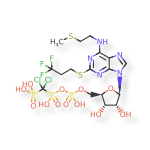
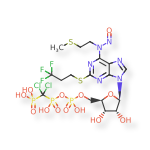
| Molecular Formula | C17H25Cl2F3N5O12P3S2 |
| Molecular Weight | 776.359 |
| Optical Activity | UNSPECIFIED |
| Defined Stereocenters | 4 / 4 |
| E/Z Centers | 0 |
| Charge | 0 |
SHOW SMILES / InChI
SMILES
CSCCNC1=C2N=CN([C@@H]3O[C@H](COP(O)(=O)OP(O)(=O)C(Cl)(Cl)P(O)(O)=O)[C@@H](O)[C@H]3O)C2=NC(SCCC(F)(F)F)=N1
InChI
InChIKey=PAEBIVWUMLRPSK-IDTAVKCVSA-N
InChI=1S/C17H25Cl2F3N5O12P3S2/c1-43-5-3-23-12-9-13(26-15(25-12)44-4-2-16(20,21)22)27(7-24-9)14-11(29)10(28)8(38-14)6-37-42(35,36)39-41(33,34)17(18,19)40(30,31)32/h7-8,10-11,14,28-29H,2-6H2,1H3,(H,33,34)(H,35,36)(H,23,25,26)(H2,30,31,32)/t8-,10-,11-,14-/m1/s1
| Molecular Formula | C17H25Cl2F3N5O12P3S2 |
| Molecular Weight | 776.359 |
| Charge | 0 |
| Count |
|
| Stereochemistry | ABSOLUTE |
| Additional Stereochemistry | No |
| Defined Stereocenters | 4 / 4 |
| E/Z Centers | 0 |
| Optical Activity | UNSPECIFIED |
Cangrelor is a P2Y12 inhibitor that has been approved as an antiplatelet drug. It is marketed in the US under the brand name Kengreal and in Europe as Kengrexal. Cangrelor is an intravenous, direct-acting reversible P2Y12 inhibitor for patients undergoing percutaneous coronary intervention.
Originator
Approval Year
Targets
| Primary Target | Pharmacology | Condition | Potency |
|---|---|---|---|
Target ID: Q9H244 Gene ID: 64805.0 Gene Symbol: P2RY12 Target Organism: Homo sapiens (Human) |
0.4 nM [IC50] | ||
Target ID: Q09QM4 Gene ID: 767613.0 Gene Symbol: Gpr17 Target Organism: Rattus norvegicus (Rat) |
Conditions
| Condition | Modality | Targets | Highest Phase | Product |
|---|---|---|---|---|
| Preventing | KENGREAL Approved UseKENGREAL is indicated as an adjunct to percutaneous coronary intervention (PCI) to reduce the risk of periprocedural myocardial infarction (MI), repeat coronary revascularization, and stent thrombosis (ST) in patients who have not been treated with a P2Y12 platelet inhibitor and are not being given a glycoprotein IIb/IIIa inhibitor [see Clinical Studies ( 14.1 ) Launch Date2015 |
|||
| Preventing | KENGREAL Approved UseKENGREAL is indicated as an adjunct to percutaneous coronary intervention (PCI) to reduce the risk of periprocedural myocardial infarction (MI), repeat coronary revascularization, and stent thrombosis (ST) in patients who have not been treated with a P2Y12 platelet inhibitor and are not being given a glycoprotein IIb/IIIa inhibitor [see Clinical Studies ( 14.1 ) Launch Date2015 |
|||
| Primary | KENGREAL Approved UseKENGREAL is indicated as an adjunct to percutaneous coronary intervention (PCI) to reduce the risk of periprocedural myocardial infarction (MI), repeat coronary revascularization, and stent thrombosis (ST) in patients who have not been treated with a P2Y12 platelet inhibitor and are not being given a glycoprotein IIb/IIIa inhibitor [see Clinical Studies ( 14.1 ) Launch Date2015 |
Cmax
| Value | Dose | Co-administered | Analyte | Population |
|---|---|---|---|---|
299 ng/mL EXPERIMENT https://pubmed.ncbi.nlm.nih.gov/19779037 |
135 μg/kg other, intravenous dose: 135 μg/kg route of administration: Intravenous experiment type: OTHER co-administered: |
CANGRELOR plasma | Homo sapiens population: HEALTHY age: ADULT sex: FEMALE / MALE food status: UNKNOWN |
|
635 ng/mL EXPERIMENT https://pubmed.ncbi.nlm.nih.gov/19779037 |
270 μg/kg other, intravenous dose: 270 μg/kg route of administration: Intravenous experiment type: OTHER co-administered: |
CANGRELOR plasma | Homo sapiens population: HEALTHY age: ADULT sex: FEMALE / MALE food status: UNKNOWN |
AUC
| Value | Dose | Co-administered | Analyte | Population |
|---|---|---|---|---|
249 ng × h/mL EXPERIMENT https://pubmed.ncbi.nlm.nih.gov/19779037 |
135 μg/kg other, intravenous dose: 135 μg/kg route of administration: Intravenous experiment type: OTHER co-administered: |
CANGRELOR plasma | Homo sapiens population: HEALTHY age: ADULT sex: FEMALE / MALE food status: UNKNOWN |
|
478 ng × h/mL EXPERIMENT https://pubmed.ncbi.nlm.nih.gov/19779037 |
270 μg/kg other, intravenous dose: 270 μg/kg route of administration: Intravenous experiment type: OTHER co-administered: |
CANGRELOR plasma | Homo sapiens population: HEALTHY age: ADULT sex: FEMALE / MALE food status: UNKNOWN |
T1/2
| Value | Dose | Co-administered | Analyte | Population |
|---|---|---|---|---|
3.61 min EXPERIMENT https://pubmed.ncbi.nlm.nih.gov/19779037 |
135 μg/kg other, intravenous dose: 135 μg/kg route of administration: Intravenous experiment type: OTHER co-administered: |
CANGRELOR plasma | Homo sapiens population: HEALTHY age: ADULT sex: FEMALE / MALE food status: UNKNOWN |
|
3.71 min EXPERIMENT https://pubmed.ncbi.nlm.nih.gov/19779037 |
270 μg/kg other, intravenous dose: 270 μg/kg route of administration: Intravenous experiment type: OTHER co-administered: |
CANGRELOR plasma | Homo sapiens population: HEALTHY age: ADULT sex: FEMALE / MALE food status: UNKNOWN |
Funbound
| Value | Dose | Co-administered | Analyte | Population |
|---|---|---|---|---|
2% |
unknown, intravenous |
CANGRELOR plasma | Homo sapiens population: UNKNOWN age: UNKNOWN sex: UNKNOWN food status: UNKNOWN |
Doses
| Dose | Population | Adverse events |
|---|---|---|
300 ug/kg single, intravenous Overdose Dose: 300 ug/kg Route: intravenous Route: single Dose: 300 ug/kg Sources: |
unhealthy |
|
12 ug/kg/min single, intravenous Overdose Dose: 12 ug/kg/min Route: intravenous Route: single Dose: 12 ug/kg/min Sources: |
unhealthy |
|
30 ug/kg single, intravenous Recommended Dose: 30 ug/kg Route: intravenous Route: single Dose: 30 ug/kg Sources: |
unhealthy Health Status: unhealthy Sex: M+F Sources: |
Disc. AE: Bleeding, Coronary artery dissection... AEs leading to discontinuation/dose reduction: Bleeding (0.3%) Sources: Coronary artery dissection (0.6%) Coronary artery perforation (0.6%) Dyspnea (0.6%) |
AEs
| AE | Significance | Dose | Population |
|---|---|---|---|
| Bleeding | 0.3% Disc. AE |
30 ug/kg single, intravenous Recommended Dose: 30 ug/kg Route: intravenous Route: single Dose: 30 ug/kg Sources: |
unhealthy Health Status: unhealthy Sex: M+F Sources: |
| Coronary artery dissection | 0.6% Disc. AE |
30 ug/kg single, intravenous Recommended Dose: 30 ug/kg Route: intravenous Route: single Dose: 30 ug/kg Sources: |
unhealthy Health Status: unhealthy Sex: M+F Sources: |
| Coronary artery perforation | 0.6% Disc. AE |
30 ug/kg single, intravenous Recommended Dose: 30 ug/kg Route: intravenous Route: single Dose: 30 ug/kg Sources: |
unhealthy Health Status: unhealthy Sex: M+F Sources: |
| Dyspnea | 0.6% Disc. AE |
30 ug/kg single, intravenous Recommended Dose: 30 ug/kg Route: intravenous Route: single Dose: 30 ug/kg Sources: |
unhealthy Health Status: unhealthy Sex: M+F Sources: |
Overview
| CYP3A4 | CYP2C9 | CYP2D6 | hERG |
|---|---|---|---|
OverviewOther
| Other Inhibitor | Other Substrate | Other Inducer |
|---|---|---|
Drug as perpetrator
| Target | Modality | Activity | Metabolite | Clinical evidence |
|---|---|---|---|---|
| no [IC50 58 uM] | ||||
| no [IC50 58 uM] | ||||
| no [IC50 >100 uM] | ||||
| no [IC50 >100 uM] | ||||
| no [IC50 >100 uM] | ||||
| no [IC50 >100 uM] | ||||
| no [IC50 >100 uM] | ||||
| no [IC50 >100 uM] | ||||
| no [IC50 >100 uM] | ||||
| no [IC50 >100 uM] | ||||
| no [IC50 >100 uM] | ||||
| no [IC50 >100 uM] | ||||
| no [IC50 >100 uM] | ||||
| no [IC50 >100 uM] | ||||
| no [IC50 >100 uM] | ||||
| no [IC50 >100 uM] | ||||
| no [IC50 >100 uM] | ||||
| no [IC50 >100 uM] | ||||
| no [IC50 >100 uM] | ||||
| no [IC50 >100 uM] | ||||
| no [IC50 >100 uM] | ||||
| no | ||||
| no | ||||
| weak | ||||
| weak | ||||
| yes | ||||
| yes |
Drug as victim
| Target | Modality | Activity | Metabolite | Clinical evidence |
|---|---|---|---|---|
| yes | ||||
| yes |
PubMed
| Title | Date | PubMed |
|---|---|---|
| Development of selective agonists and antagonists of P2Y receptors. | 2009-03 |
|
| Detection of P2Y(14) protein in platelets and investigation of the role of P2Y(14) in platelet function in comparison with the EP(3) receptor. | 2008-08 |
|
| Clinical overview of promising nonthienopyridine antiplatelet agents. | 2008-08 |
|
| Pharmacology of emerging novel platelet inhibitors. | 2008-08 |
|
| The ATP-gated P2X1 receptor plays a pivotal role in activation of aspirin-treated platelets by thrombin and epinephrine. | 2008-07-04 |
|
| New antiplatelet therapies in development. | 2008-07-01 |
|
| Antiplatelet therapy in acute coronary syndromes. | 2008-07 |
|
| The reversible P2Y antagonist cangrelor influences the ability of the active metabolites of clopidogrel and prasugrel to produce irreversible inhibition of platelet function. | 2008-07 |
|
| GPR17: molecular modeling and dynamics studies of the 3-D structure and purinergic ligand binding features in comparison with P2Y receptors. | 2008-06-04 |
|
| Multiple electrode aggregometry and P2Y(12) antagonists. | 2008-06 |
|
| Changing trends in anti-coagulant therapies. Are heparins and oral anti-coagulants challenged? | 2008-06 |
|
| Akt activation is involved in P2Y12 receptor-mediated chemotaxis of microglia. | 2008-05-15 |
|
| P2Y12 receptors in spinal microglia are required for neuropathic pain after peripheral nerve injury. | 2008-05-07 |
|
| Coronary atherothrombotic disease: progress in antiplatelet therapy. | 2008-05 |
|
| Antiplatelet therapy for secondary prevention of noncardioembolic ischemic stroke: a critical review. | 2008-05 |
|
| UCB Pharma research day-25 October 2007 'Glia-neuron interactions and purinergic receptors in neurological disorders'. | 2008-03 |
|
| P2 receptors, platelet function and pharmacological implications. | 2008-03 |
|
| Acyl derivatives of coenzyme A inhibit platelet function via antagonism at P2Y1 and P2Y12 receptors: a new finding that may influence the design of anti-thrombotic agents. | 2008-03 |
|
| The active metabolite of prasugrel effectively blocks the platelet P2Y12 receptor and inhibits procoagulant and pro-inflammatory platelet responses. | 2008-03 |
|
| P2Y12 antagonism: promises and challenges. | 2008-03 |
|
| Survival of heparins, oral anticoagulants, and aspirin after the year 2010. | 2008-02 |
|
| Modulation of platelet and leucocyte function by a Chinese herbal formulation as compared with conventional antiplatelet agents. | 2008-02 |
|
| Peripheral tachykinins and the neurokinin receptor NK1 are required for platelet thrombus formation. | 2008-01-15 |
|
| Transitioning patients from cangrelor to clopidogrel: pharmacodynamic evidence of a competitive effect. | 2008 |
|
| Enhanced platelet aggregation and activation under conditions of hypothermia. | 2007-12 |
|
| Antithrombotic therapy and the transition to the catheterization laboratory in UA/NSTEMI. | 2007-10 |
|
| Preliminary experience with intravenous P2Y12 platelet receptor inhibition as an adjunct to reduced-dose alteplase during acute myocardial infarction: results of the Safety, Tolerability and Effect on Patency in Acute Myocardial Infarction (STEP-AMI) angiographic trial. | 2007-10 |
|
| Involvement of P2X and P2Y receptors in microglial activation in vivo. | 2007-09 |
|
| Influence of preparative procedures on assay of platelet function and apparent effects of antiplatelet agents. | 2007-08-15 |
|
| New antiplatelet therapies for acute coronary syndromes. | 2007-07 |
|
| Residual platelet ADP reactivity after clopidogrel treatment is dependent on activation of both the unblocked P2Y(1) and the P2Y (12) receptor and is correlated with protein expression of P2Y (12). | 2007-06 |
|
| Primary and secondary agonists can use P2X(1) receptors as a major pathway to increase intracellular Ca(2+) in the human platelet. | 2007-05 |
|
| Seven Golden Rules for heuristic filtering of molecular formulas obtained by accurate mass spectrometry. | 2007-03-27 |
|
| Glycoprotein Ibalpha inhibition and ADP receptor antagonists, but not aspirin, reduce platelet thrombus formation in flowing blood exposed to atherosclerotic plaques. | 2007-03 |
|
| Dyspnoea after antiplatelet agents: the AZD6140 controversy. | 2007-03 |
|
| Inhibition of the platelet P2Y12 receptor for adenosine diphosphate potentiates the antiplatelet effect of prostacyclin. | 2007-03 |
|
| Optimal management of platelet function after coronary stenting. | 2007-02 |
|
| Platelet P2 receptors: old and new targets for antithrombotic drugs. | 2007-01 |
|
| ADP receptor antagonism: what's in the pipeline? | 2007 |
|
| Optimizing platelet P2Y12 inhibition for patients undergoing PCI. | 2007 |
|
| Brief review: coronary drug-eluting stents and anesthesia. | 2006-12 |
|
| Comparison of VASP-phosphorylation assay to light-transmission aggregometry in assessing inhibition of the platelet ADP P2Y12 receptor. | 2006-12 |
|
| Aspirin and clopidogrel resistance: consideration and management. | 2006-10 |
|
| ADP receptors: inhibitory strategies for antiplatelet therapy. | 2006-09-01 |
|
| Effects on blood compatibility in vitro by combining a direct P2Y12 receptor inhibitor and heparin coating of stents. | 2006-08 |
|
| ADP receptors: inhibitory strategies for antiplatelet therapy. | 2006-06 |
|
| Can the PFA-100 be modified to detect P2Y12 inhibition? | 2006-06 |
|
| Critical role of ADP interaction with P2Y12 receptor in the maintenance of alpha(IIb)beta3 activation: association with Rap1B activation. | 2006-06 |
|
| Cangrelor for treatment of coronary thrombosis. | 2006-05 |
|
| Therapeutic goals for effective platelet inhibition: a consensus document. | 2006 |
Sample Use Guides
Cangrelor is the active ingredient in KENGREAL which is administered at 30 micro-g/kg as an intravenous bolus prior to PCI and followed immediately by a 4 micro-g/kg/min IV infusion for at least 2 hours or duration of the procedure, whichever is longer.
Route of Administration:
Intravenous
Primary OPCs were isolated from mixed glial cultures from postnatal day 2 Sprague-Dawley rat cortex. Cells were suspended in NM15 Medium containing MEM, 15% heat-inactivated fetal bovine serum, 6 mg/mL glucose, 100 U/mL penicillin, 100 micro-g/mL streptomycin, 5 micro-g/mL insulin, and incubated at room Temperature in a RAN2-Ab-precoated plate. After 20 min, floating cells were transferred to a second RAN2-Ab-precoated plate and incubated for additional 20 min at RT. To verify whether OPCs can generate neurons under a standard protocol of oligodendrocyte differentiation, cells were plated in Neurobasal medium with 2 % B27 Supplement, 2 mM L-glutamine, 10 ng/ml human platelet-derived growth factor-BB, and 10 ng/ml human basic fibroblast growth factor to promote proliferation. After 2 days, OPCs were shifted to differentiating medium, and either grown under control conditions or exposed to the anticonvulsant agent valproic acid (VPA, 500 micro-M) for 24–72 h, fixed, and immunostained for GPR17 and the neuronal marker βIII-tubulin. The GPR17 antagonist Cangrelor (10 micro-M) was used in parallel to VPS (500 micro-M). The percentage of GPR17/βIII-tub double-positive cells over the total cell population increased in cultures treated with either Cangrelor or VPA. It was also observed that in Cangralor treated cells the percentage of NG2/GPR17 double-positive cells calculated on the total number of cells decreased, indicating that a subset of OPCs is shifting its fate from oligodendrocytes to neurons.
| Substance Class |
Chemical
Created
by
admin
on
Edited
Mon Mar 31 18:20:43 GMT 2025
by
admin
on
Mon Mar 31 18:20:43 GMT 2025
|
| Record UNII |
6AQ1Y404U7
|
| Record Status |
Validated (UNII)
|
| Record Version |
|
-
Download
| Name | Type | Language | ||
|---|---|---|---|---|
|
Preferred Name | English | ||
|
Official Name | English | ||
|
Common Name | English | ||
|
Common Name | English | ||
|
Common Name | English | ||
|
Common Name | English | ||
|
Common Name | English | ||
|
Common Name | English | ||
|
Common Name | English | ||
|
Code | English |
| Classification Tree | Code System | Code | ||
|---|---|---|---|---|
|
NDF-RT |
N0000182142
Created by
admin on Mon Mar 31 18:20:43 GMT 2025 , Edited by admin on Mon Mar 31 18:20:43 GMT 2025
|
||
|
NCI_THESAURUS |
C1327
Created by
admin on Mon Mar 31 18:20:43 GMT 2025 , Edited by admin on Mon Mar 31 18:20:43 GMT 2025
|
||
|
WHO-ATC |
B01AC25
Created by
admin on Mon Mar 31 18:20:43 GMT 2025 , Edited by admin on Mon Mar 31 18:20:43 GMT 2025
|
| Code System | Code | Type | Description | ||
|---|---|---|---|---|---|
|
m3019
Created by
admin on Mon Mar 31 18:20:43 GMT 2025 , Edited by admin on Mon Mar 31 18:20:43 GMT 2025
|
PRIMARY | Merck Index | ||
|
9854012
Created by
admin on Mon Mar 31 18:20:43 GMT 2025 , Edited by admin on Mon Mar 31 18:20:43 GMT 2025
|
PRIMARY | |||
|
6AQ1Y404U7
Created by
admin on Mon Mar 31 18:20:43 GMT 2025 , Edited by admin on Mon Mar 31 18:20:43 GMT 2025
|
PRIMARY | |||
|
90841
Created by
admin on Mon Mar 31 18:20:43 GMT 2025 , Edited by admin on Mon Mar 31 18:20:43 GMT 2025
|
PRIMARY | |||
|
SUB26448
Created by
admin on Mon Mar 31 18:20:43 GMT 2025 , Edited by admin on Mon Mar 31 18:20:43 GMT 2025
|
PRIMARY | |||
|
7883
Created by
admin on Mon Mar 31 18:20:43 GMT 2025 , Edited by admin on Mon Mar 31 18:20:43 GMT 2025
|
PRIMARY | |||
|
5006
Created by
admin on Mon Mar 31 18:20:43 GMT 2025 , Edited by admin on Mon Mar 31 18:20:43 GMT 2025
|
PRIMARY | |||
|
C76395
Created by
admin on Mon Mar 31 18:20:43 GMT 2025 , Edited by admin on Mon Mar 31 18:20:43 GMT 2025
|
PRIMARY | |||
|
100000092769
Created by
admin on Mon Mar 31 18:20:43 GMT 2025 , Edited by admin on Mon Mar 31 18:20:43 GMT 2025
|
PRIMARY | |||
|
C117446
Created by
admin on Mon Mar 31 18:20:43 GMT 2025 , Edited by admin on Mon Mar 31 18:20:43 GMT 2025
|
PRIMARY | |||
|
90836
Created by
admin on Mon Mar 31 18:20:43 GMT 2025 , Edited by admin on Mon Mar 31 18:20:43 GMT 2025
|
PRIMARY | |||
|
1776
Created by
admin on Mon Mar 31 18:20:43 GMT 2025 , Edited by admin on Mon Mar 31 18:20:43 GMT 2025
|
PRIMARY | |||
|
1656052
Created by
admin on Mon Mar 31 18:20:43 GMT 2025 , Edited by admin on Mon Mar 31 18:20:43 GMT 2025
|
PRIMARY | RxNorm | ||
|
6AQ1Y404U7
Created by
admin on Mon Mar 31 18:20:43 GMT 2025 , Edited by admin on Mon Mar 31 18:20:43 GMT 2025
|
PRIMARY | |||
|
N0000182143
Created by
admin on Mon Mar 31 18:20:43 GMT 2025 , Edited by admin on Mon Mar 31 18:20:43 GMT 2025
|
PRIMARY | P2Y12 Receptor Antagonists [MoA] | ||
|
RR-120
Created by
admin on Mon Mar 31 18:20:43 GMT 2025 , Edited by admin on Mon Mar 31 18:20:43 GMT 2025
|
PRIMARY | |||
|
DB06441
Created by
admin on Mon Mar 31 18:20:43 GMT 2025 , Edited by admin on Mon Mar 31 18:20:43 GMT 2025
|
PRIMARY | |||
|
CANGRELOR
Created by
admin on Mon Mar 31 18:20:43 GMT 2025 , Edited by admin on Mon Mar 31 18:20:43 GMT 2025
|
PRIMARY | |||
|
163706-06-7
Created by
admin on Mon Mar 31 18:20:43 GMT 2025 , Edited by admin on Mon Mar 31 18:20:43 GMT 2025
|
PRIMARY | |||
|
DTXSID90167651
Created by
admin on Mon Mar 31 18:20:43 GMT 2025 , Edited by admin on Mon Mar 31 18:20:43 GMT 2025
|
PRIMARY | |||
|
CHEMBL334966
Created by
admin on Mon Mar 31 18:20:43 GMT 2025 , Edited by admin on Mon Mar 31 18:20:43 GMT 2025
|
PRIMARY |
| Related Record | Type | Details | ||
|---|---|---|---|---|
|
|
TARGET -> INHIBITOR |
|
||
|
EXCRETED UNCHANGED |
The chromatographic method used did not differentiate between cangrelor (AR-69931) and one of its metabolite AR-C90439 in this study and so the presence or absence of cangrelor (AR-C69931) in urine or feces cannot be confirmed.
|
||
|
|
SALT/SOLVATE -> PARENT | |||
|
BINDER->LIGAND |
BINDING
|

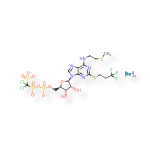

| Related Record | Type | Details | ||
|---|---|---|---|---|
|
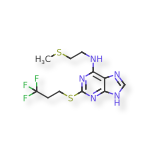
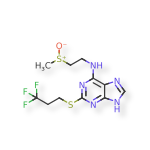
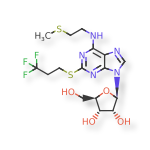
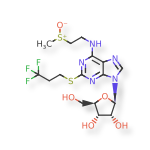
METABOLITE -> PARENT |
MINOR
FECAL
|
||
|
METABOLITE -> PARENT |
MINOR
FECAL
|
||
|
METABOLITE -> PARENT |
MAJOR
PLASMA
|
||
|
METABOLITE -> PARENT |
MAJOR
URINE
|
| Related Record | Type | Details | ||
|---|---|---|---|---|
|
IMPURITY -> PARENT |
|
| Related Record | Type | Details | ||
|---|---|---|---|---|
|
|
ACTIVE MOIETY |
| Name | Property Type | Amount | Referenced Substance | Defining | Parameters | References |
|---|---|---|---|---|---|---|
| Tmax | PHARMACOKINETIC |
|
INTRAVENOUS ADMINISTRATION |
|
||
| Biological Half-life | PHARMACOKINETIC |
|
|
|||
| Volume of Distribution | PHARMACOKINETIC |
|
|
|||