


Details
| Stereochemistry | ACHIRAL |
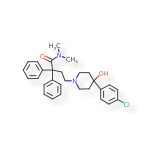
| Molecular Formula | C29H33ClN2O2 |
| Molecular Weight | 477.038 |
| Optical Activity | NONE |
| Defined Stereocenters | 0 / 0 |
| E/Z Centers | 0 |
| Charge | 0 |
SHOW SMILES / InChI
SMILES
CN(C)C(=O)C(CCN1CCC(O)(CC1)C2=CC=C(Cl)C=C2)(C3=CC=CC=C3)C4=CC=CC=C4
InChI
InChIKey=RDOIQAHITMMDAJ-UHFFFAOYSA-N
InChI=1S/C29H33ClN2O2/c1-31(2)27(33)29(24-9-5-3-6-10-24,25-11-7-4-8-12-25)19-22-32-20-17-28(34,18-21-32)23-13-15-26(30)16-14-23/h3-16,34H,17-22H2,1-2H3
| Molecular Formula | C29H33ClN2O2 |
| Molecular Weight | 477.038 |
| Charge | 0 |
| Count |
|
| Stereochemistry | ACHIRAL |
| Additional Stereochemistry | No |
| Defined Stereocenters | 0 / 0 |
| E/Z Centers | 0 |
| Optical Activity | NONE |
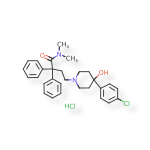
Loperamide is a commonly used over-the-counter (OTC) and prescription medicine that is approved to help control symptoms of diarrhea, including Travelers’ Diarrhea. The maximum approved daily dose for adults is 8 mg per day for OTC use and 16 mg per day for prescription use. It is sold under the OTC brand name Imodium A-D, as store brands, and as generics. In vitro and animal studies show that IMODIUM® (loperamide hydrochloride) acts by slowing
intestinal motility and by affecting water and electrolyte movement through the bowel.
Loperamide binds to the opiate receptor in the gut wall. Consequently, it inhibits the release of
acetylcholine and prostaglandins, thereby reducing propulsive peristalsis, and increasing
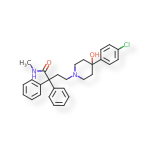
intestinal transit time. Loperamide increases the tone of the anal sphincter, thereby reducing incontinence and urgency. Loperamide is also indicated for reducing the volume of discharge from ileostomies. In man, Loperamide prolongs the transit time of the intestinal contents. It reduces the daily fecal volume, increases the viscosity and bulk density, and diminishes the loss of fluid and electrolytes. Tolerance to the antidiarrheal effect has not been observed. Loperamide is an opioid receptor agonist and acts on the mu opioid receptors in the myenteric plexus large intestines; it does not affect the central nervous system like other opioids. It works specifically by decreasing the activity of the myenteric plexus which decreases the motility of the circular and longitudinal smooth muscles of the intestinal wall. This increases the amount of time substances stay in the intestine, allowing for more water to be absorbed out of the fecal matter. Loperamide also decreases colonic mass movements and suppresses the gastrocolic reflex.
Approval Year
Cmax
| Value | Dose | Co-administered | Analyte | Population |
|---|---|---|---|---|
2.24 ng/mL EXPERIMENT https://www.ncbi.nlm.nih.gov/pubmed/438356 |
8 mg single, oral dose: 8 mg route of administration: Oral experiment type: SINGLE co-administered: |
LOPERAMIDE blood | Homo sapiens population: HEALTHY age: ADULT sex: MALE food status: FASTED |
AUC
| Value | Dose | Co-administered | Analyte | Population |
|---|---|---|---|---|
26.1 ng × h/mL EXPERIMENT https://www.ncbi.nlm.nih.gov/pubmed/438356 |
8 mg single, oral dose: 8 mg route of administration: Oral experiment type: SINGLE co-administered: |
LOPERAMIDE blood | Homo sapiens population: HEALTHY age: ADULT sex: MALE food status: FASTED |
T1/2
| Value | Dose | Co-administered | Analyte | Population |
|---|---|---|---|---|
10.8 h |
4 mg single, oral dose: 4 mg route of administration: Oral experiment type: SINGLE co-administered: |
LOPERAMIDE plasma | Homo sapiens population: HEALTHY age: ADULT sex: FEMALE / MALE food status: UNKNOWN |
|
11.2 h EXPERIMENT https://www.ncbi.nlm.nih.gov/pubmed/438356 |
8 mg single, oral dose: 8 mg route of administration: Oral experiment type: SINGLE co-administered: |
LOPERAMIDE blood | Homo sapiens population: HEALTHY age: ADULT sex: MALE food status: FASTED |
Funbound
| Value | Dose | Co-administered | Analyte | Population |
|---|---|---|---|---|
5% |
4 mg single, oral dose: 4 mg route of administration: Oral experiment type: SINGLE co-administered: |
LOPERAMIDE plasma | Homo sapiens population: HEALTHY age: ADULT sex: FEMALE / MALE food status: UNKNOWN |
Doses
| Dose | Population | Adverse events |
|---|---|---|
400 mg 2 times / day multiple, oral Overdose Dose: 400 mg, 2 times / day Route: oral Route: multiple Dose: 400 mg, 2 times / day Sources: |
unhealthy, 26 Health Status: unhealthy Age Group: 26 Sex: M Sources: |
Disc. AE: Cardiac arrest... AEs leading to discontinuation/dose reduction: Cardiac arrest (grade 5) Sources: |
792 mg 1 times / day multiple, oral Overdose Dose: 792 mg, 1 times / day Route: oral Route: multiple Dose: 792 mg, 1 times / day Sources: |
unhealthy, 28 |
Disc. AE: Syncope, Tachycardia... AEs leading to discontinuation/dose reduction: Syncope Sources: Tachycardia Electrocardiogram QTc interval prolonged Cardiac arrest |
400 mg 1 times / day multiple, oral Overdose Dose: 400 mg, 1 times / day Route: oral Route: multiple Dose: 400 mg, 1 times / day Sources: |
unhealthy, 30 Health Status: unhealthy Age Group: 30 Sex: M Sources: |
Disc. AE: Syncope, Cardiac arrest... AEs leading to discontinuation/dose reduction: Syncope Sources: Cardiac arrest Torsades de pointes |
16 mg 8 times / day multiple, oral Recommended Dose: 16 mg, 8 times / day Route: oral Route: multiple Dose: 16 mg, 8 times / day Sources: |
unhealthy Health Status: unhealthy Sources: |
Disc. AE: Torsades de pointes, Cardiac arrest... AEs leading to discontinuation/dose reduction: Torsades de pointes Sources: Cardiac arrest |
16 mg 8 times / day multiple, oral Recommended Dose: 16 mg, 8 times / day Route: oral Route: multiple Dose: 16 mg, 8 times / day Sources: |
unhealthy Health Status: unhealthy Sources: |
Disc. AE: Ventricular tachycardia, Syncope... AEs leading to discontinuation/dose reduction: Ventricular tachycardia Sources: Syncope |
AEs
| AE | Significance | Dose | Population |
|---|---|---|---|
| Cardiac arrest | grade 5 Disc. AE |
400 mg 2 times / day multiple, oral Overdose Dose: 400 mg, 2 times / day Route: oral Route: multiple Dose: 400 mg, 2 times / day Sources: |
unhealthy, 26 Health Status: unhealthy Age Group: 26 Sex: M Sources: |
| Cardiac arrest | Disc. AE | 792 mg 1 times / day multiple, oral Overdose Dose: 792 mg, 1 times / day Route: oral Route: multiple Dose: 792 mg, 1 times / day Sources: |
unhealthy, 28 |
| Electrocardiogram QTc interval prolonged | Disc. AE | 792 mg 1 times / day multiple, oral Overdose Dose: 792 mg, 1 times / day Route: oral Route: multiple Dose: 792 mg, 1 times / day Sources: |
unhealthy, 28 |
| Syncope | Disc. AE | 792 mg 1 times / day multiple, oral Overdose Dose: 792 mg, 1 times / day Route: oral Route: multiple Dose: 792 mg, 1 times / day Sources: |
unhealthy, 28 |
| Tachycardia | Disc. AE | 792 mg 1 times / day multiple, oral Overdose Dose: 792 mg, 1 times / day Route: oral Route: multiple Dose: 792 mg, 1 times / day Sources: |
unhealthy, 28 |
| Cardiac arrest | Disc. AE | 400 mg 1 times / day multiple, oral Overdose Dose: 400 mg, 1 times / day Route: oral Route: multiple Dose: 400 mg, 1 times / day Sources: |
unhealthy, 30 Health Status: unhealthy Age Group: 30 Sex: M Sources: |
| Syncope | Disc. AE | 400 mg 1 times / day multiple, oral Overdose Dose: 400 mg, 1 times / day Route: oral Route: multiple Dose: 400 mg, 1 times / day Sources: |
unhealthy, 30 Health Status: unhealthy Age Group: 30 Sex: M Sources: |
| Torsades de pointes | Disc. AE | 400 mg 1 times / day multiple, oral Overdose Dose: 400 mg, 1 times / day Route: oral Route: multiple Dose: 400 mg, 1 times / day Sources: |
unhealthy, 30 Health Status: unhealthy Age Group: 30 Sex: M Sources: |
| Cardiac arrest | Disc. AE | 16 mg 8 times / day multiple, oral Recommended Dose: 16 mg, 8 times / day Route: oral Route: multiple Dose: 16 mg, 8 times / day Sources: |
unhealthy Health Status: unhealthy Sources: |
| Torsades de pointes | Disc. AE | 16 mg 8 times / day multiple, oral Recommended Dose: 16 mg, 8 times / day Route: oral Route: multiple Dose: 16 mg, 8 times / day Sources: |
unhealthy Health Status: unhealthy Sources: |
| Syncope | Disc. AE | 16 mg 8 times / day multiple, oral Recommended Dose: 16 mg, 8 times / day Route: oral Route: multiple Dose: 16 mg, 8 times / day Sources: |
unhealthy Health Status: unhealthy Sources: |
| Ventricular tachycardia | Disc. AE | 16 mg 8 times / day multiple, oral Recommended Dose: 16 mg, 8 times / day Route: oral Route: multiple Dose: 16 mg, 8 times / day Sources: |
unhealthy Health Status: unhealthy Sources: |
Overview
| CYP3A4 | CYP2C9 | CYP2D6 | hERG |
|---|---|---|---|
Drug as perpetrator
| Target | Modality | Activity | Metabolite | Clinical evidence |
|---|---|---|---|---|
Page: 1.0 |
strong [IC50 0.05 uM] |
Drug as victim
| Target | Modality | Activity | Metabolite | Clinical evidence |
|---|---|---|---|---|
| minor | ||||
| minor | ||||
| yes | ||||
| yes | yes (co-administration study) Comment: single 4-mg dose of loperamide hydrochloride was co-administered with 600 mg gemfibrozil, a strong inhibitor of CYP2C8, on day 3 of a 5-day treatment with gemfibrozil twice daily, the mean peak plasma concentration and the systemic exposure to loperamide was increased by 1.6-fold and 2.2-fold, respectively Page: 2.0 |
|||
| yes | yes (co-administration study) Comment: Concomitant administration of multiple doses of 100 mg itraconazole twice daily, an inhibitor of both CYP3A4, with a single 4-mg dose of loperamide hydrochloride increased the peak plasma concentration and the systemic exposure to loperamide by 2.9-fold and 3.8-fold, respectively Page: 2.0 |
Tox targets
| Target | Modality | Activity | Metabolite | Clinical evidence |
|---|---|---|---|---|
PubMed
| Title | Date | PubMed |
|---|---|---|
| Drug complexation, in vitro release and cellular entry of dendrimers and hyperbranched polymers. | 2003-06-18 |
|
| Evaluation of different calorimetric methods to determine the glass transition temperature and molecular mobility below T(g) for amorphous drugs. | 2003-06-18 |
|
| [Malaria--case report]. | 2003-06-06 |
|
| Facilitation of drug entry into the CNS via transient permeation of blood brain barrier: laboratory and preliminary clinical evidence from bradykinin receptor agonist, Cereport. | 2003-05-15 |
|
| I get occasional diarrhea. Is there anything nonprescription that's particularly effective for that? | 2003-05 |
|
| Loperamide mobilizes intracellular Ca2+ stores in insulin-secreting HIT-T15 cells. | 2003-05 |
|
| Postinfectious irritable bowel syndrome. | 2003-05 |
|
| Suspicion of microscopic colitis raised by sonographic examination. | 2003-05 |
|
| Irinotecan plus raltitrexed vs raltitrexed alone in patients with gemcitabine-pretreated advanced pancreatic adenocarcinoma. | 2003-04-22 |
|
| [Ileus after the use of loperamide in a child with acute diarrhea]. | 2003-04-05 |
|
| Dose-response relationship and mechanism of action of Saccharomyces boulardii in castor oil-induced diarrhea in rats. | 2003-04 |
|
| Effect of loperamide on gastro-oesophageal reflux. | 2003-04 |
|
| Pharmacologic therapy for the irritable bowel syndrome. | 2003-04 |
|
| Antidiarrhoeal activity of hot water extract of black tea (Camellia sinensis). | 2003-04 |
|
| Cost of illness in the 1993 waterborne Cryptosporidium outbreak, Milwaukee, Wisconsin. | 2003-04 |
|
| EORTC Early Clinical Studies Group early phase II trial of S-1 in patients with advanced or metastatic colorectal cancer. | 2003-03-10 |
|
| Morphine and d-amphetamine nullify each others' hypothermic effects in mice. | 2003-02 |
|
| Racecadotril versus loperamide: antidiarrheal research revisited. | 2003-02 |
|
| Lack of opioid or dopaminergic effects on unconditioned sexual incentive motivation in male rats. | 2003-02 |
|
| Travellers' diarrhoea. | 2003-02 |
|
| Efficacy of prophylactic anti-diarrhoeal treatment in patients receiving Campto for advanced colorectal cancer. | 2003-01-30 |
|
| Evaluation of anti-diarrhoeal activity in seed extracts of Mangifera indica. | 2003-01 |
|
| Acute gastroenteritis in children. | 2002-12 |
|
| Effects of full-thickness burns on nociceptor sensitization in anesthetized rats. | 2002-12 |
|
| Management of irritable bowel syndrome. | 2002-11-15 |
|
| Phase I study of docetaxel in combination with cyclophosphamide as first-line chemotherapy for metastatic breast cancer. | 2002-11-04 |
|
| Systematic review on the management of irritable bowel syndrome in North America. | 2002-11 |
|
| Evidence-based position statement on the management of irritable bowel syndrome in North America. | 2002-11 |
|
| Lymphocytic colitis: clinical features, treatment, and outcomes. | 2002-11 |
|
| Spreading depression: imaging and blockade in the rat neocortical brain slice. | 2002-11 |
|
| Antipruritic and antihyperalgesic actions of loperamide and analogs. | 2002-10-25 |
|
| Irinotecan, cisplatin and mitomycin in inoperable gastro-oesophageal and pancreatic cancers - a new active regimen. | 2002-10-07 |
|
| New developments in the diagnosis and treatment of irritable bowel syndrome. | 2002-10 |
|
| [Taking charge of adult's anal incontinence]. | 2002-09 |
|
| [Travellers' acute diarrhea]. | 2002-09 |
|
| Antidiarrhoeal activity of seed extract of Albizzia lebbeck Benth. | 2002-09 |
|
| Functional effects of systemically administered agonists and antagonists of mu, delta, and kappa opioid receptor subtypes on body temperature in mice. | 2002-09 |
|
| A 'modified de Gramont' regimen of fluorouracil, alone and with oxaliplatin, for advanced colorectal cancer. | 2002-08-12 |
|
| [Effect of jianpi wenshen decoction on serum gastrin, plasma motilin and somatostatin in patients of diabetic diarrhea]. | 2002-08 |
|
| Irinotecan in relapsed or refractory non-Hodgkin's lymphomas. Indications of activity in a phase II trial. | 2002-08 |
|
| Irritable bowel syndrome: update on pathogenesis and management. | 2002-07-16 |
|
| Irritable bowel syndrome neuropharmacology. A review of approved and investigational compounds. | 2002-07 |
|
| Fumagillin treatment of intestinal microsporidiosis. | 2002-06-20 |
|
| Acute gastroenteritis in children. | 2002-06 |
|
| A multinational comparison of racecadotril and loperamide in the treatment of acute watery diarrhoea in adults. | 2002-06 |
|
| Laxative and anti-diarrheal activity of polycarbophil in mice and rats. | 2002-06 |
|
| Determination of the active ingredient loperamide hydrochloride in pharmaceutical caplets by high performance thin layer chromatography with ultraviolet absorption densitometry of fluorescence quenched zones. | 2002-05-25 |
|
| Short bowel syndrome: a nutritional and medical approach. | 2002-05-14 |
|
| Intestinal cryptosporidiosis as an initial manifestation in a previously healthy Japanese patient with AIDS. | 2002 |
|
| Recent concepts in fecal incontinence. | 2001-08 |
Patents
Sample Use Guides
Usual Adult Dose for Diarrhea - Acute
Tablets, capsules, and liquid:
Initial: 4 mg orally after the first loose stool, then
Maintenance: 2 mg after each loose stool, not to exceed 16 mg in any 24-hour period. Clinical improvement is usually observed within 48 hours.
Chewable tablets:
Initial: 4 mg after the first loose stool, then
Maintenance: 2 mg after each subsequent loose stool, but not exceeding 8 mg in 24 hours.
Usual Adult Dose for Diarrhea - Chronic
Tablets, capsules, and liquid:
Initial: 4 mg orally once followed by 2 mg orally after each loose stool, not to exceed 16 mg in any 24-hour period.
Maintenance: The average daily maintenance dosage is 4 to 8 mg. Clinical improvement is usually observed within 10 days. If clinical improvement is not observed at a maximum dosage of 16 mg for duration of 10 days, symptoms are unlikely to be controlled by further administration.
Route of Administration:
Oral
| Substance Class |
Chemical
Created
by
admin
on
Edited
Mon Mar 31 18:06:15 GMT 2025
by
admin
on
Mon Mar 31 18:06:15 GMT 2025
|
| Record UNII |
6X9OC3H4II
|
| Record Status |
Validated (UNII)
|
| Record Version |
|
-
Download
| Name | Type | Language | ||
|---|---|---|---|---|
|
Official Name | English | ||
|
Preferred Name | English | ||
|
Common Name | English | ||
|
Systematic Name | English | ||
|
Common Name | English | ||
|
Common Name | English | ||
|
Common Name | English | ||
|
Common Name | English | ||
|
Common Name | English |
| Classification Tree | Code System | Code | ||
|---|---|---|---|---|
|
WHO-VATC |
QA07DA03
Created by
admin on Mon Mar 31 18:06:16 GMT 2025 , Edited by admin on Mon Mar 31 18:06:16 GMT 2025
|
||
|
WHO-ATC |
A07DA53
Created by
admin on Mon Mar 31 18:06:16 GMT 2025 , Edited by admin on Mon Mar 31 18:06:16 GMT 2025
|
||
|
WHO-ATC |
A07DA03
Created by
admin on Mon Mar 31 18:06:16 GMT 2025 , Edited by admin on Mon Mar 31 18:06:16 GMT 2025
|
||
|
NCI_THESAURUS |
C1506
Created by
admin on Mon Mar 31 18:06:16 GMT 2025 , Edited by admin on Mon Mar 31 18:06:16 GMT 2025
|
||
|
NDF-RT |
N0000175690
Created by
admin on Mon Mar 31 18:06:16 GMT 2025 , Edited by admin on Mon Mar 31 18:06:16 GMT 2025
|
||
|
NCI_THESAURUS |
C266
Created by
admin on Mon Mar 31 18:06:16 GMT 2025 , Edited by admin on Mon Mar 31 18:06:16 GMT 2025
|
||
|
NDF-RT |
N0000000174
Created by
admin on Mon Mar 31 18:06:16 GMT 2025 , Edited by admin on Mon Mar 31 18:06:16 GMT 2025
|
||
|
LIVERTOX |
NBK547935
Created by
admin on Mon Mar 31 18:06:16 GMT 2025 , Edited by admin on Mon Mar 31 18:06:16 GMT 2025
|
||
|
WHO-VATC |
QA07DA53
Created by
admin on Mon Mar 31 18:06:16 GMT 2025 , Edited by admin on Mon Mar 31 18:06:16 GMT 2025
|
| Code System | Code | Type | Description | ||
|---|---|---|---|---|---|
|
6X9OC3H4II
Created by
admin on Mon Mar 31 18:06:16 GMT 2025 , Edited by admin on Mon Mar 31 18:06:16 GMT 2025
|
PRIMARY | |||
|
53179-11-6
Created by
admin on Mon Mar 31 18:06:16 GMT 2025 , Edited by admin on Mon Mar 31 18:06:16 GMT 2025
|
PRIMARY | |||
|
3098
Created by
admin on Mon Mar 31 18:06:16 GMT 2025 , Edited by admin on Mon Mar 31 18:06:16 GMT 2025
|
PRIMARY | |||
|
DTXSID6045165
Created by
admin on Mon Mar 31 18:06:16 GMT 2025 , Edited by admin on Mon Mar 31 18:06:16 GMT 2025
|
PRIMARY | |||
|
CHEMBL841
Created by
admin on Mon Mar 31 18:06:16 GMT 2025 , Edited by admin on Mon Mar 31 18:06:16 GMT 2025
|
PRIMARY | |||
|
3955
Created by
admin on Mon Mar 31 18:06:16 GMT 2025 , Edited by admin on Mon Mar 31 18:06:16 GMT 2025
|
PRIMARY | |||
|
D008139
Created by
admin on Mon Mar 31 18:06:16 GMT 2025 , Edited by admin on Mon Mar 31 18:06:16 GMT 2025
|
PRIMARY | |||
|
LOPERAMIDE
Created by
admin on Mon Mar 31 18:06:16 GMT 2025 , Edited by admin on Mon Mar 31 18:06:16 GMT 2025
|
PRIMARY | |||
|
8344
Created by
admin on Mon Mar 31 18:06:16 GMT 2025 , Edited by admin on Mon Mar 31 18:06:16 GMT 2025
|
PRIMARY | |||
|
C618
Created by
admin on Mon Mar 31 18:06:16 GMT 2025 , Edited by admin on Mon Mar 31 18:06:16 GMT 2025
|
PRIMARY | |||
|
Loperamide
Created by
admin on Mon Mar 31 18:06:16 GMT 2025 , Edited by admin on Mon Mar 31 18:06:16 GMT 2025
|
PRIMARY | |||
|
SUB08572MIG
Created by
admin on Mon Mar 31 18:06:16 GMT 2025 , Edited by admin on Mon Mar 31 18:06:16 GMT 2025
|
PRIMARY | |||
|
100000082007
Created by
admin on Mon Mar 31 18:06:16 GMT 2025 , Edited by admin on Mon Mar 31 18:06:16 GMT 2025
|
PRIMARY | |||
|
7215
Created by
admin on Mon Mar 31 18:06:16 GMT 2025 , Edited by admin on Mon Mar 31 18:06:16 GMT 2025
|
PRIMARY | |||
|
6532
Created by
admin on Mon Mar 31 18:06:16 GMT 2025 , Edited by admin on Mon Mar 31 18:06:16 GMT 2025
|
PRIMARY | |||
|
1599
Created by
admin on Mon Mar 31 18:06:16 GMT 2025 , Edited by admin on Mon Mar 31 18:06:16 GMT 2025
|
PRIMARY | |||
|
DB00836
Created by
admin on Mon Mar 31 18:06:16 GMT 2025 , Edited by admin on Mon Mar 31 18:06:16 GMT 2025
|
PRIMARY | |||
|
6468
Created by
admin on Mon Mar 31 18:06:16 GMT 2025 , Edited by admin on Mon Mar 31 18:06:16 GMT 2025
|
PRIMARY | RxNorm | ||
|
m6898
Created by
admin on Mon Mar 31 18:06:16 GMT 2025 , Edited by admin on Mon Mar 31 18:06:16 GMT 2025
|
PRIMARY | Merck Index | ||
|
258-416-5
Created by
admin on Mon Mar 31 18:06:16 GMT 2025 , Edited by admin on Mon Mar 31 18:06:16 GMT 2025
|
PRIMARY | |||
|
6X9OC3H4II
Created by
admin on Mon Mar 31 18:06:16 GMT 2025 , Edited by admin on Mon Mar 31 18:06:16 GMT 2025
|
PRIMARY |
| Related Record | Type | Details | ||
|---|---|---|---|---|
|
METABOLIC ENZYME -> SUBSTRATE |
MINOR
|
||
|
METABOLIC ENZYME -> SUBSTRATE |
MAJOR
|
||
|
|
TRANSPORTER -> SUBSTRATE |
In vitro ER in the MDCKII-MDR1 cells t from Netherlands Cancer Institute (NKI; Borst cell line)
EFFLUX RATIO
|
||
|
|
TRANSPORTER -> SUBSTRATE |
Dogs with the ABCB1-1? mutation are at risk of developing a severe neurotoxicosis with standard doses of loperamide.
|
||
|
METABOLIC ENZYME -> INHIBITOR |
IC50
|
||
|
BINDER->LIGAND |
BINDING
|
||
|
|
SALT/SOLVATE -> PARENT |
|
||
|
TRANSPORTER -> SUBSTRATE |
in vitro ER in the MDCK-MDR1 cell line from National Institutes of Health
EFFLUX RATIO
|


| Related Record | Type | Details | ||
|---|---|---|---|---|
|
METABOLITE ACTIVE -> PARENT |
|
||
|
METABOLITE ACTIVE -> PARENT |
MAJOR
PLASMA
|
||
|
METABOLITE ACTIVE -> PARENT |
MAJOR
PLASMA
|
||
|
PRODRUG -> METABOLITE ACTIVE |
| Related Record | Type | Details | ||
|---|---|---|---|---|
|
PARENT -> IMPURITY |
CHROMATOGRAPHIC PURITY (HPLC/UV)
EP
|
| Related Record | Type | Details | ||
|---|---|---|---|---|
|
|
ACTIVE MOIETY |
|
| Name | Property Type | Amount | Referenced Substance | Defining | Parameters | References |
|---|---|---|---|---|---|---|
| Biological Half-life | PHARMACOKINETIC |
|
|
|||