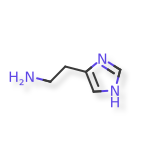
Details
| Stereochemistry | ACHIRAL |
| Molecular Formula | C5H9N3 |
| Molecular Weight | 111.1451 |
| Optical Activity | NONE |
| Defined Stereocenters | 0 / 0 |
| E/Z Centers | 0 |
| Charge | 0 |
SHOW SMILES / InChI
SMILES
NCCC1=CNC=N1
InChI
InChIKey=NTYJJOPFIAHURM-UHFFFAOYSA-N
InChI=1S/C5H9N3/c6-2-1-5-3-7-4-8-5/h3-4H,1-2,6H2,(H,7,8)
| Molecular Formula | C5H9N3 |
| Molecular Weight | 111.1451 |
| Charge | 0 |
| Count |
|
| Stereochemistry | ACHIRAL |
| Additional Stereochemistry | No |
| Defined Stereocenters | 0 / 0 |
| E/Z Centers | 0 |
| Optical Activity | NONE |
Histamine is a depressor amine derived by enzymatic decarboxylation of histidine. It is a powerful stimulant of gastric secretion, a constrictor of bronchial smooth muscle, a vasodilator, and a centrally acting neurotransmitter. Phosphate salt of jistamine was used as a diagnostic aid for evaluation of gastric acid secretory function. In addition, this compound is used as a positive control in evaluation of allergenic (immediate hypersensitivity or "Type I") skin testing. In addition, histamine is being studied for treatment of multiple sclerosis. It was approved, that histamine physiological functions are mediated by four 7-transmembrane G protein-coupled receptors (H1R, H2R, H3R, H4R) that are all targets of pharmacological intervention. The receptors display molecular heterogeneity and constitutive activity. H1R antagonists are long known antiallergic and sedating drugs, whereas the H2R led to the development of H2R-antagonists that revolutionized stomach ulcer treatment. The H3R is an auto receptor and heteroreceptor providing negative feedback on histaminergic and inhibition on other neurons. The H4R occurs on immuncompetent cells and the development of anti-inflammatory drugs is anticipated.
Originator
Approval Year
Targets
| Primary Target | Pharmacology | Condition | Potency |
|---|---|---|---|
Target ID: CHEMBL231 |
|||
Target ID: CHEMBL1941 |
|||
Target ID: CHEMBL264 |
|||
Target ID: CHEMBL3759 |
Conditions
| Condition | Modality | Targets | Highest Phase | Product |
|---|---|---|---|---|
| Diagnostic | HISTAMINE PHOSPHATE Approved UseIndications and Usage Uses temporarily relieves symptoms due to sinus discomforts associated with inflamed sinuses, hay fever or upper respiratory allergies: sinus pain and pressure runny nose sinus headaches sore throat nasal congestion dry mucus membranes sneezing itchy, burning eyes Reference image sinus.jpg Launch Date1939 |
|||
| Primary | Unknown Approved UseUnknown |
|||
| Diagnostic | HISTAMINE PHOSPHATE Approved UseHistamine phosphate is indicated as a diagnostic aid for evaluation of gastric acid secretory function. Anacidity (achlorhydria) in response to histamine may indicate pernicious anemia, atrophic gastritis, adenomatous polyps of stomach, or gastric carcinoma. Gastric hypersecretion in response to histamine may indicate duodenal ulcer or the Zollinger-Ellison syndrome. Launch Date1939 |
Cmax
| Value | Dose | Co-administered | Analyte | Population |
|---|---|---|---|---|
39 nM EXPERIMENT https://www.ncbi.nlm.nih.gov/pubmed/12092744 |
1 mg single, subcutaneous dose: 1 mg route of administration: Subcutaneous experiment type: SINGLE co-administered: |
HISTAMINE plasma | Homo sapiens population: HEALTHY age: ADULT sex: FEMALE / MALE food status: FASTED |
AUC
| Value | Dose | Co-administered | Analyte | Population |
|---|---|---|---|---|
1877 nM × min EXPERIMENT https://www.ncbi.nlm.nih.gov/pubmed/12092744 |
1 mg single, subcutaneous dose: 1 mg route of administration: Subcutaneous experiment type: SINGLE co-administered: |
HISTAMINE plasma | Homo sapiens population: HEALTHY age: ADULT sex: FEMALE / MALE food status: FASTED |
T1/2
| Value | Dose | Co-administered | Analyte | Population |
|---|---|---|---|---|
12 min EXPERIMENT https://www.ncbi.nlm.nih.gov/pubmed/12092744 |
1 mg single, subcutaneous dose: 1 mg route of administration: Subcutaneous experiment type: SINGLE co-administered: |
HISTAMINE plasma | Homo sapiens population: HEALTHY age: ADULT sex: FEMALE / MALE food status: FASTED |
PubMed
| Title | Date | PubMed |
|---|---|---|
| The physiology of brain histamine. | 2001-04 |
|
| Decreased brain histamine-releasing factor protein in patients with Down syndrome and Alzheimer's disease. | 2001-03-02 |
|
| Glycine receptor mediated responses in rat histaminergic neurons. | 2001-03-02 |
|
| Correlation between neutral endopetidase (NEP) 3.4.24.11 in serum and the degree of the bronchial hyperreactivity. | 2001-03-02 |
|
| Neurohormonal regulation of secretion from isolated rat stomach ECL cells: a critical reappraisal. | 2001-03-02 |
|
| Extracts of ECL-cell granules/vesicles and of isolated ECL cells from rat oxyntic mucosa evoke a Ca2+ second messenger response in osteoblastic cells. | 2001-03-02 |
|
| CLA reduces antigen-induced histamine and PGE(2) release from sensitized guinea pig tracheae. | 2001-03 |
|
| Differences in Ca(2+) signaling underlie age-specific effects of secretagogues on colonic Cl(-) transport. | 2001-03 |
|
| Interactions of inflammatory mediators stimulating release of calcitonin gene-related peptide, substance P and prostaglandin E(2) from isolated rat skin. | 2001-03 |
|
| Complement-dependent immune complex-induced bronchial inflammation and hyperreactivity. | 2001-03 |
|
| Ontogeny of modulatory inputs to motor networks: early established projection and progressive neurotransmitter acquisition. | 2001-02-15 |
|
| IL-13 overexpression predisposes to anaphylaxis following antigen sensitization. | 2001-02-15 |
|
| Selective down-regulation of high-affinity IgE receptor (FcepsilonRI) alpha-chain messenger RNA among transcriptome in cord blood-derived versus adult peripheral blood-derived cultured human mast cells. | 2001-02-15 |
|
| Food-deprived activity stress decreased the activity of the histaminergic neuron system in rats. | 2001-02-09 |
|
| The activation of synovial mast cells: modulation of histamine release by tryptase and chymase and their inhibitors. | 2001-02-02 |
|
| Involvement of central histaminergic neurons in polypnea induced by hyperthermia in rabbits. | 2001-02-02 |
|
| Mesenchymal transcription factor Fkh6 is essential for the development and differentiation of parietal cells. | 2001-02-02 |
|
| Predictive markers of asthma exacerbation during stepwise dose reduction of inhaled corticosteroids. | 2001-02 |
|
| Diphenhydramine for the prevention of akathisia induced by prochlorperazine: a randomized, controlled trial. | 2001-02 |
|
| No correlation between wine intolerance and histamine content of wine. | 2001-02 |
|
| IL-18 might reflect disease activity in mild and moderate asthma exacerbation. | 2001-02 |
|
| Histamine alters gene expression in cultured human nasal epithelial cells. | 2001-02 |
|
| Acquisition and alteration of adhesion molecules during cultured human mast cell differentiation. | 2001-02 |
|
| IL-4 production by human basophils found in the lung following segmental allergen challenge. | 2001-02 |
|
| Histamine prevents polyamine accumulation in mouse C57.1 mast cell cultures. | 2001-02 |
|
| Double-blind, placebo-controlled food challenge with apple. | 2001-02 |
|
| Inhibitory action of water soluble fraction of Terminalia chebula on systemic and local anaphylaxis. | 2001-02 |
|
| Characterization of a novel cationic drug transporter in human retinal pigment epithelial cells. | 2001-02 |
|
| Chronic tobacco smoke exposure increases airway sensitivity to capsaicin in awake guinea pigs. | 2001-02 |
|
| Nedocromil sodium inhibits histamine-induced itch and flare in human skin. | 2001-02 |
|
| A human tissue-engineered vascular media: a new model for pharmacological studies of contractile responses. | 2001-02 |
|
| Luminal Nalpha-methyl histamine stimulates gastric acid secretion in duodenal ulcer patients via releasing gastrin. | 2001-01-26 |
|
| The rat H3 receptor: gene organization and multiple isoforms. | 2001-01-12 |
|
| Questions regarding future research on aspirin and the gastrointestinal tract. | 2001-01-08 |
|
| Prospects for changing the burden of nonsteroidal anti-inflammatory drug toxicity. | 2001-01-08 |
|
| Approaches to healing and prophylaxis of nonsteroidal anti-inflammatory drug-associated ulcers. | 2001-01-08 |
|
| Comparison of montelukast and fexofenadine for chronic idiopathic urticaria. | 2001-01 |
|
| Preclinical profile of the monodisperse iodinated macromolecular blood pool agent P743. | 2001-01 |
|
| The dyspepsia alphabet: DU, GU, GERD, NERD, NUD/FD and UD. | 2001-01 |
|
| Effects of monotherapy with intra-nasal corticosteroid or combined oral histamine and leukotriene receptor antagonists in seasonal allergic rhinitis. | 2001-01 |
|
| Combination therapy with anti-mediator drugs in allergic disease. | 2001-01 |
|
| Urticaria induced by cetirizine. | 2001-01 |
|
| Interleukin-4-positive mast cells are highly associated with the extent of immediate allergic wheal reaction in the skin. | 2001-01 |
|
| A randomized, double-blind, crossover comparison among cetirizine, levocetirizine, and ucb 28557 on histamine-induced cutaneous responses in healthy adult volunteers. | 2001-01 |
|
| Effect of cetirizine on bronchial hyperresponsiveness in patients with seasonal allergic rhinitis and asthma. | 2001-01 |
|
| The treatment of rhinovirus infections: progress and potential. | 2001-01 |
|
| Effect of acute metabolic acid/base shifts on the human airway calibre. | 2001-01 |
|
| Effects of BP 2-94, a selective H(3)-receptor agonist, on blood flow and vascular permeability of the rat mandibular incisor pulp. | 2001-01 |
|
| Mediator involvement in antigen-induced bronchospasm and microvascular leakage in the airways of ovalbumin sensitized Brown Norway rats. | 2001-01 |
|
| Inhibition by glucocorticoids of the mast cell-dependent weal and flare response in human skin in vivo. | 2001-01 |
Sample Use Guides
The skin in the test area should be cleansed with alcohol and air dried.
The histamine control skin test solution should be placed at the same site with the other skin test antigens, either on the patient's back or on the volar surface of the forearm. The patient should be placed in a comfortable position before the testing is begun.
For the prick test, a sharp needle is used to puncture the skin, but not to draw blood. If the scratch test is used, carefully break or scratch the skin with a sterile scarifier. Do not draw blood. Each scratch should be about 2 mm - 4 mm in length.
A small drop of the histamine base 1 mg/mL (Histamine Phosphate 2.75 mg/mL) is placed on the abraded skin site no closer than 4 or 5 cm from an adjacent test site. Some physicians prefer to place the solution on the test area and then prick through the drop with a sharp needle.
Route of Administration:
Parenteral
Histamine prevented monocytic apoptosis induced by serum deprivation, CD95/Fas ligation, or dexamethasone in a dose- and time-dependent fashion. The inhibitory effects of histamine on monocytic apoptosis were blocked by an H2R antagonist, and mimicked by an H2R agonist. Histamine also up-regulated the expression of Bcl-2 and Mcl-1, and inhibited the activation of caspase-3. The culture supernatants from histamine-treated monocytes inhibited monocytic apoptosis, which was partly reversed by the removal of IL-10. Monocytes cultured with anti-IL-10 mAb and histamine did not exhibit an inhibitory effect on apoptosis. The histamine-induced anti-apoptotic effect was attenuated when monocytes were cultured in the presence of a cAMP inhibitor.
| Substance Class |
Chemical
Created
by
admin
on
Edited
Mon Mar 31 17:49:15 GMT 2025
by
admin
on
Mon Mar 31 17:49:15 GMT 2025
|
| Record UNII |
820484N8I3
|
| Record Status |
Validated (UNII)
|
| Record Version |
|
-
Download
| Name | Type | Language | ||
|---|---|---|---|---|
|
Preferred Name | English | ||
|
Systematic Name | English | ||
|
Common Name | English | ||
|
Common Name | English | ||
|
Common Name | English | ||
|
Common Name | English | ||
|
Systematic Name | English | ||
|
Common Name | English | ||
|
Systematic Name | English | ||
|
Common Name | English | ||
|
Common Name | English | ||
|
Systematic Name | English | ||
|
Systematic Name | English | ||
|
Systematic Name | English | ||
|
Common Name | English |
| Classification Tree | Code System | Code | ||
|---|---|---|---|---|
|
LOINC |
34316-0
Created by
admin on Mon Mar 31 17:49:15 GMT 2025 , Edited by admin on Mon Mar 31 17:49:15 GMT 2025
|
||
|
LOINC |
33290-8
Created by
admin on Mon Mar 31 17:49:15 GMT 2025 , Edited by admin on Mon Mar 31 17:49:15 GMT 2025
|
||
|
LOINC |
25439-1
Created by
admin on Mon Mar 31 17:49:15 GMT 2025 , Edited by admin on Mon Mar 31 17:49:15 GMT 2025
|
||
|
LOINC |
2417-4
Created by
admin on Mon Mar 31 17:49:15 GMT 2025 , Edited by admin on Mon Mar 31 17:49:15 GMT 2025
|
||
|
LOINC |
34317-8
Created by
admin on Mon Mar 31 17:49:15 GMT 2025 , Edited by admin on Mon Mar 31 17:49:15 GMT 2025
|
||
|
NCI_THESAURUS |
C687
Created by
admin on Mon Mar 31 17:49:15 GMT 2025 , Edited by admin on Mon Mar 31 17:49:15 GMT 2025
|
||
|
FDA ORPHAN DRUG |
127199
Created by
admin on Mon Mar 31 17:49:15 GMT 2025 , Edited by admin on Mon Mar 31 17:49:15 GMT 2025
|
||
|
LOINC |
2416-6
Created by
admin on Mon Mar 31 17:49:15 GMT 2025 , Edited by admin on Mon Mar 31 17:49:15 GMT 2025
|
||
|
FDA ORPHAN DRUG |
127399
Created by
admin on Mon Mar 31 17:49:15 GMT 2025 , Edited by admin on Mon Mar 31 17:49:15 GMT 2025
|
||
|
LOINC |
13755-4
Created by
admin on Mon Mar 31 17:49:15 GMT 2025 , Edited by admin on Mon Mar 31 17:49:15 GMT 2025
|
||
|
LOINC |
13756-2
Created by
admin on Mon Mar 31 17:49:15 GMT 2025 , Edited by admin on Mon Mar 31 17:49:15 GMT 2025
|
||
|
LOINC |
9410-2
Created by
admin on Mon Mar 31 17:49:15 GMT 2025 , Edited by admin on Mon Mar 31 17:49:15 GMT 2025
|
||
|
LOINC |
2415-8
Created by
admin on Mon Mar 31 17:49:15 GMT 2025 , Edited by admin on Mon Mar 31 17:49:15 GMT 2025
|
||
|
LOINC |
25925-9
Created by
admin on Mon Mar 31 17:49:15 GMT 2025 , Edited by admin on Mon Mar 31 17:49:15 GMT 2025
|
||
|
WHO-ATC |
L03AX14
Created by
admin on Mon Mar 31 17:49:15 GMT 2025 , Edited by admin on Mon Mar 31 17:49:15 GMT 2025
|
||
|
NCI_THESAURUS |
C2139
Created by
admin on Mon Mar 31 17:49:15 GMT 2025 , Edited by admin on Mon Mar 31 17:49:15 GMT 2025
|
||
|
LOINC |
35260-9
Created by
admin on Mon Mar 31 17:49:15 GMT 2025 , Edited by admin on Mon Mar 31 17:49:15 GMT 2025
|
||
|
LOINC |
43577-6
Created by
admin on Mon Mar 31 17:49:15 GMT 2025 , Edited by admin on Mon Mar 31 17:49:15 GMT 2025
|
||
|
LOINC |
44371-3
Created by
admin on Mon Mar 31 17:49:15 GMT 2025 , Edited by admin on Mon Mar 31 17:49:15 GMT 2025
|
| Code System | Code | Type | Description | ||
|---|---|---|---|---|---|
|
C73238
Created by
admin on Mon Mar 31 17:49:15 GMT 2025 , Edited by admin on Mon Mar 31 17:49:15 GMT 2025
|
PRIMARY | |||
|
33792
Created by
admin on Mon Mar 31 17:49:16 GMT 2025 , Edited by admin on Mon Mar 31 17:49:16 GMT 2025
|
PRIMARY | |||
|
820484N8I3
Created by
admin on Mon Mar 31 17:49:16 GMT 2025 , Edited by admin on Mon Mar 31 17:49:16 GMT 2025
|
PRIMARY | |||
|
DB05381
Created by
admin on Mon Mar 31 17:49:15 GMT 2025 , Edited by admin on Mon Mar 31 17:49:15 GMT 2025
|
PRIMARY | |||
|
200-100-6
Created by
admin on Mon Mar 31 17:49:15 GMT 2025 , Edited by admin on Mon Mar 31 17:49:15 GMT 2025
|
PRIMARY | |||
|
51-45-6
Created by
admin on Mon Mar 31 17:49:15 GMT 2025 , Edited by admin on Mon Mar 31 17:49:15 GMT 2025
|
PRIMARY | |||
|
HISTAMINE
Created by
admin on Mon Mar 31 17:49:15 GMT 2025 , Edited by admin on Mon Mar 31 17:49:15 GMT 2025
|
PRIMARY | |||
|
D006632
Created by
admin on Mon Mar 31 17:49:15 GMT 2025 , Edited by admin on Mon Mar 31 17:49:15 GMT 2025
|
PRIMARY | |||
|
1375
Created by
admin on Mon Mar 31 17:49:15 GMT 2025 , Edited by admin on Mon Mar 31 17:49:15 GMT 2025
|
PRIMARY | |||
|
m6026
Created by
admin on Mon Mar 31 17:49:15 GMT 2025 , Edited by admin on Mon Mar 31 17:49:15 GMT 2025
|
PRIMARY | Merck Index | ||
|
774
Created by
admin on Mon Mar 31 17:49:15 GMT 2025 , Edited by admin on Mon Mar 31 17:49:15 GMT 2025
|
PRIMARY | |||
|
18295
Created by
admin on Mon Mar 31 17:49:16 GMT 2025 , Edited by admin on Mon Mar 31 17:49:16 GMT 2025
|
PRIMARY | |||
|
58432
Created by
admin on Mon Mar 31 17:49:16 GMT 2025 , Edited by admin on Mon Mar 31 17:49:16 GMT 2025
|
PRIMARY | |||
|
DTXSID4023125
Created by
admin on Mon Mar 31 17:49:15 GMT 2025 , Edited by admin on Mon Mar 31 17:49:15 GMT 2025
|
PRIMARY | |||
|
3338
Created by
admin on Mon Mar 31 17:49:15 GMT 2025 , Edited by admin on Mon Mar 31 17:49:15 GMT 2025
|
PRIMARY | |||
|
100000089506
Created by
admin on Mon Mar 31 17:49:16 GMT 2025 , Edited by admin on Mon Mar 31 17:49:16 GMT 2025
|
PRIMARY | |||
|
820484N8I3
Created by
admin on Mon Mar 31 17:49:16 GMT 2025 , Edited by admin on Mon Mar 31 17:49:16 GMT 2025
|
PRIMARY | |||
|
5333
Created by
admin on Mon Mar 31 17:49:15 GMT 2025 , Edited by admin on Mon Mar 31 17:49:15 GMT 2025
|
PRIMARY | RxNorm | ||
|
SUB14107MIG
Created by
admin on Mon Mar 31 17:49:15 GMT 2025 , Edited by admin on Mon Mar 31 17:49:15 GMT 2025
|
PRIMARY |
| Related Record | Type | Details | ||
|---|---|---|---|---|
|
TARGET -> AGONIST |
IC50
|
||
|
|
SALT/SOLVATE -> PARENT |
|
||
|
TRANSPORTER -> SUBSTRATE |
|
||
|
|
SALT/SOLVATE -> PARENT |
|
||
|
METABOLIC ENZYME -> SUBSTRATE |
|
||
|
TRANSPORTER -> INHIBITOR | |||
|
TARGET -> AGONIST |
CHO-H1 cells, histamine stimulation resulted in a concentration-dependent increase in [Ca2+]i with an EC50 of 170±30 nM.
EC50
|
||
|
|
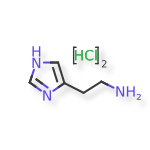
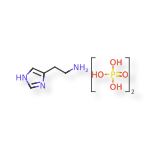
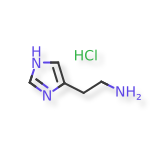
SALT/SOLVATE -> PARENT |
|

| Related Record | Type | Details | ||
|---|---|---|---|---|
|
METABOLITE INACTIVE -> PARENT |
MAJOR
|
||
|
|
METABOLITE INACTIVE -> PARENT |
|
||
|
METABOLITE INACTIVE -> PARENT |
|
||
|
METABOLITE INACTIVE -> PARENT |
MAJOR
|
| Related Record | Type | Details | ||
|---|---|---|---|---|
|
|
ACTIVE MOIETY |
|