


Details
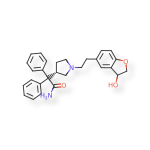
| Stereochemistry | ABSOLUTE |
| Molecular Formula | C28H30N2O2 |
| Molecular Weight | 426.55 |
| Optical Activity | UNSPECIFIED |
| Defined Stereocenters | 1 / 1 |
| E/Z Centers | 0 |
| Charge | 0 |
SHOW SMILES / InChI
SMILES
NC(=O)C([C@@H]1CCN(CCC2=CC3=C(OCC3)C=C2)C1)(C4=CC=CC=C4)C5=CC=CC=C5
InChI
InChIKey=HXGBXQDTNZMWGS-RUZDIDTESA-N
InChI=1S/C28H30N2O2/c29-27(31)28(23-7-3-1-4-8-23,24-9-5-2-6-10-24)25-14-17-30(20-25)16-13-21-11-12-26-22(19-21)15-18-32-26/h1-12,19,25H,13-18,20H2,(H2,29,31)/t25-/m1/s1
| Molecular Formula | C28H30N2O2 |
| Molecular Weight | 426.55 |
| Charge | 0 |
| Count |
|
| Stereochemistry | ABSOLUTE |
| Additional Stereochemistry | No |
| Defined Stereocenters | 1 / 1 |
| E/Z Centers | 0 |
| Optical Activity | UNSPECIFIED |
Originator
Approval Year
Targets
| Primary Target | Pharmacology | Condition | Potency |
|---|---|---|---|
Target ID: P20309 Gene ID: 1131.0 Gene Symbol: CHRM3 Target Organism: Homo sapiens (Human) |
0.33 nM [Kd] |
Conditions
| Condition | Modality | Targets | Highest Phase | Product |
|---|---|---|---|---|
| Palliative | ENABLEX Approved UseENABLEX® (darifenacin) extended-release tablets are indicated for the treatment of overactive bladder with symptoms of urge urinary incontinence, urgency and frequency. Launch Date2004 |
Cmax
| Value | Dose | Co-administered | Analyte | Population |
|---|---|---|---|---|
2.01 ng/mL |
7.5 mg 1 times / day steady-state, oral dose: 7.5 mg route of administration: Oral experiment type: STEADY-STATE co-administered: |
DARIFENACIN plasma | Homo sapiens population: HEALTHY age: ADULT sex: FEMALE / MALE food status: UNKNOWN |
|
5.76 ng/mL |
15 mg 1 times / day steady-state, oral dose: 15 mg route of administration: Oral experiment type: STEADY-STATE co-administered: |
DARIFENACIN plasma | Homo sapiens population: HEALTHY age: ADULT sex: FEMALE / MALE food status: UNKNOWN |
AUC
| Value | Dose | Co-administered | Analyte | Population |
|---|---|---|---|---|
29.24 ng × h/mL |
7.5 mg 1 times / day steady-state, oral dose: 7.5 mg route of administration: Oral experiment type: STEADY-STATE co-administered: |
DARIFENACIN plasma | Homo sapiens population: HEALTHY age: ADULT sex: FEMALE / MALE food status: UNKNOWN |
|
88.9 ng × h/mL |
15 mg 1 times / day steady-state, oral dose: 15 mg route of administration: Oral experiment type: STEADY-STATE co-administered: |
DARIFENACIN plasma | Homo sapiens population: HEALTHY age: ADULT sex: FEMALE / MALE food status: UNKNOWN |
T1/2
| Value | Dose | Co-administered | Analyte | Population |
|---|---|---|---|---|
12.43 h |
7.5 mg 1 times / day steady-state, oral dose: 7.5 mg route of administration: Oral experiment type: STEADY-STATE co-administered: |
DARIFENACIN plasma | Homo sapiens population: HEALTHY age: ADULT sex: FEMALE / MALE food status: UNKNOWN |
|
12.05 h |
15 mg 1 times / day steady-state, oral dose: 15 mg route of administration: Oral experiment type: STEADY-STATE co-administered: |
DARIFENACIN plasma | Homo sapiens population: HEALTHY age: ADULT sex: FEMALE / MALE food status: UNKNOWN |
Funbound
| Value | Dose | Co-administered | Analyte | Population |
|---|---|---|---|---|
2% |
7.5 mg 1 times / day steady-state, oral dose: 7.5 mg route of administration: Oral experiment type: STEADY-STATE co-administered: |
DARIFENACIN plasma | Homo sapiens population: HEALTHY age: ADULT sex: FEMALE / MALE food status: UNKNOWN |
|
2% |
15 mg 1 times / day steady-state, oral dose: 15 mg route of administration: Oral experiment type: STEADY-STATE co-administered: |
DARIFENACIN plasma | Homo sapiens population: HEALTHY age: ADULT sex: FEMALE / MALE food status: UNKNOWN |
Doses
| Dose | Population | Adverse events |
|---|---|---|
15 mg 1 times / day multiple, oral Recommended Dose: 15 mg, 1 times / day Route: oral Route: multiple Dose: 15 mg, 1 times / day Sources: |
unhealthy, 57.6 Health Status: unhealthy Age Group: 57.6 Sex: M+F Sources: |
Disc. AE: Constipation, Dry mouth... AEs leading to discontinuation/dose reduction: Constipation (1%) Sources: Dry mouth (1%) Nervous system disorder NOS (0.6%) |
7.5 mg 1 times / day multiple, oral Recommended Dose: 7.5 mg, 1 times / day Route: oral Route: multiple Dose: 7.5 mg, 1 times / day Sources: |
unhealthy, 57.6 Health Status: unhealthy Age Group: 57.6 Sex: M+F Sources: |
Disc. AE: Heart block AV second degree... AEs leading to discontinuation/dose reduction: Heart block AV second degree (0.3%) Sources: |
AEs
| AE | Significance | Dose | Population |
|---|---|---|---|
| Nervous system disorder NOS | 0.6% Disc. AE |
15 mg 1 times / day multiple, oral Recommended Dose: 15 mg, 1 times / day Route: oral Route: multiple Dose: 15 mg, 1 times / day Sources: |
unhealthy, 57.6 Health Status: unhealthy Age Group: 57.6 Sex: M+F Sources: |
| Constipation | 1% Disc. AE |
15 mg 1 times / day multiple, oral Recommended Dose: 15 mg, 1 times / day Route: oral Route: multiple Dose: 15 mg, 1 times / day Sources: |
unhealthy, 57.6 Health Status: unhealthy Age Group: 57.6 Sex: M+F Sources: |
| Dry mouth | 1% Disc. AE |
15 mg 1 times / day multiple, oral Recommended Dose: 15 mg, 1 times / day Route: oral Route: multiple Dose: 15 mg, 1 times / day Sources: |
unhealthy, 57.6 Health Status: unhealthy Age Group: 57.6 Sex: M+F Sources: |
| Heart block AV second degree | 0.3% Disc. AE |
7.5 mg 1 times / day multiple, oral Recommended Dose: 7.5 mg, 1 times / day Route: oral Route: multiple Dose: 7.5 mg, 1 times / day Sources: |
unhealthy, 57.6 Health Status: unhealthy Age Group: 57.6 Sex: M+F Sources: |
Overview
| CYP3A4 | CYP2C9 | CYP2D6 | hERG |
|---|---|---|---|
OverviewOther
| Other Inhibitor | Other Substrate | Other Inducer |
|---|---|---|
Drug as perpetrator
| Target | Modality | Activity | Metabolite | Clinical evidence |
|---|---|---|---|---|
| no | ||||
| no | ||||
| yes [IC50 2 uM] | yes (co-administration study) Comment: Label: Mean Cmax and AUC of imipramine, a CYP2D6 substrate, were increased 57% and 11 70%, respectively, in the presence of steady-state darifenacin; Sources: https://www.accessdata.fda.gov/drugsatfda_docs/nda/2004/21-513_Enablex_biopharmr.pdf@page=23 Page: 23.0 |
|||
| yes [IC50 5 uM] | weak (co-administration study) Comment: Label: Darifenacin coadministered with a single oral dose of 15 midazolam 7.5 mg resulted in 17% increase in midazolam exposure Sources: https://www.accessdata.fda.gov/drugsatfda_docs/nda/2004/21-513_Enablex_biopharmr.pdf@page=23 Page: 23.0 |
Drug as victim
| Target | Modality | Activity | Metabolite | Clinical evidence |
|---|---|---|---|---|
| major | yes (co-administration study) Comment: Label: Darifenacin exposure following 30 mg once daily at steady state was 33% higher in the presence of the potent CYP2D6 inhibitor paroxetine; Sources: https://www.accessdata.fda.gov/drugsatfda_docs/nda/2004/21-513_Enablex_biopharmr.pdf#page=22 Page: 22.0 |
|||
| major | yes (co-administration study) Comment: Label: Mean steady state darifenacin exposure in EM subjects was about 5 fold higher when ketoconazole was co-administered; mean Cmax and AUC of 25 darifenacin following 30 mg once daily dosing at steady state were 128% and 95% higher, 26 respectively, in the presence of erythromycin; Coadministration of fluconazole and darifenacin 30 mg once daily at steady state increased darifenacin Cmax and AUC by 88% and 84%, respectively Sources: https://www.accessdata.fda.gov/drugsatfda_docs/nda/2004/21-513_Enablex_biopharmr.pdf#page=46 Page: 46.0 |
|||
| unresponsive | ||||
| unresponsive | ||||
| yes |
Tox targets
| Target | Modality | Activity | Metabolite | Clinical evidence |
|---|---|---|---|---|
PubMed
| Title | Date | PubMed |
|---|---|---|
| In vivo demonstration of M3 muscarinic receptor subtype selectivity of darifenacin in mice. | 2006-12-14 |
|
| Treatment of the overactive bladder syndrome with muscarinic receptor antagonists: a matter of metabolites? | 2006-11 |
|
| Darifenacin: Pharmacology and clinical usage. | 2006-11 |
|
| Long-term treatment with darifenacin for overactive bladder: results of a 2-year, open-label extension study. | 2006-11 |
|
| Public Relations: Ketchum brands new product with innovative PR strategy. | 2006-10-20 |
|
| Gateways to clinical trials. | 2006-08-09 |
|
| Differential effects of the antimuscarinic agents darifenacin and oxybutynin ER on memory in older subjects. | 2006-08 |
|
| Regulation of bladder muscarinic receptor subtypes by experimental pathologies. | 2006-07 |
|
| [Oral anticholinergics in overactive bladder]. | 2006-07 |
|
| [Anticholinergics for overactive bladder: does subtype selectivity play a role?]. | 2006-07 |
|
| Dose response with darifenacin, a novel once-daily M3 selective receptor antagonist for the treatment of overactive bladder: results of a fixed dose study. | 2006-05 |
|
| Gateways to clinical trials. | 2006-04 |
|
| Practical considerations of new drugs: new choices for old problems. | 2006-04 |
|
| The causes and consequences of overactive bladder. | 2006-04 |
|
| Gateways to clinical trials. | 2006-03-17 |
|
| Gateways to clinical trials. | 2006-03 |
|
| Management of overactive bladder and urge urinary incontinence in the elderly patient. | 2006-03 |
|
| Pharmacologic management of overactive bladder: practical options for the primary care physician. | 2006-03 |
|
| Using anticholinergics to treat overactive bladder: the issue of treatment tolerability. | 2006-03 |
|
| Muscarinic receptors in the bladder: from basic research to therapeutics. | 2006-02 |
|
| New drugs 06, part I. | 2006-02 |
|
| M2 and M3 muscarinic receptor activation of urinary bladder contractile signal transduction. II. Denervated rat bladder. | 2006-02 |
|
| M2 and M3 muscarinic receptor activation of urinary bladder contractile signal transduction. I. Normal rat bladder. | 2006-02 |
|
| Efficacy, tolerability and safety of darifenacin, an M(3) selective receptor antagonist: an investigation of warning time in patients with OAB. | 2006-01 |
|
| Human muscarinic receptor binding characteristics of antimuscarinic agents to treat overactive bladder. | 2006-01 |
|
| Constitutive activity and inverse agonism at the M2 muscarinic acetylcholine receptor. | 2006-01 |
|
| The clinical pharmacokinetics of darifenacin. | 2006 |
|
| The Q-T interval and antimuscarinic drugs. | 2005-11 |
|
| Pharmacodynamic effects of darifenacin, a muscarinic M selective receptor antagonist for the treatment of overactive bladder, in healthy volunteers. | 2005-11 |
|
| Urodynamic effects of oxybutynin and tolterodine in conscious and anesthetized rats under different cystometrographic conditions. | 2005-10-11 |
|
| Gateways to clinical trials. | 2005-10 |
|
| Solifenacin in the management of the overactive bladder syndrome. | 2005-10 |
|
| Gateways to clinical trials. | 2005-09 |
|
| QT and QTc interval with standard and supratherapeutic doses of darifenacin, a muscarinic M3 selective receptor antagonist for the treatment of overactive bladder. | 2005-09 |
|
| Efficacy and tolerability of darifenacin, a muscarinic M3 selective receptor antagonist (M3 SRA), compared with oxybutynin in the treatment of patients with overactive bladder. | 2005-09 |
|
| Role of muscarinic receptor antagonists in urgency and nocturia. | 2005-09 |
|
| Treatment of overactive bladder in the older patient: pooled analysis of three phase III studies of darifenacin, an M3 selective receptor antagonist. | 2005-09 |
|
| Solifenacin and darifenacin for overactive bladder. | 2005-08 |
|
| Darifenacin in the treatment of overactive bladder. | 2005-07 |
|
| Effects of ageing on muscarinic receptor subtypes and function in rat urinary bladder. | 2005-07 |
|
| Darifenacin in the treatment of overactive bladder. | 2005-07 |
|
| Comparison of darifenacin and oxybutynin in patients with overactive bladder: assessment of ambulatory urodynamics and impact on salivary flow. | 2005-07 |
|
| Gateways to clinical trials. | 2005-06 |
|
| New treatment options for overactive bladder. | 2005-06 |
|
| Darifenacin: another antimuscarinic for overactive bladder. | 2005-05 |
|
| Solifenacin in overactive bladder syndrome. | 2005 |
|
| Overactive bladder in the elderly: a guide to pharmacological management. | 2005 |
|
| Contemporary and emerging drug treatments for urinary incontinence in children. | 2005 |
|
| Improving the tolerability of anticholinergic agents in the treatment of overactive bladder. | 2005 |
|
| [Overactive bladder]. | 2005 |
Sample Use Guides
The recommended starting dose of darifenacin extended-release tablets (Enablex) is 7.5 mg
once daily.
Route of Administration:
Oral
| Substance Class |
Chemical
Created
by
admin
on
Edited
Wed Apr 02 08:29:02 GMT 2025
by
admin
on
Wed Apr 02 08:29:02 GMT 2025
|
| Record UNII |
APG9819VLM
|
| Record Status |
Validated (UNII)
|
| Record Version |
|
-
Download
| Name | Type | Language | ||
|---|---|---|---|---|
|
Preferred Name | English | ||
|
Official Name | English | ||
|
Systematic Name | English | ||
|
Common Name | English | ||
|
Common Name | English | ||
|
Common Name | English | ||
|
Common Name | English | ||
|
Code | English | ||
|
Common Name | English | ||
|
Common Name | English | ||
|
Common Name | English | ||
|
Common Name | English |
| Classification Tree | Code System | Code | ||
|---|---|---|---|---|
|
NCI_THESAURUS |
C29704
Created by
admin on Wed Apr 02 08:29:02 GMT 2025 , Edited by admin on Wed Apr 02 08:29:02 GMT 2025
|
||
|
NDF-RT |
N0000000125
Created by
admin on Wed Apr 02 08:29:02 GMT 2025 , Edited by admin on Wed Apr 02 08:29:02 GMT 2025
|
||
|
NDF-RT |
N0000175700
Created by
admin on Wed Apr 02 08:29:02 GMT 2025 , Edited by admin on Wed Apr 02 08:29:02 GMT 2025
|
||
|
NCI_THESAURUS |
C29698
Created by
admin on Wed Apr 02 08:29:02 GMT 2025 , Edited by admin on Wed Apr 02 08:29:02 GMT 2025
|
||
|
WHO-VATC |
QG04BD10
Created by
admin on Wed Apr 02 08:29:02 GMT 2025 , Edited by admin on Wed Apr 02 08:29:02 GMT 2025
|
||
|
NDF-RT |
N0000000125
Created by
admin on Wed Apr 02 08:29:02 GMT 2025 , Edited by admin on Wed Apr 02 08:29:02 GMT 2025
|
||
|
WHO-ATC |
G04BD10
Created by
admin on Wed Apr 02 08:29:02 GMT 2025 , Edited by admin on Wed Apr 02 08:29:02 GMT 2025
|
||
|
NDF-RT |
N0000000125
Created by
admin on Wed Apr 02 08:29:02 GMT 2025 , Edited by admin on Wed Apr 02 08:29:02 GMT 2025
|
||
|
LIVERTOX |
NBK548798
Created by
admin on Wed Apr 02 08:29:02 GMT 2025 , Edited by admin on Wed Apr 02 08:29:02 GMT 2025
|
| Code System | Code | Type | Description | ||
|---|---|---|---|---|---|
|
100000085412
Created by
admin on Wed Apr 02 08:29:02 GMT 2025 , Edited by admin on Wed Apr 02 08:29:02 GMT 2025
|
PRIMARY | |||
|
391960
Created by
admin on Wed Apr 02 08:29:02 GMT 2025 , Edited by admin on Wed Apr 02 08:29:02 GMT 2025
|
PRIMARY | |||
|
RR-29
Created by
admin on Wed Apr 02 08:29:02 GMT 2025 , Edited by admin on Wed Apr 02 08:29:02 GMT 2025
|
PRIMARY | |||
|
APG9819VLM
Created by
admin on Wed Apr 02 08:29:02 GMT 2025 , Edited by admin on Wed Apr 02 08:29:02 GMT 2025
|
PRIMARY | |||
|
APG9819VLM
Created by
admin on Wed Apr 02 08:29:02 GMT 2025 , Edited by admin on Wed Apr 02 08:29:02 GMT 2025
|
PRIMARY | |||
|
136198
Created by
admin on Wed Apr 02 08:29:02 GMT 2025 , Edited by admin on Wed Apr 02 08:29:02 GMT 2025
|
PRIMARY | RxNorm | ||
|
m4096
Created by
admin on Wed Apr 02 08:29:02 GMT 2025 , Edited by admin on Wed Apr 02 08:29:02 GMT 2025
|
PRIMARY | Merck Index | ||
|
7153
Created by
admin on Wed Apr 02 08:29:02 GMT 2025 , Edited by admin on Wed Apr 02 08:29:02 GMT 2025
|
PRIMARY | |||
|
CHEMBL1346
Created by
admin on Wed Apr 02 08:29:02 GMT 2025 , Edited by admin on Wed Apr 02 08:29:02 GMT 2025
|
PRIMARY | |||
|
133099-04-4
Created by
admin on Wed Apr 02 08:29:02 GMT 2025 , Edited by admin on Wed Apr 02 08:29:02 GMT 2025
|
PRIMARY | |||
|
DB00496
Created by
admin on Wed Apr 02 08:29:02 GMT 2025 , Edited by admin on Wed Apr 02 08:29:02 GMT 2025
|
PRIMARY | |||
|
DTXSID2048290
Created by
admin on Wed Apr 02 08:29:02 GMT 2025 , Edited by admin on Wed Apr 02 08:29:02 GMT 2025
|
PRIMARY | |||
|
444031
Created by
admin on Wed Apr 02 08:29:02 GMT 2025 , Edited by admin on Wed Apr 02 08:29:02 GMT 2025
|
PRIMARY | |||
|
321
Created by
admin on Wed Apr 02 08:29:02 GMT 2025 , Edited by admin on Wed Apr 02 08:29:02 GMT 2025
|
PRIMARY | |||
|
C101207
Created by
admin on Wed Apr 02 08:29:02 GMT 2025 , Edited by admin on Wed Apr 02 08:29:02 GMT 2025
|
PRIMARY | |||
|
C65363
Created by
admin on Wed Apr 02 08:29:02 GMT 2025 , Edited by admin on Wed Apr 02 08:29:02 GMT 2025
|
PRIMARY | |||
|
SUB06913MIG
Created by
admin on Wed Apr 02 08:29:02 GMT 2025 , Edited by admin on Wed Apr 02 08:29:02 GMT 2025
|
PRIMARY | |||
|
784
Created by
admin on Wed Apr 02 08:29:02 GMT 2025 , Edited by admin on Wed Apr 02 08:29:02 GMT 2025
|
PRIMARY | |||
|
DARIFENACIN
Created by
admin on Wed Apr 02 08:29:02 GMT 2025 , Edited by admin on Wed Apr 02 08:29:02 GMT 2025
|
PRIMARY |
| Related Record | Type | Details | ||
|---|---|---|---|---|
|
|
SALT/SOLVATE -> PARENT |
|
||
|
TARGET -> INHIBITOR |
Kd
|


| Related Record | Type | Details | ||
|---|---|---|---|---|
|
|
METABOLITE -> PARENT |
MAJOR
FECAL; URINE
|
||
|
|
METABOLITE -> PARENT |
FECAL; PLASMA
|
||
|
|
METABOLITE -> PARENT |
|
||
|
METABOLITE -> PARENT |
Unlikely to contribute significantly to the overall clinical effect of darifenacin.
|
||
|
METABOLITE -> PARENT |
Unlikely to contribute significantly to the overall clinical effect of darifenacin.
MAJOR
FECAL; URINE
|
||
|
|
METABOLITE -> PARENT |
|
||
|
METABOLITE -> PARENT |
MAJOR
FECAL; URINE
|
||
|
|
METABOLITE -> PARENT |
MINOR
FECAL; URINE
|



| Related Record | Type | Details | ||
|---|---|---|---|---|
|
|
ACTIVE MOIETY |
|
