


Details
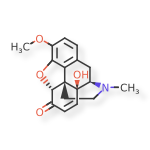
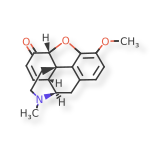
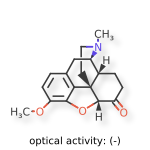
| Stereochemistry | ABSOLUTE |
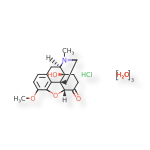
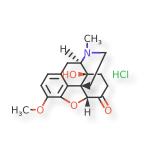
| Molecular Formula | C18H21NO4.ClH |
| Molecular Weight | 351.825 |
| Optical Activity | UNSPECIFIED |
| Defined Stereocenters | 4 / 4 |
| E/Z Centers | 0 |
| Charge | 0 |
SHOW SMILES / InChI
SMILES
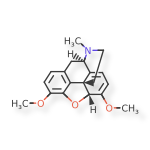
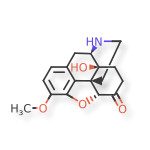
Cl.COC1=CC=C2C[C@H]3N(C)CC[C@@]45[C@@H](OC1=C24)C(=O)CC[C@@]35O
InChI
InChIKey=MUZQPDBAOYKNLO-RKXJKUSZSA-N
InChI=1S/C18H21NO4.ClH/c1-19-8-7-17-14-10-3-4-12(22-2)15(14)23-16(17)11(20)5-6-18(17,21)13(19)9-10;/h3-4,13,16,21H,5-9H2,1-2H3;1H/t13-,16+,17+,18-;/m1./s1
| Molecular Formula | ClH |
| Molecular Weight | 36.461 |
| Charge | 0 |
| Count |
|
| Stereochemistry | ACHIRAL |
| Additional Stereochemistry | No |
| Defined Stereocenters | 0 / 0 |
| E/Z Centers | 0 |
| Optical Activity | NONE |
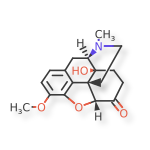
| Molecular Formula | C18H21NO4 |
| Molecular Weight | 315.3636 |
| Charge | 0 |
| Count |
|
| Stereochemistry | ABSOLUTE |
| Additional Stereochemistry | No |
| Defined Stereocenters | 4 / 4 |
| E/Z Centers | 0 |
| Optical Activity | UNSPECIFIED |
DescriptionCurator's Comment: description was created based on several sources, including
http://reference.medscape.com/drug/oxycontin-xtampza-er-oxycodone-343321 | https://www.ncbi.nlm.nih.gov/pubmed/23880538 | https://www.drugs.com/oxycodone.html
Curator's Comment: description was created based on several sources, including
http://reference.medscape.com/drug/oxycontin-xtampza-er-oxycodone-343321 | https://www.ncbi.nlm.nih.gov/pubmed/23880538 | https://www.drugs.com/oxycodone.html
Oxycodone is a semisynthetic opioid used for the management of acute and chronic pain severe enough to require an opioid analgesic and for which alternative treatments are inadequate. Oxycodone is a highly selective full agonist of the μ-opioid receptor (MOR), with low affinity for the δ-opioid receptor (DOR) and κ-opioid receptor (KOR). After oxycodone binds to the MOR, a G protein-complex is released, which inhibits the release of neurotransmitters by the cell by reducing the amount of cAMP produced, closing calcium channels, and opening potassium channels. After a dose of conventional (instant-release) oral oxycodone, the onset of action is 10–30 minutes, and peak plasma levels of the drug are attained within roughly 30–60 minutes in contrast, after a dose of OxyContin (an oral controlled-release formulation), peak plasma levels of oxycodone occur in about three hours. The duration of instant-release oxycodone is 3 to 6 hours, although this can be variable depending on the individual. Oxycodone in the blood is distributed to skeletal muscle, liver, intestinal tract, lungs, spleen, and brain. Serious side effects of oxycodone include reduced sensitivity to pain (beyond the pain the drug is taken to reduce), euphoria, anxiolysis, feelings of relaxation, and respiratory depression. Common side effects of oxycodone include constipation (23%), nausea (23%), vomiting (12%), somnolence (23%), dizziness (13%), itching (13%), dry mouth (6%), and sweating (5%).
Originator
Approval Year
Targets
| Primary Target | Pharmacology | Condition | Potency |
|---|---|---|---|
Target ID: CHEMBL233 |
500.0 nM [EC50] | ||
Target ID: CHEMBL237 |
16000.0 nM [EC50] | ||
Target ID: CHEMBL236 |
4000.0 nM [EC50] |
Conditions
| Condition | Modality | Targets | Highest Phase | Product |
|---|---|---|---|---|
| Primary | PERCODAN-DEMI Approved UseOxyContin Tablets are a controlled-release oral formulation of oxycodone hydrochloride indicated for the management of moderate to severe pain when a continuous, around-the-clock analgesic is needed for an extended period of time. OxyContin is NOT intended for use as a prn analgesic. Physicians should individualize treatment in every case, initiating therapy at the appropriate point along a progression from non-opioid analgesics, such as non-steroidal anti-inflammatory drugs and acetaminophen to opioids in a plan of pain management such as outlined by the World Health Organization, the Agency for Healthcare Research and Quality (formerly known as the Agency for HealthCare Policy and Research), the Federation of State Medical Boards Model Guidelines, or the American Pain Society. OxyContin is not indicated for pain in the immediate postoperative period (the first 12-24 hours following surgery), or if the pain is mild, or not expected to persist for an extended period of time. OxyContin is only indicated for postoperative use if the patient is already receiving the drug prior to surgery or if the postoperative pain is expected to be moderate to severe and persist for an extended period of time. Physicians should individualize treatment, moving from parenteral to oral analgesics as appropriate. (See American Pain Society guidelines.) Launch Date1950 |
|||
| Primary | PERCODAN-DEMI Approved UseOxyContin Tablets are a controlled-release oral formulation of oxycodone hydrochloride indicated for the management of moderate to severe pain when a continuous, around-the-clock analgesic is needed for an extended period of time. OxyContin is NOT intended for use as a prn analgesic. Physicians should individualize treatment in every case, initiating therapy at the appropriate point along a progression from non-opioid analgesics, such as non-steroidal anti-inflammatory drugs and acetaminophen to opioids in a plan of pain management such as outlined by the World Health Organization, the Agency for Healthcare Research and Quality (formerly known as the Agency for HealthCare Policy and Research), the Federation of State Medical Boards Model Guidelines, or the American Pain Society. OxyContin is not indicated for pain in the immediate postoperative period (the first 12-24 hours following surgery), or if the pain is mild, or not expected to persist for an extended period of time. OxyContin is only indicated for postoperative use if the patient is already receiving the drug prior to surgery or if the postoperative pain is expected to be moderate to severe and persist for an extended period of time. Physicians should individualize treatment, moving from parenteral to oral analgesics as appropriate. (See American Pain Society guidelines.) Launch Date1950 |
|||
| Primary | PERCODAN-DEMI Approved UseOxyContin Tablets are a controlled-release oral formulation of oxycodone hydrochloride indicated for the management of moderate to severe pain when a continuous, around-the-clock analgesic is needed for an extended period of time. OxyContin is NOT intended for use as a prn analgesic. Physicians should individualize treatment in every case, initiating therapy at the appropriate point along a progression from non-opioid analgesics, such as non-steroidal anti-inflammatory drugs and acetaminophen to opioids in a plan of pain management such as outlined by the World Health Organization, the Agency for Healthcare Research and Quality (formerly known as the Agency for HealthCare Policy and Research), the Federation of State Medical Boards Model Guidelines, or the American Pain Society. OxyContin is not indicated for pain in the immediate postoperative period (the first 12-24 hours following surgery), or if the pain is mild, or not expected to persist for an extended period of time. OxyContin is only indicated for postoperative use if the patient is already receiving the drug prior to surgery or if the postoperative pain is expected to be moderate to severe and persist for an extended period of time. Physicians should individualize treatment, moving from parenteral to oral analgesics as appropriate. (See American Pain Society guidelines.) Launch Date1950 |
Cmax
| Value | Dose | Co-administered | Analyte | Population |
|---|---|---|---|---|
22.2 ng/mL |
15 mg single, oral dose: 15 mg route of administration: Oral experiment type: SINGLE co-administered: |
OXYCODONE plasma | Homo sapiens population: UNKNOWN age: ADULT sex: UNKNOWN food status: UNKNOWN |
|
39.3 ng/mL |
30 mg single, oral dose: 30 mg route of administration: Oral experiment type: SINGLE co-administered: |
OXYCODONE plasma | Homo sapiens population: UNKNOWN age: ADULT sex: UNKNOWN food status: UNKNOWN |
|
19 ng/mL |
10 mg single, oral dose: 10 mg route of administration: Oral experiment type: SINGLE co-administered: |
OXYCODONE plasma | Homo sapiens population: UNKNOWN age: ADULT sex: UNKNOWN food status: FASTED |
|
17.7 ng/mL |
10 mg single, oral dose: 10 mg route of administration: Oral experiment type: SINGLE co-administered: |
OXYCODONE plasma | Homo sapiens population: UNKNOWN age: ADULT sex: UNKNOWN food status: FED |
|
15.7 ng/mL |
5 mg 4 times / day steady-state, oral dose: 5 mg route of administration: Oral experiment type: STEADY-STATE co-administered: |
OXYCODONE plasma | Homo sapiens population: UNKNOWN age: ADULT sex: UNKNOWN food status: UNKNOWN |
|
12.9 ng/mL |
3.33 mg 6 times / day steady-state, oral dose: 3.33 mg route of administration: Oral experiment type: STEADY-STATE co-administered: |
OXYCODONE plasma | Homo sapiens population: UNKNOWN age: UNKNOWN sex: UNKNOWN food status: UNKNOWN |
AUC
| Value | Dose | Co-administered | Analyte | Population |
|---|---|---|---|---|
128.2 ng × h/mL |
15 mg single, oral dose: 15 mg route of administration: Oral experiment type: SINGLE co-administered: |
OXYCODONE plasma | Homo sapiens population: UNKNOWN age: ADULT sex: UNKNOWN food status: UNKNOWN |
|
268.2 ng × h/mL |
30 mg single, oral dose: 30 mg route of administration: Oral experiment type: SINGLE co-administered: |
OXYCODONE plasma | Homo sapiens population: UNKNOWN age: ADULT sex: UNKNOWN food status: UNKNOWN |
|
105 ng × h/mL |
10 mg single, oral dose: 10 mg route of administration: Oral experiment type: SINGLE co-administered: |
OXYCODONE plasma | Homo sapiens population: UNKNOWN age: ADULT sex: UNKNOWN food status: FASTED |
|
133 ng × h/mL |
10 mg single, oral dose: 10 mg route of administration: Oral experiment type: SINGLE co-administered: |
OXYCODONE plasma | Homo sapiens population: UNKNOWN age: ADULT sex: UNKNOWN food status: FED |
|
113.3 ng × h/mL |
5 mg 4 times / day steady-state, oral dose: 5 mg route of administration: Oral experiment type: STEADY-STATE co-administered: |
OXYCODONE plasma | Homo sapiens population: UNKNOWN age: ADULT sex: UNKNOWN food status: UNKNOWN |
|
99 ng × h/mL |
3.33 mg 6 times / day steady-state, oral dose: 3.33 mg route of administration: Oral experiment type: STEADY-STATE co-administered: |
OXYCODONE plasma | Homo sapiens population: UNKNOWN age: UNKNOWN sex: UNKNOWN food status: UNKNOWN |
T1/2
| Value | Dose | Co-administered | Analyte | Population |
|---|---|---|---|---|
3.55 h |
15 mg single, oral dose: 15 mg route of administration: Oral experiment type: SINGLE co-administered: |
OXYCODONE plasma | Homo sapiens population: UNKNOWN age: ADULT sex: UNKNOWN food status: UNKNOWN |
|
3.85 h |
30 mg single, oral dose: 30 mg route of administration: Oral experiment type: SINGLE co-administered: |
OXYCODONE plasma | Homo sapiens population: UNKNOWN age: ADULT sex: UNKNOWN food status: UNKNOWN |
|
2.9 h |
10 mg single, oral dose: 10 mg route of administration: Oral experiment type: SINGLE co-administered: |
OXYCODONE plasma | Homo sapiens population: UNKNOWN age: ADULT sex: UNKNOWN food status: FASTED |
|
3.3 h |
10 mg single, oral dose: 10 mg route of administration: Oral experiment type: SINGLE co-administered: |
OXYCODONE plasma | Homo sapiens population: UNKNOWN age: ADULT sex: UNKNOWN food status: FED |
Funbound
| Value | Dose | Co-administered | Analyte | Population |
|---|---|---|---|---|
55% |
15 mg single, oral dose: 15 mg route of administration: Oral experiment type: SINGLE co-administered: |
OXYCODONE plasma | Homo sapiens population: UNKNOWN age: ADULT sex: UNKNOWN food status: UNKNOWN |
|
55% |
30 mg single, oral dose: 30 mg route of administration: Oral experiment type: SINGLE co-administered: |
OXYCODONE plasma | Homo sapiens population: UNKNOWN age: ADULT sex: UNKNOWN food status: UNKNOWN |
|
55% |
10 mg single, oral dose: 10 mg route of administration: Oral experiment type: SINGLE co-administered: |
OXYCODONE plasma | Homo sapiens population: UNKNOWN age: ADULT sex: UNKNOWN food status: FASTED |
|
55% |
10 mg single, oral dose: 10 mg route of administration: Oral experiment type: SINGLE co-administered: |
OXYCODONE plasma | Homo sapiens population: UNKNOWN age: ADULT sex: UNKNOWN food status: FED |
|
55% |
5 mg 4 times / day steady-state, oral dose: 5 mg route of administration: Oral experiment type: STEADY-STATE co-administered: |
OXYCODONE plasma | Homo sapiens population: UNKNOWN age: ADULT sex: UNKNOWN food status: UNKNOWN |
|
55% |
3.33 mg 6 times / day steady-state, oral dose: 3.33 mg route of administration: Oral experiment type: STEADY-STATE co-administered: |
OXYCODONE plasma | Homo sapiens population: UNKNOWN age: UNKNOWN sex: UNKNOWN food status: UNKNOWN |
Doses
| Dose | Population | Adverse events |
|---|---|---|
30 mg 1 times / day single, oral Studied dose Dose: 30 mg, 1 times / day Route: oral Route: single Dose: 30 mg, 1 times / day Sources: |
healthy, 30 years |
Other AEs: Pulmonary edema... |
20 mg 2 times / day multiple, oral Recommended Dose: 20 mg, 2 times / day Route: oral Route: multiple Dose: 20 mg, 2 times / day Sources: |
unhealthy, adult Health Status: unhealthy Age Group: adult Sex: M+F Sources: |
Disc. AE: Nausea, Dizziness... AEs leading to discontinuation/dose reduction: Nausea (grade 1-2, 1.7%) Sources: Dizziness (grade 1-2, 1.7%) Abdominal pain (grade 1-2, 0.8%) |
20 mg 2 times / day multiple, oral Recommended Dose: 20 mg, 2 times / day Route: oral Route: multiple Dose: 20 mg, 2 times / day Sources: |
unhealthy, adult Health Status: unhealthy Age Group: adult Sex: M+F Sources: |
Disc. AE: Headache, Vomiting... AEs leading to discontinuation/dose reduction: Headache (grade 1-2, 0.8%) Sources: Vomiting (grade 1-2, 0.8%) Nausea (grade 1-2, 0.8%) Somnolence (grade 1-2, 0.8%) |
5 mg 4 times / day multiple, oral Recommended Dose: 5 mg, 4 times / day Route: oral Route: multiple Dose: 5 mg, 4 times / day Sources: |
unhealthy, adult Health Status: unhealthy Age Group: adult Sex: M+F Sources: |
Disc. AE: Nausea, Dizziness... AEs leading to discontinuation/dose reduction: Nausea (grade 1-2, 6.3%) Sources: Dizziness (grade 1-2, 4.8%) Confusion (grade 1-2, 3.2%) |
5 mg 4 times / day multiple, oral Recommended Dose: 5 mg, 4 times / day Route: oral Route: multiple Dose: 5 mg, 4 times / day Sources: |
unhealthy, adult Health Status: unhealthy Age Group: adult Sex: M+F Sources: |
Disc. AE: Vomiting, Flu syndrome... AEs leading to discontinuation/dose reduction: Vomiting (grade 1-2, 0.8%) Sources: Flu syndrome (grade 1-2, 0.8%) Confusion (grade 1-2, 0.8%) Fatigue (grade 1-2, 0.8%) |
6 mg 2 times / day single, oral Studied dose Dose: 6 mg, 2 times / day Route: oral Route: single Dose: 6 mg, 2 times / day Sources: |
healthy, mean age 33 years Health Status: healthy Age Group: mean age 33 years Sex: M+F Sources: |
Disc. AE: Vomiting... AEs leading to discontinuation/dose reduction: Vomiting (11.4%) Sources: |
15 mg 1 times / day single, oral Studied dose Dose: 15 mg, 1 times / day Route: oral Route: single Dose: 15 mg, 1 times / day Sources: |
healthy, mean age 36 years Health Status: healthy Age Group: mean age 36 years Sex: M+F Sources: |
Disc. AE: Vomiting... AEs leading to discontinuation/dose reduction: Vomiting (2.5%) Sources: |
AEs
| AE | Significance | Dose | Population |
|---|---|---|---|
| Pulmonary edema | 30 mg 1 times / day single, oral Studied dose Dose: 30 mg, 1 times / day Route: oral Route: single Dose: 30 mg, 1 times / day Sources: |
healthy, 30 years |
|
| Abdominal pain | grade 1-2, 0.8% Disc. AE |
20 mg 2 times / day multiple, oral Recommended Dose: 20 mg, 2 times / day Route: oral Route: multiple Dose: 20 mg, 2 times / day Sources: |
unhealthy, adult Health Status: unhealthy Age Group: adult Sex: M+F Sources: |
| Dizziness | grade 1-2, 1.7% Disc. AE |
20 mg 2 times / day multiple, oral Recommended Dose: 20 mg, 2 times / day Route: oral Route: multiple Dose: 20 mg, 2 times / day Sources: |
unhealthy, adult Health Status: unhealthy Age Group: adult Sex: M+F Sources: |
| Nausea | grade 1-2, 1.7% Disc. AE |
20 mg 2 times / day multiple, oral Recommended Dose: 20 mg, 2 times / day Route: oral Route: multiple Dose: 20 mg, 2 times / day Sources: |
unhealthy, adult Health Status: unhealthy Age Group: adult Sex: M+F Sources: |
| Headache | grade 1-2, 0.8% Disc. AE |
20 mg 2 times / day multiple, oral Recommended Dose: 20 mg, 2 times / day Route: oral Route: multiple Dose: 20 mg, 2 times / day Sources: |
unhealthy, adult Health Status: unhealthy Age Group: adult Sex: M+F Sources: |
| Nausea | grade 1-2, 0.8% Disc. AE |
20 mg 2 times / day multiple, oral Recommended Dose: 20 mg, 2 times / day Route: oral Route: multiple Dose: 20 mg, 2 times / day Sources: |
unhealthy, adult Health Status: unhealthy Age Group: adult Sex: M+F Sources: |
| Somnolence | grade 1-2, 0.8% Disc. AE |
20 mg 2 times / day multiple, oral Recommended Dose: 20 mg, 2 times / day Route: oral Route: multiple Dose: 20 mg, 2 times / day Sources: |
unhealthy, adult Health Status: unhealthy Age Group: adult Sex: M+F Sources: |
| Vomiting | grade 1-2, 0.8% Disc. AE |
20 mg 2 times / day multiple, oral Recommended Dose: 20 mg, 2 times / day Route: oral Route: multiple Dose: 20 mg, 2 times / day Sources: |
unhealthy, adult Health Status: unhealthy Age Group: adult Sex: M+F Sources: |
| Confusion | grade 1-2, 3.2% Disc. AE |
5 mg 4 times / day multiple, oral Recommended Dose: 5 mg, 4 times / day Route: oral Route: multiple Dose: 5 mg, 4 times / day Sources: |
unhealthy, adult Health Status: unhealthy Age Group: adult Sex: M+F Sources: |
| Dizziness | grade 1-2, 4.8% Disc. AE |
5 mg 4 times / day multiple, oral Recommended Dose: 5 mg, 4 times / day Route: oral Route: multiple Dose: 5 mg, 4 times / day Sources: |
unhealthy, adult Health Status: unhealthy Age Group: adult Sex: M+F Sources: |
| Nausea | grade 1-2, 6.3% Disc. AE |
5 mg 4 times / day multiple, oral Recommended Dose: 5 mg, 4 times / day Route: oral Route: multiple Dose: 5 mg, 4 times / day Sources: |
unhealthy, adult Health Status: unhealthy Age Group: adult Sex: M+F Sources: |
| Confusion | grade 1-2, 0.8% Disc. AE |
5 mg 4 times / day multiple, oral Recommended Dose: 5 mg, 4 times / day Route: oral Route: multiple Dose: 5 mg, 4 times / day Sources: |
unhealthy, adult Health Status: unhealthy Age Group: adult Sex: M+F Sources: |
| Fatigue | grade 1-2, 0.8% Disc. AE |
5 mg 4 times / day multiple, oral Recommended Dose: 5 mg, 4 times / day Route: oral Route: multiple Dose: 5 mg, 4 times / day Sources: |
unhealthy, adult Health Status: unhealthy Age Group: adult Sex: M+F Sources: |
| Flu syndrome | grade 1-2, 0.8% Disc. AE |
5 mg 4 times / day multiple, oral Recommended Dose: 5 mg, 4 times / day Route: oral Route: multiple Dose: 5 mg, 4 times / day Sources: |
unhealthy, adult Health Status: unhealthy Age Group: adult Sex: M+F Sources: |
| Vomiting | grade 1-2, 0.8% Disc. AE |
5 mg 4 times / day multiple, oral Recommended Dose: 5 mg, 4 times / day Route: oral Route: multiple Dose: 5 mg, 4 times / day Sources: |
unhealthy, adult Health Status: unhealthy Age Group: adult Sex: M+F Sources: |
| Vomiting | 11.4% Disc. AE |
6 mg 2 times / day single, oral Studied dose Dose: 6 mg, 2 times / day Route: oral Route: single Dose: 6 mg, 2 times / day Sources: |
healthy, mean age 33 years Health Status: healthy Age Group: mean age 33 years Sex: M+F Sources: |
| Vomiting | 2.5% Disc. AE |
15 mg 1 times / day single, oral Studied dose Dose: 15 mg, 1 times / day Route: oral Route: single Dose: 15 mg, 1 times / day Sources: |
healthy, mean age 36 years Health Status: healthy Age Group: mean age 36 years Sex: M+F Sources: |
Overview
| CYP3A4 | CYP2C9 | CYP2D6 | hERG |
|---|---|---|---|
Drug as perpetrator
| Target | Modality | Activity | Metabolite | Clinical evidence |
|---|---|---|---|---|
| yes | ||||
| yes |
Drug as victim
| Target | Modality | Activity | Metabolite | Clinical evidence |
|---|---|---|---|---|
| major | ||||
| minor | ||||
| yes | ||||
| yes | ||||
| yes | yes (co-administration study) Comment: When both oxidative pathways of the metabolism of oxycodone were inhibited with paroxetine and itraconazole (CYP3A4 AND CYP2D6 inhibitors), the mean AUC(0,∞) of oxycodone increased by 2.9-fold (P < 0.001), and its Cmax by 1.8-fold (P < 0.001). Page: 7.0 |
|||
| yes | yes (co-administration study) Comment: When both oxidative pathways of the metabolism of oxycodone were inhibited with paroxetine and itraconazole (CYP3A4 AND CYP2D6 inhibitors), the mean AUC(0,∞) of oxycodone increased by 2.9-fold (P < 0.001), and its Cmax by 1.8-fold (P < 0.001). |
Tox targets
| Target | Modality | Activity | Metabolite | Clinical evidence |
|---|---|---|---|---|
PubMed
| Title | Date | PubMed |
|---|---|---|
| Venous malformations associated with central pain: report of a case. | 2002-11 |
|
| Synergy between mu opioid ligands: evidence for functional interactions among mu opioid receptor subtypes. | 2002-11 |
|
| Paravertebral somatic nerve block compared with peripheral nerve blocks for outpatient inguinal herniorrhaphy. | 2002-10-10 |
|
| Simultaneous quantitation of opioids in blood by GC-EI-MS analysis following deproteination, detautomerization of keto analytes, solid-phase extraction, and trimethylsilyl derivatization. | 2002-10 |
|
| Detection of cocaine analytes and opiates in nails from postmortem cases. | 2002-10 |
|
| Oxycontin: the concept of a "ghost pill" and the postmortem tissue distribution of oxycodone in 36 cases. | 2002-10 |
|
| Pharmacogenomics as molecular autopsy for postmortem forensic toxicology: genotyping cytochrome P450 2D6 for oxycodone cases. | 2002-10 |
|
| Determination of 6-oxo-morphinans, as the oximes, by difference circular dichroism spectroscopy. | 2002-10 |
|
| Propacetamol as adjunctive treatment for postoperative pain after cardiac surgery. | 2002-10 |
|
| Massive OxyContin ingestion refractory to naloxone therapy. | 2002-10 |
|
| Gateways to clinical trials. | 2002-09-13 |
|
| [Pain therapy in rheumatic diseases. Oxycodon is not a weak opioid]. | 2002-09-12 |
|
| Review: tricyclic antidepressants, capsaicin, gabapentin, and oxycodone are effective for postherpetic neuralgia. | 2002-09-05 |
|
| Induced hypothermia for drug overdose. | 2002-09 |
|
| Interscalene brachial plexus block is superior to subacromial bursa block after arthroscopic shoulder surgery. | 2002-09 |
|
| Severe chronic renal failure in association with oxycodone addiction: a new form of fibrillary glomerulopathy. | 2002-08 |
|
| Minimal interaction between gatifloxacin and oxycodone. | 2002-08 |
|
| Nasal administration of opioids for pain management in adults. | 2002-08 |
|
| Safety and efficacy of controlled-release oxycodone: a systematic literature review. | 2002-07 |
|
| OxyContin and neonatal abstinence syndrome. | 2002-06 |
|
| An evaluation of the efficacy and tolerability of oral tramadol hydrochloride tablets for the treatment of postsurgical pain in children. | 2002-06 |
|
| Narcotic analgesics for dental pain: available products, strengths, and formulations. | 2002-05-15 |
|
| Perioperative management in children with sickle cell disease undergoing laparoscopic surgery. | 2002-05-11 |
|
| From physician to inmate. | 2002-05 |
|
| The analgesic efficacy of valdecoxib vs. oxycodone/acetaminophen after oral surgery. | 2002-05 |
|
| Preoperative administration of controlled-release oxycodone for the management of pain after ambulatory laparoscopic tubal ligation surgery. | 2002-05 |
|
| Oral ondansetron, tropisetron or metoclopramide to prevent postoperative nausea and vomiting: a comparison in high-risk patients undergoing thyroid or parathyroid surgery. | 2002-05 |
|
| Sevoflurane versus halothane: effect of oxycodone premedication on emergence behaviour in children. | 2002-05 |
|
| A randomized controlled trial of early oral analgesia in gynecologic oncology patients undergoing intra-abdominal surgery. | 2002-05 |
|
| More blame and praise for a pain drug. | 2002-04-29 |
|
| Capillary electrophoresis and capillary electrophoresis-ion trap multiple-stage mass spectrometry for the differentiation and identification of oxycodone and its major metabolites in human urine. | 2002-04-25 |
|
| Oxy's offspring. | 2002-04-22 |
|
| Pain management after major orthopaedic surgery: current strategies and new concepts. | 2002-04-04 |
|
| The simultaneous determination of codeine, morphine, hydrocodone, hydromorphone, 6-acetylmorphine, and oxycodone in hair and oral fluid. | 2002-04 |
|
| [Chronic pain of the musculoskeletal system. Make your patients move!]. | 2002-03-14 |
|
| OxyContin Use and Abuse. | 2002-03-14 |
|
| Comparison of the opioid-sparing efficacy of diclofenac and ketoprofen for 3 days after knee arthroplasty. | 2002-03 |
|
| There is no accounting for accountability. | 2002-03 |
|
| Validity and reliability of three commercially available breath-by-breath respiratory systems. | 2002-03 |
|
| Treatment of postherpetic neuralgia: a systematic review of the literature. | 2002-02 |
|
| Comparison of pre- and postoperative administration of ketoprofen for analgesia after tonsillectomy in children. | 2002-02 |
|
| The influence of anaesthesia and surgery on the circadian rhythm of melatonin. | 2002-01 |
|
| A rapid and sensitive high-performance liquid chromatography-electrospray ionization-triple quadrupole mass spectrometry method for the quantitation of oxycodone in human plasma. | 2002-01 |
|
| Combination hydrocodone and ibuprofen versus combination oxycodone and acetaminophen in the treatment of moderate or severe acute low back pain. | 2002-01 |
|
| Valdecoxib. | 2002 |
|
| Oxycontin--misuse and abuse. | 2002 |
|
| Oxycodone/ibuprofen. | 2002 |
|
| Hydromorphone for acute and chronic pain. | 2002 |
|
| Controlled-release oxycodone hydrochloride (OxyContin). | 2001-09 |
|
| Prescription for addiction? | 2001-03 |
Sample Use Guides
For opioid naïve patients, initiate treatment with 5 mg to 15 mg every 4 to 6 hours as needed for pain.
Route of Administration:
Oral
Human embryonic kidney (HEK)-293 were used for activity evaluation. Receptor G protein-mediated responses were determined by measuring changes in cAMP using the cAMP–homogenous timeresolved fluorescence kit (Cisbio, Codolet, France). MOR, KOR, DOR all couple to Gai so G protein coupling was measured as inhibition of forskolin-stimulated cAMP accumulation in the presence of 1.5 mkM NKH-477 (water-soluble forskolin, Tocris catalog #1603) and 500 mkM 3-isobutyl-1-methylxanthine (IBMX). cAMP accumulation assays were run in parallel with b-arrestin-2 recruitment, using the same cells, drug dilutions, and assay buffers [1% dimethylsulfoxide (DMSO), F12 Ham’s buffer] to ensure accurate assay-to-assay comparisons of data. Plates were read using a time-resolved fluorescence ratio (665 nm/620 nm) on a PheraStar plate reader
| Substance Class |
Chemical
Created
by
admin
on
Edited
Mon Mar 31 17:45:34 GMT 2025
by
admin
on
Mon Mar 31 17:45:34 GMT 2025
|
| Record UNII |
C1ENJ2TE6C
|
| Record Status |
Validated (UNII)
|
| Record Version |
|
-
Download
| Name | Type | Language | ||
|---|---|---|---|---|
|
Preferred Name | English | ||
|
Official Name | English | ||
|
Common Name | English | ||
|
Common Name | English | ||
|
Common Name | English | ||
|
Systematic Name | English | ||
|
Common Name | English | ||
|
Common Name | English | ||
|
Common Name | English | ||
|
Common Name | English | ||
|
Systematic Name | English | ||
|
Common Name | English | ||
|
Common Name | English | ||
|
Brand Name | English | ||
|
Common Name | English | ||
|
Brand Name | English | ||
|
Brand Name | English | ||
|
Common Name | English | ||
|
Common Name | English | ||
|
Common Name | English | ||
|
Common Name | English | ||
|
Brand Name | English | ||
|
Common Name | English | ||
|
Brand Name | English | ||
|
Brand Name | English | ||
|
Common Name | English | ||
|
Brand Name | English | ||
|
Brand Name | English | ||
|
Common Name | English | ||
|
Common Name | English | ||
|
Common Name | English | ||
|
Common Name | English | ||
|
Common Name | English |
| Classification Tree | Code System | Code | ||
|---|---|---|---|---|
|
DEA NO. |
9143
Created by
admin on Mon Mar 31 17:45:34 GMT 2025 , Edited by admin on Mon Mar 31 17:45:34 GMT 2025
|
||
|
NCI_THESAURUS |
C67413
Created by
admin on Mon Mar 31 17:45:34 GMT 2025 , Edited by admin on Mon Mar 31 17:45:34 GMT 2025
|
||
|
NCI_THESAURUS |
C1506
Created by
admin on Mon Mar 31 17:45:34 GMT 2025 , Edited by admin on Mon Mar 31 17:45:34 GMT 2025
|
| Code System | Code | Type | Description | ||
|---|---|---|---|---|---|
|
7859
Created by
admin on Mon Mar 31 17:45:34 GMT 2025 , Edited by admin on Mon Mar 31 17:45:34 GMT 2025
|
PRIMARY | |||
|
C48010
Created by
admin on Mon Mar 31 17:45:34 GMT 2025 , Edited by admin on Mon Mar 31 17:45:34 GMT 2025
|
PRIMARY | |||
|
124-90-3
Created by
admin on Mon Mar 31 17:45:34 GMT 2025 , Edited by admin on Mon Mar 31 17:45:34 GMT 2025
|
PRIMARY | |||
|
C1ENJ2TE6C
Created by
admin on Mon Mar 31 17:45:34 GMT 2025 , Edited by admin on Mon Mar 31 17:45:34 GMT 2025
|
PRIMARY | |||
|
5462350
Created by
admin on Mon Mar 31 17:45:34 GMT 2025 , Edited by admin on Mon Mar 31 17:45:34 GMT 2025
|
PRIMARY | |||
|
82063
Created by
admin on Mon Mar 31 17:45:34 GMT 2025 , Edited by admin on Mon Mar 31 17:45:34 GMT 2025
|
PRIMARY | RxNorm | ||
|
1485205
Created by
admin on Mon Mar 31 17:45:34 GMT 2025 , Edited by admin on Mon Mar 31 17:45:34 GMT 2025
|
PRIMARY | |||
|
SUB03583MIG
Created by
admin on Mon Mar 31 17:45:34 GMT 2025 , Edited by admin on Mon Mar 31 17:45:34 GMT 2025
|
PRIMARY | |||
|
DTXSID80924674
Created by
admin on Mon Mar 31 17:45:34 GMT 2025 , Edited by admin on Mon Mar 31 17:45:34 GMT 2025
|
PRIMARY | |||
|
C1ENJ2TE6C
Created by
admin on Mon Mar 31 17:45:34 GMT 2025 , Edited by admin on Mon Mar 31 17:45:34 GMT 2025
|
PRIMARY | |||
|
204-717-1
Created by
admin on Mon Mar 31 17:45:34 GMT 2025 , Edited by admin on Mon Mar 31 17:45:34 GMT 2025
|
PRIMARY | |||
|
100000090368
Created by
admin on Mon Mar 31 17:45:34 GMT 2025 , Edited by admin on Mon Mar 31 17:45:34 GMT 2025
|
PRIMARY | |||
|
m8328
Created by
admin on Mon Mar 31 17:45:34 GMT 2025 , Edited by admin on Mon Mar 31 17:45:34 GMT 2025
|
PRIMARY | Merck Index | ||
|
CHEMBL656
Created by
admin on Mon Mar 31 17:45:34 GMT 2025 , Edited by admin on Mon Mar 31 17:45:34 GMT 2025
|
PRIMARY | |||
|
DBSALT000277
Created by
admin on Mon Mar 31 17:45:34 GMT 2025 , Edited by admin on Mon Mar 31 17:45:34 GMT 2025
|
PRIMARY |
| Related Record | Type | Details | ||
|---|---|---|---|---|
|
SOLVATE->ANHYDROUS | |||
|
BASIS OF STRENGTH->SUBSTANCE |
ASSAY (HPLC)
USP
|
||
|
|
PARENT -> SALT/SOLVATE | |||
|
BASIS OF STRENGTH->SUBSTANCE |
ASSAY (TITRATION)
EP
|
| Related Record | Type | Details | ||
|---|---|---|---|---|
|
IMPURITY -> PARENT |
|
||
|
IMPURITY -> PARENT |
CHROMATOGRAPHIC PURITY (HPLC/UV)
USP
|
||
|
IMPURITY -> PARENT |
CHROMATOGRAPHIC PURITY (HPLC/UV)
EP
|
||
|
IMPURITY -> PARENT |
sum of impurities D and E: not more than 10 times the area of the peak due to oxycodone in the chromatogram obtained with reference solution (b) (1.0 per cent)
CHROMATOGRAPHIC PURITY (HPLC/UV)
EP
|
||
|
IMPURITY -> PARENT |
CHROMATOGRAPHIC PURITY (HPLC/UV)
USP
|
||
|
IMPURITY -> PARENT |
CHROMATOGRAPHIC PURITY (HPLC/UV)
USP
|
||
|
IMPURITY -> PARENT |
sum of impurities D and E: not more than 10 times the area of the peak due to oxycodone in the chromatogram obtained with reference solution (b) (1.0 per cent)
CHROMATOGRAPHIC PURITY (HPLC/UV)
EP
|
||
|
IMPURITY -> PARENT |
CHROMATOGRAPHIC PURITY (HPLC/UV)
USP
|
||
|
IMPURITY -> PARENT |
CHROMATOGRAPHIC PURITY (HPLC/UV)
EP
|
||
|
IMPURITY -> PARENT |
CHROMATOGRAPHIC PURITY (HPLC/UV)
USP
|
||
|
IMPURITY -> PARENT |
CHROMATOGRAPHIC PURITY (HPLC/UV)
EP
|
||
|
IMPURITY -> PARENT |
CHROMATOGRAPHIC PURITY (HPLC/UV)
USP
|
||
|
IMPURITY -> PARENT |
CHROMATOGRAPHIC PURITY (HPLC/UV)
USP
|
||
|
IMPURITY -> PARENT |
CHROMATOGRAPHIC PURITY (HPLC/UV)
EP
|



| Related Record | Type | Details | ||
|---|---|---|---|---|
|
|
ACTIVE MOIETY |