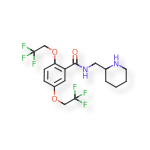
Details
| Stereochemistry | RACEMIC |
| Molecular Formula | C17H20F6N2O3 |
| Molecular Weight | 414.3427 |
| Optical Activity | ( + / - ) |
| Defined Stereocenters | 0 / 1 |
| E/Z Centers | 0 |
| Charge | 0 |
SHOW SMILES / InChI
SMILES
FC(F)(F)COC1=CC=C(OCC(F)(F)F)C(=C1)C(=O)NCC2CCCCN2
InChI
InChIKey=DJBNUMBKLMJRSA-UHFFFAOYSA-N
InChI=1S/C17H20F6N2O3/c18-16(19,20)9-27-12-4-5-14(28-10-17(21,22)23)13(7-12)15(26)25-8-11-3-1-2-6-24-11/h4-5,7,11,24H,1-3,6,8-10H2,(H,25,26)
| Molecular Formula | C17H20F6N2O3 |
| Molecular Weight | 414.3427 |
| Charge | 0 |
| Count |
|
| Stereochemistry | RACEMIC |
| Additional Stereochemistry | No |
| Defined Stereocenters | 0 / 1 |
| E/Z Centers | 0 |
| Optical Activity | ( + / - ) |
DescriptionSources: http://www.drugbank.ca/drugs/DB01195Curator's Comment: Description was created based on several sources, including
https://www.drugs.com/pro/flecainide.html
Sources: http://www.drugbank.ca/drugs/DB01195
Curator's Comment: Description was created based on several sources, including
https://www.drugs.com/pro/flecainide.html
Flecainide is a potent anti-arrhythmia agent, effective in a wide range of ventricular and atrial arrhythmias and tachycardias. Flecainide has local anesthetic activity and belongs to the membrane stabilizing (Class 1) group of antiarrhythmic agents; it has electrophysiologic effects characteristic of the IC class of antiarrhythmics. Flecainide acts on sodium channels on the neuronal cell membrane, limiting the spread of seizure activity and reducing seizure propagation. The antiarrhythmic actions are mediated through effects on sodium channels in Purkinje fibers. Flecainide is a sodium channel blocker, binding to voltage gated sodium channels. It stabilizes the neuronal membrane by inhibiting the ionic fluxes required for the initiation and conduction of impulses. Ventricular excitability is depressed and the stimulation threshold of the ventricle is increased during diastole. Flecainide is sold under the trade name Tambocor (manufactured by 3M pharmaceuticals). Flecainide went off-patent on February 10, 2004. In addition to being marketed as Tambocor, it is also available in generic version and under the trade names Almarytm, Apocard, Ecrinal, and Flécaine.
Originator
Approval Year
Targets
| Primary Target | Pharmacology | Condition | Potency |
|---|---|---|---|
Target ID: CHEMBL1980 |
67.2 µM [IC50] | ||
Target ID: CHEMBL2072 |
18.0 µM [Ki] | ||
Target ID: CHEMBL240 |
1.49 µM [IC50] | ||
Target ID: CHEMBL1964 |
7.8 µM [IC50] |
Conditions
| Condition | Modality | Targets | Highest Phase | Product |
|---|---|---|---|---|
| Preventing | Flecainide Approved UseIn patients without structural heart disease, Flecainide is indicated for the prevention of
- paroxysmal supraventricular tachycardias (PSVT), including atrioventricular nodal reentrant tachycardia, atrioventricular reentrant tachycardia and other supraventricular tachycardias of unspecified mechanism associated with disabling symptoms
- paroxysmal atrial fibrillation/flutter (PAF) associated with disabling symptoms
Flecainide is also indicated for the prevention of
- documented ventricular arrhythmias, such as sustained ventricular tachycardia (sustained VT), that in the judgment of the physician, are lifethreatening. Launch Date2001 |
|||
| Preventing | Flecainide Approved UseIn patients without structural heart disease, Flecainide is indicated for the prevention of
- paroxysmal supraventricular tachycardias (PSVT), including atrioventricular nodal reentrant tachycardia, atrioventricular reentrant tachycardia and other supraventricular tachycardias of unspecified mechanism associated with disabling symptoms
- paroxysmal atrial fibrillation/flutter (PAF) associated with disabling symptoms
Flecainide is also indicated for the prevention of
- documented ventricular arrhythmias, such as sustained ventricular tachycardia (sustained VT), that in the judgment of the physician, are lifethreatening. Launch Date2001 |
Cmax
| Value | Dose | Co-administered | Analyte | Population |
|---|---|---|---|---|
1710 ng/mL EXPERIMENT https://www.ncbi.nlm.nih.gov/pubmed/3094570 |
2 mg/kg single, intravenous dose: 2 mg/kg route of administration: Intravenous experiment type: SINGLE co-administered: |
FLECAINIDE plasma | Homo sapiens population: HEALTHY age: ADULT sex: MALE food status: FASTED |
|
355 ng/mL EXPERIMENT https://www.ncbi.nlm.nih.gov/pubmed/3094570 |
200 mg single, oral dose: 200 mg route of administration: Oral experiment type: SINGLE co-administered: |
FLECAINIDE plasma | Homo sapiens population: HEALTHY age: ADULT sex: MALE food status: FASTED |
AUC
| Value | Dose | Co-administered | Analyte | Population |
|---|---|---|---|---|
5.9 μg × h/mL EXPERIMENT https://www.ncbi.nlm.nih.gov/pubmed/1782978 |
200 mg single, oral dose: 200 mg route of administration: Oral experiment type: SINGLE co-administered: |
FLECAINIDE plasma | Homo sapiens population: UNHEALTHY age: ADULT sex: FEMALE / MALE food status: UNKNOWN |
|
6238 ng × h/mL EXPERIMENT https://www.ncbi.nlm.nih.gov/pubmed/3094570 |
2 mg/kg single, intravenous dose: 2 mg/kg route of administration: Intravenous experiment type: SINGLE co-administered: |
FLECAINIDE plasma | Homo sapiens population: HEALTHY age: ADULT sex: MALE food status: FASTED |
|
5979 ng × h/mL EXPERIMENT https://www.ncbi.nlm.nih.gov/pubmed/3094570 |
200 mg single, oral dose: 200 mg route of administration: Oral experiment type: SINGLE co-administered: |
FLECAINIDE plasma | Homo sapiens population: HEALTHY age: ADULT sex: MALE food status: FASTED |
T1/2
| Value | Dose | Co-administered | Analyte | Population |
|---|---|---|---|---|
11.5 h EXPERIMENT https://www.ncbi.nlm.nih.gov/pubmed/1782978 |
200 mg single, oral dose: 200 mg route of administration: Oral experiment type: SINGLE co-administered: |
FLECAINIDE plasma | Homo sapiens population: UNHEALTHY age: ADULT sex: FEMALE / MALE food status: UNKNOWN |
Funbound
| Value | Dose | Co-administered | Analyte | Population |
|---|---|---|---|---|
60% EXPERIMENT https://www.ncbi.nlm.nih.gov/pubmed/6364769 |
FLECAINIDE plasma | Homo sapiens population: HEALTHY age: ADULT sex: UNKNOWN food status: UNKNOWN |
Doses
| Dose | Population | Adverse events |
|---|---|---|
1200 mg single, oral Overdose |
healthy, 18 |
Disc. AE: Unconsciousness, Cyanosis... AEs leading to discontinuation/dose reduction: Unconsciousness Sources: Cyanosis Bradycardia Arrhythmia |
3800 mg single, oral Overdose |
healthy, 28 |
Disc. AE: Polymorphic ventricular tachycardia... AEs leading to discontinuation/dose reduction: Polymorphic ventricular tachycardia Sources: |
10 g single, oral Overdose |
healthy, 36 |
Disc. AE: Ventricular tachycardia, Hypotension... AEs leading to discontinuation/dose reduction: Ventricular tachycardia Sources: Hypotension Cardiopulmonary arrest |
1 g single, oral Overdose |
unhealthy, 62 |
Disc. AE: Brugada syndrome, Mental status changes... AEs leading to discontinuation/dose reduction: Brugada syndrome Sources: Mental status changes Fatigue |
200 mg 2 times / day multiple, oral Recommended Dose: 200 mg, 2 times / day Route: oral Route: multiple Dose: 200 mg, 2 times / day Sources: |
unhealthy Health Status: unhealthy Sources: |
Disc. AE: Ventricular tachycardia, Cardiac arrest... AEs leading to discontinuation/dose reduction: Ventricular tachycardia Sources: Cardiac arrest |
AEs
| AE | Significance | Dose | Population |
|---|---|---|---|
| Arrhythmia | Disc. AE | 1200 mg single, oral Overdose |
healthy, 18 |
| Bradycardia | Disc. AE | 1200 mg single, oral Overdose |
healthy, 18 |
| Cyanosis | Disc. AE | 1200 mg single, oral Overdose |
healthy, 18 |
| Unconsciousness | Disc. AE | 1200 mg single, oral Overdose |
healthy, 18 |
| Polymorphic ventricular tachycardia | Disc. AE | 3800 mg single, oral Overdose |
healthy, 28 |
| Cardiopulmonary arrest | Disc. AE | 10 g single, oral Overdose |
healthy, 36 |
| Hypotension | Disc. AE | 10 g single, oral Overdose |
healthy, 36 |
| Ventricular tachycardia | Disc. AE | 10 g single, oral Overdose |
healthy, 36 |
| Brugada syndrome | Disc. AE | 1 g single, oral Overdose |
unhealthy, 62 |
| Fatigue | Disc. AE | 1 g single, oral Overdose |
unhealthy, 62 |
| Mental status changes | Disc. AE | 1 g single, oral Overdose |
unhealthy, 62 |
| Cardiac arrest | Disc. AE | 200 mg 2 times / day multiple, oral Recommended Dose: 200 mg, 2 times / day Route: oral Route: multiple Dose: 200 mg, 2 times / day Sources: |
unhealthy Health Status: unhealthy Sources: |
| Ventricular tachycardia | Disc. AE | 200 mg 2 times / day multiple, oral Recommended Dose: 200 mg, 2 times / day Route: oral Route: multiple Dose: 200 mg, 2 times / day Sources: |
unhealthy Health Status: unhealthy Sources: |
Overview
| CYP3A4 | CYP2C9 | CYP2D6 | hERG |
|---|---|---|---|
OverviewOther
| Other Inhibitor | Other Substrate | Other Inducer |
|---|---|---|
Drug as perpetrator
| Target | Modality | Activity | Metabolite | Clinical evidence |
|---|---|---|---|---|
| yes [IC50 0.44 uM] | ||||
| yes [IC50 0.49 uM] | ||||
| yes [IC50 191 uM] |
Drug as victim
| Target | Modality | Activity | Metabolite | Clinical evidence |
|---|---|---|---|---|
| yes | ||||
| yes | yes (co-administration study) Comment: During the period in which the CYP2D6 inhibitor paroxetine was administered, the flecainide AUC in extensive and intermediate metabolizers was increased to 128.5% of basal values (90% CI, 122.2%– 135.2%) and 116.6% of basal values (90% CI, 107.3%–126.8%). However, poor metabolizers exhibited no alterations in AUC after administration of paroxetine (pharmacogenomic studies were also performed) |
Tox targets
| Target | Modality | Activity | Metabolite | Clinical evidence |
|---|---|---|---|---|
PubMed
| Title | Date | PubMed |
|---|---|---|
| Refining the human iPSC-cardiomyocyte arrhythmic risk assessment model. | 2013-12 |
|
| The effects of jaspamide on human cardiomyocyte function and cardiac ion channel activity. | 2013-03 |
|
| Palmitate increases the susceptibility of cells to drug-induced toxicity: an in vitro method to identify drugs with potential contraindications in patients with metabolic disease. | 2012-10 |
|
| Comparison of a genomic and a multiplex cell imaging approach for the detection of phospholipidosis. | 2011-10 |
|
| Estimating the risk of drug-induced proarrhythmia using human induced pluripotent stem cell-derived cardiomyocytes. | 2011-09 |
|
| Carvedilol and its new analogs suppress arrhythmogenic store overload-induced Ca2+ release. | 2011-07-10 |
|
| Selective regulation of cardiac organic cation transporter novel type 2 (OCTN2) in dilated cardiomyopathy. | 2011-06 |
|
| Iatrogenic Flecainide toxicity. | 2010-12 |
|
| Tachycardia due to atrial flutter with rapid 1:1 conduction following treatment of atrial fibrillation with flecainide. | 2010-03-10 |
|
| Tpeak-Tend interval and Tpeak-Tend/QT ratio as markers of ventricular tachycardia inducibility in subjects with Brugada ECG phenotype. | 2010-02 |
|
| A case of flecainide-induced hyponatremia. | 2009-10 |
|
| Delirium in a patient with toxic flecainide plasma concentrations: the role of a pharmacokinetic drug interaction with paroxetine. | 2009-07 |
|
| Effects of antiarrhythmic drugs on the hyperpolarization-activated cyclic nucleotide-gated channel current. | 2009-06 |
|
| A preliminary assessment of the effects of ATI-2042 in subjects with paroxysmal atrial fibrillation using implanted pacemaker methodology. | 2009-04 |
|
| Is flecainide dangerous in long QT-3 patients? | 2009-01 |
|
| ECGs in the ED. | 2008-11 |
|
| Role of cytochrome P450 in drug interactions. | 2008-10-18 |
|
| Drug therapy considerations in arrhythmias in children. | 2008-08-01 |
|
| The Relationship Between HIV Infection and Cardiovascular Disease. | 2008-08 |
|
| Proarrhythmia, cardiac arrest and death in young patients receiving encainide and flecainide. The Pediatric Electrophysiology Group. | 1991-08 |
|
| Mortality and morbidity in patients receiving encainide, flecainide, or placebo. The Cardiac Arrhythmia Suppression Trial. | 1991-03-21 |
|
| Safety and efficacy of oral flecainide therapy in patients with atrioventricular re-entrant tachycardia. | 1991-02-01 |
|
| Flecainide acetate treatment of paroxysmal supraventricular tachycardia and paroxysmal atrial fibrillation: dose-response studies. The Flecainide Supraventricular Tachycardia Study Group. | 1991-02 |
|
| Reversion of recent-onset atrial fibrillation to sinus rhythm by intravenous flecainide. | 1991-01-15 |
|
| Flecainide acetate prevents recurrence of symptomatic paroxysmal supraventricular tachycardia. The Flecainide Supraventricular Tachycardia Study Group. | 1991-01 |
|
| Combined application of class I antiarrhythmic drugs causes "additive", "reductive", or "synergistic" sodium channel block in cardiac muscles. | 1990-11 |
|
| Relative efficacy and safety of intravenous drugs for termination of sustained ventricular tachycardia. | 1990-09-15 |
|
| Possible atrial proarrhythmic effects of class 1C antiarrhythmic drugs. | 1990-08-01 |
|
| Dangerous recurrence of arrhythmia following withdrawal of flecainide. | 1990-08 |
|
| Amiodarone toxicity: myopathy and neuropathy. | 1990-05 |
|
| [Effects of oral flecainide treatment of refractory tachyarrhythmias]. | 1990-05 |
|
| Serious interactions of sotalol with amiodarone and flecainide. | 1990-03-05 |
|
| Profound exacerbation of neuromuscular weakness by flecainide. | 1990-02 |
|
| Acute urinary retention associated with flecainide. | 1990-01-01 |
|
| Torsades de pointe with flecainide-amiodarone therapy. | 1990 |
|
| Prevention of symptomatic recurrences of paroxysmal atrial fibrillation in patients initially tolerating antiarrhythmic therapy. A multicenter, double-blind, crossover study of flecainide and placebo with transtelephonic monitoring. Flecainide Supraventricular Tachycardia Study Group. | 1989-12 |
|
| Reversal of proarrhythmic effects of flecainide acetate and encainide hydrochloride by propranolol. | 1989-12 |
|
| [Bidirectional tachycardia during therapy with lorajmine]. | 1989-10 |
|
| Generalized seizures as the presentation of flecainide toxicity. | 1989-10 |
|
| [Arrhythmogenic effect of flecainide--treatment with i.v. magnesium]. | 1989-09 |
|
| Flecainide-induced ventricular tachycardia and fibrillation in patients treated for atrial fibrillation. | 1989-07-15 |
|
| Cardioprotective effects of various class I antiarrhythmic drugs in canine hearts. | 1989-07 |
|
| Rapid suppression of flecainide-induced incessant ventricular tachycardia with high-dose intravenous amiodarone. | 1988-04 |
|
| [Central nervous system side effects due to anti-arrhythmia therapy. Psychotic depression due to flecainide]. | 1988-03-11 |
|
| Flecainide-induced sustained ventricular tachycardia successfully treated with lidocaine. | 1987-09 |
|
| Flecainide acetate in the treatment of tachycardias associated with Mahaim fibres. | 1987-08 |
|
| [Hemodynamic effects of the anti-arrhythmia agent flecainide (Tambocor) in coronary surgery patients]. | 1987-06 |
|
| [Drug-induced intrahepatic cholestasis caused by flecainide acetate and enalapril]. | 1987-03 |
|
| Comparative haemodynamic effects of intravenous lignocaine, disopyramide and flecainide in uncomplicated acute myocardial infarction. | 1986-12 |
|
| Dysarthria and visual hallucinations due to flecainide toxicity. | 1986-01 |
Patents
Sample Use Guides
Usual Adult Dose for Ventricular Tachycardia
Initial dose: 100 mg orally every 12 hours.
Maintenance dose: May be increased in increments of 50 mg bid every 4 days until efficacy is achieved. Most patients with SUSTAINED VT do not require more than 150 mg every 12 hours (300 mg/day), and the maximum dose recommended is 400 mg/day.
Usual Adult Dose for Atrial Fibrillation
Initial dose: 50 mg orally every 12 hours.
Maintenance dose: May be increased in increments of 50 mg bid every 4 days until efficacy is achieved.
Route of Administration:
Oral
| Substance Class |
Chemical
Created
by
admin
on
Edited
Wed Apr 02 09:30:17 GMT 2025
by
admin
on
Wed Apr 02 09:30:17 GMT 2025
|
| Record UNII |
K94FTS1806
|
| Record Status |
Validated (UNII)
|
| Record Version |
|
-
Download
| Name | Type | Language | ||
|---|---|---|---|---|
|
Preferred Name | English | ||
|
Official Name | English | ||
|
Systematic Name | English | ||
|
Common Name | English | ||
|
Common Name | English | ||
|
Code | English | ||
|
Common Name | English | ||
|
Common Name | English | ||
|
Common Name | English |
| Classification Tree | Code System | Code | ||
|---|---|---|---|---|
|
NDF-RT |
N0000175426
Created by
admin on Wed Apr 02 09:30:17 GMT 2025 , Edited by admin on Wed Apr 02 09:30:17 GMT 2025
|
||
|
WHO-VATC |
QC01BC04
Created by
admin on Wed Apr 02 09:30:17 GMT 2025 , Edited by admin on Wed Apr 02 09:30:17 GMT 2025
|
||
|
LIVERTOX |
NBK548023
Created by
admin on Wed Apr 02 09:30:17 GMT 2025 , Edited by admin on Wed Apr 02 09:30:17 GMT 2025
|
||
|
FDA ORPHAN DRUG |
536716
Created by
admin on Wed Apr 02 09:30:17 GMT 2025 , Edited by admin on Wed Apr 02 09:30:17 GMT 2025
|
||
|
WHO-ATC |
C01BC04
Created by
admin on Wed Apr 02 09:30:17 GMT 2025 , Edited by admin on Wed Apr 02 09:30:17 GMT 2025
|
||
|
NCI_THESAURUS |
C47793
Created by
admin on Wed Apr 02 09:30:17 GMT 2025 , Edited by admin on Wed Apr 02 09:30:17 GMT 2025
|
||
|
NCI_THESAURUS |
C93038
Created by
admin on Wed Apr 02 09:30:17 GMT 2025 , Edited by admin on Wed Apr 02 09:30:17 GMT 2025
|
| Code System | Code | Type | Description | ||
|---|---|---|---|---|---|
|
m5400
Created by
admin on Wed Apr 02 09:30:17 GMT 2025 , Edited by admin on Wed Apr 02 09:30:17 GMT 2025
|
PRIMARY | Merck Index | ||
|
3356
Created by
admin on Wed Apr 02 09:30:17 GMT 2025 , Edited by admin on Wed Apr 02 09:30:17 GMT 2025
|
PRIMARY | |||
|
C62029
Created by
admin on Wed Apr 02 09:30:17 GMT 2025 , Edited by admin on Wed Apr 02 09:30:17 GMT 2025
|
PRIMARY | |||
|
SUB07637MIG
Created by
admin on Wed Apr 02 09:30:17 GMT 2025 , Edited by admin on Wed Apr 02 09:30:17 GMT 2025
|
PRIMARY | |||
|
D005424
Created by
admin on Wed Apr 02 09:30:17 GMT 2025 , Edited by admin on Wed Apr 02 09:30:17 GMT 2025
|
PRIMARY | |||
|
K94FTS1806
Created by
admin on Wed Apr 02 09:30:17 GMT 2025 , Edited by admin on Wed Apr 02 09:30:17 GMT 2025
|
PRIMARY | |||
|
719273
Created by
admin on Wed Apr 02 09:30:17 GMT 2025 , Edited by admin on Wed Apr 02 09:30:17 GMT 2025
|
PRIMARY | |||
|
4441
Created by
admin on Wed Apr 02 09:30:17 GMT 2025 , Edited by admin on Wed Apr 02 09:30:17 GMT 2025
|
PRIMARY | RxNorm | ||
|
75984
Created by
admin on Wed Apr 02 09:30:17 GMT 2025 , Edited by admin on Wed Apr 02 09:30:17 GMT 2025
|
PRIMARY | |||
|
K94FTS1806
Created by
admin on Wed Apr 02 09:30:17 GMT 2025 , Edited by admin on Wed Apr 02 09:30:17 GMT 2025
|
PRIMARY | |||
|
1176
Created by
admin on Wed Apr 02 09:30:17 GMT 2025 , Edited by admin on Wed Apr 02 09:30:17 GMT 2025
|
PRIMARY | |||
|
FLECAINIDE
Created by
admin on Wed Apr 02 09:30:17 GMT 2025 , Edited by admin on Wed Apr 02 09:30:17 GMT 2025
|
PRIMARY | |||
|
DB01195
Created by
admin on Wed Apr 02 09:30:17 GMT 2025 , Edited by admin on Wed Apr 02 09:30:17 GMT 2025
|
PRIMARY | |||
|
54143-55-4
Created by
admin on Wed Apr 02 09:30:17 GMT 2025 , Edited by admin on Wed Apr 02 09:30:17 GMT 2025
|
PRIMARY | |||
|
DTXSID8023054
Created by
admin on Wed Apr 02 09:30:17 GMT 2025 , Edited by admin on Wed Apr 02 09:30:17 GMT 2025
|
PRIMARY | |||
|
Flecainide
Created by
admin on Wed Apr 02 09:30:17 GMT 2025 , Edited by admin on Wed Apr 02 09:30:17 GMT 2025
|
PRIMARY | |||
|
100000080972
Created by
admin on Wed Apr 02 09:30:17 GMT 2025 , Edited by admin on Wed Apr 02 09:30:17 GMT 2025
|
PRIMARY | |||
|
CHEMBL652
Created by
admin on Wed Apr 02 09:30:17 GMT 2025 , Edited by admin on Wed Apr 02 09:30:17 GMT 2025
|
PRIMARY | |||
|
2560
Created by
admin on Wed Apr 02 09:30:17 GMT 2025 , Edited by admin on Wed Apr 02 09:30:17 GMT 2025
|
PRIMARY | |||
|
4096
Created by
admin on Wed Apr 02 09:30:17 GMT 2025 , Edited by admin on Wed Apr 02 09:30:17 GMT 2025
|
PRIMARY |
| Related Record | Type | Details | ||
|---|---|---|---|---|
|
TRANSPORTER -> INHIBITOR | |||
|
|
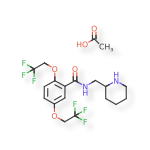
SALT/SOLVATE -> PARENT |
|
||
|
|
TARGET -> INHIBITOR |
|

| Related Record | Type | Details | ||
|---|---|---|---|---|
|
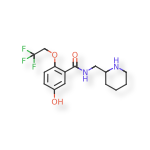
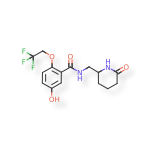
METABOLITE -> PARENT | |||
|
METABOLITE -> PARENT |
|
| Related Record | Type | Details | ||
|---|---|---|---|---|
|
|
PARENT -> IMPURITY |
Intermediate
|
| Related Record | Type | Details | ||
|---|---|---|---|---|
|
|
ACTIVE MOIETY |
|