


Details
| Stereochemistry | RACEMIC |
| Molecular Formula | C22H31NO3 |
| Molecular Weight | 357.4864 |
| Optical Activity | ( + / - ) |
| Defined Stereocenters | 0 / 1 |
| E/Z Centers | 0 |
| Charge | 0 |
SHOW SMILES / InChI
SMILES
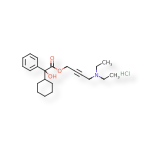
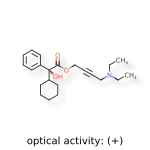
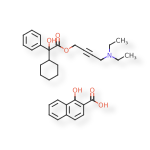
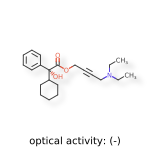
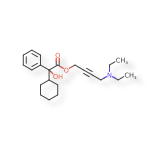
CCN(CC)CC#CCOC(=O)C(O)(C1CCCCC1)C2=CC=CC=C2
InChI
InChIKey=XIQVNETUBQGFHX-UHFFFAOYSA-N
InChI=1S/C22H31NO3/c1-3-23(4-2)17-11-12-18-26-21(24)22(25,19-13-7-5-8-14-19)20-15-9-6-10-16-20/h5,7-8,13-14,20,25H,3-4,6,9-10,15-18H2,1-2H3
| Molecular Formula | C22H31NO3 |
| Molecular Weight | 357.4864 |
| Charge | 0 |
| Count |
|
| Stereochemistry | RACEMIC |
| Additional Stereochemistry | No |
| Defined Stereocenters | 0 / 1 |
| E/Z Centers | 0 |
| Optical Activity | ( + / - ) |
DescriptionSources: http://www.drugbank.ca/drugs/DB01062Curator's Comment: Description was created based on several sources, including http://www.accessdata.fda.gov/drugsatfda_docs/label/2008/017577s034,018211s017,020897s018lbl.pdf
Sources: http://www.drugbank.ca/drugs/DB01062
Curator's Comment: Description was created based on several sources, including http://www.accessdata.fda.gov/drugsatfda_docs/label/2008/017577s034,018211s017,020897s018lbl.pdf
Oxybutynin is an antispasmodic, anticholinergic agent indicated for the treatment of overactive bladder with symptoms of urge urinary incontinence, urgency, and frequency. Oxybutynin relaxes bladder smooth muscle. Oxybutynin exhibits only one-fifth of the anticholinergic activity of atropine on the rabbit detrusor muscle, but four to ten times the antispasmodic activity. Antimuscarinic activity resides predominantly in the R-isomer. Oxybutynin exerts a direct antispasmodic effect on smooth muscle and inhibits the muscarinic action of acetylcholine on smooth muscle. No blocking effects occur at skeletal neuromuscular junctions or autonomic ganglia (antinicotinic effects). By inhibiting particularily the M1 and M2 receptors of the bladder, detrusor activity is markedly decreased.
CNS Activity
Originator
Approval Year
Targets
| Primary Target | Pharmacology | Condition | Potency |
|---|---|---|---|
Target ID: CHEMBL211 Sources: http://www.drugbank.ca/drugs/DB01062 |
8.1 nM [Ki] | ||
Target ID: CHEMBL216 Sources: http://www.drugbank.ca/drugs/DB01062 |
1.0 nM [Ki] | ||
Target ID: CHEMBL245 Sources: http://www.drugbank.ca/drugs/DB01062 |
0.78 nM [Ki] |
Conditions
| Condition | Modality | Targets | Highest Phase | Product |
|---|---|---|---|---|
| Primary | DITROPAN Approved UseDITROPAN® (oxybutynin chloride) is indicated for the relief of symptoms of bladder instability associated with voiding in patients with uninhibited neurogenic or reflex neurogenic bladder (i.e., urgency, frequency, urinary leakage, urge incontinence,
dysuria). Launch Date1975 |
Cmax
| Value | Dose | Co-administered | Analyte | Population |
|---|---|---|---|---|
6.73 ng/mL EXPERIMENT https://pubmed.ncbi.nlm.nih.gov/3234461/ |
5 mg single, oral dose: 5 mg route of administration: Oral experiment type: SINGLE co-administered: |
OXYBUTYNIN plasma | Homo sapiens population: HEALTHY age: ADULT sex: FEMALE / MALE food status: FASTED |
AUC
| Value | Dose | Co-administered | Analyte | Population |
|---|---|---|---|---|
9.24 ng × h/mL EXPERIMENT https://pubmed.ncbi.nlm.nih.gov/3234461/ |
5 mg single, oral dose: 5 mg route of administration: Oral experiment type: SINGLE co-administered: |
OXYBUTYNIN plasma | Homo sapiens population: HEALTHY age: ADULT sex: FEMALE / MALE food status: FASTED |
T1/2
| Value | Dose | Co-administered | Analyte | Population |
|---|---|---|---|---|
2.44 h EXPERIMENT https://pubmed.ncbi.nlm.nih.gov/3234461/ |
5 mg single, oral dose: 5 mg route of administration: Oral experiment type: SINGLE co-administered: |
OXYBUTYNIN plasma | Homo sapiens population: HEALTHY age: ADULT sex: FEMALE / MALE food status: FASTED |
Overview
| CYP3A4 | CYP2C9 | CYP2D6 | hERG |
|---|---|---|---|
OverviewOther
| Other Inhibitor | Other Substrate | Other Inducer |
|---|---|---|
Drug as perpetrator
| Target | Modality | Activity | Metabolite | Clinical evidence |
|---|---|---|---|---|
| no | ||||
| no | ||||
| no | ||||
| no | ||||
Page: 205.0 |
yes [IC50 128 uM] | |||
Page: 205.0 |
yes [IC50 130 uM] | |||
Page: 205.0 |
yes [IC50 20 uM] | |||
Page: 496.0 |
yes [IC50 27.4 uM] | |||
Page: abstract |
yes [IC50 7.7 uM] | |||
Page: abstract |
yes [IC50 9.5 uM] | |||
| yes | ||||
| yes |
Drug as victim
| Target | Modality | Activity | Metabolite | Clinical evidence |
|---|---|---|---|---|
| major | yes (co-administration study) Comment: itraconazole increased oxybutynin cmax, auc 2x Page: 4.0 |
|||
Page: 451.0 |
no | |||
Page: abstract |
no | |||
Page: 451.0 |
no | |||
Page: abstract |
no | |||
Page: abstract |
no | |||
Page: 451.0 |
no | |||
Page: abstract |
no | |||
| no | ||||
Page: 206.0 |
yes | |||
Page: 206.0 |
yes | |||
Page: 206.0 |
yes |
Tox targets
| Target | Modality | Activity | Metabolite | Clinical evidence |
|---|---|---|---|---|
PubMed
| Title | Date | PubMed |
|---|---|---|
| A dynamic mechanical method for determining the silicone elastomer solubility of drugs and pharmaceutical excipients in silicone intravaginal drug delivery rings. | 2002-09 |
|
| M(3) receptor antagonism by the novel antimuscarinic agent solifenacin in the urinary bladder and salivary gland. | 2002-08 |
|
| Current pharmacotherapeutic strategies for overactive bladder. | 2002-07 |
|
| Extractionless and sensitive method for high-throughput quantitation of cetirizine in human plasma samples by liquid chromatography-tandem mass spectrometry. | 2002-06-25 |
|
| Inappropriate medication prescribing in residential care/assisted living facilities. | 2002-06 |
|
| Effect of muscarinic antagonists on micturition pressure measured by cystometry in normal, conscious rats. | 2002-06 |
|
| A long-term follow-up of autoaugmentation in myelodysplastic children. | 2002-06 |
|
| Overactive bladder patients and role of the pharmacist. | 2002-05-28 |
|
| Tolterodine: as effective but better tolerated than oxybutynin in Asian patients with symptoms of overactive bladder. | 2002-05 |
|
| Advances in anticholinergic therapy delivery systems. | 2002-05 |
|
| Urodynamic changes associated with behavioral and drug treatment of urge incontinence in older women. | 2002-05 |
|
| The management of urinary incontinence in the exstrophy complex, posterior urethral valves, and infrasphincteric ureters. | 2002-05 |
|
| Assessment and conservative management of the neuropathic bladder. | 2002-05 |
|
| Oxybutynin chloride: alterations in drug delivery and improved therapeutic index. | 2002-04 |
|
| Preliminary study of the safety and efficacy of extended-release oxybutynin in children. | 2002-03 |
|
| Efficacy of botulinum-a toxin in children with detrusor hyperreflexia due to myelomeningocele: preliminary results. | 2002-03 |
|
| Pharmacotherapy of the overactive bladder and advances in drug delivery. | 2002-03 |
|
| Vesicoureteral reflux and bladder management in spinal cord injury patients. | 2002-03 |
|
| Binding study of desethyloxybutynin using high-performance frontal analysis method. | 2002-02-25 |
|
| Plasma protein binding study of oxybutynin by high-performance frontal analysis. | 2002-02-25 |
|
| Pharmacokinetics, efficacy, and safety of intravesical formulation of oxybutynin in patients with detrusor overactivity. | 2002-02 |
|
| Highlights of the 22nd French pharmacovigilance meeting. | 2002-02 |
|
| Medication update. | 2002-02 |
|
| Enuresis. | 2002-02 |
|
| Influence of pump compliance (peristaltic vs. infusion) on urodynamic measurement during cystometry in conscious rats. | 2002-01-05 |
|
| Urinary antispasmodic use and the risks of ventricular arrhythmia and sudden death in older patients. | 2002-01 |
|
| Once-daily, extended-release formulations of antimuscarinic agents in the treatment of overactive bladder: a review. | 2002-01 |
|
| [Sling suspension of incontinent urinary reservoir]. | 2002-01 |
|
| New treatment options for overactive bladder and incontinence. | 2002 |
|
| S-oxybutynin. | 2002 |
|
| Oxybutynin intravesical--situs. I-oxy. | 2002 |
|
| Tolterodine: selectivity for the urinary bladder over the eye (as measured by visual accommodation) in healthy volunteers. | 2002 |
|
| Treatment can lead to a long dry spell. | 2002 |
|
| Actions of the new antimuscarinic compound Lu 25-109 on isolated human and pig detrusor. | 2002 |
|
| Cost-Effectiveness of tolterodine for patients with urge incontinence who discontinue initial therapy with oxybutynin: a Canadian perspective. | 2001-12 |
|
| Is tolterodine (Detrol) or oxybutynin (Ditropan) the best for treatment of urge urinary incontinence? | 2001-12 |
|
| Urethral catheterization in hypospadias surgery: Should the device enter the bladder or be made a urethral stent? | 2001-12 |
|
| Prescribing for multiple sclerosis patients in general practice: a case-control study. | 2001-12 |
|
| Evidence based management of nocturnal enuresis. | 2001-11-17 |
|
| Efficacy, tolerability and safety profile of propiverine in the treatment of the overactive bladder (non-neurogenic and neurogenic). | 2001-11 |
|
| Oxybutynin and the overactive bladder. | 2001-11 |
|
| Tolterodine: an overview. | 2001-11 |
|
| Which muscarinic receptor is important in the bladder? | 2001-11 |
|
| Medical treatment of overactive bladder. | 2001-11 |
|
| Evidence for the efficacy and safety of tolterodine in the treatment of overactive bladder. | 2001-10 |
|
| Transdermally-delivered oxybutynin (Oxytrol(R) for overactive bladder. | 2001-10 |
|
| Combination therapy for nocturnal enuresis. | 2001-10 |
|
| Identification of muscarinic receptor subtypes of cultured smooth muscle cells and tissue of human bladder body. | 2001-10 |
|
| Tolterodine: a clinical review. | 2001-10 |
|
| [Continence problems after radical prostatectomy: medical treatment]. | 2001-09 |
Sample Use Guides
Tablets
Adults: The usual dose is one 5-mg tablet two to three times a day. The maximum recommended dose is one 5-mg tablet four times a day. A lower starting dose of 2.5 mg two or three times a day is recommended for the frail elderly.
Pediatric patients over 5 years of age: The usual dose is one 5-mg tablet two times a day. The maximum recommended dose is one 5-mg tablet three times a day.
Route of Administration:
Oral
| Substance Class |
Chemical
Created
by
admin
on
Edited
Mon Mar 31 19:22:10 GMT 2025
by
admin
on
Mon Mar 31 19:22:10 GMT 2025
|
| Record UNII |
K9P6MC7092
|
| Record Status |
Validated (UNII)
|
| Record Version |
|
-
Download
| Name | Type | Language | ||
|---|---|---|---|---|
|
Official Name | English | ||
|
Preferred Name | English | ||
|
Common Name | English | ||
|
Common Name | English | ||
|
Systematic Name | English | ||
|
Common Name | English | ||
|
Common Name | English | ||
|
Common Name | English | ||
|
Common Name | English | ||
|
Common Name | English | ||
|
Brand Name | English | ||
|
Systematic Name | English | ||
|
Common Name | English | ||
|
Common Name | English |
| Classification Tree | Code System | Code | ||
|---|---|---|---|---|
|
NDF-RT |
N0000000125
Created by
admin on Mon Mar 31 19:22:10 GMT 2025 , Edited by admin on Mon Mar 31 19:22:10 GMT 2025
|
||
|
WHO-ATC |
G04BD04
Created by
admin on Mon Mar 31 19:22:10 GMT 2025 , Edited by admin on Mon Mar 31 19:22:10 GMT 2025
|
||
|
NDF-RT |
N0000000125
Created by
admin on Mon Mar 31 19:22:10 GMT 2025 , Edited by admin on Mon Mar 31 19:22:10 GMT 2025
|
||
|
LIVERTOX |
NBK548652
Created by
admin on Mon Mar 31 19:22:10 GMT 2025 , Edited by admin on Mon Mar 31 19:22:10 GMT 2025
|
||
|
NDF-RT |
N0000000125
Created by
admin on Mon Mar 31 19:22:10 GMT 2025 , Edited by admin on Mon Mar 31 19:22:10 GMT 2025
|
||
|
NDF-RT |
N0000175700
Created by
admin on Mon Mar 31 19:22:10 GMT 2025 , Edited by admin on Mon Mar 31 19:22:10 GMT 2025
|
||
|
EMA ASSESSMENT REPORTS |
KENTERA (AUTHORIZED: URINARY INCONTINENCE, URGE)
Created by
admin on Mon Mar 31 19:22:10 GMT 2025 , Edited by admin on Mon Mar 31 19:22:10 GMT 2025
|
||
|
WHO-VATC |
QG04BD04
Created by
admin on Mon Mar 31 19:22:10 GMT 2025 , Edited by admin on Mon Mar 31 19:22:10 GMT 2025
|
||
|
NCI_THESAURUS |
C29704
Created by
admin on Mon Mar 31 19:22:10 GMT 2025 , Edited by admin on Mon Mar 31 19:22:10 GMT 2025
|
| Code System | Code | Type | Description | ||
|---|---|---|---|---|---|
|
m8324
Created by
admin on Mon Mar 31 19:22:10 GMT 2025 , Edited by admin on Mon Mar 31 19:22:10 GMT 2025
|
PRIMARY | Merck Index | ||
|
SUB09558MIG
Created by
admin on Mon Mar 31 19:22:10 GMT 2025 , Edited by admin on Mon Mar 31 19:22:10 GMT 2025
|
PRIMARY | |||
|
DTXSID0023406
Created by
admin on Mon Mar 31 19:22:10 GMT 2025 , Edited by admin on Mon Mar 31 19:22:10 GMT 2025
|
PRIMARY | |||
|
K9P6MC7092
Created by
admin on Mon Mar 31 19:22:10 GMT 2025 , Edited by admin on Mon Mar 31 19:22:10 GMT 2025
|
PRIMARY | |||
|
3270
Created by
admin on Mon Mar 31 19:22:10 GMT 2025 , Edited by admin on Mon Mar 31 19:22:10 GMT 2025
|
PRIMARY | |||
|
4634
Created by
admin on Mon Mar 31 19:22:10 GMT 2025 , Edited by admin on Mon Mar 31 19:22:10 GMT 2025
|
PRIMARY | |||
|
7856
Created by
admin on Mon Mar 31 19:22:10 GMT 2025 , Edited by admin on Mon Mar 31 19:22:10 GMT 2025
|
PRIMARY | |||
|
K9P6MC7092
Created by
admin on Mon Mar 31 19:22:10 GMT 2025 , Edited by admin on Mon Mar 31 19:22:10 GMT 2025
|
PRIMARY | |||
|
5633-20-5
Created by
admin on Mon Mar 31 19:22:10 GMT 2025 , Edited by admin on Mon Mar 31 19:22:10 GMT 2025
|
PRIMARY | |||
|
Oxybutinyn
Created by
admin on Mon Mar 31 19:22:10 GMT 2025 , Edited by admin on Mon Mar 31 19:22:10 GMT 2025
|
PRIMARY | |||
|
DB01062
Created by
admin on Mon Mar 31 19:22:10 GMT 2025 , Edited by admin on Mon Mar 31 19:22:10 GMT 2025
|
PRIMARY | |||
|
359
Created by
admin on Mon Mar 31 19:22:10 GMT 2025 , Edited by admin on Mon Mar 31 19:22:10 GMT 2025
|
PRIMARY | |||
|
C47647
Created by
admin on Mon Mar 31 19:22:10 GMT 2025 , Edited by admin on Mon Mar 31 19:22:10 GMT 2025
|
PRIMARY | |||
|
100000085472
Created by
admin on Mon Mar 31 19:22:10 GMT 2025 , Edited by admin on Mon Mar 31 19:22:10 GMT 2025
|
PRIMARY | |||
|
OXYBUTYNIN
Created by
admin on Mon Mar 31 19:22:10 GMT 2025 , Edited by admin on Mon Mar 31 19:22:10 GMT 2025
|
PRIMARY | |||
|
NN-54
Created by
admin on Mon Mar 31 19:22:10 GMT 2025 , Edited by admin on Mon Mar 31 19:22:10 GMT 2025
|
PRIMARY | |||
|
1354
Created by
admin on Mon Mar 31 19:22:10 GMT 2025 , Edited by admin on Mon Mar 31 19:22:10 GMT 2025
|
PRIMARY | |||
|
C005419
Created by
admin on Mon Mar 31 19:22:10 GMT 2025 , Edited by admin on Mon Mar 31 19:22:10 GMT 2025
|
PRIMARY | |||
|
CHEMBL1231
Created by
admin on Mon Mar 31 19:22:10 GMT 2025 , Edited by admin on Mon Mar 31 19:22:10 GMT 2025
|
PRIMARY | |||
|
2028
Created by
admin on Mon Mar 31 19:22:10 GMT 2025 , Edited by admin on Mon Mar 31 19:22:10 GMT 2025
|
PRIMARY | |||
|
32675
Created by
admin on Mon Mar 31 19:22:10 GMT 2025 , Edited by admin on Mon Mar 31 19:22:10 GMT 2025
|
PRIMARY | RxNorm |
| Related Record | Type | Details | ||
|---|---|---|---|---|
|
BINDER->LIGAND |
|
||
|
|
SALT/SOLVATE -> PARENT |
|
||
|
|
ENANTIOMER -> RACEMATE |
|
||
|
|
SALT/SOLVATE -> PARENT |
|
||
|
|
TARGET -> INHIBITOR |
|
||
|
TARGET -> INHIBITOR | |||
|
ACTIVE ENANTIOMER->RACEMATE | |||
|
TARGET -> INHIBITOR |


| Related Record | Type | Details | ||
|---|---|---|---|---|
|
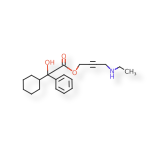
METABOLITE ACTIVE -> PARENT |
MAJOR
PLASMA; URINE
|
||
|
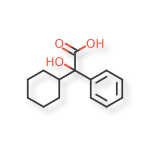
METABOLITE INACTIVE -> PARENT |
MAJOR
|
||
|
METABOLITE ACTIVE -> PARENT |
|
| Related Record | Type | Details | ||
|---|---|---|---|---|
|
|
ACTIVE MOIETY |
|
| Name | Property Type | Amount | Referenced Substance | Defining | Parameters | References |
|---|---|---|---|---|---|---|
| Biological Half-life | PHARMACOKINETIC |
|
Elimination PHARMACOKINETIC PHARMACOKINETIC PHARMACOKINETIC |
|
||
| Biological Half-life | PHARMACOKINETIC |
|
|
|||
| Volume of Distribution | PHARMACOKINETIC |
|
|
|||
| Biological Half-life | PHARMACOKINETIC |
|
Elimination PHARMACOKINETIC PHARMACOKINETIC |
|
||