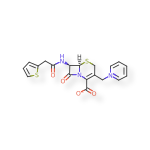
Details
| Stereochemistry | ABSOLUTE |
| Molecular Formula | C19H17N3O4S2 |
| Molecular Weight | 415.486 |
| Optical Activity | UNSPECIFIED |
| Defined Stereocenters | 2 / 2 |
| E/Z Centers | 0 |
| Charge | 0 |
SHOW SMILES / InChI
SMILES
[O-]C(=O)C1=C(C[N+]2=CC=CC=C2)CS[C@@H]3[C@H](NC(=O)CC4=CC=CS4)C(=O)N13
InChI
InChIKey=CZTQZXZIADLWOZ-CRAIPNDOSA-N
InChI=1S/C19H17N3O4S2/c23-14(9-13-5-4-8-27-13)20-15-17(24)22-16(19(25)26)12(11-28-18(15)22)10-21-6-2-1-3-7-21/h1-8,15,18H,9-11H2,(H-,20,23,25,26)/t15-,18-/m1/s1
| Molecular Formula | C19H17N3O4S2 |
| Molecular Weight | 415.486 |
| Charge | 0 |
| Count |
|
| Stereochemistry | ABSOLUTE |
| Additional Stereochemistry | No |
| Defined Stereocenters | 2 / 2 |
| E/Z Centers | 0 |
| Optical Activity | UNSPECIFIED |
DescriptionCurator's Comment: Description was created based on several sources. including http://www.drugbank.ca/drugs/DB09008 and http://onlinelibrary.wiley.com/doi/10.1002/cpt196896819/abstract
Curator's Comment: Description was created based on several sources. including http://www.drugbank.ca/drugs/DB09008 and http://onlinelibrary.wiley.com/doi/10.1002/cpt196896819/abstract
Cephaloridine (or cefaloridine) is a first generation semisynthetic derivative of cephalosporin C. It is unique among cephalosporins in that it exists as a zwitterion. It is of semi synthetic origin and belongs to cephem carboxylate. It belongs to Peptidoglycan synthesis inhibitor pharmacological group on the basis of mechanism of action. Since the discovery of cephalosporins P, N and C in 1948 there have been many studies describing the antibiotic action of cephalosporins and the possibility to synthesize derivatives. Hydrolysis of cephalosporin C, isolation of 7-aminocephalosporanic acid and the addition of side chains opened the possibility to produce various semi-synthetic cephalosporins. In 1962, cephalothin and cephaloridine were introduced. Cephaloridine is very active against gram positive cocci and used in a large variety of bacterial infections, such as respiratory tract, skin and urinary tract infections. Cephaloridine is primarily indicated in conditions like Bacterial infections, Bronchitis, Gonorrhoea, and can also be given in adjunctive therapy as an alternative drug of choice in Corneal ulcers, Intraocular infections. Cephaloridine was temporarily popular because it was better tolerated intramuscularly and attained in higher and more sustained levels in blood than cephalothin. Because it is also poorly absorbed after oral administration the use of this drug for humans declined rapidly, especially since the second generation of cephalosporins was introduced in the 1970s. Today it is more commonly used in veterinary practice to treat mild to severe bacterial infections caused by penicillin resistant and penicillin sensitive Staphylococcus aureus, Escherichia coli, Streptococcus pyogenes, Streptococcus pneumoniae, Bacillus sutbtilis, Klebsiella, Clostridium diptheriae, Salmonella and Shigella. Before the 1970s, cephaloridine was used to treat patients with urinary tract infections. Besides the drug has been used successfully in the treatment of various lower respiratory tract infections. Cephaloridine was very effective to cure pneumococcal pneumonia. It has a high clinical and bacteriological rate of success in staphylococcal and streptococcal infections.
Approval Year
Targets
| Primary Target | Pharmacology | Condition | Potency |
|---|---|---|---|
Target ID: P39844 Gene ID: 939990.0 Gene Symbol: dacC Target Organism: Bacillus subtilis (strain 168) |
|||
Target ID: Rabbit proximal tubules |
1.1 mM [EC50] | ||
Target ID: CHEMBL2073693 |
0.23 mM [IC50] | ||
Target ID: CHEMBL1641347 |
1250.0 µM [IC50] | ||
Target ID: CHEMBL1955711 |
4.48 mM [IC50] | ||
Target ID: Escherichia coli growth |
|||
Target ID: map00550 Sources: http://www.kegg.jp/entry/D01075 |
Conditions
| Condition | Modality | Targets | Highest Phase | Product |
|---|---|---|---|---|
| Curative | Ceporan Approved UseRespiratory tract infections, Septicemia, Skin & Soft tissue infections, Urinary tract & genital tract infections, Surgical prophylaxis |
|||
| Curative | Ceporan Approved UseRespiratory tract infections, Septicemia, Skin & Soft tissue infections, Urinary tract & genital tract infections, Surgical prophylaxis |
|||
| Curative | Ceporan Approved UseRespiratory tract infections, Septicemia, Skin & Soft tissue infections, Urinary tract & genital tract infections, Surgical prophylaxis |
Cmax
| Value | Dose | Co-administered | Analyte | Population |
|---|---|---|---|---|
38 μg/mL EXPERIMENT https://pubmed.ncbi.nlm.nih.gov/278145/ |
1 g single, intramuscular dose: 1 g route of administration: Intramuscular experiment type: SINGLE co-administered: |
CEPHALORIDINE plasma | Homo sapiens population: UNHEALTHY age: ADULT sex: UNKNOWN food status: UNKNOWN |
AUC
| Value | Dose | Co-administered | Analyte | Population |
|---|---|---|---|---|
40 μg × h/mL EXPERIMENT https://pubmed.ncbi.nlm.nih.gov/278145/ |
1 g single, intramuscular dose: 1 g route of administration: Intramuscular experiment type: SINGLE co-administered: |
CEPHALORIDINE plasma | Homo sapiens population: UNHEALTHY age: ADULT sex: UNKNOWN food status: UNKNOWN |
T1/2
| Value | Dose | Co-administered | Analyte | Population |
|---|---|---|---|---|
1.5 h EXPERIMENT https://pubmed.ncbi.nlm.nih.gov/278145/ |
1 g single, intramuscular dose: 1 g route of administration: Intramuscular experiment type: SINGLE co-administered: |
CEPHALORIDINE plasma | Homo sapiens population: UNHEALTHY age: ADULT sex: UNKNOWN food status: UNKNOWN |
Funbound
| Value | Dose | Co-administered | Analyte | Population |
|---|---|---|---|---|
69% EXPERIMENT https://pubmed.ncbi.nlm.nih.gov/278145/ |
1 g single, intramuscular dose: 1 g route of administration: Intramuscular experiment type: SINGLE co-administered: |
CEPHALORIDINE plasma | Homo sapiens population: UNHEALTHY age: ADULT sex: UNKNOWN food status: UNKNOWN |
Overview
| CYP3A4 | CYP2C9 | CYP2D6 | hERG |
|---|---|---|---|
Drug as perpetrator
| Target | Modality | Activity | Metabolite | Clinical evidence |
|---|---|---|---|---|
| yes [IC50 230 uM] | ||||
| yes [IC50 4480 uM] | ||||
| yes [Ki 2460 uM] | ||||
| yes [Ki 3630 uM] | ||||
| yes [Ki 740 uM] | ||||
| yes |
Drug as victim
| Target | Modality | Activity | Metabolite | Clinical evidence |
|---|---|---|---|---|
| yes | ||||
| yes | ||||
| yes |
PubMed
| Title | Date | PubMed |
|---|---|---|
| In vitro and in vivo efficacy of β-lactams against replicating and slowly growing/nonreplicating Mycobacterium tuberculosis. | 2013-06 |
|
| Kidney injury molecule-1 expression in rat proximal tubule after treatment with segment-specific nephrotoxicants: a tool for early screening of potential kidney toxicity. | 2010-04 |
|
| Transcriptomic analysis of nephrotoxicity induced by cephaloridine, a representative cephalosporin antibiotic. | 2008-06 |
|
| In vitro gene expression analysis of nephrotoxic drugs in rat primary renal cortical tubular cells. | 2008-03 |
|
| Serum thymic factor, FTS, attenuates cisplatin nephrotoxicity by suppressing cisplatin-induced ERK activation. | 2005-11-01 |
|
| Protective effect of serum thymic factor, FTS, on cephaloridine-induced nephrotoxicity in rats. | 2005-11 |
|
| Effect of ginsenoside-Rd in cephaloridine-induced renal disorder. | 1999-02 |
|
| Magnesium lithospermate B ameliorates cephaloridine-induced renal injury. | 1997-12 |
|
| Can penicillins and other beta-lactam antibiotics be used to treat tuberculosis? | 1995-12 |
|
| [Studies on the mechanisms of renal damages induced by nephrotoxic compounds]. | 1995-12 |
|
| Suppressed expression of calcium-binding protein regucalcin mRNA in the renal cortex of rats with chemically induced kidney damage. | 1995-10-04 |
|
| Glucocorticoid amelioration of nephrotoxicity: a study of cephaloridine-methylprednisolone interaction in the rat. | 1995-07 |
|
| Cephaloridine nephrotoxicity in diabetic rats: modulation by insulin treatment. | 1995-06-26 |
|
| Preventive effect of betamipron on nephrotoxicity and uptake of carbapenems in rabbit renal cortex. | 1994-09 |
|
| Effects of KW-3902, a novel adenosine A1-receptor antagonist, on cephaloridine-induced acute renal failure in rats. | 1994-01 |
|
| [Study on gamma-GTP activity in urine and renal tissue of drug-induced nephrotoxicity in rats]. | 1993-07 |
|
| Methimazole protection of rats against chemically induced kidney damage in vivo. | 1992-01 |
|
| Drugs as allergens: an immunoassay for detecting IgE antibodies to cephalosporins. | 1990 |
|
| Safety evaluation of meropenem in animals: studies on the kidney. | 1989-09 |
|
| [Acute renal failure caused by ceporin, kanamycin and gentamicin]. | 1989-03-01 |
|
| Relieving effect of saline on cephaloridine nephrotoxicity in rats. | 1989-03 |
|
| The use of renal cortical slices from the Fischer 344 rat as an in vitro model to evaluate nephrotoxicity. | 1988-07 |
|
| Protective effect of piperacillin against nephrotoxicity of cephaloridine and gentamicin in animals. | 1988-06 |
|
| [Nephrotoxicity of cefodizime sodium in rats--single and 14-day repeated intravenous administration]. | 1988-06 |
|
| Biochemical mechanisms of cephaloridine nephrotoxicity. | 1988 |
|
| Neurotoxicity of beta-lactam antibiotics. Experimental kinetic and neurophysiological studies. | 1988 |
|
| Vasopressin-resistant polyuria induced by cephaloridine administration in rats. | 1986 |
|
| Ceftazidime nephrotoxicity in rats. | 1984-04 |
|
| Lipid peroxidation: a possible mechanism of cephaloridine-induced nephrotoxicity. | 1983-01 |
|
| [Studies on the nephrotoxicity of cephaloridine in the mouse (author's transl)]. | 1982 |
|
| In vitro and in vivo susceptibility of atypical mycobacteria to various drugs. | 1981-09-01 |
|
| Nephrotoxicity of cefotiam (CGP 14221/E) in rats and rabbits. | 1981-09 |
|
| Renal tolerance of ceftazidime in animals. | 1981-09 |
|
| Cephaloridine encephalopathy. | 1981-08-08 |
|
| IgE antibodies for penicillins and cephalosporins in rats. III. Antigenic specificity of rat anti-cephalosporin-OvA IgE sera. | 1981-01 |
|
| Renal tubular necrosis following cephalothin. | 1979 |
|
| Drug-induced lysosomal changes and nephrotoxicity in rats. | 1978-11 |
|
| Renal and hepatic necrosis after metabolic activation of 2-substituted furans and thiophenes, including furosemide and cephaloridine. | 1977-11 |
|
| Molecular basis for several drug-induced nephropathies. | 1977-04 |
|
| [Acute renal failure following combined cephaloridine-gentamycin therapy (author's transl)]. | 1973-12-21 |
|
| Relative nephrotoxicity of cephalosporin antibiotics in an animal model. | 1972-09-09 |
|
| Nephrotoxicity and acute renal failure associated with cephalothin and cephaloridine. | 1971-11 |
|
| Nephrotoxicity of cephaloridine. | 1971-10-09 |
|
| Parkinsonism syndrome due to cephaloridine. | 1971-05-17 |
|
| Reversible encephalopathy and acute renal failure after cephaloridine. | 1970-10-31 |
|
| The nephrotoxicity of cephaloridine. | 1970-10 |
|
| [Nephrotoxicity of cephaloridine. 3 cases of acute renal failure with anuria]. | 1969-10-18 |
|
| Renal damage associated with prolonged administration of ampicillin, cephaloridine, and cephalothin. | 1969 |
|
| Penicillin-induced haemolytic anaemia. | 1968-07-06 |
|
| Nephrotoxicity associated with the use of cephaloridine. | 1967-05-22 |
Sample Use Guides
1gm to1.5gm daily in two or three divided doses I.M. or I.V. In severe infections: 1.5 gm 8 hourly or 12 hourly. Children: 15 to 30 mg/kg/d.
Route of Administration:
Intramuscular
| Substance Class |
Chemical
Created
by
admin
on
Edited
Mon Mar 31 17:54:43 GMT 2025
by
admin
on
Mon Mar 31 17:54:43 GMT 2025
|
| Record UNII |
LVZ1VC61HB
|
| Record Status |
Validated (UNII)
|
| Record Version |
|
-
Download
| Name | Type | Language | ||
|---|---|---|---|---|
|
Preferred Name | English | ||
|
Official Name | English | ||
|
Common Name | English | ||
|
Common Name | English | ||
|
Common Name | English | ||
|
Common Name | English | ||
|
Common Name | English | ||
|
Common Name | English | ||
|
Common Name | English | ||
|
Common Name | English | ||
|
Code | English | ||
|
Common Name | English | ||
|
Common Name | English |
| Classification Tree | Code System | Code | ||
|---|---|---|---|---|
|
WHO-VATC |
QJ01DB02
Created by
admin on Mon Mar 31 17:54:43 GMT 2025 , Edited by admin on Mon Mar 31 17:54:43 GMT 2025
|
||
|
NCI_THESAURUS |
C357
Created by
admin on Mon Mar 31 17:54:43 GMT 2025 , Edited by admin on Mon Mar 31 17:54:43 GMT 2025
|
||
|
WHO-ATC |
J01DB02
Created by
admin on Mon Mar 31 17:54:43 GMT 2025 , Edited by admin on Mon Mar 31 17:54:43 GMT 2025
|
| Code System | Code | Type | Description | ||
|---|---|---|---|---|---|
|
573
Created by
admin on Mon Mar 31 17:54:43 GMT 2025 , Edited by admin on Mon Mar 31 17:54:43 GMT 2025
|
PRIMARY | |||
|
5773
Created by
admin on Mon Mar 31 17:54:43 GMT 2025 , Edited by admin on Mon Mar 31 17:54:43 GMT 2025
|
PRIMARY | |||
|
1910
Created by
admin on Mon Mar 31 17:54:43 GMT 2025 , Edited by admin on Mon Mar 31 17:54:43 GMT 2025
|
PRIMARY | |||
|
SUB06169MIG
Created by
admin on Mon Mar 31 17:54:43 GMT 2025 , Edited by admin on Mon Mar 31 17:54:43 GMT 2025
|
PRIMARY | |||
|
2233
Created by
admin on Mon Mar 31 17:54:43 GMT 2025 , Edited by admin on Mon Mar 31 17:54:43 GMT 2025
|
PRIMARY | RxNorm | ||
|
CEPHALORIDINE
Created by
admin on Mon Mar 31 17:54:43 GMT 2025 , Edited by admin on Mon Mar 31 17:54:43 GMT 2025
|
PRIMARY | |||
|
D002509
Created by
admin on Mon Mar 31 17:54:43 GMT 2025 , Edited by admin on Mon Mar 31 17:54:43 GMT 2025
|
PRIMARY | |||
|
100000081556
Created by
admin on Mon Mar 31 17:54:43 GMT 2025 , Edited by admin on Mon Mar 31 17:54:43 GMT 2025
|
PRIMARY | |||
|
C76594
Created by
admin on Mon Mar 31 17:54:43 GMT 2025 , Edited by admin on Mon Mar 31 17:54:43 GMT 2025
|
PRIMARY | |||
|
DB09008
Created by
admin on Mon Mar 31 17:54:43 GMT 2025 , Edited by admin on Mon Mar 31 17:54:43 GMT 2025
|
PRIMARY | |||
|
3023
Created by
admin on Mon Mar 31 17:54:43 GMT 2025 , Edited by admin on Mon Mar 31 17:54:43 GMT 2025
|
PRIMARY | |||
|
50-59-9
Created by
admin on Mon Mar 31 17:54:43 GMT 2025 , Edited by admin on Mon Mar 31 17:54:43 GMT 2025
|
PRIMARY | |||
|
m1065
Created by
admin on Mon Mar 31 17:54:43 GMT 2025 , Edited by admin on Mon Mar 31 17:54:43 GMT 2025
|
PRIMARY | Merck Index | ||
|
200-052-6
Created by
admin on Mon Mar 31 17:54:43 GMT 2025 , Edited by admin on Mon Mar 31 17:54:43 GMT 2025
|
PRIMARY | |||
|
3537
Created by
admin on Mon Mar 31 17:54:43 GMT 2025 , Edited by admin on Mon Mar 31 17:54:43 GMT 2025
|
PRIMARY | |||
|
LVZ1VC61HB
Created by
admin on Mon Mar 31 17:54:43 GMT 2025 , Edited by admin on Mon Mar 31 17:54:43 GMT 2025
|
PRIMARY | |||
|
DTXSID9022782
Created by
admin on Mon Mar 31 17:54:43 GMT 2025 , Edited by admin on Mon Mar 31 17:54:43 GMT 2025
|
PRIMARY | |||
|
CHEMBL316157
Created by
admin on Mon Mar 31 17:54:43 GMT 2025 , Edited by admin on Mon Mar 31 17:54:43 GMT 2025
|
PRIMARY |
| Related Record | Type | Details | ||
|---|---|---|---|---|
|
TRANSPORTER -> INHIBITOR | |||
|
TRANSPORTER -> INHIBITOR | |||
|
TRANSPORTER -> INHIBITOR | |||
|
TRANSPORTER -> INHIBITOR | |||
|
TRANSPORTER -> INHIBITOR |

| Related Record | Type | Details | ||
|---|---|---|---|---|
|
|
ACTIVE MOIETY |