


Details
| Stereochemistry | ACHIRAL |
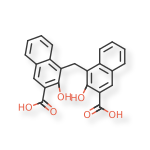
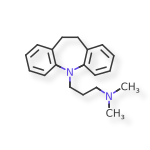
| Molecular Formula | C23H16O6.2C19H24N2 |
| Molecular Weight | 949.1841 |
| Optical Activity | NONE |
| Defined Stereocenters | 0 / 0 |
| E/Z Centers | 0 |
| Charge | 0 |
SHOW SMILES / InChI
SMILES
CN(C)CCCN1C2=CC=CC=C2CCC3=CC=CC=C13.CN(C)CCCN4C5=CC=CC=C5CCC6=CC=CC=C46.OC(=O)C7=CC8=CC=CC=C8C(CC9=C%10C=CC=CC%10=CC(C(O)=O)=C9O)=C7O
InChI
InChIKey=BPQZYOJIXDMZSX-UHFFFAOYSA-N
InChI=1S/C23H16O6.2C19H24N2/c24-20-16(14-7-3-1-5-12(14)9-18(20)22(26)27)11-17-15-8-4-2-6-13(15)10-19(21(17)25)23(28)29;2*1-20(2)14-7-15-21-18-10-5-3-8-16(18)12-13-17-9-4-6-11-19(17)21/h1-10,24-25H,11H2,(H,26,27)(H,28,29);2*3-6,8-11H,7,12-15H2,1-2H3
| Molecular Formula | C19H24N2 |
| Molecular Weight | 280.4073 |
| Charge | 0 |
| Count |
|
| Stereochemistry | ACHIRAL |
| Additional Stereochemistry | No |
| Defined Stereocenters | 0 / 0 |
| E/Z Centers | 0 |
| Optical Activity | NONE |
| Molecular Formula | C23H16O6 |
| Molecular Weight | 388.3695 |
| Charge | 0 |
| Count |
|
| Stereochemistry | ACHIRAL |
| Additional Stereochemistry | No |
| Defined Stereocenters | 0 / 0 |
| E/Z Centers | 0 |
| Optical Activity | NONE |
DescriptionCurator's Comment: Description was created based on several sources, including
http://www.accessdata.fda.gov/drugsatfda_docs/label/2014/087846s028,087844s027,087845s027lbl.pdf
Curator's Comment: Description was created based on several sources, including
http://www.accessdata.fda.gov/drugsatfda_docs/label/2014/087846s028,087844s027,087845s027lbl.pdf
Imipramine is a tricyclic antidepressant with general pharmacological properties similar to those of structurally related tricyclic antidepressant drugs such as amitriptyline and doxepin. A tertiary amine, imipramine inhibits the reuptake of serotonin more so than most secondary amine tricyclics, meaning that it blocks the reuptake of neurotransmitters serotonin and noradrenaline almost equally. With chronic use, imipramine also down-regulates cerebral cortical β-adrenergic receptors and sensitizes post-synaptic sertonergic receptors, which also contributes to increased serotonergic transmission. It takes approximately 2 - 4 weeks for antidepressants effects to occur. The onset of action may be longer, up to 8 weeks, in some individuals. It is also effective in migraine prophylaxis, but not in abortion of acute migraine attack. Imipramine works by inhibiting the neuronal reuptake of the neurotransmitters norepinephrine and serotonin. It binds the sodium-dependent serotonin transporter and sodium-dependent norepinephrine transporter preventing or reducing the reuptake of norepinephrine and serotonin by nerve cells. Depression has been linked to a lack of stimulation of the post-synaptic neuron by norepinephrine and serotonin. Slowing the reuptake of these neurotransmitters increases their concentration in the synaptic cleft, which is thought to contribute to relieving symptoms of depression. In addition to acutely inhibiting neurotransmitter re-uptake, imipramine causes down-regulation of cerebral cortical beta-adrenergic receptors and sensitization of post-synaptic serotonergic receptors with chronic use. This leads to enhanced serotonergic transmission. Used for relief of symptoms of depression and as temporary adjunctive therapy in reducing enuresis in children aged 6 years and older. May also be used to manage panic disorders, with or without agoraphobia, as a second line agent in ADHD, management of eating disorders, for short-term management of acute depressive episodes in bipolar disorder and schizophrenia, and for symptomatic treatment of postherpetic neuralgia.
Approval Year
Targets
| Primary Target | Pharmacology | Condition | Potency |
|---|---|---|---|
Target ID: P27169 Gene ID: 5444.0 Gene Symbol: PON1 Target Organism: Homo sapiens (Human) |
|||
Target ID: CHEMBL222 |
12.0 nM [Ki] | ||
Target ID: CHEMBL228 |
3.2 nM [Ki] |
Conditions
| Condition | Modality | Targets | Highest Phase | Product |
|---|---|---|---|---|
| Primary | Tofranil Approved UseTofranil is used for:
Treating depression. It is also used in some children to help reduce bedwetting. It may also be used for other conditions as determined by your doctor. Launch Date1984 |
Cmax
| Value | Dose | Co-administered | Analyte | Population |
|---|---|---|---|---|
24.5 ng/mL |
50 mg single, oral dose: 50 mg route of administration: Oral experiment type: SINGLE co-administered: |
IMIPRAMINE plasma | Homo sapiens population: HEALTHY age: ADULT sex: MALE food status: UNKNOWN |
|
107 μg/L |
130 mg 1 times / day steady-state, oral dose: 130 mg route of administration: Oral experiment type: STEADY-STATE co-administered: Desipramine |
IMIPRAMINE plasma | Homo sapiens population: HEALTHY age: ADULT sex: MALE food status: UNKNOWN |
AUC
| Value | Dose | Co-administered | Analyte | Population |
|---|---|---|---|---|
427 ng × h/mL |
50 mg single, oral dose: 50 mg route of administration: Oral experiment type: SINGLE co-administered: |
IMIPRAMINE plasma | Homo sapiens population: HEALTHY age: ADULT sex: MALE food status: UNKNOWN |
T1/2
| Value | Dose | Co-administered | Analyte | Population |
|---|---|---|---|---|
21.1 h |
50 mg single, oral dose: 50 mg route of administration: Oral experiment type: SINGLE co-administered: |
IMIPRAMINE plasma | Homo sapiens population: HEALTHY age: ADULT sex: MALE food status: UNKNOWN |
|
12 h |
130 mg 1 times / day steady-state, oral dose: 130 mg route of administration: Oral experiment type: STEADY-STATE co-administered: Desipramine |
IMIPRAMINE plasma | Homo sapiens population: HEALTHY age: ADULT sex: MALE food status: UNKNOWN |
Funbound
| Value | Dose | Co-administered | Analyte | Population |
|---|---|---|---|---|
22% |
130 mg 1 times / day steady-state, oral dose: 130 mg route of administration: Oral experiment type: STEADY-STATE co-administered: Desipramine |
IMIPRAMINE plasma | Homo sapiens population: HEALTHY age: ADULT sex: MALE food status: UNKNOWN |
Doses
| Dose | Population | Adverse events |
|---|---|---|
200 mg/day 1 times / day steady, oral Dose: 200 mg/day, 1 times / day Route: oral Route: steady Dose: 200 mg/day, 1 times / day Sources: |
unhealthy, 18-70 years |
Disc. AE: Nausea... AEs leading to discontinuation/dose reduction: Nausea (1 patient) Sources: |
25 mg/day 1 times / day steady, oral Dose: 25 mg/day, 1 times / day Route: oral Route: steady Dose: 25 mg/day, 1 times / day Sources: |
unhealthy, 42.6 ± 12.4 years Health Status: unhealthy Age Group: 42.6 ± 12.4 years Sex: M+F Sources: |
Disc. AE: Sleep disturbance, Urinary tract signs and symptoms NEC... AEs leading to discontinuation/dose reduction: Sleep disturbance (3 patients) Sources: Urinary tract signs and symptoms NEC (2 patients) Palpitations (2 patients) Anxiety (1 patient) Dry mouth (1 patient) Dizziness (3 patients) Flushing (1 patient) Constipation (1 patient) |
75 mg/day 1 times / day steady, oral Recommended Dose: 75 mg/day, 1 times / day Route: oral Route: steady Dose: 75 mg/day, 1 times / day Sources: |
unhealthy, < 24 years Health Status: unhealthy Age Group: < 24 years Sources: |
Disc. AE: Suicidal ideation... AEs leading to discontinuation/dose reduction: Suicidal ideation (grade 5) Sources: |
AEs
| AE | Significance | Dose | Population |
|---|---|---|---|
| Nausea | 1 patient Disc. AE |
200 mg/day 1 times / day steady, oral Dose: 200 mg/day, 1 times / day Route: oral Route: steady Dose: 200 mg/day, 1 times / day Sources: |
unhealthy, 18-70 years |
| Anxiety | 1 patient Disc. AE |
25 mg/day 1 times / day steady, oral Dose: 25 mg/day, 1 times / day Route: oral Route: steady Dose: 25 mg/day, 1 times / day Sources: |
unhealthy, 42.6 ± 12.4 years Health Status: unhealthy Age Group: 42.6 ± 12.4 years Sex: M+F Sources: |
| Constipation | 1 patient Disc. AE |
25 mg/day 1 times / day steady, oral Dose: 25 mg/day, 1 times / day Route: oral Route: steady Dose: 25 mg/day, 1 times / day Sources: |
unhealthy, 42.6 ± 12.4 years Health Status: unhealthy Age Group: 42.6 ± 12.4 years Sex: M+F Sources: |
| Dry mouth | 1 patient Disc. AE |
25 mg/day 1 times / day steady, oral Dose: 25 mg/day, 1 times / day Route: oral Route: steady Dose: 25 mg/day, 1 times / day Sources: |
unhealthy, 42.6 ± 12.4 years Health Status: unhealthy Age Group: 42.6 ± 12.4 years Sex: M+F Sources: |
| Flushing | 1 patient Disc. AE |
25 mg/day 1 times / day steady, oral Dose: 25 mg/day, 1 times / day Route: oral Route: steady Dose: 25 mg/day, 1 times / day Sources: |
unhealthy, 42.6 ± 12.4 years Health Status: unhealthy Age Group: 42.6 ± 12.4 years Sex: M+F Sources: |
| Palpitations | 2 patients Disc. AE |
25 mg/day 1 times / day steady, oral Dose: 25 mg/day, 1 times / day Route: oral Route: steady Dose: 25 mg/day, 1 times / day Sources: |
unhealthy, 42.6 ± 12.4 years Health Status: unhealthy Age Group: 42.6 ± 12.4 years Sex: M+F Sources: |
| Urinary tract signs and symptoms NEC | 2 patients Disc. AE |
25 mg/day 1 times / day steady, oral Dose: 25 mg/day, 1 times / day Route: oral Route: steady Dose: 25 mg/day, 1 times / day Sources: |
unhealthy, 42.6 ± 12.4 years Health Status: unhealthy Age Group: 42.6 ± 12.4 years Sex: M+F Sources: |
| Dizziness | 3 patients Disc. AE |
25 mg/day 1 times / day steady, oral Dose: 25 mg/day, 1 times / day Route: oral Route: steady Dose: 25 mg/day, 1 times / day Sources: |
unhealthy, 42.6 ± 12.4 years Health Status: unhealthy Age Group: 42.6 ± 12.4 years Sex: M+F Sources: |
| Sleep disturbance | 3 patients Disc. AE |
25 mg/day 1 times / day steady, oral Dose: 25 mg/day, 1 times / day Route: oral Route: steady Dose: 25 mg/day, 1 times / day Sources: |
unhealthy, 42.6 ± 12.4 years Health Status: unhealthy Age Group: 42.6 ± 12.4 years Sex: M+F Sources: |
| Suicidal ideation | grade 5 Disc. AE |
75 mg/day 1 times / day steady, oral Recommended Dose: 75 mg/day, 1 times / day Route: oral Route: steady Dose: 75 mg/day, 1 times / day Sources: |
unhealthy, < 24 years Health Status: unhealthy Age Group: < 24 years Sources: |
Overview
| CYP3A4 | CYP2C9 | CYP2D6 | hERG |
|---|---|---|---|
OverviewOther
| Other Inhibitor | Other Substrate | Other Inducer |
|---|---|---|
Drug as perpetrator
| Target | Modality | Activity | Metabolite | Clinical evidence |
|---|---|---|---|---|
| yes [IC50 6 uM] | ||||
| yes [Ki 182.9 uM] | ||||
| yes [Ki 42 uM] | ||||
| yes [Ki 42 uM] |
Drug as victim
| Target | Modality | Activity | Metabolite | Clinical evidence |
|---|---|---|---|---|
| yes | ||||
| yes | ||||
| yes | ||||
| yes | ||||
| yes | ||||
| yes | ||||
| yes | ||||
| yes |
Tox targets
| Target | Modality | Activity | Metabolite | Clinical evidence |
|---|---|---|---|---|
PubMed
| Title | Date | PubMed |
|---|---|---|
| Hormonal responses to the 5-HT1A agonist buspirone in remitted endogenous depressive patients after long-term imipramine treatment. | 2010-05 |
|
| Prediction of phospholipidosis-inducing potential of drugs by in vitro biochemical and physicochemical assays followed by multivariate analysis. | 2010-03 |
|
| Imipramine enhances cell proliferation and decreases neurodegeneration in the hippocampus after transient global cerebral ischemia in rats. | 2010-02-05 |
|
| Sub-chronic administration of rimonabant causes loss of antidepressive activity and decreases doublecortin immunoreactivity in the mouse hippocampus. | 2009-12-25 |
|
| A new homogeneous high-throughput screening assay for profiling compound activity on the human ether-a-go-go-related gene channel. | 2009-11-01 |
|
| Medicine and psychiatry in Western culture: Ancient Greek myths and modern prejudices. | 2009-10-07 |
|
| Possible role of trazodone and imipramine in sleep deprivation-induced anxiety-like behavior and oxidative damage in mice. | 2009-10-03 |
|
| Suppressive effect of imipramine on vincristine-induced mechanical allodynia in mice. | 2009-07 |
|
| Neurogenesis-dependent and -independent effects of fluoxetine in an animal model of anxiety/depression. | 2009-05-28 |
|
| Chronic administration of imipramine normalizes decreased sexual motivation and increased predisposition to catalepsy induced by propylthiouracil in rats. | 2009-05 |
|
| Behavioral changes in rats induced by a dipeptidyl peptidase IV inhibitor methionyl-2(S)-cyanopyrrolidine: experimental model of anxiety-depression disorder. | 2009-03 |
|
| Manifestation of psychiatric behaviors in a mouse model of griseofulvin-induced hepatic porphyria. | 2008-12 |
|
| Community-based randomised controlled trial evaluating falls and osteoporosis risk management strategies. | 2008-11-04 |
|
| [Chronic imipramine treatment normalizes decreased sexual motivation and high predisposition to catalepsy induced by propylthiouracil in rat]. | 2008-07-30 |
|
| D-161, a novel pyran-based triple monoamine transporter blocker: behavioral pharmacological evidence for antidepressant-like action. | 2008-07-28 |
|
| Gene expression profiling in rat liver treated with compounds inducing phospholipidosis. | 2008-06-15 |
|
| Pharmacological separation of hEAG and hERG K+ channel function in the human mammary carcinoma cell line MCF-7. | 2008-06 |
|
| Chronic coadministration of carbamazepine together with imipramine produces antidepressant-like effects in an ACTH-induced animal model of treatment-resistant depression: involvement of 5-HT(2A) receptors? | 2008-05 |
|
| Temporal expression of brain-derived neurotrophic factor (BDNF) mRNA in the rat hippocampus after treatment with selective and mixed monoaminergic antidepressants. | 2008-01-14 |
|
| Hereditary diffuse gastric cancer: association with lobular breast cancer. | 2008 |
|
| Histone deacetylase 5 epigenetically controls behavioral adaptations to chronic emotional stimuli. | 2007-11-08 |
|
| In vitro detection of drug-induced phospholipidosis using gene expression and fluorescent phospholipid based methodologies. | 2007-09 |
|
| Curcumin reverses impaired hippocampal neurogenesis and increases serotonin receptor 1A mRNA and brain-derived neurotrophic factor expression in chronically stressed rats. | 2007-08-08 |
|
| [Chemico-toxicological analysis of haloperidol in blood with high-performance liquid chromatography in combined poisoning]. | 2007-06-30 |
|
| Polypharmacy and EPS in a child; a case report. | 2007 |
|
| Influence of antidepressants on hemostasis. | 2007 |
|
| Molecular identification and functional characterization of rat multidrug and toxin extrusion type transporter 1 as an organic cation/H+ antiporter in the kidney. | 2006-11 |
|
| Mechanism of imipramine-induced seizures in amygdala-kindled rats. | 2006-11 |
|
| Recurrence of dilated cardiomyopathy after re-introduction of a tricyclic antidepressant. | 2006-10 |
|
| [Trazodone for the treatment of behavioral and psychological symptoms of dementia (BPSD) in Alzheimer's disease: a retrospective study focused on the aggression and negativism in caregiving situations]. | 2006-06 |
|
| Frequency of high-risk use of QT-prolonging medications. | 2006-06 |
|
| [Cardiac arrhythmia in amitriptyline poisoning in children]. | 2006-04-13 |
|
| [Lack of antidepresant-like activity of some ligands of polyamine binding sites of NMDA receptors in models of depression]. | 2006-04-04 |
|
| Antidepressant drugs activate SREBP and up-regulate cholesterol and fatty acid biosynthesis in human glial cells. | 2006-03-13 |
|
| Induction of neuroserpin expression in rat frontal cortex after chronic antidepressant treatment and electroconvulsive treatment. | 2006-02 |
|
| [Treatment of anxiety syndrome. A systematic literature review. Summary and conclusions by the SBU]. | 2006-01-18 |
|
| The role of serendipity in drug discovery. | 2006 |
|
| Roles for C16-ceramide and sphingosine 1-phosphate in regulating hepatocyte apoptosis in response to tumor necrosis factor-alpha. | 2005-07-29 |
|
| Organophosphorothionate pesticides inhibit the bioactivation of imipramine by human hepatic cytochrome P450s. | 2005-06-15 |
|
| Prediction of genotoxicity of chemical compounds by statistical learning methods. | 2005-06 |
|
| Exacerbation of harmaline-induced tremor by imipramine. | 2005-05 |
|
| UDP-glucuronosyltransferase 1A4 polymorphisms in a Japanese population and kinetics of clozapine glucuronidation. | 2005-05 |
|
| [Influence of chronic melipramine administration abolition on locomotion and defensive conditioned reflexes in passive and active avoidance in rats]. | 2005-04-15 |
|
| Imipramine-induced syndrome of inappropriate antidiuretic hormone secretion. | 1991-12 |
|
| Rabbit syndrome, antidepressant use, and cerebral perfusion SPECT scan findings. | 1991-11 |
|
| Painful ejaculation associated with antidepressants in four patients. | 1991-11 |
|
| Lithium and calcium channel blockers: possible neurotoxicity. | 1991-09-15 |
|
| Pediatric cardiovascular effects of imipramine and desipramine. | 1991-01 |
|
| Biphasic effects of imipramine in experimental models of epilepsy. | 1976-06 |
|
| The antinicotinic effects of drugs with clinically useful sedative-antianxiety properties. | 1975 |
Sample Use Guides
Usual Adult Dose for Depression
Tablets:
Initial dose: 100 mg orally per day
Maintenance dose: 100 to 200 mg orally per day (If no response after 2 weeks, increase to 250 to 300 mg per day)
Maximum dose: 300 mg orally per day
Route of Administration:
Oral
| Substance Class |
Chemical
Created
by
admin
on
Edited
Mon Mar 31 17:48:47 GMT 2025
by
admin
on
Mon Mar 31 17:48:47 GMT 2025
|
| Record UNII |
MC34P30298
|
| Record Status |
Validated (UNII)
|
| Record Version |
|
-
Download
| Name | Type | Language | ||
|---|---|---|---|---|
|
Preferred Name | English | ||
|
Common Name | English | ||
|
Common Name | English | ||
|
Common Name | English | ||
|
Common Name | English | ||
|
Common Name | English | ||
|
Brand Name | English | ||
|
Common Name | English | ||
|
Common Name | English | ||
|
Common Name | English | ||
|
Common Name | English | ||
|
Common Name | English |
| Classification Tree | Code System | Code | ||
|---|---|---|---|---|
|
NCI_THESAURUS |
C94727
Created by
admin on Mon Mar 31 17:48:47 GMT 2025 , Edited by admin on Mon Mar 31 17:48:47 GMT 2025
|
| Code System | Code | Type | Description | ||
|---|---|---|---|---|---|
|
Imipramine pamoate
Created by
admin on Mon Mar 31 17:48:47 GMT 2025 , Edited by admin on Mon Mar 31 17:48:47 GMT 2025
|
PRIMARY | |||
|
DTXSID80143484
Created by
admin on Mon Mar 31 17:48:47 GMT 2025 , Edited by admin on Mon Mar 31 17:48:47 GMT 2025
|
PRIMARY | |||
|
SUB02643MIG
Created by
admin on Mon Mar 31 17:48:47 GMT 2025 , Edited by admin on Mon Mar 31 17:48:47 GMT 2025
|
PRIMARY | |||
|
MC34P30298
Created by
admin on Mon Mar 31 17:48:47 GMT 2025 , Edited by admin on Mon Mar 31 17:48:47 GMT 2025
|
PRIMARY | |||
|
233-206-6
Created by
admin on Mon Mar 31 17:48:47 GMT 2025 , Edited by admin on Mon Mar 31 17:48:47 GMT 2025
|
PRIMARY | |||
|
100000091075
Created by
admin on Mon Mar 31 17:48:47 GMT 2025 , Edited by admin on Mon Mar 31 17:48:47 GMT 2025
|
PRIMARY | |||
|
MC34P30298
Created by
admin on Mon Mar 31 17:48:47 GMT 2025 , Edited by admin on Mon Mar 31 17:48:47 GMT 2025
|
PRIMARY | |||
|
CHEMBL11
Created by
admin on Mon Mar 31 17:48:47 GMT 2025 , Edited by admin on Mon Mar 31 17:48:47 GMT 2025
|
PRIMARY | |||
|
1338481
Created by
admin on Mon Mar 31 17:48:47 GMT 2025 , Edited by admin on Mon Mar 31 17:48:47 GMT 2025
|
PRIMARY | |||
|
24904
Created by
admin on Mon Mar 31 17:48:47 GMT 2025 , Edited by admin on Mon Mar 31 17:48:47 GMT 2025
|
PRIMARY | |||
|
C61788
Created by
admin on Mon Mar 31 17:48:47 GMT 2025 , Edited by admin on Mon Mar 31 17:48:47 GMT 2025
|
PRIMARY | |||
|
10075-24-8
Created by
admin on Mon Mar 31 17:48:47 GMT 2025 , Edited by admin on Mon Mar 31 17:48:47 GMT 2025
|
PRIMARY | |||
|
91118
Created by
admin on Mon Mar 31 17:48:47 GMT 2025 , Edited by admin on Mon Mar 31 17:48:47 GMT 2025
|
PRIMARY | RxNorm | ||
|
DBSALT000100
Created by
admin on Mon Mar 31 17:48:47 GMT 2025 , Edited by admin on Mon Mar 31 17:48:47 GMT 2025
|
PRIMARY | |||
|
m6232
Created by
admin on Mon Mar 31 17:48:47 GMT 2025 , Edited by admin on Mon Mar 31 17:48:47 GMT 2025
|
PRIMARY | Merck Index |
| Related Record | Type | Details | ||
|---|---|---|---|---|
|
|
PARENT -> SALT/SOLVATE | |||
|
|
PARENT -> SALT/SOLVATE |
| Related Record | Type | Details | ||
|---|---|---|---|---|
|
IMPURITY -> PARENT |
CHROMATOGRAPHIC PURITY (HPLC/UV)
USP
|
||
|
IMPURITY -> PARENT |
CHROMATOGRAPHIC PURITY (HPLC/UV)
USP
|
||
|
IMPURITY -> PARENT |
|
||
|
IMPURITY -> PARENT |
CHROMATOGRAPHIC PURITY (HPLC/UV)
USP
|
| Related Record | Type | Details | ||
|---|---|---|---|---|
|
|
ACTIVE MOIETY |