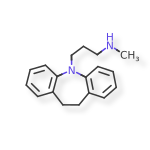
Details
| Stereochemistry | ACHIRAL |
| Molecular Formula | C18H22N2 |
| Molecular Weight | 266.3807 |
| Optical Activity | NONE |
| Defined Stereocenters | 0 / 0 |
| E/Z Centers | 0 |
| Charge | 0 |
SHOW SMILES / InChI
SMILES
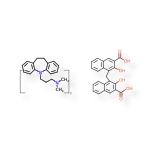
CNCCCN1C2=CC=CC=C2CCC3=CC=CC=C13
InChI
InChIKey=HCYAFALTSJYZDH-UHFFFAOYSA-N
InChI=1S/C18H22N2/c1-19-13-6-14-20-17-9-4-2-7-15(17)11-12-16-8-3-5-10-18(16)20/h2-5,7-10,19H,6,11-14H2,1H3
| Molecular Formula | C18H22N2 |
| Molecular Weight | 266.3807 |
| Charge | 0 |
| Count |
|
| Stereochemistry | ACHIRAL |
| Additional Stereochemistry | No |
| Defined Stereocenters | 0 / 0 |
| E/Z Centers | 0 |
| Optical Activity | NONE |
Desipramine is a tricyclic antidepressant that was approved by the FDA in 1964. It was derived from imipramine, which was the first tricyclic antidepressant to be manufactured. Desipramine is one of many tricyclic antidepressants, and this type of antidepressant gets its name due to its three-ring chemical structure. Desipramine, a secondary amine tricyclic antidepressant, is structurally related to both the skeletal muscle relaxant cyclobenzaprine and the thioxanthene antipsychotics such as thiothixene. It is the active metabolite of imipramine, a tertiary amine TCA. The acute effects of desipramine include inhibition of noradrenaline re-uptake at noradrenergic nerve endings and inhibition of serotonin (5-hydroxy tryptamine, 5HT) re-uptake at the serotoninergic nerve endings in the central nervous system. Desipramine exhibits greater noradrenergic re-uptake inhibition compared to the tertiary amine TCA imipramine. In addition to inhibiting neurotransmitter re-uptake, desipramine down-regulates beta-adrenergic receptors in the cerebral cortex and sensitizes serotonergic receptors with chronic use. The overall effect is increased serotonergic transmission. Antidepressant effects are typically observed 2 - 4 weeks following the onset of therapy though some patients may require up to 8 weeks of therapy prior to symptom improvement. Patients experiencing more severe depressive episodes may respond quicker than those with mild depressive symptoms. Desipramine is marketed under the trade name Norpramin, indicated for the treatment of depression.
Approval Year
Targets
| Primary Target | Pharmacology | Condition | Potency |
|---|---|---|---|
Target ID: CHEMBL222 |
1.5 nM [IC50] | ||
| 163.0 nM [Ki] | |||
Target ID: CHEMBL224 |
Conditions
| Condition | Modality | Targets | Highest Phase | Product |
|---|---|---|---|---|
| Primary | NORPRAMIN Approved UseDesipramine hydrochloride tablets are indicated for the treatment of depression. Launch Date1964 |
Cmax
| Value | Dose | Co-administered | Analyte | Population |
|---|---|---|---|---|
21.8 ng/mL EXPERIMENT https://pubmed.ncbi.nlm.nih.gov/16680561 |
50 mg single, oral dose: 50 mg route of administration: Oral experiment type: SINGLE co-administered: |
DESIPRAMINE plasma | Homo sapiens population: HEALTHY age: ADULT sex: FEMALE / MALE food status: FASTED |
AUC
| Value | Dose | Co-administered | Analyte | Population |
|---|---|---|---|---|
656 ng × h/mL EXPERIMENT https://pubmed.ncbi.nlm.nih.gov/16680561 |
50 mg single, oral dose: 50 mg route of administration: Oral experiment type: SINGLE co-administered: |
DESIPRAMINE plasma | Homo sapiens population: HEALTHY age: ADULT sex: FEMALE / MALE food status: FASTED |
T1/2
| Value | Dose | Co-administered | Analyte | Population |
|---|---|---|---|---|
21 h EXPERIMENT https://pubmed.ncbi.nlm.nih.gov/16680561 |
50 mg single, oral dose: 50 mg route of administration: Oral experiment type: SINGLE co-administered: |
DESIPRAMINE plasma | Homo sapiens population: HEALTHY age: ADULT sex: FEMALE / MALE food status: FASTED |
Funbound
| Value | Dose | Co-administered | Analyte | Population |
|---|---|---|---|---|
9.78% EXPERIMENT https://pubmed.ncbi.nlm.nih.gov/4386616 |
DESIPRAMINE plasma | Homo sapiens population: UNKNOWN age: UNKNOWN sex: UNKNOWN food status: UNKNOWN |
Doses
| Dose | Population | Adverse events |
|---|---|---|
2500 mg single, oral Overdose |
healthy, 2 years |
Other AEs: Coma, Seizures... Other AEs: Coma (grade 5, 1 patient) Sources: Seizures (grade 5, 1 patient) Hypotension (grade 5, 1 patient) |
300 mg 1 times / day multiple, oral Highest studied dose Dose: 300 mg, 1 times / day Route: oral Route: multiple Dose: 300 mg, 1 times / day Sources: |
unhealthy, adult |
|
25 mg 1 times / day multiple, oral Recommended Dose: 25 mg, 1 times / day Route: oral Route: multiple Dose: 25 mg, 1 times / day Sources: |
unhealthy, children | adolescents | and young adults Health Status: unhealthy Age Group: children | adolescents | and young adults Sources: |
Other AEs: Suicidal ideation... Other AEs: Suicidal ideation Sources: |
AEs
| AE | Significance | Dose | Population |
|---|---|---|---|
| Coma | grade 5, 1 patient | 2500 mg single, oral Overdose |
healthy, 2 years |
| Hypotension | grade 5, 1 patient | 2500 mg single, oral Overdose |
healthy, 2 years |
| Seizures | grade 5, 1 patient | 2500 mg single, oral Overdose |
healthy, 2 years |
| Suicidal ideation | 25 mg 1 times / day multiple, oral Recommended Dose: 25 mg, 1 times / day Route: oral Route: multiple Dose: 25 mg, 1 times / day Sources: |
unhealthy, children | adolescents | and young adults Health Status: unhealthy Age Group: children | adolescents | and young adults Sources: |
Overview
| CYP3A4 | CYP2C9 | CYP2D6 | hERG |
|---|---|---|---|
OverviewOther
| Other Inhibitor | Other Substrate | Other Inducer |
|---|---|---|
Drug as perpetrator
| Target | Modality | Activity | Metabolite | Clinical evidence |
|---|---|---|---|---|
| yes [IC50 16 uM] | ||||
| yes [Inhibition 20 uM] | ||||
| yes [Inhibition 20 uM] | ||||
| yes [Inhibition 20 uM] | ||||
| yes [Inhibition 20 uM] | ||||
| yes [Ki 14 uM] | ||||
| yes [Ki 2.3 uM] | ||||
| yes [Ki 283 uM] | ||||
| yes [Ki 55.7 uM] |
Drug as victim
| Target | Modality | Activity | Metabolite | Clinical evidence |
|---|---|---|---|---|
| yes | no (co-administration study) Comment: Ketoconazole did not alter the pharmacokinetics of orally administered desipramine in healthy volunteers; Genetic deficiency in CYP2D6 activity results in a 85% lower oral clearance of desipramine, as shown by a single dose pharmacokinetic study in healthy volunteers |
Tox targets
| Target | Modality | Activity | Metabolite | Clinical evidence |
|---|---|---|---|---|
Page: 11.0 |
PubMed
| Title | Date | PubMed |
|---|---|---|
| Transient supersensitivity to alpha-adrenoceptor agonists, and distinct hyper-reactivity to vasopressin and angiotensin II after denervation of rat tail artery. | 2010-01 |
|
| Tetrabenazine as anti-chorea therapy in Huntington disease: an open-label continuation study. Huntington Study Group/TETRA-HD Investigators. | 2009-12-18 |
|
| MPTP-induced neuroblast apoptosis in the subventricular zone is not regulated by dopamine or other monoamine transporters. | 2009-11 |
|
| Time course and dose response of alpha tocopherol on oxidative stress in haemodialysis patients. | 2009-10-22 |
|
| Behavioral sensitization to cocaine: cooperation between glucocorticoids and epinephrine. | 2009-07 |
|
| Reactivation of inflammatory bowel disease in a mouse model of depression. | 2009-06 |
|
| Association of changes in norepinephrine and serotonin transporter expression with the long-term behavioral effects of antidepressant drugs. | 2009-05 |
|
| Desipramine-induced Ca-independent apoptosis in Mg63 human osteosarcoma cells: dependence on P38 mitogen-activated protein kinase-regulated activation of caspase 3. | 2009-03 |
|
| Antidepressants influence somatostatin levels and receptor pharmacology in brain. | 2009-03 |
|
| Neuronal damage and protection in the pathophysiology and treatment of psychiatric illness: stress and depression. | 2009 |
|
| Do desipramine [10,11-dihydro-5-[3-(methylamino) propyl]-5H-dibenz[b,f]azepine monohydrochloride] and fluoxetine [N-methyl-3-phenyl-3-[4-(trifluoromethyl)phenoxy]-propan-1-amine] ameliorate the extent of colonic damage induced by acetic acid in rats? | 2008-12 |
|
| The 5-hydroxytryptamine2A receptor antagonist R-(+)-alpha-(2,3-dimethoxyphenyl)-1-[2-(4-fluorophenyl)ethyl-4-piperidinemethanol (M100907) attenuates impulsivity after both drug-induced disruption (dizocilpine) and enhancement (antidepressant drugs) of differential-reinforcement-of-low-rate 72-s behavior in the rat. | 2008-12 |
|
| Community-based randomised controlled trial evaluating falls and osteoporosis risk management strategies. | 2008-11-04 |
|
| Evaluation of the repeated open-space swim model of depression in the mouse. | 2008-11 |
|
| Desipramine potentiation of the acute depressant effects of ethanol: modulation by alpha2-adrenoreceptors and stress. | 2008-10 |
|
| Assessing the neuronal serotonergic target-based antidepressant stratagem: impact of in vivo interaction studies and knockout models. | 2008-09 |
|
| Desipramine-induced apoptosis in human PC3 prostate cancer cells: activation of JNK kinase and caspase-3 pathways and a protective role of [Ca2+]i elevation. | 2008-08-19 |
|
| D-161, a novel pyran-based triple monoamine transporter blocker: behavioral pharmacological evidence for antidepressant-like action. | 2008-07-28 |
|
| Narcolepsy: current treatment options and future approaches. | 2008-06 |
|
| Impaired parasympathetic function increases susceptibility to inflammatory bowel disease in a mouse model of depression. | 2008-06 |
|
| Glucagon-like peptide 1 receptor stimulation reverses key deficits in distinct rodent models of Parkinson's disease. | 2008-05-21 |
|
| The role of NMDA receptor antagonists in nicotine tolerance, sensitization, and physical dependence: a preclinical review. | 2008-04-30 |
|
| An anti-immobility effect of exogenous corticosterone in mice. | 2008-02-02 |
|
| Comparison of the effects of desmethylimipramine on behavior in the forced swim test in peripubertal and adult rats. | 2008-02 |
|
| Photophysics and photochemistry of imipramine, desimipramine, and clomipramine in several solvents: a fluorescence, 266 nm laser flash, and theoretical study. | 2008-01-10 |
|
| A novel approach for predicting antidepressant-induced sexual dysfunction in rats. | 2008-01 |
|
| The role of the entorhinal cortex in extinction: influences of aging. | 2008 |
|
| Desipramine induces apoptotic cell death through nonmitochondrial and mitochondrial pathways in different types of human colon carcinoma cells. | 2008 |
|
| A possible role for the endocannabinoid system in the neurobiology of depression. | 2007-11-19 |
|
| Reduced evoked fos expression in activity-related brain regions in animal models of behavioral depression. | 2007-08-15 |
|
| CRE/CREB-driven up-regulation of gene expression by chronic social stress in CRE-luciferase transgenic mice: reversal by antidepressant treatment. | 2007-05-09 |
|
| Anti-inflammatory properties of desipramine and fluoxetine. | 2007-05-03 |
|
| Reduction of high-affinity beta2-adrenergic receptor binding by hyperforin and hyperoside on rat C6 glioblastoma cells measured by fluorescence correlation spectroscopy. | 2007-05-01 |
|
| Desipramine activated Bcl-2 expression and inhibited lipopolysaccharide-induced apoptosis in hippocampus-derived adult neural stem cells. | 2007-05 |
|
| Rhesus monkey trace amine-associated receptor 1 signaling: enhancement by monoamine transporters and attenuation by the D2 autoreceptor in vitro. | 2007-04 |
|
| Pharmacokinetics of desipramine HCl when administered with cinacalcet HCl. | 2007-02 |
|
| Nigrostriatal damage with 6-OHDA: validation of routinely applied procedures. | 2006-08 |
|
| Down-regulation of norepinephrine transporter function induced by chronic administration of desipramine linking to the alteration of sensitivity of local-anesthetics-induced convulsions and the counteraction by co-administration with local anesthetics. | 2006-06-22 |
|
| [Trazodone for the treatment of behavioral and psychological symptoms of dementia (BPSD) in Alzheimer's disease: a retrospective study focused on the aggression and negativism in caregiving situations]. | 2006-06 |
|
| Frequency of high-risk use of QT-prolonging medications. | 2006-06 |
|
| The involvement of norepinephrine and microglia in hypothalamic and splenic IL-1beta responses to stress. | 2006-04 |
|
| Response to SSRI-induced enuresis: a case report. | 2006-02 |
|
| Sudden self-harm while taking fluoxetine. | 1992-08 |
|
| Increased pulse and blood pressure associated with desipramine treatment of bulimia nervosa. | 1992-06 |
|
| Control of depression with fluoxetine and antiseizure medication in a brain-injured patient. | 1992-02 |
|
| Low dose desipramine treatment of cocaine-related panic attacks. | 1991-12 |
|
| Regulation of serotonin type 2 (5-HT2) and beta-adrenergic receptors in rat cerebral cortex following novel and classical antidepressant treatment. | 1991-11 |
|
| Repeated administration of desmethylimipramine blocks the reserpine-induced increase in tyrosine hydroxylase mRNA in locus coeruleus neurons of the rat. | 1991-07 |
|
| Changes in convulsion susceptibility of lidocaine by alteration of brain catecholaminergic functions. | 1991-05 |
|
| Low dose tricyclic tachycardia. | 1991-01 |
Sample Use Guides
Usual Adult Dose for Depression
100 to 200 mg orally per day
Maximum dose: 300 mg orally per day
Comments:
-Dosage should be initiated at a lower level and increased according to tolerance and clinical response.
-In severely ill patients, dosage may be further increased to 300 mg per day if needed.
-Treatment of patients requiring as much as 300 mg should generally be initiated in hospitals.
Usual Geriatric Dose for Depression
25 to 100 mg orally per day
Maximum dose: 150 mg orally per day
Route of Administration:
Oral
| Substance Class |
Chemical
Created
by
admin
on
Edited
Mon Mar 31 17:52:13 GMT 2025
by
admin
on
Mon Mar 31 17:52:13 GMT 2025
|
| Record UNII |
TG537D343B
|
| Record Status |
Validated (UNII)
|
| Record Version |
|
-
Download
| Name | Type | Language | ||
|---|---|---|---|---|
|
Preferred Name | English | ||
|
Official Name | English | ||
|
Common Name | English | ||
|
Systematic Name | English | ||
|
Common Name | English | ||
|
Systematic Name | English | ||
|
Common Name | English | ||
|
Common Name | English | ||
|
Common Name | English | ||
|
Common Name | English | ||
|
Common Name | English | ||
|
Common Name | English | ||
|
Common Name | English |
| Classification Tree | Code System | Code | ||
|---|---|---|---|---|
|
NCI_THESAURUS |
C94727
Created by
admin on Mon Mar 31 17:52:13 GMT 2025 , Edited by admin on Mon Mar 31 17:52:13 GMT 2025
|
||
|
NDF-RT |
N0000175752
Created by
admin on Mon Mar 31 17:52:13 GMT 2025 , Edited by admin on Mon Mar 31 17:52:13 GMT 2025
|
||
|
LIVERTOX |
NBK548233
Created by
admin on Mon Mar 31 17:52:13 GMT 2025 , Edited by admin on Mon Mar 31 17:52:13 GMT 2025
|
||
|
WHO-ATC |
N06AA01
Created by
admin on Mon Mar 31 17:52:13 GMT 2025 , Edited by admin on Mon Mar 31 17:52:13 GMT 2025
|
||
|
WHO-VATC |
QN06AA01
Created by
admin on Mon Mar 31 17:52:13 GMT 2025 , Edited by admin on Mon Mar 31 17:52:13 GMT 2025
|
| Code System | Code | Type | Description | ||
|---|---|---|---|---|---|
|
50-47-5
Created by
admin on Mon Mar 31 17:52:13 GMT 2025 , Edited by admin on Mon Mar 31 17:52:13 GMT 2025
|
PRIMARY | |||
|
CHEMBL72
Created by
admin on Mon Mar 31 17:52:13 GMT 2025 , Edited by admin on Mon Mar 31 17:52:13 GMT 2025
|
PRIMARY | |||
|
DTXSID6022896
Created by
admin on Mon Mar 31 17:52:13 GMT 2025 , Edited by admin on Mon Mar 31 17:52:13 GMT 2025
|
PRIMARY | |||
|
100000083169
Created by
admin on Mon Mar 31 17:52:13 GMT 2025 , Edited by admin on Mon Mar 31 17:52:13 GMT 2025
|
PRIMARY | |||
|
2995
Created by
admin on Mon Mar 31 17:52:13 GMT 2025 , Edited by admin on Mon Mar 31 17:52:13 GMT 2025
|
PRIMARY | |||
|
SUB06995MIG
Created by
admin on Mon Mar 31 17:52:13 GMT 2025 , Edited by admin on Mon Mar 31 17:52:13 GMT 2025
|
PRIMARY | |||
|
1500
Created by
admin on Mon Mar 31 17:52:13 GMT 2025 , Edited by admin on Mon Mar 31 17:52:13 GMT 2025
|
PRIMARY | |||
|
47781
Created by
admin on Mon Mar 31 17:52:13 GMT 2025 , Edited by admin on Mon Mar 31 17:52:13 GMT 2025
|
PRIMARY | |||
|
200-040-0
Created by
admin on Mon Mar 31 17:52:13 GMT 2025 , Edited by admin on Mon Mar 31 17:52:13 GMT 2025
|
PRIMARY | |||
|
3052
Created by
admin on Mon Mar 31 17:52:13 GMT 2025 , Edited by admin on Mon Mar 31 17:52:13 GMT 2025
|
PRIMARY | |||
|
812
Created by
admin on Mon Mar 31 17:52:13 GMT 2025 , Edited by admin on Mon Mar 31 17:52:13 GMT 2025
|
PRIMARY | |||
|
3247
Created by
admin on Mon Mar 31 17:52:13 GMT 2025 , Edited by admin on Mon Mar 31 17:52:13 GMT 2025
|
PRIMARY | RxNorm | ||
|
DB01151
Created by
admin on Mon Mar 31 17:52:13 GMT 2025 , Edited by admin on Mon Mar 31 17:52:13 GMT 2025
|
PRIMARY | |||
|
m4191
Created by
admin on Mon Mar 31 17:52:13 GMT 2025 , Edited by admin on Mon Mar 31 17:52:13 GMT 2025
|
PRIMARY | Merck Index | ||
|
2399
Created by
admin on Mon Mar 31 17:52:13 GMT 2025 , Edited by admin on Mon Mar 31 17:52:13 GMT 2025
|
PRIMARY | |||
|
DESIPRAMINE
Created by
admin on Mon Mar 31 17:52:13 GMT 2025 , Edited by admin on Mon Mar 31 17:52:13 GMT 2025
|
PRIMARY | |||
|
D003891
Created by
admin on Mon Mar 31 17:52:13 GMT 2025 , Edited by admin on Mon Mar 31 17:52:13 GMT 2025
|
PRIMARY | |||
|
C61700
Created by
admin on Mon Mar 31 17:52:13 GMT 2025 , Edited by admin on Mon Mar 31 17:52:13 GMT 2025
|
PRIMARY | |||
|
TG537D343B
Created by
admin on Mon Mar 31 17:52:13 GMT 2025 , Edited by admin on Mon Mar 31 17:52:13 GMT 2025
|
PRIMARY | |||
|
TG537D343B
Created by
admin on Mon Mar 31 17:52:13 GMT 2025 , Edited by admin on Mon Mar 31 17:52:13 GMT 2025
|
PRIMARY | |||
|
Desipramine
Created by
admin on Mon Mar 31 17:52:13 GMT 2025 , Edited by admin on Mon Mar 31 17:52:13 GMT 2025
|
PRIMARY |
| Related Record | Type | Details | ||
|---|---|---|---|---|
|
|
SALT/SOLVATE -> PARENT | |||
|
TRANSPORTER -> INHIBITOR | |||
|
METABOLIC ENZYME -> SUBSTRATE |
Metabolizing reaction by CYP2D6: Hydroxylation
|
||
|
TARGET -> INHIBITOR |
BINDING
IC50
|
||
|
TRANSPORTER -> INHIBITOR | |||
|
|
TARGET -> INHIBITOR | |||
|
METABOLIC ENZYME -> SUBSTRATE |
Pharmacological action: Tricyclic antidepressant drug (TCA)
|
||
|
BINDER->LIGAND |
|
||
|
TRANSPORTER -> SUBSTRATE | |||
|
TRANSPORTER -> INHIBITOR | |||
|
TRANSPORTER -> INHIBITOR | |||
|
|
SALT/SOLVATE -> PARENT |
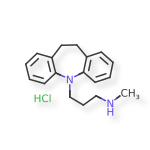


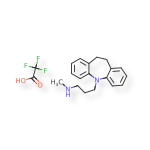
| Related Record | Type | Details | ||
|---|---|---|---|---|
|
PARENT -> METABOLITE ACTIVE |
Imipramine has activities at both the serotonin and norepeinephrine transporters with greater affinity for the serotonin transporter while desipramine and 2-hydroxydesipramine have greater affinities for the norepinephrine transporter (Owens et al., 1997).
|
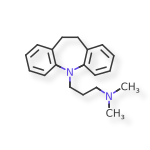
| Related Record | Type | Details | ||
|---|---|---|---|---|
|
PARENT -> IMPURITY |
CHROMATOGRAPHIC PURITY (HPLC/UV)
USP
|
| Related Record | Type | Details | ||
|---|---|---|---|---|
|
|
ACTIVE MOIETY |
|