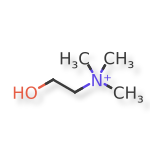
Details
| Stereochemistry | ACHIRAL |
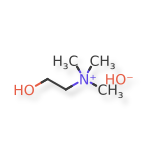
| Molecular Formula | C5H14NO |
| Molecular Weight | 104.1708 |
| Optical Activity | NONE |
| Defined Stereocenters | 0 / 1 |
| E/Z Centers | 0 |
| Charge | 1 |
SHOW SMILES / InChI
SMILES
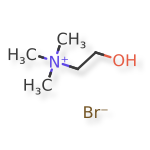
C[N+](C)(C)CCO
InChI
InChIKey=OEYIOHPDSNJKLS-UHFFFAOYSA-N
InChI=1S/C5H14NO/c1-6(2,3)4-5-7/h7H,4-5H2,1-3H3/q+1
| Molecular Formula | C5H13NO |
| Molecular Weight | 103.1628 |
| Charge | 0 |
| Count |
|
| Stereochemistry | RACEMIC |
| Additional Stereochemistry | No |
| Defined Stereocenters | 0 / 1 |
| E/Z Centers | 0 |
| Optical Activity | NONE |
DescriptionCurator's Comment: description was created based on several sources, including
https://clinicaltrials.gov/ct2/show/NCT02669641 | https://clinicaltrials.gov/ct2/show/NCT01098383 | https://clinicaltrials.gov/ct2/show/NCT00720343 | https://www.ncbi.nlm.nih.gov/pubmed/15213044 | https://www.ncbi.nlm.nih.gov/pubmed/28152052
Curator's Comment: description was created based on several sources, including
https://clinicaltrials.gov/ct2/show/NCT02669641 | https://clinicaltrials.gov/ct2/show/NCT01098383 | https://clinicaltrials.gov/ct2/show/NCT00720343 | https://www.ncbi.nlm.nih.gov/pubmed/15213044 | https://www.ncbi.nlm.nih.gov/pubmed/28152052
CHOLINE is a basic constituent of lecithin that is found in many plants and animal organs. Choline was officially recognized as an essential nutrient by the Institute of Medicine in 1998.1 Its role in the body is complex. It is needed for neurotransmitter synthesis (acetylcholine), cell-membrane signaling (phospholipids), lipid transport (lipoproteins), and methyl-group metabolism (homocysteine reduction). It is the major dietary source of methyl groups via the synthesis of S-adenosylmethionine (AdoMet). At least 50 AdoMet-dependent reactions have been identified in mammals, and it is likely that the number is much higher. Choline is required to make the phospholipids phosphatidylcholine, lysophosphatidylcholine, choline plasmalogen, and sphingomyelin—essential components for all membranes. It plays important roles in brain and memory development in the fetus and appears to decrease the risk of the development of neural tube defects. The importance of choline in the diet extends into adulthood and old age. In a study of healthy adult subjects deprived of dietary choline, 77% of the men and 80% of the postmenopausal women developed signs of subclinical organ dysfunction (fatty liver or muscle damage). Less than half of premenopausal women developed such signs. Ten percent of the subjects studied developed fatty liver, muscle damage, or both when they consumed the Adequate Intake (AI) of choline. The damage was reversed when they consumed a high-choline diet. Plasma choline concentration has been found to vary in response to diet, decreasing approximately 30 percent in humans fed a choline-deficient diet for 3 weeks. Based on estimated dietary intakes and studies reporting liver damage with lower choline intakes, the Institute of Medicine, Food and Nutrition Board set the AI for choline at 425 milligrams/per day for women aged 19 and older, and 550 milligrams/per day for men aged 19 and older.
CNS Activity
Originator
Approval Year
Targets
| Primary Target | Pharmacology | Condition | Potency |
|---|---|---|---|
Target ID: CHEMBL220 |
3013.0 µM [IC50] |
Conditions
| Condition | Modality | Targets | Highest Phase | Product |
|---|---|---|---|---|
| Palliative | GABAZOLAMINE Approved UseAlprazolam tablets are indicated for the management of anxiety disorder (a condition corresponding most closely to the APA Diagnostic and Statistical Manual (DSM-III-R) diagnosis of generalized anxiety disorder) or the short-term relief of symptoms of anxiety. Anxiety or tension associated with the stress of everyday life usually does not require treatment with an anxiolytic. |
|||
| Primary | TRILIPIX Approved UseINDICATIONS AND USAGE Trilipix is a peroxisome proliferator-activated receptor (PPAR) alpha agonist
indicated as adjunctive therapy to diet to:
• Reduce TG in patients with severe hypertriglyceridemia (1.1).
• Reduce elevated LDL-C, Total-C, TG and Apo B, and to increase HDLC
in patients with primary hypercholesterolemia or mixed dyslipidemia
(1.2).
Limitations of Use: Fenofibrate at a dose equivalent to 135 mg of Trilipix did
not reduce coronary heart disease morbidity and mortality in patients with
type 2 diabetes mellitus (5.1). Launch Date2008 |
|||
| Primary | TRILIPIX Approved UseINDICATIONS AND USAGE Trilipix is a peroxisome proliferator-activated receptor (PPAR) alpha agonist
indicated as adjunctive therapy to diet to:
• Reduce TG in patients with severe hypertriglyceridemia (1.1).
• Reduce elevated LDL-C, Total-C, TG and Apo B, and to increase HDLC
in patients with primary hypercholesterolemia or mixed dyslipidemia
(1.2).
Limitations of Use: Fenofibrate at a dose equivalent to 135 mg of Trilipix did
not reduce coronary heart disease morbidity and mortality in patients with
type 2 diabetes mellitus (5.1). Launch Date2008 |
|||
| Primary | TRILIPIX Approved UseINDICATIONS AND USAGE Trilipix is a peroxisome proliferator-activated receptor (PPAR) alpha agonist
indicated as adjunctive therapy to diet to:
• Reduce TG in patients with severe hypertriglyceridemia (1.1).
• Reduce elevated LDL-C, Total-C, TG and Apo B, and to increase HDLC
in patients with primary hypercholesterolemia or mixed dyslipidemia
(1.2).
Limitations of Use: Fenofibrate at a dose equivalent to 135 mg of Trilipix did
not reduce coronary heart disease morbidity and mortality in patients with
type 2 diabetes mellitus (5.1). Launch Date2008 |
PubMed
| Title | Date | PubMed |
|---|---|---|
| The biochemical analysis of neurotransmitters in central neurocytomas. | 2001-05 |
|
| Effect of AF64A, a cholinergic neurotoxin, on footshock stimulation-induced locus coeruleus excitation in rats. | 2001-04-13 |
|
| In vivo 1H magnetic resonance spectroscopic measurement of brain glycine levels in nonketotic hyperglycinemia. | 2001-04 |
|
| Reproducibility of proton magnetic resonance spectroscopy imaging measurements of normal human hippocampus at 1.5 T: clinical implications. | 2001-04 |
|
| Lateralizing ability of single-voxel proton mr spectroscopy in hippocampal sclerosis: comparison with mr imaging and positron emission tomography. | 2001-04 |
|
| Serial proton MR spectroscopic imaging of recurrent malignant gliomas after gamma knife radiosurgery. | 2001-04 |
|
| Preoperative proton MR spectroscopic imaging of brain tumors: correlation with histopathologic analysis of resection specimens. | 2001-04 |
|
| Theta-frequency facilitation of AMPA receptor-mediated synaptic currents in the principal cells of the medial septum. | 2001-04 |
|
| Aging alters the multichemical networking profile of the human brain: an in vivo (1)H-MRS study of young versus middle-aged subjects. | 2001-04 |
|
| Neurotrophins differentially enhance acetylcholine release, acetylcholine content and choline acetyltransferase activity in basal forebrain neurons. | 2001-04 |
|
| Overactivation of alpha-amino-3-hydroxy-5-methylisoxazole-4-propionate and N-methyl-D-aspartate but not kainate receptors inhibits phosphatidylcholine synthesis before excitotoxic neuronal death. | 2001-04 |
|
| Proton MR spectroscopy in clinical routine. | 2001-04 |
|
| Proton magnetic resonance spectroscopic imaging reveals differences in spinocerebellar ataxia types 2 and 6. | 2001-04 |
|
| Magnetic resonance spectroscopy in traumatic brain injury. | 2001-04 |
|
| Impaired neurotransmitter release from lacrimal and salivary gland nerves of a murine model of Sjögren's syndrome. | 2001-04 |
|
| Carrier-mediated hepatobiliary transport of a novel antifolate, N-[4-[(2,4-dianninopteridine-6-yl)methyl]-3,4-dihydro-2H-1,4-benzothiazin-7-yl]carbonyl-L-homoglutamic acid, in rats. | 2001-04 |
|
| Nutritional support at home and in the community. | 2001-04 |
|
| Lysosomal-type PLA2 and turnover of alveolar DPPC. | 2001-04 |
|
| Cloning of dimethylglycine dehydrogenase and a new human inborn error of metabolism, dimethylglycine dehydrogenase deficiency. | 2001-04 |
|
| Magnetic resonance spectroscopy in AD. | 2001-03-13 |
|
| De novo synthesis and recycling pathways of sphingomyelin in rat Sertoli cells. | 2001-03-09 |
|
| Na/Li countertransport abnormalities in type 1 diabetes with and without nephropathy are familial. | 2001-03 |
|
| Altered cellular metabolism following traumatic brain injury: a magnetic resonance spectroscopy study. | 2001-03 |
|
| Resveratrol inhibits the formation of phosphatidic acid and diglyceride in chemotactic peptide- or phorbol ester-stimulated human neutrophils. | 2001-03 |
|
| Imidazoline I(1) receptor-induced activation of phosphatidylcholine-specific phospholipase C elicits mitogen-activated protein kinase phosphorylation in PC12 cells. | 2001-03 |
|
| Characterization of the deg-3/des-2 receptor: a nicotinic acetylcholine receptor that mutates to cause neuronal degeneration. | 2001-03 |
|
| The puzzle of zmpB and extensive chain formation, autolysis defect and non-translocation of choline-binding proteins in Streptococcus pneumoniae. | 2001-03 |
|
| Expression of the INO2 regulatory gene of Saccharomyces cerevisiae is controlled by positive and negative promoter elements and an upstream open reading frame. | 2001-03 |
|
| Reanalysis of multislice (1)H MRSI in amyotrophic lateral sclerosis. | 2001-03 |
|
| Sustained bilateral hemodynamic benefit of contralateral carotid endarterectomy in patients with symptomatic internal carotid artery occlusion. | 2001-03 |
|
| Evaluation of accumulated mucopolysaccharides in the brain of patients with mucopolysaccharidoses by (1)H-magnetic resonance spectroscopy before and after bone marrow transplantation. | 2001-03 |
|
| Crystallization and preliminary X-ray crystallographic studies of recombinant human betaine-homocysteine S-methyltransferase. | 2001-03 |
|
| Menstrual cycle-related brain metabolite changes using 1H magnetic resonance spectroscopy in premenopausal women: a pilot study. | 2001-02-28 |
|
| Increased thalamic N-acetylaspartate in male patients with familial bipolar I disorder. | 2001-02-28 |
|
| Chronic ingestion of ethanol stimulates lipogenic response in rat hepatocytes. | 2001-02-02 |
|
| Efficient synthesis of the cholinephosphate phospholipid headgroup. | 2001-02 |
|
| A novel method to analyze betaine in chicken liver: effect of dietary betaine and choline supplementation on the hepatic betaine concentration in broiler chicks. | 2001-02 |
|
| Magnetic coupling between water and creatine protons in human brain and skeletal muscle, as measured using inversion transfer (1)H-MRS. | 2001-02 |
|
| GD1a in phospholipid bilayer: a molecular dynamics simulation. | 2001-02 |
|
| Lactate and other metabolic changes in neuronal migration disorders. | 2001-02 |
|
| Rumen undegradable protein, rumen-protected choline and mRNA expression for enzymes in gluconeogenesis and ureagenesis in periparturient dairy cows. | 2001-02 |
|
| Intestinal uptake of betaine in vitro and the distribution of methyl groups from betaine, choline, and methionine in the body of broiler chicks. | 2001-02 |
|
| Three-dimensional magnetic resonance spectroscopic imaging of histologically confirmed brain tumors. | 2001-01 |
|
| Modulation of biosynthesis of phosphatidylcholine via CDP-choline in rat liver: influence of ethanol on the microsomal cholinephosphotransferase activity. | 2001-01 |
|
| Animal models of steatosis. | 2001 |
|
| Imaging biochemistry: applications to breast cancer. | 2001 |
|
| Glucose plus choline improve passive avoidance behaviour and increase hippocampal acetylcholine release in mice. | 2001 |
|
| Role of cholinergic mossy fibers in medial vestibular and prepositus hypoglossal nuclei in vestibular compensation. | 2001 |
|
| Optimisation of the quantitative determination of chlormequat by matrix-assisted laser desorption/ionisation mass spectrometry. | 2001 |
|
| Temporal lobe changes following radiation therapy: imaging and proton MR spectroscopic findings. | 2001 |
Patents
Sample Use Guides
Choline tablets will be taken at daily doses of 250 mg (in children with up to 40 kg body weight) and 500 mg (in children with more than 40 kg body weight).
Route of Administration:
Oral
Monolayer cultures of Primary bovine hepatocytes were maintained for 24 h and were approximately 80% confluent before exposure to treatment. Cells were randomly assigned to increasing concentrations (61, 128, 2028, and 4528 μmol/L) of choline chloride (CC), DL-methionine (DLM), and a fatty acid cocktail in a 4X4X2 factorial arrangement. All treatments were applied in triplicate in independent preparations of cells from 4 Holstein calves.
| Substance Class |
Chemical
Created
by
admin
on
Edited
Mon Mar 31 17:45:05 GMT 2025
by
admin
on
Mon Mar 31 17:45:05 GMT 2025
|
| Record UNII |
N91BDP6H0X
|
| Record Status |
Validated (UNII)
|
| Record Version |
|
-
Download
| Name | Type | Language | ||
|---|---|---|---|---|
|
Systematic Name | English | ||
|
Preferred Name | English | ||
|
Common Name | English | ||
|
Systematic Name | English | ||
|
Common Name | English | ||
|
Common Name | English | ||
|
Common Name | English | ||
|
Systematic Name | English | ||
|
Common Name | English | ||
|
Common Name | English | ||
|
Common Name | English | ||
|
Common Name | English | ||
|
Common Name | English | ||
|
Common Name | English |
| Classification Tree | Code System | Code | ||
|---|---|---|---|---|
|
LIVERTOX |
NBK548710
Created by
admin on Mon Mar 31 17:45:05 GMT 2025 , Edited by admin on Mon Mar 31 17:45:05 GMT 2025
|
||
|
DSLD |
39 (Number of products:4095)
Created by
admin on Mon Mar 31 17:45:05 GMT 2025 , Edited by admin on Mon Mar 31 17:45:05 GMT 2025
|
||
|
NCI_THESAURUS |
C1551
Created by
admin on Mon Mar 31 17:45:05 GMT 2025 , Edited by admin on Mon Mar 31 17:45:05 GMT 2025
|
| Code System | Code | Type | Description | ||
|---|---|---|---|---|---|
|
15354
Created by
admin on Mon Mar 31 17:45:05 GMT 2025 , Edited by admin on Mon Mar 31 17:45:05 GMT 2025
|
PRIMARY | |||
|
SUB13349MIG
Created by
admin on Mon Mar 31 17:45:05 GMT 2025 , Edited by admin on Mon Mar 31 17:45:05 GMT 2025
|
PRIMARY | |||
|
SUB20877
Created by
admin on Mon Mar 31 17:45:05 GMT 2025 , Edited by admin on Mon Mar 31 17:45:05 GMT 2025
|
ALTERNATIVE | |||
|
m3481
Created by
admin on Mon Mar 31 17:45:05 GMT 2025 , Edited by admin on Mon Mar 31 17:45:05 GMT 2025
|
PRIMARY | Merck Index | ||
|
N91BDP6H0X
Created by
admin on Mon Mar 31 17:45:05 GMT 2025 , Edited by admin on Mon Mar 31 17:45:05 GMT 2025
|
PRIMARY | |||
|
CHOLINE
Created by
admin on Mon Mar 31 17:45:05 GMT 2025 , Edited by admin on Mon Mar 31 17:45:05 GMT 2025
|
PRIMARY | |||
|
62-49-7
Created by
admin on Mon Mar 31 17:45:05 GMT 2025 , Edited by admin on Mon Mar 31 17:45:05 GMT 2025
|
PRIMARY | |||
|
D002794
Created by
admin on Mon Mar 31 17:45:05 GMT 2025 , Edited by admin on Mon Mar 31 17:45:05 GMT 2025
|
PRIMARY | |||
|
2449
Created by
admin on Mon Mar 31 17:45:05 GMT 2025 , Edited by admin on Mon Mar 31 17:45:05 GMT 2025
|
PRIMARY | RxNorm | ||
|
DB00122
Created by
admin on Mon Mar 31 17:45:05 GMT 2025 , Edited by admin on Mon Mar 31 17:45:05 GMT 2025
|
PRIMARY | |||
|
C61674
Created by
admin on Mon Mar 31 17:45:05 GMT 2025 , Edited by admin on Mon Mar 31 17:45:05 GMT 2025
|
PRIMARY | |||
|
100000080081
Created by
admin on Mon Mar 31 17:45:05 GMT 2025 , Edited by admin on Mon Mar 31 17:45:05 GMT 2025
|
PRIMARY | |||
|
305
Created by
admin on Mon Mar 31 17:45:05 GMT 2025 , Edited by admin on Mon Mar 31 17:45:05 GMT 2025
|
PRIMARY | |||
|
3097
Created by
admin on Mon Mar 31 17:45:05 GMT 2025 , Edited by admin on Mon Mar 31 17:45:05 GMT 2025
|
PRIMARY | |||
|
200-535-1
Created by
admin on Mon Mar 31 17:45:05 GMT 2025 , Edited by admin on Mon Mar 31 17:45:05 GMT 2025
|
PRIMARY | |||
|
DTXSID8043789
Created by
admin on Mon Mar 31 17:45:05 GMT 2025 , Edited by admin on Mon Mar 31 17:45:05 GMT 2025
|
PRIMARY | |||
|
N91BDP6H0X
Created by
admin on Mon Mar 31 17:45:05 GMT 2025 , Edited by admin on Mon Mar 31 17:45:05 GMT 2025
|
PRIMARY |
| Related Record | Type | Details | ||
|---|---|---|---|---|
|
|
SALT/SOLVATE -> PARENT | |||
|
|
SALT/SOLVATE -> PARENT | |||
|
|
SALT/SOLVATE -> PARENT | |||
|
|
SALT/SOLVATE -> PARENT | |||
|
|
SALT/SOLVATE -> PARENT | |||
|
|
SALT/SOLVATE -> PARENT | |||
|
PARENT -> CONSTITUENT ALWAYS PRESENT | |||
|
|
SALT/SOLVATE -> PARENT | |||
|
|
SALT/SOLVATE -> PARENT | |||
|
|
SALT/SOLVATE -> PARENT | |||
|
|
SALT/SOLVATE -> PARENT | |||
|
|
SALT/SOLVATE -> PARENT |
|
||
|
PARENT -> CONSTITUENT ALWAYS PRESENT | |||
|
|
SALT/SOLVATE -> PARENT | |||
|
|
SALT/SOLVATE -> PARENT |
|
||
|
|
SALT/SOLVATE -> PARENT | |||
|
|
SALT/SOLVATE -> PARENT |
|
||
|
PARENT -> CONSTITUENT ALWAYS PRESENT | |||
|
|
SALT/SOLVATE -> PARENT | |||
|
|
SALT/SOLVATE -> PARENT | |||
|
|
SALT/SOLVATE -> PARENT | |||
|
|
SALT/SOLVATE -> PARENT | |||
|
|
SALT/SOLVATE -> PARENT | |||
|
|
SALT/SOLVATE -> PARENT | |||
|
|
SALT/SOLVATE -> PARENT | |||
|
|
TARGET -> AGONIST |
|
||
|
TRANSPORTER -> SUBSTRATE | |||
|
|
SALT/SOLVATE -> PARENT | |||
|
|
SALT/SOLVATE -> PARENT | |||
|
PARENT -> CONSTITUENT ALWAYS PRESENT |
Amine found in Acorus calamus rhizome.
|
||
|
|
SALT/SOLVATE -> PARENT | |||
|
|
SALT/SOLVATE -> PARENT | |||
|
|
SALT/SOLVATE -> PARENT |
|
||
|
|
SALT/SOLVATE -> PARENT |





| Related Record | Type | Details | ||
|---|---|---|---|---|
|
METABOLITE -> PARENT | |||
|
PARENT -> METABOLITE INACTIVE |
| Related Record | Type | Details | ||
|---|---|---|---|---|
|
PARENT -> IMPURITY |
CHROMATOGRAPHIC PURITY (TLC)
EP
|
||
|
PARENT -> IMPURITY |
CHROMATOGRAPHIC PURITY (HPLC/UV)
EP
|
| Related Record | Type | Details | ||
|---|---|---|---|---|
|
|
ACTIVE MOIETY |
|