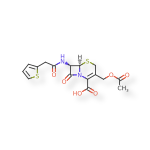
Details
| Stereochemistry | ABSOLUTE |
| Molecular Formula | C16H16N2O6S2 |
| Molecular Weight | 396.438 |
| Optical Activity | UNSPECIFIED |
| Defined Stereocenters | 2 / 2 |
| E/Z Centers | 0 |
| Charge | 0 |
SHOW SMILES / InChI
SMILES
CC(=O)OCC1=C(N2[C@H](SC1)[C@H](NC(=O)CC3=CC=CS3)C2=O)C(O)=O
InChI
InChIKey=XIURVHNZVLADCM-IUODEOHRSA-N
InChI=1S/C16H16N2O6S2/c1-8(19)24-6-9-7-26-15-12(14(21)18(15)13(9)16(22)23)17-11(20)5-10-3-2-4-25-10/h2-4,12,15H,5-7H2,1H3,(H,17,20)(H,22,23)/t12-,15-/m1/s1
| Molecular Formula | C16H16N2O6S2 |
| Molecular Weight | 396.438 |
| Charge | 0 |
| Count |
|
| Stereochemistry | ABSOLUTE |
| Additional Stereochemistry | No |
| Defined Stereocenters | 2 / 2 |
| E/Z Centers | 0 |
| Optical Activity | UNSPECIFIED |
DescriptionCurator's Comment: description was created based on several sources, including:
http://www.druginfosys.com/drug.aspx?drugcode=150 | http://cdn-1.consultaremedios.com.br/bulas/2/14787.pdf
Curator's Comment: description was created based on several sources, including:
http://www.druginfosys.com/drug.aspx?drugcode=150 | http://cdn-1.consultaremedios.com.br/bulas/2/14787.pdf
Cephalothin is a first generation, semisynthetic analogue of natural cephalosporin antibiotic. The in-vitro bactericidal action of Cephalothin results from inhibition of cell-wall synthesis. In general, Cephalothin has higher activity against Gram positive than Gram negative organisms. Cephalothin is primarily indicated in conditions like bone and joint infection, genitourinary tract infections, respiratory tract infections, soft tissue and skin infections and others. The severe or irreversible adverse effects of Cephalothin, which give rise to further complications, include nephrotoxicity, hemolytic anemia. Cephalothin produces potentially life-threatening effects, which include anaphylaxis, serum sickness syndrome. The symptomatic adverse reactions produced by Cephalothin are: rashes, urticaria, allergic reactions, thrombophlebitis, pain at injection site. Co-administration of diuretics, such as furanthril, ethacrynic acid and nephrotoxic antibiotics may increase the risk of renal damage. Reciprocal inactivation could be observed during in vitro mixing of Cephalothin with aminoglycosides.
Originator
Approval Year
Targets
| Primary Target | Pharmacology | Condition | Potency |
|---|---|---|---|
Target ID: CHEMBL2354204 |
|||
Target ID: P15555 Gene ID: NA Gene Symbol: NA Target Organism: Streptomyces sp. (strain R61) |
|||
Target ID: Q9Y694 Gene ID: 10864.0 Gene Symbol: SLC22A7 Target Organism: Homo sapiens (Human) |
1.41 mM [IC50] |
Conditions
| Condition | Modality | Targets | Highest Phase | Product |
|---|---|---|---|---|
| Curative | KEFLIN Approved UseCephalothin is indicated in the treatment of serious infections caused by susceptible strains of the designated microorganisms in the respiratory tract infections, skin and soft-tissue infections, genito-urinary tract infections, septicaemia, including endocarditis, bone and joint infections. Launch Date1974 |
|||
| Curative | KEFLIN Approved UseCephalothin is indicated in the treatment of serious infections caused by susceptible strains of the designated microorganisms in the respiratory tract infections, skin and soft-tissue infections, genito-urinary tract infections, septicaemia, including endocarditis, bone and joint infections. Launch Date1974 |
|||
| Curative | KEFLIN Approved UseCephalothin is indicated in the treatment of serious infections caused by susceptible strains of the designated microorganisms in the respiratory tract infections, skin and soft-tissue infections, genito-urinary tract infections, septicaemia, including endocarditis, bone and joint infections. Launch Date1974 |
|||
| Curative | KEFLIN Approved UseCephalothin is indicated in the treatment of serious infections caused by susceptible strains of the designated microorganisms in the respiratory tract infections, skin and soft-tissue infections, genito-urinary tract infections, septicaemia, including endocarditis, bone and joint infections. Launch Date1974 |
|||
| Curative | KEFLIN Approved UseCephalothin is indicated in the treatment of serious infections caused by susceptible strains of the designated microorganisms in the respiratory tract infections, skin and soft-tissue infections, genito-urinary tract infections, septicaemia, including endocarditis, bone and joint infections. Launch Date1974 |
|||
| Curative | KEFLIN Approved UseCephalothin is indicated in the treatment of serious infections caused by susceptible strains of the designated microorganisms in the respiratory tract infections, skin and soft-tissue infections, genito-urinary tract infections, septicaemia, including endocarditis, bone and joint infections. Launch Date1974 |
Cmax
| Value | Dose | Co-administered | Analyte | Population |
|---|---|---|---|---|
20.8 μg/mL EXPERIMENT https://pubmed.ncbi.nlm.nih.gov/15830475/ |
3 g single, intravenous dose: 3 g route of administration: Intravenous experiment type: SINGLE co-administered: |
CEPHALOTHIN plasma | Homo sapiens population: HEALTHY age: ADULT sex: MALE food status: UNKNOWN |
AUC
| Value | Dose | Co-administered | Analyte | Population |
|---|---|---|---|---|
25.2 μg × h/mL EXPERIMENT https://pubmed.ncbi.nlm.nih.gov/15830475/ |
3 g single, intravenous dose: 3 g route of administration: Intravenous experiment type: SINGLE co-administered: |
CEPHALOTHIN plasma | Homo sapiens population: HEALTHY age: ADULT sex: MALE food status: UNKNOWN |
T1/2
| Value | Dose | Co-administered | Analyte | Population |
|---|---|---|---|---|
28 min EXPERIMENT https://pubmed.ncbi.nlm.nih.gov/15830475/ |
3 g single, intravenous dose: 3 g route of administration: Intravenous experiment type: SINGLE co-administered: |
CEPHALOTHIN plasma | Homo sapiens population: HEALTHY age: ADULT sex: MALE food status: UNKNOWN |
Doses
| Dose | Population | Adverse events |
|---|---|---|
2 g 3 times / day steady, oral Recommended Dose: 2 g, 3 times / day Route: oral Route: steady Dose: 2 g, 3 times / day Sources: |
unhealthy, 18 - 91 years Health Status: unhealthy Age Group: 18 - 91 years Sex: M+F Sources: |
Disc. AE: Death, Urinary tract yeast infection... AEs leading to discontinuation/dose reduction: Death (grade 5, 13 patients) Sources: Urinary tract yeast infection (1 patient) |
1 g single, intramuscular Recommended |
healthy, 23 - 28 years Health Status: healthy Age Group: 23 - 28 years Sex: M+F Sources: |
AEs
| AE | Significance | Dose | Population |
|---|---|---|---|
| Urinary tract yeast infection | 1 patient Disc. AE |
2 g 3 times / day steady, oral Recommended Dose: 2 g, 3 times / day Route: oral Route: steady Dose: 2 g, 3 times / day Sources: |
unhealthy, 18 - 91 years Health Status: unhealthy Age Group: 18 - 91 years Sex: M+F Sources: |
| Death | grade 5, 13 patients Disc. AE |
2 g 3 times / day steady, oral Recommended Dose: 2 g, 3 times / day Route: oral Route: steady Dose: 2 g, 3 times / day Sources: |
unhealthy, 18 - 91 years Health Status: unhealthy Age Group: 18 - 91 years Sex: M+F Sources: |
PubMed
| Title | Date | PubMed |
|---|---|---|
| Protective effect of topical antibiotics in breast augmentation. | 2009-08 |
|
| Rapid evolution of virulence and drug resistance in the emerging zoonotic pathogen Streptococcus suis. | 2009-07-15 |
|
| Effects of mosapride on motility of the small intestine and caecum in normal horses after jejunocaecostomy. | 2009-06 |
|
| Antibacterial effects of Iranian fennel essential oil on isolates of Acinetobacter baumannii. | 2009-05-01 |
|
| CTX-M beta-lactamases in Escherichia coli from community-acquired urinary tract infections, Cambodia. | 2009-05 |
|
| [Are antimicrobials useful in closed thoracostomy due to trauma?]. | 2009-04-07 |
|
| Effect of iron-chelator deferiprone on the in vitro growth of staphylococci. | 2009-04 |
|
| [Characterization of Listeria monocytogenes isolates obtained from raw cheese samples acquired from different Costa Rican producer zones]. | 2009-03 |
|
| Development and validation of an immunochromatographic assay for rapid multi-residues detection of cephems in milk. | 2009-02-16 |
|
| Frequency of Escherichia coli O157:H7 in children with diarrhoea in Zahedan, Islamic Republic of Iran. | 2009-01-24 |
|
| Isolation of bacteria from remote high altitude Andean lakes able to grow in the presence of antibiotics. | 2009-01 |
|
| The photosynthetic apparatus and its regulation in the aerobic gammaproteobacterium Congregibacter litoralis gen. nov., sp. nov. | 2009 |
|
| [Distribution and drug resistance of the isolated bacteria from children with acute respiratory infection]. | 2008-10 |
|
| Determination of cephalosporins in solid binary mixtures by polarized IR- and Raman spectroscopy. | 2008-09-10 |
|
| Interaction of beta-lactam antibiotics with the mitochondrial carnitine/acylcarnitine transporter. | 2008-06-17 |
|
| Antimicrobial resistance of Salmonella enterica isolates from apparently healthy and clinically ill finishing pigs in Spain. | 2008-05 |
|
| [Review of the actions in prevention of infections in total arthroplasty of hip]. | 2008-04-05 |
|
| [Study on Acinetobacter baumannii plasmid with 3 types of beta-lactamase genes in a burn ward]. | 2008-04 |
|
| Structure-function studies of arginine at position 276 in CTX-M beta-lactamases. | 2008-04 |
|
| Antibiotic resistance of commensal Escherichia coli of food-producing animals from three Vojvodinian farms, Serbia. | 2008-04 |
|
| [Antimicrobial resistance of uropathogens among outpatients, 2000-2004]. | 2008-01-28 |
|
| Assay for integrons and pattern of antibiotic resistance in clinical Escherichia coli strains by PCR-RFLP in Southern Iran. | 2008-01 |
|
| A Case of Helicobacter cinaedi Bacteraemia in a Previously Healthy Person with Cellulitis. | 2008 |
|
| A reservoir of drug-resistant pathogenic bacteria in asymptomatic hosts. | 2008 |
|
| Campylobacter canadensis sp. nov., from captive whooping cranes in Canada. | 2007-11 |
|
| [Integrons and their relationship with resistance phenotype in Gram negative bacilli isolated in the Hospital Torres Galdames, Iquique, Chile]. | 2007-10 |
|
| [Nonpuerperal breast abscess caused by Finegoldia magna]. | 2007-08-19 |
|
| Bacteriological findings in patients with ocular infection and antibiotic susceptibility patterns of isolated pathogens. | 2007-08 |
|
| Antibiotic and heavy metal resistance in motile aeromonads and pseudomonads from rainbow trout (Oncorhynchus mykiss) farms in Australia. | 2007-08 |
|
| Genotypic and phenotypic profiles of enterotoxigenic Escherichia coli associated with acute diarrhea in Tunis, Tunisia. | 2007-07 |
|
| Inadequate antimicrobial prophylaxis during surgery: a study of beta-lactam levels during burn debridement. | 2007-07 |
|
| Pulsed-field gel electrophoresis in the identification of the origin of bacterial keratitis caused by Pseudomonas aeruginosa. | 2007-07 |
|
| Characterization of Klebsiella pneumoniae isolates from New Zealand sea lion (Phocarctos hookeri) pups during and after the epidemics on Enderby Island, Auckland Islands. | 2007-05-16 |
|
| Molecular characterization of the gene encoding a new AmpC beta-lactamase in Acinetobacter baylyi. | 2007-05 |
|
| [Serratia rubidaea bacteremia]. | 2007-05 |
|
| Antimicrobial resistance of Yersinia enterocolitica strains from human patients, pigs and retail pork in Switzerland. | 2007-04-01 |
|
| Characterization of antimicrobial resistance patterns and class 1 integrons in Escherichia coli O26 isolated from humans and animals. | 2007-03 |
|
| Studies on the mechanisms of beta-lactam resistance in Bordetella bronchiseptica. | 2007-03 |
|
| Predictive analysis of ceftazidime hydrolysis in CTX-M-type beta-lactamase family members with a mutational substitution at position 167. | 2007-03 |
|
| Helicobacter equorum sp. nov., a urease-negative Helicobacter species isolated from horse faeces. | 2007-02 |
|
| [Short communication: comparison of susceptibilities of Escherichia coli urinary tract isolates against fosfomycin tromethamine and different antibiotics]. | 2007-01 |
|
| Serratia marcescens infection in a swallow-tailed hummingbird. | 2007-01 |
|
| Antimicrobial sensitivity and adherence study in strains of coagulase-negative Staphylococcus spp. | 2006-10-26 |
|
| In vivo selection of OmpK35-deficient mutant after cefuroxime therapy for primary liver abscess caused by Klebsiella pneumoniae. | 2006-10 |
|
| Occurrence and characterization of Aeromonas spp. in mussels from the Adriatic Sea. | 2006-08 |
|
| Integron presence in a multiresistant Morganella morganii isolate. | 2006-06 |
|
| Conjunctival bacterial flora and antibiotic resistance pattern in patients undergoing cataract surgery. | 2006-02-24 |
|
| [Phenotypical differences of Helicobacter pylori strains isolated in Georgia]. | 2006-01-28 |
|
| [Community-acquired methicillin-resistant Staphylococcus aureus disseminated disease]. | 2006 |
|
| Identification of penicillin allergenic determinants that bind IgE antibodies in the sera of subjects with penicillin allergy. | 1990-11 |
Sample Use Guides
The usual dosage range is 500 mg to 1 g of cefalotin every four to six hours. In severe infections, this may be increased by giving the injections every four hours or, when the desired response is not obtained, by raising the dose to 1 g. In lifethreatening infections, in patients with normal renal function, doses up to 2 g every four hours may be required.
Route of Administration:
Other
| Substance Class |
Chemical
Created
by
admin
on
Edited
Mon Mar 31 17:36:10 GMT 2025
by
admin
on
Mon Mar 31 17:36:10 GMT 2025
|
| Record UNII |
R72LW146E6
|
| Record Status |
Validated (UNII)
|
| Record Version |
|
-
Download
| Name | Type | Language | ||
|---|---|---|---|---|
|
Preferred Name | English | ||
|
Common Name | English | ||
|
Common Name | English | ||
|
Common Name | English | ||
|
Common Name | English | ||
|
Common Name | English | ||
|
Common Name | English | ||
|
Common Name | English | ||
|
Common Name | English |
| Classification Tree | Code System | Code | ||
|---|---|---|---|---|
|
NCI_THESAURUS |
C357
Created by
admin on Mon Mar 31 17:36:10 GMT 2025 , Edited by admin on Mon Mar 31 17:36:10 GMT 2025
|
||
|
WHO-ATC |
J01DB03
Created by
admin on Mon Mar 31 17:36:10 GMT 2025 , Edited by admin on Mon Mar 31 17:36:10 GMT 2025
|
||
|
WHO-VATC |
QJ01DB03
Created by
admin on Mon Mar 31 17:36:10 GMT 2025 , Edited by admin on Mon Mar 31 17:36:10 GMT 2025
|
| Code System | Code | Type | Description | ||
|---|---|---|---|---|---|
|
6024
Created by
admin on Mon Mar 31 17:36:10 GMT 2025 , Edited by admin on Mon Mar 31 17:36:10 GMT 2025
|
PRIMARY | |||
|
100000081576
Created by
admin on Mon Mar 31 17:36:10 GMT 2025 , Edited by admin on Mon Mar 31 17:36:10 GMT 2025
|
PRIMARY | |||
|
SUB06170MIG
Created by
admin on Mon Mar 31 17:36:10 GMT 2025 , Edited by admin on Mon Mar 31 17:36:10 GMT 2025
|
PRIMARY | |||
|
1477
Created by
admin on Mon Mar 31 17:36:10 GMT 2025 , Edited by admin on Mon Mar 31 17:36:10 GMT 2025
|
PRIMARY | |||
|
m3251
Created by
admin on Mon Mar 31 17:36:10 GMT 2025 , Edited by admin on Mon Mar 31 17:36:10 GMT 2025
|
PRIMARY | Merck Index | ||
|
DTXSID4022783
Created by
admin on Mon Mar 31 17:36:10 GMT 2025 , Edited by admin on Mon Mar 31 17:36:10 GMT 2025
|
PRIMARY | |||
|
C62021
Created by
admin on Mon Mar 31 17:36:10 GMT 2025 , Edited by admin on Mon Mar 31 17:36:10 GMT 2025
|
PRIMARY | |||
|
205-815-7
Created by
admin on Mon Mar 31 17:36:10 GMT 2025 , Edited by admin on Mon Mar 31 17:36:10 GMT 2025
|
PRIMARY | |||
|
CEFALOTIN
Created by
admin on Mon Mar 31 17:36:10 GMT 2025 , Edited by admin on Mon Mar 31 17:36:10 GMT 2025
|
PRIMARY | |||
|
574
Created by
admin on Mon Mar 31 17:36:10 GMT 2025 , Edited by admin on Mon Mar 31 17:36:10 GMT 2025
|
PRIMARY | |||
|
CHEMBL617
Created by
admin on Mon Mar 31 17:36:10 GMT 2025 , Edited by admin on Mon Mar 31 17:36:10 GMT 2025
|
PRIMARY | |||
|
8798
Created by
admin on Mon Mar 31 17:36:10 GMT 2025 , Edited by admin on Mon Mar 31 17:36:10 GMT 2025
|
PRIMARY | |||
|
DB00456
Created by
admin on Mon Mar 31 17:36:10 GMT 2025 , Edited by admin on Mon Mar 31 17:36:10 GMT 2025
|
PRIMARY | |||
|
D002512
Created by
admin on Mon Mar 31 17:36:10 GMT 2025 , Edited by admin on Mon Mar 31 17:36:10 GMT 2025
|
PRIMARY | |||
|
2236
Created by
admin on Mon Mar 31 17:36:10 GMT 2025 , Edited by admin on Mon Mar 31 17:36:10 GMT 2025
|
PRIMARY | RxNorm | ||
|
3024
Created by
admin on Mon Mar 31 17:36:10 GMT 2025 , Edited by admin on Mon Mar 31 17:36:10 GMT 2025
|
PRIMARY | |||
|
124991
Created by
admin on Mon Mar 31 17:36:10 GMT 2025 , Edited by admin on Mon Mar 31 17:36:10 GMT 2025
|
PRIMARY | |||
|
R72LW146E6
Created by
admin on Mon Mar 31 17:36:10 GMT 2025 , Edited by admin on Mon Mar 31 17:36:10 GMT 2025
|
PRIMARY | |||
|
153-61-7
Created by
admin on Mon Mar 31 17:36:10 GMT 2025 , Edited by admin on Mon Mar 31 17:36:10 GMT 2025
|
PRIMARY |
| Related Record | Type | Details | ||
|---|---|---|---|---|
|
|
SALT/SOLVATE -> PARENT | |||
|
|
SALT/SOLVATE -> PARENT | |||
|
|
SALT/SOLVATE -> PARENT | |||
|
TRANSPORTER -> INHIBITOR | |||
|
TRANSPORTER -> INHIBITOR | |||
|
ENZYME->SUBSTRATE |
Leads to resistance to the antibiotic.
|
||
|
TRANSPORTER -> INHIBITOR | |||
|
BINDER->LIGAND |
BINDING
|
||
|
TRANSPORTER -> INHIBITOR |
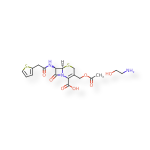
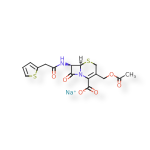
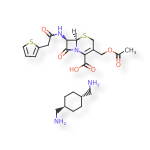


| Related Record | Type | Details | ||
|---|---|---|---|---|
|
|
ACTIVE MOIETY |