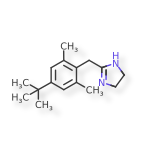
Details
| Stereochemistry | ACHIRAL |
| Molecular Formula | C16H24N2 |
| Molecular Weight | 244.3752 |
| Optical Activity | NONE |
| Defined Stereocenters | 0 / 0 |
| E/Z Centers | 0 |
| Charge | 0 |
SHOW SMILES / InChI
SMILES
CC1=CC(=CC(C)=C1CC2=NCCN2)C(C)(C)C
InChI
InChIKey=HUCJFAOMUPXHDK-UHFFFAOYSA-N
InChI=1S/C16H24N2/c1-11-8-13(16(3,4)5)9-12(2)14(11)10-15-17-6-7-18-15/h8-9H,6-7,10H2,1-5H3,(H,17,18)
| Molecular Formula | C16H24N2 |
| Molecular Weight | 244.3752 |
| Charge | 0 |
| Count |
|
| Stereochemistry | ACHIRAL |
| Additional Stereochemistry | No |
| Defined Stereocenters | 0 / 0 |
| E/Z Centers | 0 |
| Optical Activity | NONE |
DescriptionCurator's Comment: description was created based on several sources, including
https://www.ncbi.nlm.nih.gov/pubmed/19085441 | https://clinicaltrials.gov/ct2/show/NCT00630474 | https://clinicaltrials.gov/ct2/show/NCT00452270 | https://www.ncbi.nlm.nih.gov/pubmed/20151787
Curator's Comment: description was created based on several sources, including
https://www.ncbi.nlm.nih.gov/pubmed/19085441 | https://clinicaltrials.gov/ct2/show/NCT00630474 | https://clinicaltrials.gov/ct2/show/NCT00452270 | https://www.ncbi.nlm.nih.gov/pubmed/20151787
Xylometazoline, also spelled xylomethazoline, is a medication which is used to improve symptoms of nasal congestion, allergic rhinitis, and sinusitis. Xylometazoline was patented in 1956 and came into medical use in 1959. It is on the World Health Organization's List of Essential Medicines, the most effective and safe medicines needed in a health system. The drug works by stimulating adrenergic receptors on the lamina propria of blood vessels in the nose. The decongestant effect is due to constriction of large veins in the nose which swell up during the inflammation of any infection or allergy of the nose. The smaller arteries are also constricted and this causes the colour of the nasal epithelium to be visibly paler after dosage. The standard adult solution strength is 0.1% w/v xylometazoline (or 1 mg per 1 mL solution), and the dose for children under 12 is usually 0.05% (0.5 mg/mL).
CNS Activity
Approval Year
Targets
| Primary Target | Pharmacology | Condition | Potency |
|---|---|---|---|
Target ID: CHEMBL229 |
91.0 nM [Ki] |
Conditions
| Condition | Modality | Targets | Highest Phase | Product |
|---|---|---|---|---|
| Primary | Otrivin Approved UseXylometazoline is indicated for the temporary relief of nasal congestion due to colds , sinusitis, hay fever , other upper respiratory allergies (allergic rhinitis) and for headache, tubal block, and serious otitis media associated with nasal congestion. |
|||
| Primary | Otrivin Approved UseXylometazoline is indicated for the temporary relief of nasal congestion due to colds , sinusitis, hay fever , other upper respiratory allergies (allergic rhinitis) and for headache, tubal block, and serious otitis media associated with nasal congestion. |
|||
| Primary | Otrivin Approved UseXylometazoline is indicated for the temporary relief of nasal congestion due to colds , sinusitis, hay fever , other upper respiratory allergies (allergic rhinitis) and for headache, tubal block, and serious otitis media associated with nasal congestion. |
PubMed
| Title | Date | PubMed |
|---|---|---|
| Profiling of a prescription drug library for potential renal drug-drug interactions mediated by the organic cation transporter 2. | 2011-07-14 |
|
| Case report: unilateral mydriasis following nasal cautery. | 2010-12 |
|
| Alpha-adrenoceptor agonistic activity of oxymetazoline and xylometazoline. | 2010-12 |
|
| Prognostic value of anterior rhinomanometry in diode laser turbinoplasty. | 2010-10 |
|
| Xylometazoline pretreatment reduces nasotracheal intubation-related epistaxis in paediatric dental surgery. | 2010-10 |
|
| Structural and functional evolution of the trace amine-associated receptors TAAR3, TAAR4 and TAAR5 in primates. | 2010-06-15 |
|
| A randomized trial of topical anesthesia comparing lidocaine versus lidocaine plus xylometazoline for unsedated transnasal upper gastrointestinal endoscopy. | 2010-05 |
|
| Treatment of congestion in upper respiratory diseases. | 2010-04-08 |
|
| Effects of intranasal xylometazoline, alone or in combination with ipratropium, in patients with common cold. | 2010-04 |
|
| Comments on: Central serous chorioretinopathy after dacryocystorhinostomy operation on the same side. | 2010-03-03 |
|
| Influence of intranasal sterile isotonic sea water applications on xylometazoline administration: an experimental study in pigs. | 2010-02 |
|
| Retrograde intubation in a case of ankylosing spondylitis posted for correction of deformity of spine. | 2010-01 |
|
| Numerical simulation and nasal air-conditioning. | 2010 |
|
| Physiology and pathophysiology of respiratory mucosa of the nose and the paranasal sinuses. | 2010 |
|
| OTC use of a topical nasal spray solution containing xylometazoline plus ipratropium in patients with common cold. | 2009-12 |
|
| Effects of topical drops and sprays on mucociliary transport time and nasal air flow. | 2009-11 |
|
| Parallel functional activity profiling reveals valvulopathogens are potent 5-hydroxytryptamine(2B) receptor agonists: implications for drug safety assessment. | 2009-10 |
|
| Relation of nasal air flow to nasal cavity dimensions. | 2009-06 |
|
| A comparison of xylometazoline (Otrivine) and phenylephrine/lignocaine mixture (Cophenylcaine) for the purposes of rigid nasendoscopy: a prospective, double-blind, randomised trial. | 2009-06 |
|
| Efficacy and safety of intranasal xylometazoline and ipratropium in patients with common cold. | 2009-04 |
|
| Anaesthetic consideration in macroglossia due to lymphangioma of tongue: a case report. | 2009-02 |
|
| Xylometazoline hydrochloride 0.1 per cent versus physiological saline in nasal surgical aftercare: a randomised, single-blinded, comparative clinical trial. | 2009-01 |
|
| [Misuse of substances theoretically without abuse potential--case series]. | 2009 |
|
| Central serous chorioretinopathy after dacryocystorhinostomy operation on the same side. | 2008-12-17 |
|
| Oxymetazoline plus dexpanthenol in nasal congestion. | 2008-12 |
|
| Misuse of xylometazoline nasal drops by inhalation. | 2008-12 |
|
| Does nasal decongestion improve obstructive sleep apnea? | 2008-12 |
|
| Drug use in children: cohort study in three European countries. | 2008-11-24 |
|
| The value of herbal medicines in the treatment of acute non-purulent rhinosinusitis. Results of a double-blind, randomised, controlled trial. | 2008-11 |
|
| Miscellaneous. | 2008-10 |
|
| The nasal decongestant effect of xylometazoline in the common cold. | 2008-07-29 |
|
| Health-related quality of life in a trial of acupuncture, sham acupuncture and conventional treatment for chronic sinusitis. | 2008-06-27 |
|
| Sinusitis (acute). | 2008-03-10 |
|
| [The influence of different alpha-sympathomimetic drugs and benzalkoniumchlorid on the ciliary beat frequency of in vitro cultured human nasal mucosa cells]. | 2008-01 |
|
| Trapping of adrenergic decongestant drugs into cellular endomembrane compartments: toxicological and pharmacological consequences. | 2007-12-20 |
|
| Negative pressure pulmonary oedema. | 2007-12 |
|
| Effects of an external nasal dilator strip (ENDS) compared to xylometazolin nasal spray. | 2007-11 |
|
| Optical rhinometry: application on children and adolescents for nasal provocation tests. | 2007-08 |
|
| Comparison of optical rhinometry and active anterior rhinomanometry using nasal provocation testing. | 2007-04 |
|
| Drug management in chronic rhinosinusitis: identification of the needs. | 2007-03 |
|
| Efficacy and safety of topical combinations of ipratropium and xylometazoline for the treatment of symptoms of runny nose and nasal congestion associated with acute upper respiratory tract infection. | 2007-02-08 |
|
| Diurnal variation of prescribing pattern of primary care doctors in Bahrain. | 2007-02 |
|
| Medication administered to children from 0 to 7.5 years in the Avon Longitudinal Study of Parents and Children (ALSPAC). | 2007-02 |
|
| Effects on nasal nitric oxide production of 2 mechanisms of vasoconstriction. | 2007 |
|
| A case series of xylometazoline overdose in children. | 2007 |
|
| Immunology and homeopathy. 4. Clinical studies-part 1. | 2006-09 |
|
| [Pharmacological and clinical evalutation of nasal obstruction: application to xylometazoline]. | 2006-06-24 |
|
| Selectivity of agonists for cloned alpha 1-adrenergic receptor subtypes. | 1994-11 |
|
| The influence of alpha-adrenergic drugs on catalepsy induced by haloperidol or fluphenazine in rats. | 1978-09-01 |
|
| Central action of narcotic analgesics. Part IV. Noradrenergic influences on the activity of analgesics in rats. | 1978-09-01 |
Patents
Sample Use Guides
Usual adult and adolescent dose Intranasal, 1 to 3 drops or sprays of a 0.1% solution into each nostril every eight to ten hours as needed. Maxiumum of 3 doses per day.
Usual pediatric dose: Intranasal, 1 to 2 sprays of a 0.05% solution into in each nostril every 8 to 10 hours not to exceed 3 doses daily. Do not use for more than 3 days.
Route of Administration:
Nasal
Agarose plates, containing the Xylometazoline (2.5-200mg/l), were prepared with six series of three wells in each. The addition of the Xylometazoline did not change the pH of the agarose. The leucocytes (107/ml) were preincubated for 30 min. with the Xylometazoline in Parker’s 199 medium and then adjusted to a final concentration of 10’ leucocytes/ml and added to the middle wells. The inner wells were tilled with tissue culture medium and the outer wells with a chemotactically active E. coli culture supernatant. Incubation was carried out for 3 hr in humidified air with 10% CO, or in ordinary air. After fixation the directed migration was measured, i.e. the enlarged projection of distances of migration from the middle wells towards the outer wells.
| Substance Class |
Chemical
Created
by
admin
on
Edited
Mon Mar 31 18:00:28 GMT 2025
by
admin
on
Mon Mar 31 18:00:28 GMT 2025
|
| Record UNII |
WPY40FTH8K
|
| Record Status |
Validated (UNII)
|
| Record Version |
|
-
Download
| Name | Type | Language | ||
|---|---|---|---|---|
|
Official Name | English | ||
|
Preferred Name | English | ||
|
Systematic Name | English | ||
|
Common Name | English | ||
|
Common Name | English | ||
|
Systematic Name | English | ||
|
Common Name | English | ||
|
Common Name | English |
| Classification Tree | Code System | Code | ||
|---|---|---|---|---|
|
WHO-VATC |
QS01GA03
Created by
admin on Mon Mar 31 18:00:28 GMT 2025 , Edited by admin on Mon Mar 31 18:00:28 GMT 2025
|
||
|
NCI_THESAURUS |
C29578
Created by
admin on Mon Mar 31 18:00:28 GMT 2025 , Edited by admin on Mon Mar 31 18:00:28 GMT 2025
|
||
|
WHO-ESSENTIAL MEDICINES LIST |
28
Created by
admin on Mon Mar 31 18:00:28 GMT 2025 , Edited by admin on Mon Mar 31 18:00:28 GMT 2025
|
||
|
WHO-ATC |
R01AB06
Created by
admin on Mon Mar 31 18:00:28 GMT 2025 , Edited by admin on Mon Mar 31 18:00:28 GMT 2025
|
||
|
WHO-ATC |
R01AA07
Created by
admin on Mon Mar 31 18:00:28 GMT 2025 , Edited by admin on Mon Mar 31 18:00:28 GMT 2025
|
||
|
WHO-VATC |
QR01AB06
Created by
admin on Mon Mar 31 18:00:28 GMT 2025 , Edited by admin on Mon Mar 31 18:00:28 GMT 2025
|
||
|
WHO-ATC |
S01GA53
Created by
admin on Mon Mar 31 18:00:28 GMT 2025 , Edited by admin on Mon Mar 31 18:00:28 GMT 2025
|
||
|
WHO-VATC |
QR01AA07
Created by
admin on Mon Mar 31 18:00:28 GMT 2025 , Edited by admin on Mon Mar 31 18:00:28 GMT 2025
|
||
|
WHO-VATC |
QS01GA53
Created by
admin on Mon Mar 31 18:00:28 GMT 2025 , Edited by admin on Mon Mar 31 18:00:28 GMT 2025
|
||
|
WHO-ATC |
S01GA03
Created by
admin on Mon Mar 31 18:00:28 GMT 2025 , Edited by admin on Mon Mar 31 18:00:28 GMT 2025
|
||
|
NCI_THESAURUS |
C29709
Created by
admin on Mon Mar 31 18:00:28 GMT 2025 , Edited by admin on Mon Mar 31 18:00:28 GMT 2025
|
| Code System | Code | Type | Description | ||
|---|---|---|---|---|---|
|
517
Created by
admin on Mon Mar 31 18:00:28 GMT 2025 , Edited by admin on Mon Mar 31 18:00:28 GMT 2025
|
PRIMARY | |||
|
C009695
Created by
admin on Mon Mar 31 18:00:28 GMT 2025 , Edited by admin on Mon Mar 31 18:00:28 GMT 2025
|
PRIMARY | |||
|
DB06694
Created by
admin on Mon Mar 31 18:00:28 GMT 2025 , Edited by admin on Mon Mar 31 18:00:28 GMT 2025
|
PRIMARY | |||
|
C87749
Created by
admin on Mon Mar 31 18:00:28 GMT 2025 , Edited by admin on Mon Mar 31 18:00:28 GMT 2025
|
PRIMARY | |||
|
100000079363
Created by
admin on Mon Mar 31 18:00:28 GMT 2025 , Edited by admin on Mon Mar 31 18:00:28 GMT 2025
|
PRIMARY | |||
|
39841
Created by
admin on Mon Mar 31 18:00:28 GMT 2025 , Edited by admin on Mon Mar 31 18:00:28 GMT 2025
|
PRIMARY | RxNorm | ||
|
208-390-6
Created by
admin on Mon Mar 31 18:00:28 GMT 2025 , Edited by admin on Mon Mar 31 18:00:28 GMT 2025
|
PRIMARY | |||
|
XYLOMETAZOLINE
Created by
admin on Mon Mar 31 18:00:28 GMT 2025 , Edited by admin on Mon Mar 31 18:00:28 GMT 2025
|
PRIMARY | |||
|
m11554
Created by
admin on Mon Mar 31 18:00:28 GMT 2025 , Edited by admin on Mon Mar 31 18:00:28 GMT 2025
|
PRIMARY | Merck Index | ||
|
526-36-3
Created by
admin on Mon Mar 31 18:00:28 GMT 2025 , Edited by admin on Mon Mar 31 18:00:28 GMT 2025
|
PRIMARY | |||
|
5709
Created by
admin on Mon Mar 31 18:00:28 GMT 2025 , Edited by admin on Mon Mar 31 18:00:28 GMT 2025
|
PRIMARY | |||
|
SUB00122MIG
Created by
admin on Mon Mar 31 18:00:28 GMT 2025 , Edited by admin on Mon Mar 31 18:00:28 GMT 2025
|
PRIMARY | |||
|
WPY40FTH8K
Created by
admin on Mon Mar 31 18:00:28 GMT 2025 , Edited by admin on Mon Mar 31 18:00:28 GMT 2025
|
PRIMARY | |||
|
DTXSID8046957
Created by
admin on Mon Mar 31 18:00:28 GMT 2025 , Edited by admin on Mon Mar 31 18:00:28 GMT 2025
|
PRIMARY | |||
|
CHEMBL312448
Created by
admin on Mon Mar 31 18:00:28 GMT 2025 , Edited by admin on Mon Mar 31 18:00:28 GMT 2025
|
PRIMARY | |||
|
WPY40FTH8K
Created by
admin on Mon Mar 31 18:00:28 GMT 2025 , Edited by admin on Mon Mar 31 18:00:28 GMT 2025
|
PRIMARY | |||
|
809
Created by
admin on Mon Mar 31 18:00:28 GMT 2025 , Edited by admin on Mon Mar 31 18:00:28 GMT 2025
|
PRIMARY | |||
|
3658
Created by
admin on Mon Mar 31 18:00:28 GMT 2025 , Edited by admin on Mon Mar 31 18:00:28 GMT 2025
|
PRIMARY |
| Related Record | Type | Details | ||
|---|---|---|---|---|
|
TARGET -> AGONIST | |||
|
|
SALT/SOLVATE -> PARENT | |||
|
TARGET -> AGONIST | |||
|
|
TARGET -> AGONIST |
|

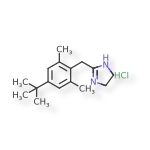
| Related Record | Type | Details | ||
|---|---|---|---|---|
|
|
IMPURITY -> PARENT |
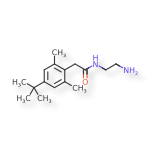
| Related Record | Type | Details | ||
|---|---|---|---|---|
|
|
ACTIVE MOIETY |