


Details
| Stereochemistry | ACHIRAL |
| Molecular Formula | C12H18O |
| Molecular Weight | 178.2707 |
| Optical Activity | NONE |
| Defined Stereocenters | 0 / 0 |
| E/Z Centers | 0 |
| Charge | 0 |
SHOW SMILES / InChI
SMILES
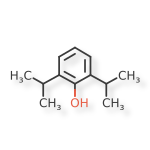
CC(C)C1=CC=CC(C(C)C)=C1O
InChI
InChIKey=OLBCVFGFOZPWHH-UHFFFAOYSA-N
InChI=1S/C12H18O/c1-8(2)10-6-5-7-11(9(3)4)12(10)13/h5-9,13H,1-4H3
| Molecular Formula | C12H18O |
| Molecular Weight | 178.2707 |
| Charge | 0 |
| Count |
|
| Stereochemistry | ACHIRAL |
| Additional Stereochemistry | No |
| Defined Stereocenters | 0 / 0 |
| E/Z Centers | 0 |
| Optical Activity | NONE |
DescriptionCurator's Comment: description was created based on several sources, including
http://www.accessdata.fda.gov/drugsatfda_docs/label/2007/019627s045lbl.pdf
https://www.ncbi.nlm.nih.gov/pubmed/12665397
Curator's Comment: description was created based on several sources, including
http://www.accessdata.fda.gov/drugsatfda_docs/label/2007/019627s045lbl.pdf
https://www.ncbi.nlm.nih.gov/pubmed/12665397
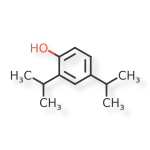
Propofol (2,6-diisopropylphenol) is an intravenous anaesthetic agent used for induction and maintenance of general anaesthesia. IV administration of propfol is used to induce unconsciousness after which anaesthesia may be maintained using a combination of medications. It is extensively metabolized, with most of the administered dose appearing in the urine as glucuronide conjugates. Favorable operating conditions and rapid recovery are claimed as the main advantages in using propofol, whereas disadvantages include a relatively high incidence of apnea, and blood pressure reductions. The action of propofol involves a positive modulation of the inhibitory function of the neurotransmitter gama-aminobutyric acid (GABA) through GABA-A receptors. Due to its high lipid-solubility, propofol was initially formulated as a solution with the surfactant Cremophor EL, but the occurrence of pain on injection and anaphylactoid reactions prompted to search for alternative formulations. Results from using cyclodextrins, water-soluble prodrugs, and adopting Bodor's approach to the site-specific chemical delivery system (CDS), as well as the advantages provided by computer-controlled infusion systems, are examined in some detail.
Originator
Approval Year
Targets
| Primary Target | Pharmacology | Condition | Potency |
|---|---|---|---|
Target ID: CHEMBL2093872 |
Conditions
| Condition | Modality | Targets | Highest Phase | Product |
|---|---|---|---|---|
| Primary | DIPRIVAN Approved UsePropofol injectable emulsion is an I.V. sedative-hypnotic agent that can be used as described in the table below. TABLE 3. INDICATIONS FOR PROPOFOL INJECTABLE EMULSION Indication Approved Patient Population Initiation and maintenance of Monitored Anesthesia Care (MAC) sedation Adults only Combined sedation and regional anesthesia Adults only (See PRECAUTIONS ) Induction of General Anesthesia Patients ≥ 3 years of age Maintenance of General Anesthesia Patients ≥ 2 months of age Intensive Care Unit (ICU) sedation of intubated, mechanically ventilated patients Adults only Safety, effectiveness and dosing guidelines for propofol injectable emulsion have not been established for MAC Sedation in the pediatric population; therefore, it is not recommended for this use. (See PRECAUTIONS - Pediatric Use.) Propofol injectable emulsion is not recommended for induction of anesthesia below the age of 3 years or for maintenance of anesthesia below the age of 2 months because its safety and effectiveness have not been established in those populations. In the Intensive Care Unit (ICU), propofol injectable emulsion can be administered to intubated, mechanically ventilated adult patients to provide continuous sedation and control of stress responses, only by persons skilled in the medical management of critically ill patients and trained in cardiovascular resuscitation and airway management. Propofol injectable emulsion is not indicated for use in Pediatric ICU sedation since the safety of this regimen has not been established. (See PRECAUTIONS - Pediatric Use.) Propofol injectable emulsion is not recommended for obstetrics, including Cesarean section deliveries. Propofol injectable emulsion crosses the placenta, and as with other general anesthetic agents, the administration of propofol injectable emulsion may be associated with neonatal depression. (See PRECAUTIONS .) Propofol is not recommended for use in nursing mothers because propofol injectable emulsion has been reported to be excreted in human milk and the effects of oral absorption of small amounts of propofol are not known. (See PRECAUTIONS .) Launch Date1989 |
Cmax
| Value | Dose | Co-administered | Analyte | Population |
|---|---|---|---|---|
3.854 ng/mL EXPERIMENT https://www.ncbi.nlm.nih.gov/pubmed/11753007 |
2 mg/kg single, intravenous dose: 2 mg/kg route of administration: Intravenous experiment type: SINGLE co-administered: |
PROPOFOL plasma | Homo sapiens population: HEALTHY age: ADULT sex: FEMALE / MALE food status: UNKNOWN |
AUC
| Value | Dose | Co-administered | Analyte | Population |
|---|---|---|---|---|
1.183 ng × h/mL EXPERIMENT https://www.ncbi.nlm.nih.gov/pubmed/11753007 |
2 mg/kg single, intravenous dose: 2 mg/kg route of administration: Intravenous experiment type: SINGLE co-administered: |
PROPOFOL plasma | Homo sapiens population: HEALTHY age: ADULT sex: FEMALE / MALE food status: UNKNOWN |
T1/2
| Value | Dose | Co-administered | Analyte | Population |
|---|---|---|---|---|
3.43 h EXPERIMENT https://www.ncbi.nlm.nih.gov/pubmed/11753007 |
2 mg/kg single, intravenous dose: 2 mg/kg route of administration: Intravenous experiment type: SINGLE co-administered: |
PROPOFOL plasma | Homo sapiens population: HEALTHY age: ADULT sex: FEMALE / MALE food status: UNKNOWN |
Overview
| CYP3A4 | CYP2C9 | CYP2D6 | hERG |
|---|---|---|---|
OverviewOther
| Other Inhibitor | Other Substrate | Other Inducer |
|---|---|---|
Drug as perpetrator
| Target | Modality | Activity | Metabolite | Clinical evidence |
|---|---|---|---|---|
| weak [IC50 213 uM] | ||||
| yes [IC50 32 uM] | ||||
| yes [IC50 40 uM] | ||||
| yes [IC50 49 uM] | ||||
| yes [IC50 55 uM] | ||||
| yes [IC50 59 uM] | ||||
| yes [Ki 48 uM] | ||||
| yes | ||||
| yes | ||||
| yes | ||||
| yes | ||||
| yes |
Drug as victim
| Target | Modality | Activity | Metabolite | Clinical evidence |
|---|---|---|---|---|
| major | no (pharmacogenomic study) Comment: polymorphisms c.98T>C in the UGT1A9 and c.1075A>C in the CYP2C9 genes did not affect the pharmacokinetic profile of propofol |
|||
| major | yes (pharmacogenomic study) Comment: only polymorphism c.516G>T in the CYP2B6 gene and BMI affect the metabolism rate of propofol and may play an important role in the optimisation of propofol anaesthesia |
|||
| minor | ||||
| minor | ||||
| minor | ||||
| minor | ||||
| minor | ||||
| minor | ||||
| yes | no (pharmacogenomic study) Comment: polymorphisms c.98T>C in the UGT1A9 and c.1075A>C in the CYP2C9 genes did not affect the pharmacokinetic profile of propofol |
Tox targets
| Target | Modality | Activity | Metabolite | Clinical evidence |
|---|---|---|---|---|
PubMed
| Title | Date | PubMed |
|---|---|---|
| Evaluation of the safety and efficacy of repeated sedations for the radiotherapy of young children with cancer: a prospective study of 1033 consecutive sedations. | 2001-03-01 |
|
| Small doses of propofol, droperidol, and metoclopramide for the prevention of postoperative nausea and vomiting after thyroidectomy. | 2001-03 |
|
| Use of the Bispectral Index monitor to aid titration of propofol during a drug-assisted interview. | 2001-03 |
|
| Anaesthetic technique for transoesophageal echocardiography in children. | 2001-03 |
|
| Propofol is not effective for hyperventilation syndrome. | 2001-03 |
|
| The effect of the preemptive use of the NMDA receptor antagonist dextromethorphan on postoperative analgesic requirements. | 2001-03 |
|
| The determinants of propofol induction of anesthesia dose. | 2001-03 |
|
| Recovery profile and side effects of remifentanil-based anaesthesia with desflurane or propofol for laparoscopic cholecystectomy. | 2001-03 |
|
| Reduced isoflurane consumption with bispectral index monitoring. | 2001-03 |
|
| [Hemodynamic effects of propofol induction administered with target controlled infusion pump in patients scheduled for open heart surgery]. | 2001-02-18 |
|
| Chronic mu-opioid receptor stimulation in humans decreases muscle sympathetic nerve activity. | 2001-02-13 |
|
| The effects of propofol on NMDA- or nitric oxide-mediated neurotoxicity in vitro. | 2001-02-12 |
|
| Propofol action in both spinal cord and brain blunts electroencephalographic responses to noxious stimulation in goats. | 2001-02-01 |
|
| [Preliminary report: the effect of flumazenil on the hypnotic dose of propofol in ddY mice]. | 2001-02 |
|
| [Anesthetic management of two patients with insulinoma using propofol--in association with rapid radioimmunoassay for insulin]. | 2001-02 |
|
| [Clinical evaluation of roxatidine acetate hydrochlorides as a preanesthetic medication]. | 2001-02 |
|
| A randomized prospective comparative study of general versus epidural anesthesia for transcervical hysteroscopic endometrial resection. | 2001-02 |
|
| Propofol in subanesthetic doses terminates status epilepticus in a rodent model. | 2001-02 |
|
| Timing of pre-emptive tenoxicam is important for postoperative analgesia. | 2001-02 |
|
| High concentrations of isoflurane do not block the sympathetic nervous system activation from desflurane. | 2001-02 |
|
| Evaluation of the effective drugs for the prevention of nausea and vomiting induced by morphine used for postoperative pain: a quantitative systematic review. | 2001-02 |
|
| Anesthetic concentrations of propofol protect against oxidative stress in primary astrocyte cultures: comparison with hypothermia. | 2001-02 |
|
| Assessment of depth of anesthesia and postoperative respiratory recovery after remifentanil- versus alfentanil-based total intravenous anesthesia in patients undergoing ear-nose-throat surgery. | 2001-02 |
|
| Relation between initial blood distribution volume and propofol induction dose requirement. | 2001-02 |
|
| Effect of dexmedetomidine on propofol requirements in healthy subjects. | 2001-02 |
|
| Effect of midazolam pretreatment on induction dose requirements of propofol in combination with fentanyl in younger and older adults. | 2001-02 |
|
| Reversal of rocuronium with edrophonium during propofol versus sevoflurane anesthesia. | 2001-02 |
|
| Effects of different preparations of propofol, diazepam, and etomidate on human neutrophils in vitro. | 2001-02 |
|
| Propofol anesthesia induces phase synchronization changes in EEG. | 2001-02 |
|
| Evidence for significant differences in microsomal drug glucuronidation by canine and human liver and kidney. | 2001-02 |
|
| The differential effect of propofol on contractility of isolated myocardial trabeculae of rat and guinea-pig. | 2001-02 |
|
| Propofol depressed neutrophil hydrogen peroxide production more than midazolam, whereas adhesion molecule expression was minimally affected by both anesthetics in rats with abdominal sepsis. | 2001-02 |
|
| Long-term propofol infusion and cardiac failure in adult head-injured patients. | 2001-01-13 |
|
| Extracranial radiosurgery: immobilizing liver motion in dogs using high-frequency jet ventilation and total intravenous anesthesia. | 2001-01-01 |
|
| [Epileptoform EEG activity: occurrence under sevoflurane and not during propofol application]. | 2001-01 |
|
| High concentration sevoflurane induction of anesthesia accelerates onset of vecuronium neuromuscular blockade. | 2001-01 |
|
| Remifentanil and controlled hypotension; comparison with nitroprusside or esmolol during tympanoplasty. | 2001-01 |
|
| Dystonic reaction after anesthesia. | 2001-01 |
|
| [The Baxter AS 50 syringe pump: a comparison with propofol-specific syringe pumps]. | 2001-01 |
|
| [Marked bradycardia during anesthetic induction treated with temporary cardiac pacing in a patient with latent sick sinus syndrome]. | 2001-01 |
|
| [The influence of age on hemodynamics and the dose requirements of propofol and buprenorphine in total intravenous anesthesia]. | 2001-01 |
|
| [A case of hyperperfusion syndrome treated successfully by propofol]. | 2001-01 |
|
| Propofol versus midazolam regarding their antioxidant activities. | 2001-01 |
|
| Does the use of propofol require a specialist anesthetist? | 2001-01 |
|
| Differential roles of iNOS and nNOS at rostral ventrolateral medulla during experimental endotoxemia in the rat. | 2001-01 |
|
| Spectral changes in systemic arterial pressure signals during acute mevinphos intoxication in the rat. | 2001-01 |
|
| Target-controlled infusion in sleep endoscopy. | 2001-01 |
|
| Prevention of postoperative nausea and vomiting with antiemetics in patients undergoing middle ear surgery: comparison of a small dose of propofol with droperidol or metoclopramide. | 2001-01 |
|
| Effect of dexmedetomidine, an alpha2-adrenoceptor agonist, on human pupillary reflexes during general anaesthesia. | 2001-01 |
|
| The immunomodulatory effects of prolonged intravenous infusion of propofol versus midazolam in critically ill surgical patients. | 2001-01 |
Sample Use Guides
Adult Patients: Most adult patients under 55 years of age and classified as ASA-PS I or II require 2 to 2.5 mg/kg of DIPRIVAN ((propofol) Injectable Emulsion ) for induction when unpremedicated or when premedicated with oral benzodiazepines or intramuscular opioids.
Elderly, Debilitated, or ASA-PS III or IV Patients: most of these patients require approximately 1 to 1.5 mg/kg (approximately 20 mg every 10 seconds) of DIPRIVAN Injectable Emulsion for induction of anesthesia according to their condition and responses.
Pediatric Patients: Most patients aged 3 years through 16 years and classified ASA-PS I or II require 2.5 to 3.5 mg/kg of DIPRIVAN Injectable Emulsion for induction when unpremedicated or when lightly premedicated with oral benzodiazepines or intramuscular opioids
Route of Administration:
Intravenous
| Substance Class |
Chemical
Created
by
admin
on
Edited
Wed Apr 02 09:53:23 GMT 2025
by
admin
on
Wed Apr 02 09:53:23 GMT 2025
|
| Record UNII |
YI7VU623SF
|
| Record Status |
Validated (UNII)
|
| Record Version |
|
-
Download
| Name | Type | Language | ||
|---|---|---|---|---|
|
Preferred Name | English | ||
|
Official Name | English | ||
|
Common Name | English | ||
|
Brand Name | English | ||
|
Common Name | English | ||
|
Common Name | English | ||
|
Code | English | ||
|
Common Name | English | ||
|
Code | English | ||
|
Common Name | English | ||
|
Brand Name | English | ||
|
Common Name | English | ||
|
Code | English | ||
|
Common Name | English | ||
|
Common Name | English | ||
|
Brand Name | English | ||
|
Common Name | English | ||
|
Common Name | English | ||
|
Systematic Name | English | ||
|
Code | English | ||
|
Common Name | English | ||
|
Common Name | English | ||
|
Systematic Name | English | ||
|
Common Name | English | ||
|
Common Name | English | ||
|
Common Name | English | ||
|
Common Name | English |
| Classification Tree | Code System | Code | ||
|---|---|---|---|---|
|
NCI_THESAURUS |
C29756
Created by
admin on Wed Apr 02 09:53:23 GMT 2025 , Edited by admin on Wed Apr 02 09:53:23 GMT 2025
|
||
|
CFR |
21 CFR 522.2005
Created by
admin on Wed Apr 02 09:53:23 GMT 2025 , Edited by admin on Wed Apr 02 09:53:23 GMT 2025
|
||
|
WHO-ATC |
N01AX10
Created by
admin on Wed Apr 02 09:53:23 GMT 2025 , Edited by admin on Wed Apr 02 09:53:23 GMT 2025
|
||
|
NDF-RT |
N0000175681
Created by
admin on Wed Apr 02 09:53:23 GMT 2025 , Edited by admin on Wed Apr 02 09:53:23 GMT 2025
|
||
|
NDF-RT |
N0000175975
Created by
admin on Wed Apr 02 09:53:23 GMT 2025 , Edited by admin on Wed Apr 02 09:53:23 GMT 2025
|
||
|
WHO-VATC |
QN01AX10
Created by
admin on Wed Apr 02 09:53:23 GMT 2025 , Edited by admin on Wed Apr 02 09:53:23 GMT 2025
|
||
|
LIVERTOX |
NBK547909
Created by
admin on Wed Apr 02 09:53:23 GMT 2025 , Edited by admin on Wed Apr 02 09:53:23 GMT 2025
|
||
|
WHO-ESSENTIAL MEDICINES LIST |
1.1.2
Created by
admin on Wed Apr 02 09:53:23 GMT 2025 , Edited by admin on Wed Apr 02 09:53:23 GMT 2025
|
| Code System | Code | Type | Description | ||
|---|---|---|---|---|---|
|
m9217
Created by
admin on Wed Apr 02 09:53:23 GMT 2025 , Edited by admin on Wed Apr 02 09:53:23 GMT 2025
|
PRIMARY | Merck Index | ||
|
5073
Created by
admin on Wed Apr 02 09:53:23 GMT 2025 , Edited by admin on Wed Apr 02 09:53:23 GMT 2025
|
PRIMARY | |||
|
DB00818
Created by
admin on Wed Apr 02 09:53:23 GMT 2025 , Edited by admin on Wed Apr 02 09:53:23 GMT 2025
|
PRIMARY | |||
|
C29384
Created by
admin on Wed Apr 02 09:53:23 GMT 2025 , Edited by admin on Wed Apr 02 09:53:23 GMT 2025
|
PRIMARY | |||
|
7123
Created by
admin on Wed Apr 02 09:53:23 GMT 2025 , Edited by admin on Wed Apr 02 09:53:23 GMT 2025
|
PRIMARY | |||
|
44915
Created by
admin on Wed Apr 02 09:53:23 GMT 2025 , Edited by admin on Wed Apr 02 09:53:23 GMT 2025
|
PRIMARY | |||
|
DTXSID6023523
Created by
admin on Wed Apr 02 09:53:23 GMT 2025 , Edited by admin on Wed Apr 02 09:53:23 GMT 2025
|
PRIMARY | |||
|
YI7VU623SF
Created by
admin on Wed Apr 02 09:53:23 GMT 2025 , Edited by admin on Wed Apr 02 09:53:23 GMT 2025
|
PRIMARY | |||
|
YI7VU623SF
Created by
admin on Wed Apr 02 09:53:23 GMT 2025 , Edited by admin on Wed Apr 02 09:53:23 GMT 2025
|
PRIMARY | |||
|
2302
Created by
admin on Wed Apr 02 09:53:23 GMT 2025 , Edited by admin on Wed Apr 02 09:53:23 GMT 2025
|
PRIMARY | |||
|
4943
Created by
admin on Wed Apr 02 09:53:23 GMT 2025 , Edited by admin on Wed Apr 02 09:53:23 GMT 2025
|
PRIMARY | |||
|
100000091539
Created by
admin on Wed Apr 02 09:53:23 GMT 2025 , Edited by admin on Wed Apr 02 09:53:23 GMT 2025
|
PRIMARY | |||
|
D015742
Created by
admin on Wed Apr 02 09:53:23 GMT 2025 , Edited by admin on Wed Apr 02 09:53:23 GMT 2025
|
PRIMARY | |||
|
Propofol
Created by
admin on Wed Apr 02 09:53:23 GMT 2025 , Edited by admin on Wed Apr 02 09:53:23 GMT 2025
|
PRIMARY | |||
|
CHEMBL526
Created by
admin on Wed Apr 02 09:53:23 GMT 2025 , Edited by admin on Wed Apr 02 09:53:23 GMT 2025
|
PRIMARY | |||
|
5464
Created by
admin on Wed Apr 02 09:53:23 GMT 2025 , Edited by admin on Wed Apr 02 09:53:23 GMT 2025
|
PRIMARY | |||
|
U-89
Created by
admin on Wed Apr 02 09:53:23 GMT 2025 , Edited by admin on Wed Apr 02 09:53:23 GMT 2025
|
PRIMARY | |||
|
2078-54-8
Created by
admin on Wed Apr 02 09:53:23 GMT 2025 , Edited by admin on Wed Apr 02 09:53:23 GMT 2025
|
PRIMARY | |||
|
SUB10116MIG
Created by
admin on Wed Apr 02 09:53:23 GMT 2025 , Edited by admin on Wed Apr 02 09:53:23 GMT 2025
|
PRIMARY | |||
|
8782
Created by
admin on Wed Apr 02 09:53:23 GMT 2025 , Edited by admin on Wed Apr 02 09:53:23 GMT 2025
|
PRIMARY | RxNorm | ||
|
218-206-6
Created by
admin on Wed Apr 02 09:53:23 GMT 2025 , Edited by admin on Wed Apr 02 09:53:23 GMT 2025
|
PRIMARY | |||
|
1572503
Created by
admin on Wed Apr 02 09:53:23 GMT 2025 , Edited by admin on Wed Apr 02 09:53:23 GMT 2025
|
PRIMARY | |||
|
PROPOFOL
Created by
admin on Wed Apr 02 09:53:23 GMT 2025 , Edited by admin on Wed Apr 02 09:53:23 GMT 2025
|
PRIMARY |
| Related Record | Type | Details | ||
|---|---|---|---|---|
|
METABOLIC ENZYME -> SUBSTRATE | |||
|
BASIS OF STRENGTH->SUBSTANCE |
ASSAY (HPLC)
EP
|
||
|
METABOLIC ENZYME -> SUBSTRATE | |||
|
BASIS OF STRENGTH->SUBSTANCE |
ASSAY (HPLC)
USP
|

| Related Record | Type | Details | ||
|---|---|---|---|---|
|
|
PRODRUG -> METABOLITE ACTIVE |

| Related Record | Type | Details | ||
|---|---|---|---|---|
|
IMPURITY -> PARENT |
For the calculation of contents, multiply the peak areas by 0.25
CHROMATOGRAPHIC PURITY (HPLC/UV)
EP
|
||
|
IMPURITY -> PARENT |
test 1
CHROMATOGRAPHIC PURITY (HPLC/UV)
USP
|
||
|
IMPURITY -> PARENT |
CHROMATOGRAPHIC PURITY (GC)
EP
|
||
|
IMPURITY -> PARENT |
UNSPECIFIED
EP
|
||
|
IMPURITY -> PARENT |
UNSPECIFIED
EP
|
||
|
IMPURITY -> PARENT |
UNSPECIFIED
EP
|
||
|
IMPURITY -> PARENT |
For the calculation of contents, multiply the peak areas by 5.0
CHROMATOGRAPHIC PURITY (HPLC/UV)
EP
|
||
|
IMPURITY -> PARENT |
test 2
CHROMATOGRAPHIC PURITY (HPLC/UV)
USP
|
||
|
IMPURITY -> PARENT |
UNSPECIFIED
EP
|
||
|
IMPURITY -> PARENT |
Limit of propofol related compound A?[note?This test is to be performed in conjunction with Related compounds Test 1. ]
CHROMATOGRAPHIC PURITY (HPLC/UV)
USP
|
||
|
IMPURITY -> PARENT |
test 2
CHROMATOGRAPHIC PURITY (HPLC/UV)
USP
|
||
|
IMPURITY -> PARENT |
Limit of propofol related compound B
CHROMATOGRAPHIC PURITY (HPLC/UV)
USP
|
||
|
IMPURITY -> PARENT |
UNSPECIFIED
EP
|
||
|
IMPURITY -> PARENT |
UNSPECIFIED
EP
|
||
|
IMPURITY -> PARENT |
UNSPECIFIED
EP
|
||
|
IMPURITY -> PARENT |
CHROMATOGRAPHIC PURITY (GC)
EP
|
||
|
IMPURITY -> PARENT |
CHROMATOGRAPHIC PURITY (GC)
EP
|
||
|
IMPURITY -> PARENT |
UNSPECIFIED
EP
|
||
|
IMPURITY -> PARENT |
CHROMATOGRAPHIC PURITY (GC)
EP
|
||
|
IMPURITY -> PARENT |
UNSPECIFIED
EP
|




| Related Record | Type | Details | ||
|---|---|---|---|---|
|
ACTIVE MOIETY |
| Name | Property Type | Amount | Referenced Substance | Defining | Parameters | References |
|---|---|---|---|---|---|---|
| Biological Half-life |
|
Elimination PHARMACOKINETIC PHARMACOKINETIC PHARMACOKINETIC |
|
|||
| Volume of Distribution | PHARMACOKINETIC |
|
After a 10-day infusion PHARMACOKINETIC |
|
||