


Details
| Stereochemistry | ABSOLUTE |
| Molecular Formula | C22H31NO2 |
| Molecular Weight | 341.487 |
| Optical Activity | ( + ) |
| Defined Stereocenters | 1 / 1 |
| E/Z Centers | 0 |
| Charge | 0 |
SHOW SMILES / InChI
SMILES
CC(C)N(CC[C@H](C1=CC=CC=C1)C2=C(O)C=CC(CO)=C2)C(C)C
InChI
InChIKey=DUXZAXCGJSBGDW-HXUWFJFHSA-N
InChI=1S/C22H31NO2/c1-16(2)23(17(3)4)13-12-20(19-8-6-5-7-9-19)21-14-18(15-24)10-11-22(21)25/h5-11,14,16-17,20,24-25H,12-13,15H2,1-4H3/t20-/m1/s1
| Molecular Formula | C22H31NO2 |
| Molecular Weight | 341.487 |
| Charge | 0 |
| Count |
|
| Stereochemistry | ABSOLUTE |
| Additional Stereochemistry | No |
| Defined Stereocenters | 1 / 1 |
| E/Z Centers | 0 |
| Optical Activity | UNSPECIFIED |
DescriptionSources: https://www.ncbi.nlm.nih.gov/pubmed/19835561 | DOI: 10.1002/(SICI)1520-6777(1996)15:4<249::AID-NAU1>3.0.CO;2-F | https://www.ncbi.nlm.nih.gov/pubmed/9353847https://www.ncbi.nlm.nih.gov/pubmed/19835561Curator's Comment: Description was created based on several sources, including
https://www.ncbi.nlm.nih.gov/pubmed/18279452
Sources: https://www.ncbi.nlm.nih.gov/pubmed/19835561 | DOI: 10.1002/(SICI)1520-6777(1996)15:4<249::AID-NAU1>3.0.CO;2-F | https://www.ncbi.nlm.nih.gov/pubmed/9353847https://www.ncbi.nlm.nih.gov/pubmed/19835561
Curator's Comment: Description was created based on several sources, including
https://www.ncbi.nlm.nih.gov/pubmed/18279452
Fesoterodine (trade name Toviaz) is a prodrug of 5-hydroxymethyl tolterodine, which is also the active metabolite of tolterodine. Fesoterodine and its active metabolites are nonsubtype selective, competitive antagonists of human muscarinic receptors, but 5-hydroxymethyl tolterodine has greater potency than the parent compound. A prodrug approach was necessary for systemic bioavailability of 5-hydroxymethyl tolterodine after oral administration. Fesoterodine was originated by Schwarz Pharma (later a subsidiary of UCB) and is being developed by Pfizer for the treatment of overactive bladder and urinary urge incontinence. The agent is launched in several countries for the treatment of overactive bladder, including the US, Japan, Canada, Europe and Asia.
CNS Activity
Sources: https://www.ncbi.nlm.nih.gov/pubmed/21392072https://www.ncbi.nlm.nih.gov/pubmed/22390261 | https://www.ncbi.nlm.nih.gov/pubmed/21392072
Curator's Comment: Fesoterodine is a substrate for permeability-glycoprotein (P-gp) and, therefore, is actively transported away from the brain.
Originator
Sources: DOI: 10.1002/(SICI)1520-6777(1996)15:4<249::AID-NAU1>3.0.CO;2-Fhttp://adisinsight.springer.com/drugs/800010689
Curator's Comment: Gillberg, P-G, Sparf, B, Nilvebrant, L. Pharmacological in vitro and in vivo profile of DD01, a major metabolite of tolterodine (abstract). Neurourol Urodyn. 1996;15:308–309.
Approval Year
Targets
| Primary Target | Pharmacology | Condition | Potency |
|---|---|---|---|
Target ID: CHEMBL216 Sources: DOI: 10.1002/(SICI)1520-6777(1996)15:4<249::AID-NAU1>3.0.CO;2-F |
2.3 nM [Ki] | ||
Target ID: CHEMBL211 Sources: DOI: 10.1002/(SICI)1520-6777(1996)15:4<249::AID-NAU1>3.0.CO;2-F |
2.0 nM [Ki] | ||
Target ID: CHEMBL245 Sources: DOI: 10.1002/(SICI)1520-6777(1996)15:4<249::AID-NAU1>3.0.CO;2-F |
2.5 nM [Ki] | ||
Target ID: CHEMBL1821 Sources: DOI: 10.1002/(SICI)1520-6777(1996)15:4<249::AID-NAU1>3.0.CO;2-F |
2.8 nM [Ki] | ||
Target ID: CHEMBL2035 Sources: DOI: 10.1002/(SICI)1520-6777(1996)15:4<249::AID-NAU1>3.0.CO;2-F |
2.9 nM [Ki] | ||
| 8.0 null [pKi] | |||
| 7.7 null [pKi] | |||
| 7.4 null [pKi] | |||
| 7.3 null [pKi] | |||
| 7.5 null [pKi] |
Conditions
| Condition | Modality | Targets | Highest Phase | Product |
|---|---|---|---|---|
Sources: DOI: 10.1002/(SICI)1520-6777(1996)15:4<249::AID-NAU1>3.0.CO;2-F https://www.ncbi.nlm.nih.gov/pubmed/9353847 |
Primary | Unknown Approved UseUnknown |
||
| Primary | Unknown Approved UseUnknown |
|||
| Palliative | TOVIAZ Approved UseToviaz is a muscarinic antagonist indicated for the treatment of overactive bladder with symptoms of urge urinary incontinence, urgency, and frequency. Launch Date2008 |
|||
| Primary | TOVIAZ Approved UseToviaz® is a muscarinic antagonist indicated for the treatment of overactive bladder with symptoms of urge urinary incontinence, urgency, and frequency. Toviaz is a muscarinic antagonist indicated for the treatment of overactive bladder with symptoms of urge urinary incontinence, urgency, and frequency. Launch Date2008 |
Cmax
| Value | Dose | Co-administered | Analyte | Population |
|---|---|---|---|---|
1.89 ng/mL |
4 mg single, oral dose: 4 mg route of administration: Oral experiment type: SINGLE co-administered: |
5-HYDROXYMETHYL TOLTERODINE plasma | Homo sapiens population: UNKNOWN age: ADULT sex: UNKNOWN food status: UNKNOWN |
|
2.464 ng/mL |
4 mg single, oral dose: 4 mg route of administration: Oral experiment type: SINGLE co-administered: |
DESFESOTERODINE plasma | Homo sapiens population: HEALTHY age: ADULT sex: MALE food status: UNKNOWN |
|
5.519 ng/mL |
8 mg single, oral dose: 8 mg route of administration: Oral experiment type: SINGLE co-administered: |
DESFESOTERODINE plasma | Homo sapiens population: HEALTHY age: ADULT sex: MALE food status: UNKNOWN |
|
10.863 ng/mL |
16 mg single, oral dose: 16 mg route of administration: Oral experiment type: SINGLE co-administered: |
DESFESOTERODINE plasma | Homo sapiens population: HEALTHY age: ADULT sex: MALE food status: UNKNOWN |
|
1.96 ng/mL |
4 mg single, oral dose: 4 mg route of administration: Oral experiment type: SINGLE co-administered: |
DESFESOTERODINE plasma | Homo sapiens population: HEALTHY age: ADULT sex: MALE food status: FASTED |
|
2.89 ng/mL |
8 mg 1 times / day single, oral dose: 8 mg route of administration: Oral experiment type: SINGLE co-administered: |
DESFESOTERODINE plasma | Homo sapiens population: HEALTHY age: ADULT sex: MALE food status: FASTED |
|
2.32 ng/mL |
4 mg 1 times / day multiple, oral dose: 4 mg route of administration: Oral experiment type: MULTIPLE co-administered: |
DESFESOTERODINE plasma | Homo sapiens population: HEALTHY age: ADULT sex: MALE food status: FASTED |
|
3.59 ng/mL |
8 mg 1 times / day multiple, oral dose: 8 mg route of administration: Oral experiment type: MULTIPLE co-administered: |
DESFESOTERODINE plasma | Homo sapiens population: HEALTHY age: ADULT sex: MALE food status: FASTED |
AUC
| Value | Dose | Co-administered | Analyte | Population |
|---|---|---|---|---|
24.461 ng × h/mL |
4 mg single, oral dose: 4 mg route of administration: Oral experiment type: SINGLE co-administered: |
DESFESOTERODINE plasma | Homo sapiens population: HEALTHY age: ADULT sex: MALE food status: UNKNOWN |
|
53.715 ng × h/mL |
8 mg single, oral dose: 8 mg route of administration: Oral experiment type: SINGLE co-administered: |
DESFESOTERODINE plasma | Homo sapiens population: HEALTHY age: ADULT sex: MALE food status: UNKNOWN |
|
111.091 ng × h/mL |
16 mg single, oral dose: 16 mg route of administration: Oral experiment type: SINGLE co-administered: |
DESFESOTERODINE plasma | Homo sapiens population: HEALTHY age: ADULT sex: MALE food status: UNKNOWN |
|
19.9 ng × h/mL |
4 mg single, oral dose: 4 mg route of administration: Oral experiment type: SINGLE co-administered: |
DESFESOTERODINE plasma | Homo sapiens population: HEALTHY age: ADULT sex: MALE food status: FASTED |
|
26.9 ng × h/mL |
8 mg 1 times / day single, oral dose: 8 mg route of administration: Oral experiment type: SINGLE co-administered: |
DESFESOTERODINE plasma | Homo sapiens population: HEALTHY age: ADULT sex: MALE food status: FASTED |
|
23.4 ng × h/mL |
4 mg 1 times / day multiple, oral dose: 4 mg route of administration: Oral experiment type: MULTIPLE co-administered: |
DESFESOTERODINE plasma | Homo sapiens population: HEALTHY age: ADULT sex: MALE food status: FASTED |
|
32.8 ng × h/mL |
8 mg 1 times / day multiple, oral dose: 8 mg route of administration: Oral experiment type: MULTIPLE co-administered: |
DESFESOTERODINE plasma | Homo sapiens population: HEALTHY age: ADULT sex: MALE food status: FASTED |
T1/2
| Value | Dose | Co-administered | Analyte | Population |
|---|---|---|---|---|
7.31 h |
4 mg single, oral dose: 4 mg route of administration: Oral experiment type: SINGLE co-administered: |
5-HYDROXYMETHYL TOLTERODINE plasma | Homo sapiens population: UNKNOWN age: ADULT sex: UNKNOWN food status: UNKNOWN |
|
9.671 h |
4 mg single, oral dose: 4 mg route of administration: Oral experiment type: SINGLE co-administered: |
DESFESOTERODINE plasma | Homo sapiens population: HEALTHY age: ADULT sex: MALE food status: UNKNOWN |
|
9.37 h |
8 mg single, oral dose: 8 mg route of administration: Oral experiment type: SINGLE co-administered: |
DESFESOTERODINE plasma | Homo sapiens population: HEALTHY age: ADULT sex: MALE food status: UNKNOWN |
|
7.58 h |
16 mg single, oral dose: 16 mg route of administration: Oral experiment type: SINGLE co-administered: |
DESFESOTERODINE plasma | Homo sapiens population: HEALTHY age: ADULT sex: MALE food status: UNKNOWN |
|
8.13 h |
4 mg single, oral dose: 4 mg route of administration: Oral experiment type: SINGLE co-administered: |
DESFESOTERODINE plasma | Homo sapiens population: HEALTHY age: ADULT sex: MALE food status: FASTED |
|
6.86 h |
8 mg 1 times / day single, oral dose: 8 mg route of administration: Oral experiment type: SINGLE co-administered: |
DESFESOTERODINE plasma | Homo sapiens population: HEALTHY age: ADULT sex: MALE food status: FASTED |
|
5.13 h |
4 mg 1 times / day multiple, oral dose: 4 mg route of administration: Oral experiment type: MULTIPLE co-administered: |
DESFESOTERODINE plasma | Homo sapiens population: HEALTHY age: ADULT sex: MALE food status: FASTED |
|
4.86 h |
8 mg 1 times / day multiple, oral dose: 8 mg route of administration: Oral experiment type: MULTIPLE co-administered: |
DESFESOTERODINE plasma | Homo sapiens population: HEALTHY age: ADULT sex: MALE food status: FASTED |
Funbound
| Value | Dose | Co-administered | Analyte | Population |
|---|---|---|---|---|
50% |
4 mg single, oral dose: 4 mg route of administration: Oral experiment type: SINGLE co-administered: |
5-HYDROXYMETHYL TOLTERODINE plasma | Homo sapiens population: UNKNOWN age: ADULT sex: UNKNOWN food status: UNKNOWN |
|
50% |
DESFESOTERODINE plasma | Homo sapiens |
Overview
| CYP3A4 | CYP2C9 | CYP2D6 | hERG |
|---|---|---|---|
OverviewOther
| Other Inhibitor | Other Substrate | Other Inducer |
|---|---|---|
Drug as perpetrator
| Target | Modality | Activity | Metabolite | Clinical evidence |
|---|---|---|---|---|
| no | ||||
| no | ||||
| no | ||||
| no | ||||
| no | ||||
| no | ||||
| no | ||||
| no | ||||
| no | ||||
| no | ||||
| no | ||||
| no | ||||
| no | ||||
| weak | ||||
| yes [Inhibition 15 uM] |
Drug as victim
| Target | Modality | Activity | Metabolite | Clinical evidence |
|---|---|---|---|---|
| yes | ||||
| yes | yes (co-administration study) Comment: Following blockade of CYP3A4 by coadministration of the potent CYP3A4 inhibitor ketoconazoles, Cmax and AUC of the active metabolite of fesoterodine increased 2.0- and 2.3-fold, respectively, after oral administration of Toviaz to CYP2D6 extensive metabolizers. In CYP2D6 poor metabolizers, Cmax and AUC of the active metabolite of fesoterodine increased 2.1- and 2.5-fold, respectively, during coadministration of ketoconazole. Cmax and AUC were 4.5- and 5.7-fold higher, respectively, in subjects who were CYP2D6 poor metabolizers and taking ketoconazole; Following induction of CYP3A4 by coadministration of rifampicin (inducer), Cmax and AUC of the active metabolite of fesoterodine decreased by approximately 70% and 75%, respectively, after oral administration of Toviaz Page: 38.0 |
|||
| yes | yes (pharmacogenomic study) Comment: CYP2D6 PMs have values for AUC and Cmax that are about 2-fold higher that CYP2D6 EMs Page: 38.0 |
Tox targets
| Target | Modality | Activity | Metabolite | Clinical evidence |
|---|---|---|---|---|
PubMed
| Title | Date | PubMed |
|---|---|---|
| Effects of the moderate CYP3A4 inhibitor, fluconazole, on the pharmacokinetics of fesoterodine in healthy subjects. | 2011-08 |
|
| Efficacy and tolerability of fesoterodine in older and younger subjects with overactive bladder. | 2010-12 |
|
| Dose escalation improves therapeutic outcome: post hoc analysis of data from a 12-week, multicentre, double-blind, parallel-group trial of trospium chloride in patients with urinary urge incontinence. | 2010-09-14 |
|
| Fesoterodine in patients with overactive bladder syndrome: can the severity of baseline urgency urinary incontinence predict dosing requirement? | 2010-09 |
|
| Modeling dose-response relationships of the effects of fesoterodine in patients with overactive bladder. | 2010-08-19 |
|
| The cost-effectiveness of solifenacin vs fesoterodine, oxybutynin immediate-release, propiverine, tolterodine extended-release and tolterodine immediate-release in the treatment of patients with overactive bladder in the UK National Health Service. | 2010-08 |
|
| Spinal effects of the fesoterodine metabolite 5-hydroxymethyl tolterodine and/or doxazosin in rats with or without partial urethral obstruction. | 2010-08 |
|
| The cost-effectiveness of solifenacin vs fesoterodine, oxybutynin immediate-release, propiverine, tolterodine extended-release and tolterodine immediate-release in the treatment of patients with overactive bladder in the UK National Health Service. | 2010-08 |
|
| Urodynamic evaluation of fesoterodine metabolite, doxazosin and their combination in a rat model of partial urethral obstruction. | 2010-07 |
|
| Thorough QT study of the effect of fesoterodine on cardiac repolarization. | 2010-05 |
|
| Efficacy and tolerability of fesoterodine in men with overactive bladder: a pooled analysis of 2 phase III studies. | 2010-05 |
|
| Response to fesoterodine in patients with an overactive bladder and urgency urinary incontinence is independent of the urodynamic finding of detrusor overactivity. | 2010-05 |
|
| The overlap of interstitial cystitis/painful bladder syndrome and overactive bladder. | 2010-04-24 |
|
| Medical management of overactive bladder. | 2010-04 |
|
| Durability of treatments for overactive bladder. | 2010-04 |
|
| Long-term safety, tolerability and efficacy of fesoterodine treatment in subjects with overactive bladder symptoms. | 2010-04 |
|
| Efficacy of fesoterodine over 24 hours in subjects with overactive bladder. | 2010-04 |
|
| Recent advances in management of bladder overactivity. | 2010-02-11 |
|
| The pharmacokinetic profile of fesoterodine 8 mg with daytime or nighttime dosing. | 2010-02 |
|
| Fesoterodine fumarate. | 2010-02 |
|
| New Drugs2010, PART 1. | 2010-02 |
|
| Comparison of fesoterodine and tolterodine extended release for the treatment of overactive bladder: a head-to-head placebo-controlled trial. | 2010-01 |
|
| Randomized, double-blind, placebo-controlled trial of flexible-dose fesoterodine in subjects with overactive bladder. | 2010-01 |
|
| Bladder dysfunction in diabetes mellitus. | 2010 |
|
| Determination of fesoterodine in pharmaceutical formulations by using liquid chromatography-tandem mass spectrometry. | 2010 |
|
| Fesoterodine for the treatment of overactive bladder. | 2009-12 |
|
| Basic mechanisms of urgency: roles and benefits of pharmacotherapy. | 2009-12 |
|
| Influence of age, gender, and race on pharmacokinetics, pharmacodynamics, and safety of fesoterodine. | 2009-09 |
|
| Tolterodine extended-release for overactive bladder. | 2009-09 |
|
| Fesoterodine for the treatment of overactive bladder. | 2009-08 |
|
| Practical aspects of lifestyle modifications and behavioural interventions in the treatment of overactive bladder and urgency urinary incontinence. | 2009-08 |
|
| A meta-analysis of the placebo response in antimuscarinic drug trials for overactive bladder. | 2009-07-22 |
|
| Efficacy and tolerability of fesoterodine in women with overactive bladder. | 2009-07 |
|
| New drug information: Toviaz. | 2009-06 |
|
| Influence of food on the pharmacokinetic profile of fesoterodine. | 2009-06 |
|
| Evaluation of drug-drug interactions with fesoterodine. | 2009-06 |
|
| Fesoterodine (toviaz) for overactive bladder. | 2009-05-04 |
|
| Effects of flexible-dose fesoterodine on overactive bladder symptoms and treatment satisfaction: an open-label study. | 2009-04 |
|
| Assessment of the effects of renal impairment on the pharmacokinetic profile of fesoterodine. | 2009-04 |
|
| New drugs: milnacipran hydrochloride, fesoterodine fumarate, and silodosin. | 2009-03-18 |
|
| The pharmacokinetic profile of fesoterodine: similarities and differences to tolterodine. | 2009-03-07 |
|
| Fesoterodine: a new agent for treating overactive bladder. | 2009-03 |
|
| [Anticholinergic treatment of overactive bladder syndrome. Is it all the same?]. | 2009-03 |
|
| Muscarinic receptor antagonists for overactive bladder treatment: does one fit all? | 2009-01 |
|
| The design and development of fesoterodine as a prodrug of 5-hydroxymethyl tolterodine (5-HMT), the active metabolite of tolterodine. | 2009 |
|
| Fesoterodine for the treatment of urinary incontinence and overactive bladder. | 2009 |
|
| The safety and efficacy of tolterodine extended release in the treatment of overactive bladder in the elderly. | 2009 |
|
| Fesoterodine. | 2009 |
|
| Antimuscarinic potency and bladder selectivity of PNU-200577, a major metabolite of tolterodine. | 1997-10 |
|
| Tolterodine--a new bladder selective muscarinic receptor antagonist: preclinical pharmacological and clinical data. | 1997 |
Sample Use Guides
In terms of IC50 values (mean of 3-6 experiments), Desfesoterodine was >900 times more potent in blocking bladder muscarinic receptors (IC50 5.7 nM) than calcium channels (papillary muscle: IC50 5.4 uM; atrium: IC50 15 uM, bladder IC50 39 uM), alph-adrenoceptors (portal vein: IC50 100 uM) and histamine receptors (ileum: IC50 6.1 uM).
| Substance Class |
Chemical
Created
by
admin
on
Edited
Mon Mar 31 18:34:49 GMT 2025
by
admin
on
Mon Mar 31 18:34:49 GMT 2025
|
| Record UNII |
YU871O78GR
|
| Record Status |
Validated (UNII)
|
| Record Version |
|
-
Download
| Name | Type | Language | ||
|---|---|---|---|---|
|
Preferred Name | English | ||
|
Official Name | English | ||
|
Systematic Name | English | ||
|
Code | English | ||
|
Systematic Name | English | ||
|
Common Name | English | ||
|
Common Name | English | ||
|
Code | English | ||
|
Systematic Name | English |
| Classification Tree | Code System | Code | ||
|---|---|---|---|---|
|
WHO-ATC |
G04BD13
Created by
admin on Mon Mar 31 18:34:49 GMT 2025 , Edited by admin on Mon Mar 31 18:34:49 GMT 2025
|
| Code System | Code | Type | Description | ||
|---|---|---|---|---|---|
|
SUB179842
Created by
admin on Mon Mar 31 18:34:49 GMT 2025 , Edited by admin on Mon Mar 31 18:34:49 GMT 2025
|
PRIMARY | |||
|
C169886
Created by
admin on Mon Mar 31 18:34:49 GMT 2025 , Edited by admin on Mon Mar 31 18:34:49 GMT 2025
|
PRIMARY | |||
|
100000165970
Created by
admin on Mon Mar 31 18:34:49 GMT 2025 , Edited by admin on Mon Mar 31 18:34:49 GMT 2025
|
PRIMARY | |||
|
Desfesoterodine
Created by
admin on Mon Mar 31 18:34:49 GMT 2025 , Edited by admin on Mon Mar 31 18:34:49 GMT 2025
|
PRIMARY | |||
|
YU871O78GR
Created by
admin on Mon Mar 31 18:34:49 GMT 2025 , Edited by admin on Mon Mar 31 18:34:49 GMT 2025
|
PRIMARY | |||
|
207679-81-0
Created by
admin on Mon Mar 31 18:34:49 GMT 2025 , Edited by admin on Mon Mar 31 18:34:49 GMT 2025
|
PRIMARY | |||
|
DB15578
Created by
admin on Mon Mar 31 18:34:49 GMT 2025 , Edited by admin on Mon Mar 31 18:34:49 GMT 2025
|
PRIMARY | |||
|
DTXSID40431319
Created by
admin on Mon Mar 31 18:34:49 GMT 2025 , Edited by admin on Mon Mar 31 18:34:49 GMT 2025
|
PRIMARY | |||
|
9819382
Created by
admin on Mon Mar 31 18:34:49 GMT 2025 , Edited by admin on Mon Mar 31 18:34:49 GMT 2025
|
PRIMARY | |||
|
10020
Created by
admin on Mon Mar 31 18:34:49 GMT 2025 , Edited by admin on Mon Mar 31 18:34:49 GMT 2025
|
PRIMARY |
| Related Record | Type | Details | ||
|---|---|---|---|---|
|
BINDER->LIGAND |
|
||
|
METABOLIC ENZYME -> SUBSTRATE |
MAJOR
|
||
|
|
SALT/SOLVATE -> PARENT |
|
||
|
METABOLIC ENZYME -> SUBSTRATE |
MAJOR
|
||
|
|
SALT/SOLVATE -> PARENT |
|
||
|
TARGET -> INHIBITOR |
|


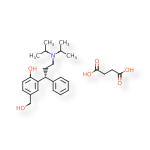

| Related Record | Type | Details | ||
|---|---|---|---|---|
|
METABOLITE INACTIVE -> PARENT |
FECAL
|
||
|
PARENT -> METABOLITE ACTIVE | |||
|
METABOLITE INACTIVE -> PARENT |
PLASMA
|
||
|
METABOLITE INACTIVE -> PARENT |
PLASMA
|
||
|
METABOLITE INACTIVE -> PARENT |
URINE
|
||
|
METABOLITE INACTIVE -> PARENT |
FECAL
|
||
|
METABOLITE INACTIVE -> PARENT |
FECAL
|
||
|
METABOLITE INACTIVE -> PARENT |
URINE
|
||
|
METABOLITE INACTIVE -> PARENT |
PLASMA
|
||
|
METABOLITE INACTIVE -> PARENT |
URINE
|
||
|
PRODRUG -> METABOLITE ACTIVE |
MAJOR
URINE
|
||
|
PRODRUG -> METABOLITE ACTIVE |
Extensive hydrolysis by nonspecific esterases
MAJOR
PLASMA
|
||
|
PRODRUG -> METABOLITE ACTIVE |
FECAL
|
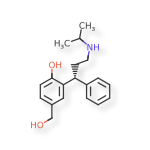
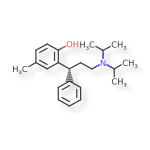
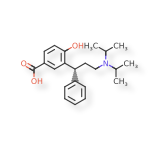
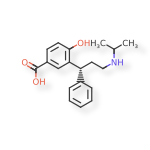
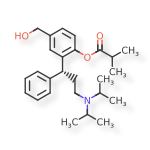
| Related Record | Type | Details | ||
|---|---|---|---|---|
|
ACTIVE MOIETY |
|
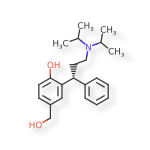
| Name | Property Type | Amount | Referenced Substance | Defining | Parameters | References |
|---|---|---|---|---|---|---|
| Biological Half-life | PHARMACOKINETIC |
|
INTRAVENOUS ADMINISTRATION |
|
||
| Tmax | PHARMACOKINETIC |
|
ORAL ADMINISTRATION |
|
||