


Details
| Stereochemistry | ACHIRAL |
| Molecular Formula | C14H20N2O3 |
| Molecular Weight | 264.3202 |
| Optical Activity | NONE |
| Defined Stereocenters | 0 / 0 |
| E/Z Centers | 0 |
| Charge | 0 |
SHOW SMILES / InChI
SMILES
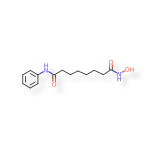
ONC(=O)CCCCCCC(=O)NC1=CC=CC=C1
InChI
InChIKey=WAEXFXRVDQXREF-UHFFFAOYSA-N
InChI=1S/C14H20N2O3/c17-13(15-12-8-4-3-5-9-12)10-6-1-2-7-11-14(18)16-19/h3-5,8-9,19H,1-2,6-7,10-11H2,(H,15,17)(H,16,18)
| Molecular Formula | C14H20N2O3 |
| Molecular Weight | 264.3202 |
| Charge | 0 |
| Count |
|
| Stereochemistry | ACHIRAL |
| Additional Stereochemistry | No |
| Defined Stereocenters | 0 / 0 |
| E/Z Centers | 0 |
| Optical Activity | NONE |
DescriptionSources: http://www.drugbank.ca/drugs/DB02546Curator's Comment: Description was created based on several sources, including
http://www.accessdata.fda.gov/drugsatfda_docs/label/2011/021991s002lbl.pdf
Sources: http://www.drugbank.ca/drugs/DB02546
Curator's Comment: Description was created based on several sources, including
http://www.accessdata.fda.gov/drugsatfda_docs/label/2011/021991s002lbl.pdf
Vorinostat (rINN) or suberoylanilide hydroxamic acid (SAHA), is a drug currently under investigation for the treatment of cutaneous T cell lymphoma (CTCL). Vorinostat inhibits the enzymatic activity of histone deacetylases HDAC1, HDAC2 and HDAC3 (Class I) and HDAC6 (Class II) at nanomolar concentrations (IC50< 86 nM). These enzymes catalyze the removal of acetyl groups from the lysine residues of histones proteins. In some cancer cells, there is an overexpression of HDACs, or an aberrant recruitment of HDACs to oncogenic transcription factors causing hypoacetylation of core nucleosomal histones. By inhibiting histone deacetylase, vorinostat causes the accumulation of acetylated histones and induces cell cycle arrest and/or apoptosis of some transformed cells. The mechanism of the antineoplastic effect of vorinostat has not been fully characterized. Vorinostat is used for the treatment of cutaneous manifestations in patients with cutaneous T-cell lymphoma who have progressive, persistent or recurrent disease on or following two systemic therapies. Vorinostat is marketed under the name Zolinza by Merck for the treatment of cutaneous manifestations in patients with cutaneous T cell lymphoma (CTCL) when the disease persists, gets worse, or comes back during or after two systemic therapies.
CNS Activity
Curator's Comment: Vorinostat was shown to cross the blood-brain barrier in a mouse model of Huntington's disease. It inhibited the growth of GL26 GBM cells implanted into the brains of mice. Vorinostat treatment induced accumulation of acetylated histones H2B, H3, and H4 in patients with recurrent GBM.
Approval Year
Targets
| Primary Target | Pharmacology | Condition | Potency |
|---|---|---|---|
Target ID: CHEMBL2366922 |
0.12 µM [IC50] | ||
Target ID: CHEMBL1075544 |
0.13 µM [IC50] | ||
Target ID: CHEMBL325 |
0.15 µM [IC50] | ||
Target ID: CHEMBL1937 |
0.28 µM [IC50] | ||
Target ID: CHEMBL3192 |
1.68 µM [IC50] | ||
Target ID: CHEMBL1829 |
57.0 nM [IC50] | ||
Target ID: CHEMBL1865 |
1.0 µM [EC50] |
Conditions
| Condition | Modality | Targets | Highest Phase | Product |
|---|---|---|---|---|
| Primary | Zolinza Approved UseTreatment of cutaneous manifestations in patients with cutaneous T cell lymphoma (CTCL) who have progressive, persistent or recurrent disease on or following two systemic therapies. Launch Date2006 |
Cmax
| Value | Dose | Co-administered | Analyte | Population |
|---|---|---|---|---|
0.83 uM Clinical Trial https://clinicaltrials.gov/ct2/show/NCT00771472 |
400 mg single, oral dose: 400 mg route of administration: oral experiment type: single co-administered: |
VORINOSTAT plasma | Homo sapiens population: unhealthy age: sex: food status: |
|
1.17 uM Clinical Trial https://clinicaltrials.gov/ct2/show/NCT00771472 |
400 mg 1 times / day steady, oral dose: 400 mg route of administration: oral experiment type: steady co-administered: |
VORINOSTAT plasma | Homo sapiens population: unhealthy age: sex: food status: |
|
1.2 μM |
400 mg single, oral dose: 400 mg route of administration: Oral experiment type: SINGLE co-administered: |
VORINOSTAT plasma | Homo sapiens population: UNHEALTHY age: ADULT sex: UNKNOWN food status: HIGH-FAT |
AUC
| Value | Dose | Co-administered | Analyte | Population |
|---|---|---|---|---|
4.59 uM*h Clinical Trial https://clinicaltrials.gov/ct2/show/NCT00771472 |
400 mg single, oral dose: 400 mg route of administration: oral experiment type: single co-administered: |
VORINOSTAT plasma | Homo sapiens population: unhealthy age: sex: food status: |
|
5.59 uM*h Clinical Trial https://clinicaltrials.gov/ct2/show/NCT00771472 |
400 mg 1 times / day steady, oral dose: 400 mg route of administration: oral experiment type: steady co-administered: |
VORINOSTAT plasma | Homo sapiens population: unhealthy age: sex: food status: |
|
5.5 μM × h |
400 mg single, oral dose: 400 mg route of administration: Oral experiment type: SINGLE co-administered: |
VORINOSTAT plasma | Homo sapiens population: UNHEALTHY age: ADULT sex: UNKNOWN food status: HIGH-FAT |
T1/2
| Value | Dose | Co-administered | Analyte | Population |
|---|---|---|---|---|
1.94 h Clinical Trial https://clinicaltrials.gov/ct2/show/NCT00771472 |
400 mg single, oral dose: 400 mg route of administration: oral experiment type: single co-administered: |
VORINOSTAT plasma | Homo sapiens population: unhealthy age: sex: food status: |
|
2.3 h Clinical Trial https://clinicaltrials.gov/ct2/show/NCT00771472 |
400 mg 1 times / day steady, oral dose: 400 mg route of administration: oral experiment type: steady co-administered: |
VORINOSTAT plasma | Homo sapiens population: unhealthy age: sex: food status: |
|
2 h |
400 mg single, oral dose: 400 mg route of administration: Oral experiment type: SINGLE co-administered: |
VORINOSTAT plasma | Homo sapiens population: UNHEALTHY age: ADULT sex: UNKNOWN food status: HIGH-FAT |
Funbound
| Value | Dose | Co-administered | Analyte | Population |
|---|---|---|---|---|
29% |
400 mg single, oral dose: 400 mg route of administration: Oral experiment type: SINGLE co-administered: |
VORINOSTAT plasma | Homo sapiens population: UNHEALTHY age: ADULT sex: UNKNOWN food status: HIGH-FAT |
Doses
| Dose | Population | Adverse events |
|---|---|---|
250 mg 2 times / day multiple, oral Dose: 250 mg, 2 times / day Route: oral Route: multiple Dose: 250 mg, 2 times / day Sources: |
unhealthy, 63 years (range: 38 - 74 years) Health Status: unhealthy Age Group: 63 years (range: 38 - 74 years) Sources: |
DLT: Fatigue... Dose limiting toxicities: Fatigue (grade 3, 1 patient) Sources: |
300 mg 2 times / day multiple, oral Highest studied dose Dose: 300 mg, 2 times / day Route: oral Route: multiple Dose: 300 mg, 2 times / day Sources: |
unhealthy, 69 years (range: 26.0 - 80.0 years) Health Status: unhealthy Age Group: 69 years (range: 26.0 - 80.0 years) Sex: M+F Sources: |
Disc. AE: Thrombocytopenia, Anemia... Other AEs: Hypotension, Sepsis... AEs leading to discontinuation/dose reduction: Thrombocytopenia (grade 3-4, 8%) Other AEs:Anemia (grade 3-4, 17%) Deep vein thrombosis (grade 3-4, 25%) Pyrexia (grade 3-4, 25%) Pulmonary embolism (grade 3-4, 17%) Hypotension (grade 3-4, 17%) Sources: Sepsis (grade 3-4, 8%) Fatigue (all grades, 27%) Diarrhea (11%) Nausea (8%) Dysgeusia (11%) Weight loss (3%) Vomiting (11%) Anorexia (3%) Blood creatinine increased (8%) Dehydration (5%) Anemia (5%) |
AEs
| AE | Significance | Dose | Population |
|---|---|---|---|
| Fatigue | grade 3, 1 patient DLT, Disc. AE |
250 mg 2 times / day multiple, oral Dose: 250 mg, 2 times / day Route: oral Route: multiple Dose: 250 mg, 2 times / day Sources: |
unhealthy, 63 years (range: 38 - 74 years) Health Status: unhealthy Age Group: 63 years (range: 38 - 74 years) Sources: |
| Diarrhea | 11% | 300 mg 2 times / day multiple, oral Highest studied dose Dose: 300 mg, 2 times / day Route: oral Route: multiple Dose: 300 mg, 2 times / day Sources: |
unhealthy, 69 years (range: 26.0 - 80.0 years) Health Status: unhealthy Age Group: 69 years (range: 26.0 - 80.0 years) Sex: M+F Sources: |
| Dysgeusia | 11% | 300 mg 2 times / day multiple, oral Highest studied dose Dose: 300 mg, 2 times / day Route: oral Route: multiple Dose: 300 mg, 2 times / day Sources: |
unhealthy, 69 years (range: 26.0 - 80.0 years) Health Status: unhealthy Age Group: 69 years (range: 26.0 - 80.0 years) Sex: M+F Sources: |
| Vomiting | 11% | 300 mg 2 times / day multiple, oral Highest studied dose Dose: 300 mg, 2 times / day Route: oral Route: multiple Dose: 300 mg, 2 times / day Sources: |
unhealthy, 69 years (range: 26.0 - 80.0 years) Health Status: unhealthy Age Group: 69 years (range: 26.0 - 80.0 years) Sex: M+F Sources: |
| Anorexia | 3% | 300 mg 2 times / day multiple, oral Highest studied dose Dose: 300 mg, 2 times / day Route: oral Route: multiple Dose: 300 mg, 2 times / day Sources: |
unhealthy, 69 years (range: 26.0 - 80.0 years) Health Status: unhealthy Age Group: 69 years (range: 26.0 - 80.0 years) Sex: M+F Sources: |
| Weight loss | 3% | 300 mg 2 times / day multiple, oral Highest studied dose Dose: 300 mg, 2 times / day Route: oral Route: multiple Dose: 300 mg, 2 times / day Sources: |
unhealthy, 69 years (range: 26.0 - 80.0 years) Health Status: unhealthy Age Group: 69 years (range: 26.0 - 80.0 years) Sex: M+F Sources: |
| Anemia | 5% | 300 mg 2 times / day multiple, oral Highest studied dose Dose: 300 mg, 2 times / day Route: oral Route: multiple Dose: 300 mg, 2 times / day Sources: |
unhealthy, 69 years (range: 26.0 - 80.0 years) Health Status: unhealthy Age Group: 69 years (range: 26.0 - 80.0 years) Sex: M+F Sources: |
| Dehydration | 5% | 300 mg 2 times / day multiple, oral Highest studied dose Dose: 300 mg, 2 times / day Route: oral Route: multiple Dose: 300 mg, 2 times / day Sources: |
unhealthy, 69 years (range: 26.0 - 80.0 years) Health Status: unhealthy Age Group: 69 years (range: 26.0 - 80.0 years) Sex: M+F Sources: |
| Blood creatinine increased | 8% | 300 mg 2 times / day multiple, oral Highest studied dose Dose: 300 mg, 2 times / day Route: oral Route: multiple Dose: 300 mg, 2 times / day Sources: |
unhealthy, 69 years (range: 26.0 - 80.0 years) Health Status: unhealthy Age Group: 69 years (range: 26.0 - 80.0 years) Sex: M+F Sources: |
| Nausea | 8% | 300 mg 2 times / day multiple, oral Highest studied dose Dose: 300 mg, 2 times / day Route: oral Route: multiple Dose: 300 mg, 2 times / day Sources: |
unhealthy, 69 years (range: 26.0 - 80.0 years) Health Status: unhealthy Age Group: 69 years (range: 26.0 - 80.0 years) Sex: M+F Sources: |
| Fatigue | all grades, 27% | 300 mg 2 times / day multiple, oral Highest studied dose Dose: 300 mg, 2 times / day Route: oral Route: multiple Dose: 300 mg, 2 times / day Sources: |
unhealthy, 69 years (range: 26.0 - 80.0 years) Health Status: unhealthy Age Group: 69 years (range: 26.0 - 80.0 years) Sex: M+F Sources: |
| Hypotension | grade 3-4, 17% | 300 mg 2 times / day multiple, oral Highest studied dose Dose: 300 mg, 2 times / day Route: oral Route: multiple Dose: 300 mg, 2 times / day Sources: |
unhealthy, 69 years (range: 26.0 - 80.0 years) Health Status: unhealthy Age Group: 69 years (range: 26.0 - 80.0 years) Sex: M+F Sources: |
| Anemia | grade 3-4, 17% Disc. AE |
300 mg 2 times / day multiple, oral Highest studied dose Dose: 300 mg, 2 times / day Route: oral Route: multiple Dose: 300 mg, 2 times / day Sources: |
unhealthy, 69 years (range: 26.0 - 80.0 years) Health Status: unhealthy Age Group: 69 years (range: 26.0 - 80.0 years) Sex: M+F Sources: |
| Pulmonary embolism | grade 3-4, 17% Disc. AE |
300 mg 2 times / day multiple, oral Highest studied dose Dose: 300 mg, 2 times / day Route: oral Route: multiple Dose: 300 mg, 2 times / day Sources: |
unhealthy, 69 years (range: 26.0 - 80.0 years) Health Status: unhealthy Age Group: 69 years (range: 26.0 - 80.0 years) Sex: M+F Sources: |
| Deep vein thrombosis | grade 3-4, 25% Disc. AE |
300 mg 2 times / day multiple, oral Highest studied dose Dose: 300 mg, 2 times / day Route: oral Route: multiple Dose: 300 mg, 2 times / day Sources: |
unhealthy, 69 years (range: 26.0 - 80.0 years) Health Status: unhealthy Age Group: 69 years (range: 26.0 - 80.0 years) Sex: M+F Sources: |
| Pyrexia | grade 3-4, 25% Disc. AE |
300 mg 2 times / day multiple, oral Highest studied dose Dose: 300 mg, 2 times / day Route: oral Route: multiple Dose: 300 mg, 2 times / day Sources: |
unhealthy, 69 years (range: 26.0 - 80.0 years) Health Status: unhealthy Age Group: 69 years (range: 26.0 - 80.0 years) Sex: M+F Sources: |
| Sepsis | grade 3-4, 8% | 300 mg 2 times / day multiple, oral Highest studied dose Dose: 300 mg, 2 times / day Route: oral Route: multiple Dose: 300 mg, 2 times / day Sources: |
unhealthy, 69 years (range: 26.0 - 80.0 years) Health Status: unhealthy Age Group: 69 years (range: 26.0 - 80.0 years) Sex: M+F Sources: |
| Thrombocytopenia | grade 3-4, 8% Disc. AE |
300 mg 2 times / day multiple, oral Highest studied dose Dose: 300 mg, 2 times / day Route: oral Route: multiple Dose: 300 mg, 2 times / day Sources: |
unhealthy, 69 years (range: 26.0 - 80.0 years) Health Status: unhealthy Age Group: 69 years (range: 26.0 - 80.0 years) Sex: M+F Sources: |
Overview
| CYP3A4 | CYP2C9 | CYP2D6 | hERG |
|---|---|---|---|
OverviewOther
| Other Inhibitor | Other Substrate | Other Inducer |
|---|---|---|
Drug as perpetrator
| Target | Modality | Activity | Metabolite | Clinical evidence |
|---|---|---|---|---|
| inconclusive | no (co-administration study) Comment: vorinostat has no inhibitory effect on the tranport of vinblastine Page: 4, 6, 27 |
|||
| no [IC50 79.8 uM] | ||||
| no [IC50 >100 uM] | ||||
| no [IC50 >100 uM] | ||||
| no [IC50 >100 uM] | ||||
| no [IC50 >100 uM] | ||||
| no [IC50 >100 uM] | ||||
| no [IC50 >100 uM] | ||||
| no | ||||
| yes | ||||
| yes | ||||
| yes | ||||
| yes | ||||
| yes | ||||
| yes |
Drug as victim
| Target | Modality | Activity | Metabolite | Clinical evidence |
|---|---|---|---|---|
| inconclusive | ||||
| no | ||||
| yes | ||||
| yes | ||||
| yes | ||||
| yes | ||||
| yes | ||||
| yes | ||||
| yes |
Tox targets
| Target | Modality | Activity | Metabolite | Clinical evidence |
|---|---|---|---|---|
PubMed
| Title | Date | PubMed |
|---|---|---|
| SAHA-sensitized prostate cancer cells to TNFalpha-related apoptosis-inducing ligand (TRAIL): mechanisms leading to synergistic apoptosis. | 2006-07-01 |
|
| Carbonyl- and sulfur-containing analogs of suberoylanilide hydroxamic acid: Potent inhibition of histone deacetylases. | 2006-05-15 |
|
| Loss of interleukin-2-dependency in HTLV-I-infected T cells on gene silencing of thioredoxin-binding protein-2. | 2006-04-06 |
|
| Suberoylanilide hydroxamic acid potentiates apoptosis, inhibits invasion, and abolishes osteoclastogenesis by suppressing nuclear factor-kappaB activation. | 2006-03-03 |
|
| Histone deacetylase inhibitors induce cell death and enhance the susceptibility to ionizing radiation, etoposide, and TRAIL in medulloblastoma cells. | 2006-03 |
|
| Clinical experience with intravenous and oral formulations of the novel histone deacetylase inhibitor suberoylanilide hydroxamic acid in patients with advanced hematologic malignancies. | 2006-01-01 |
|
| Histone deacetylase inhibitors reduce VEGF production and induce growth suppression and apoptosis in human mantle cell lymphoma. | 2006-01 |
|
| SAHA, a HDAC inhibitor, has profound anti-growth activity against non-small cell lung cancer cells. | 2006-01 |
|
| 5-Aza-2'-deoxycytidine (decitabine) can relieve p21WAF1 repression in human acute myeloid leukemia by a mechanism involving release of histone deacetylase 1 (HDAC1) without requiring p21WAF1 promoter demethylation. | 2006-01 |
|
| Histone deacetylase inhibitors induce differentiation of human endometrial adenocarcinoma cells through up-regulation of glycodelin. | 2005-12 |
|
| Crystal structure of a bacterial class 2 histone deacetylase homologue. | 2005-11-18 |
|
| Suberoylanilide hydroxamic acid enhances gap junctional intercellular communication via acetylation of histone containing connexin 43 gene locus. | 2005-11-01 |
|
| Selective induction of apoptosis by histone deacetylase inhibitor SAHA in cutaneous T-cell lymphoma cells: relevance to mechanism of therapeutic action. | 2005-11 |
|
| Histone deacetylases in acute myeloid leukaemia show a distinctive pattern of expression that changes selectively in response to deacetylase inhibitors. | 2005-10 |
|
| Histone deacetylase inhibitors suppress the induction of c-Jun and its target genes including COX-2. | 2005-09-23 |
|
| Activity of suberoylanilide hydroxamic Acid against human breast cancer cells with amplification of her-2. | 2005-09-01 |
|
| Induction of polyploidy by histone deacetylase inhibitor: a pathway for antitumor effects. | 2005-09-01 |
|
| Early clinical data and potential clinical utility of novel histone deacetylase inhibitors in prostate cancer. | 2005-09 |
|
| Synergistic interactions between MEK1/2 and histone deacetylase inhibitors in BCR/ABL+ human leukemia cells. | 2005-09 |
|
| It's about time: scheduling alters effect of histone deacetylase inhibitors on camptothecin-treated cells. | 2005-08-01 |
|
| Suberoylanilide hydroxamic acid combined with gemcitabine enhances apoptosis in non-small cell lung cancer. | 2005-08 |
|
| Synergistic apoptosis induction by proteasome and histone deacetylase inhibitors is dependent on protein synthesis. | 2005-08 |
|
| Histone deacetylase inhibitors induced caspase-independent apoptosis in human pancreatic adenocarcinoma cell lines. | 2005-08 |
|
| A new simple and high-yield synthesis of suberoylanilide hydroxamic acid and its inhibitory effect alone or in combination with retinoids on proliferation of human prostate cancer cells. | 2005-07-28 |
|
| Design and synthesis of non-hydroxamate histone deacetylase inhibitors: identification of a selective histone acetylating agent. | 2005-07-01 |
|
| Interactive effects of HDAC inhibitors and TRAIL on apoptosis are associated with changes in mitochondrial functions and expressions of cell cycle regulatory genes in multiple myeloma. | 2005-07 |
|
| Blockade of histone deacetylase inhibitor-induced RelA/p65 acetylation and NF-kappaB activation potentiates apoptosis in leukemia cells through a process mediated by oxidative damage, XIAP downregulation, and c-Jun N-terminal kinase 1 activation. | 2005-07 |
|
| Effect of inhibitors of histone deacetylase on the induction of cell differentiation in murine and human erythroleukemia cell lines. | 2005-07 |
|
| Phase I study of an oral histone deacetylase inhibitor, suberoylanilide hydroxamic acid, in patients with advanced cancer. | 2005-06-10 |
|
| The histone-deacetylase inhibitor SAHA potentiates proapoptotic effects of 5-fluorouracil and irinotecan in hepatoma cells. | 2005-06 |
|
| Novel histone deacetylase inhibitors in the treatment of thyroid cancer. | 2005-05-15 |
|
| Modulation of radiation response by histone deacetylase inhibition. | 2005-05-01 |
|
| The role of histone acetylation in SMN gene expression. | 2005-05-01 |
|
| Suberoylanilide hydroxamic acid (SAHA) has potent anti-glioma properties in vitro, ex vivo and in vivo. | 2005-05 |
|
| Histone deacetylase inhibitors in programmed cell death and cancer therapy. | 2005-04 |
|
| Cotreatment with suberanoylanilide hydroxamic acid and 17-allylamino 17-demethoxygeldanamycin synergistically induces apoptosis in Bcr-Abl+ Cells sensitive and resistant to STI571 (imatinib mesylate) in association with down-regulation of Bcr-Abl, abrogation of signal transducer and activator of transcription 5 activity, and Bax conformational change. | 2005-04 |
|
| Coadministration of histone deacetylase inhibitors and perifosine synergistically induces apoptosis in human leukemia cells through Akt and ERK1/2 inactivation and the generation of ceramide and reactive oxygen species. | 2005-03-15 |
|
| [Histone deacetylase inhibitors as a new generation of anti-cancer agents]. | 2005-03-11 |
|
| Effects of suberoylanilide hydroxamic acid and trichostatin A on induction of cytochrome P450 enzymes and benzo[a]pyrene DNA adduct formation in human cells. | 2005-03-01 |
|
| Drug insight: Histone deacetylase inhibitors--development of the new targeted anticancer agent suberoylanilide hydroxamic acid. | 2005-03 |
|
| 4-Hydroxybenzoyl derivative from the aqueous extract of the hydroid Campanularia sp. | 2005-03 |
|
| Histone deacetylase inhibitors interact synergistically with tumor necrosis factor-related apoptosis-inducing ligand (TRAIL) to induce apoptosis in carcinoma cell lines. | 2005-03 |
|
| Novel inhibitors of human histone deacetylases: design, synthesis, enzyme inhibition, and cancer cell growth inhibition of SAHA-based non-hydroxamates. | 2005-02-24 |
|
| Identification of a potent non-hydroxamate histone deacetylase inhibitor by mechanism-based drug design. | 2005-01-17 |
|
| Histone deacetylase inhibitors profoundly decrease proliferation of human lymphoid cancer cell lines. | 2005-01 |
|
| The histone deacetylase inhibitor suberoylanilide hydroxamic acid down-regulates expression levels of Bcr-abl, c-Myc and HDAC3 in chronic myeloid leukemia cell lines. | 2005-01 |
|
| High turbulence liquid chromatography online extraction and tandem mass spectrometry for the simultaneous determination of suberoylanilide hydroxamic acid and its two metabolites in human serum. | 2005 |
|
| The histone deacetylase inhibitor suberoylanilide hydroxamic acid induces apoptosis via induction of 15-lipoxygenase-1 in colorectal cancer cells. | 2004-12-01 |
|
| Histone deacetylase inhibitors up-regulate the expression of tight junction proteins. | 2004-12 |
|
| Proteasome inhibition sensitizes non-small cell lung cancer to histone deacetylase inhibitor-induced apoptosis through the generation of reactive oxygen species. | 2004-11 |
Patents
Sample Use Guides
400 mg orally once daily with food.
If patient is intolerant to therapy, the dose may be reduced to
300 mg orally once daily with food. If necessary, the dose may be
further reduced to 300 mg once daily with food for 5 consecutive
days each week.
Route of Administration:
Oral
| Substance Class |
Chemical
Created
by
admin
on
Edited
Wed Apr 02 06:51:50 GMT 2025
by
admin
on
Wed Apr 02 06:51:50 GMT 2025
|
| Record UNII |
58IFB293JI
|
| Record Status |
Validated (UNII)
|
| Record Version |
|
-
Download
| Name | Type | Language | ||
|---|---|---|---|---|
|
Preferred Name | English | ||
|
Official Name | English | ||
|
Common Name | English | ||
|
Code | English | ||
|
Common Name | English | ||
|
Code | English | ||
|
Code | English | ||
|
Brand Name | English | ||
|
Code | English | ||
|
Common Name | English | ||
|
Code | English | ||
|
Common Name | English | ||
|
Systematic Name | English | ||
|
Common Name | English | ||
|
Common Name | English | ||
|
Common Name | English | ||
|
Common Name | English | ||
|
Common Name | English |
| Classification Tree | Code System | Code | ||
|---|---|---|---|---|
|
FDA ORPHAN DRUG |
177203
Created by
admin on Wed Apr 02 06:51:50 GMT 2025 , Edited by admin on Wed Apr 02 06:51:50 GMT 2025
|
||
|
WHO-VATC |
QL01XX38
Created by
admin on Wed Apr 02 06:51:50 GMT 2025 , Edited by admin on Wed Apr 02 06:51:50 GMT 2025
|
||
|
EU-Orphan Drug |
EU/3/11/854
Created by
admin on Wed Apr 02 06:51:50 GMT 2025 , Edited by admin on Wed Apr 02 06:51:50 GMT 2025
|
||
|
LIVERTOX |
NBK548004
Created by
admin on Wed Apr 02 06:51:50 GMT 2025 , Edited by admin on Wed Apr 02 06:51:50 GMT 2025
|
||
|
NCI_THESAURUS |
C1946
Created by
admin on Wed Apr 02 06:51:50 GMT 2025 , Edited by admin on Wed Apr 02 06:51:50 GMT 2025
|
||
|
NDF-RT |
N0000175588
Created by
admin on Wed Apr 02 06:51:50 GMT 2025 , Edited by admin on Wed Apr 02 06:51:50 GMT 2025
|
||
|
FDA ORPHAN DRUG |
540116
Created by
admin on Wed Apr 02 06:51:50 GMT 2025 , Edited by admin on Wed Apr 02 06:51:50 GMT 2025
|
||
|
WHO-ATC |
L01XX38
Created by
admin on Wed Apr 02 06:51:50 GMT 2025 , Edited by admin on Wed Apr 02 06:51:50 GMT 2025
|
||
|
NDF-RT |
N0000175071
Created by
admin on Wed Apr 02 06:51:50 GMT 2025 , Edited by admin on Wed Apr 02 06:51:50 GMT 2025
|
||
|
FDA ORPHAN DRUG |
174203
Created by
admin on Wed Apr 02 06:51:50 GMT 2025 , Edited by admin on Wed Apr 02 06:51:50 GMT 2025
|
||
|
FDA ORPHAN DRUG |
169503
Created by
admin on Wed Apr 02 06:51:50 GMT 2025 , Edited by admin on Wed Apr 02 06:51:50 GMT 2025
|
| Code System | Code | Type | Description | ||
|---|---|---|---|---|---|
|
CHEMBL98
Created by
admin on Wed Apr 02 06:51:50 GMT 2025 , Edited by admin on Wed Apr 02 06:51:50 GMT 2025
|
PRIMARY | |||
|
100000088823
Created by
admin on Wed Apr 02 06:51:50 GMT 2025 , Edited by admin on Wed Apr 02 06:51:50 GMT 2025
|
PRIMARY | |||
|
4124
Created by
admin on Wed Apr 02 06:51:50 GMT 2025 , Edited by admin on Wed Apr 02 06:51:50 GMT 2025
|
PRIMARY | |||
|
149647-78-9
Created by
admin on Wed Apr 02 06:51:50 GMT 2025 , Edited by admin on Wed Apr 02 06:51:50 GMT 2025
|
PRIMARY | |||
|
m11502
Created by
admin on Wed Apr 02 06:51:50 GMT 2025 , Edited by admin on Wed Apr 02 06:51:50 GMT 2025
|
PRIMARY | Merck Index | ||
|
7930
Created by
admin on Wed Apr 02 06:51:50 GMT 2025 , Edited by admin on Wed Apr 02 06:51:50 GMT 2025
|
PRIMARY | |||
|
5311
Created by
admin on Wed Apr 02 06:51:50 GMT 2025 , Edited by admin on Wed Apr 02 06:51:50 GMT 2025
|
PRIMARY | |||
|
194337
Created by
admin on Wed Apr 02 06:51:50 GMT 2025 , Edited by admin on Wed Apr 02 06:51:50 GMT 2025
|
PRIMARY | RxNorm | ||
|
759852
Created by
admin on Wed Apr 02 06:51:50 GMT 2025 , Edited by admin on Wed Apr 02 06:51:50 GMT 2025
|
PRIMARY | |||
|
58IFB293JI
Created by
admin on Wed Apr 02 06:51:50 GMT 2025 , Edited by admin on Wed Apr 02 06:51:50 GMT 2025
|
PRIMARY | |||
|
58IFB293JI
Created by
admin on Wed Apr 02 06:51:50 GMT 2025 , Edited by admin on Wed Apr 02 06:51:50 GMT 2025
|
PRIMARY | |||
|
C111237
Created by
admin on Wed Apr 02 06:51:50 GMT 2025 , Edited by admin on Wed Apr 02 06:51:50 GMT 2025
|
PRIMARY | |||
|
8661
Created by
admin on Wed Apr 02 06:51:50 GMT 2025 , Edited by admin on Wed Apr 02 06:51:50 GMT 2025
|
PRIMARY | |||
|
C1796
Created by
admin on Wed Apr 02 06:51:50 GMT 2025 , Edited by admin on Wed Apr 02 06:51:50 GMT 2025
|
PRIMARY | |||
|
45716
Created by
admin on Wed Apr 02 06:51:50 GMT 2025 , Edited by admin on Wed Apr 02 06:51:50 GMT 2025
|
PRIMARY | |||
|
6852
Created by
admin on Wed Apr 02 06:51:50 GMT 2025 , Edited by admin on Wed Apr 02 06:51:50 GMT 2025
|
PRIMARY | |||
|
701852
Created by
admin on Wed Apr 02 06:51:50 GMT 2025 , Edited by admin on Wed Apr 02 06:51:50 GMT 2025
|
PRIMARY | |||
|
748799
Created by
admin on Wed Apr 02 06:51:50 GMT 2025 , Edited by admin on Wed Apr 02 06:51:50 GMT 2025
|
PRIMARY | |||
|
VORINOSTAT
Created by
admin on Wed Apr 02 06:51:50 GMT 2025 , Edited by admin on Wed Apr 02 06:51:50 GMT 2025
|
PRIMARY | |||
|
RR-09
Created by
admin on Wed Apr 02 06:51:50 GMT 2025 , Edited by admin on Wed Apr 02 06:51:50 GMT 2025
|
PRIMARY | |||
|
DTXSID6041133
Created by
admin on Wed Apr 02 06:51:50 GMT 2025 , Edited by admin on Wed Apr 02 06:51:50 GMT 2025
|
PRIMARY | |||
|
SUB23356
Created by
admin on Wed Apr 02 06:51:50 GMT 2025 , Edited by admin on Wed Apr 02 06:51:50 GMT 2025
|
PRIMARY | |||
|
DB02546
Created by
admin on Wed Apr 02 06:51:50 GMT 2025 , Edited by admin on Wed Apr 02 06:51:50 GMT 2025
|
PRIMARY |
| Related Record | Type | Details | ||
|---|---|---|---|---|
|
TARGET -> INHIBITOR |
BINDING
IC50
|
||
|
TARGET -> INHIBITOR |
BINDING
IC50
|
||
|
METABOLIC ENZYME -> SUBSTRATE |
|
||
|
TARGET -> INHIBITOR |
Enzymatic Inhibition
IC50
|
||
|
EXCRETED UNCHANGED |
AMOUNT EXCRETED
URINE
|
||
|
TARGET -> INHIBITOR |
BINDING
IC50
|
||
|
TARGET->WEAK INHIBITOR |
BINDING
IC50
|
||
|
METABOLIC ENZYME -> SUBSTRATE |
|
||
|
TARGET -> INHIBITOR |
Enzymatic Inhibition
IC50
|
||
|
TARGET->WEAK INHIBITOR |
BINDING
IC50
|
||
|
TARGET -> INHIBITOR |
Enzymatic Inhibition
IC50
|
||
|
METABOLIC ENZYME -> SUBSTRATE |
|
||
|
METABOLIC ENZYME -> SUBSTRATE |
|
||
|
TARGET -> INHIBITOR |
Enzymatic Inhibition
IC50
|
||
|
TARGET -> INHIBITOR |
Enzymatic Inhibition
IC50
|
||
|
METABOLIC ENZYME -> SUBSTRATE |
|
||
|
TARGET -> INHIBITOR |
Enzymatic Inhibition
IC50
|
||
|
BINDER->LIGAND |
BINDING
|
||
|
TARGET ORGANISM->INHIBITOR |
|
||
|
METABOLIC ENZYME -> SUBSTRATE |
|
||
|
TARGET -> INHIBITOR |
BINDING
IC50
|
||
|
METABOLIC ENZYME -> SUBSTRATE |
|
||
|
TARGET -> INHIBITOR |
Enzymatic Inhibition
IC50
|



| Related Record | Type | Details | ||
|---|---|---|---|---|
|
METABOLITE -> PARENT |
|
||
|
METABOLITE -> PARENT |
|
||
|
METABOLITE -> PARENT |
|
||
|
METABOLITE -> PARENT |
|
||
|
METABOLITE -> PARENT |
|
||
|
METABOLITE INACTIVE -> PARENT |
PLASMA
|
||
|
METABOLITE -> PARENT |
|
||
|
METABOLITE INACTIVE -> PARENT |
MAJOR
URINE
|
||
|
METABOLITE -> PARENT |
|
||
|
METABOLITE INACTIVE -> PARENT |
URINE
|
||
|
METABOLITE -> PARENT |
|
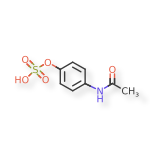
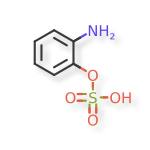
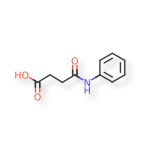
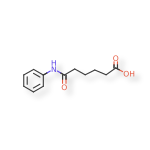
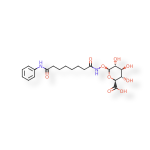
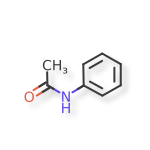
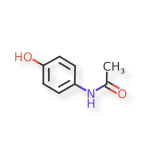
| Related Record | Type | Details | ||
|---|---|---|---|---|
|
|
ACTIVE MOIETY |
|
| Name | Property Type | Amount | Referenced Substance | Defining | Parameters | References |
|---|---|---|---|---|---|---|
| blood-to-plasma ratio | PHARMACOKINETIC |
|
|
|||
| Tmax | PHARMACOKINETIC |
|
FED CONDITION |
|
||
| Volume of Distribution | PHARMACOKINETIC |
|
INTRAVENOUS ADMINISTRATION |
|
||
| Biological Half-life | PHARMACOKINETIC |
|
|
|||
| Tmax | PHARMACOKINETIC |
|
ORAL ADMINISTRATION |
|
||