


Details
| Stereochemistry | ABSOLUTE |
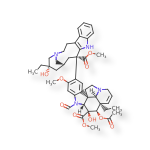
| Molecular Formula | C46H56N4O10 |
| Molecular Weight | 824.9576 |
| Optical Activity | UNSPECIFIED |
| Defined Stereocenters | 9 / 9 |
| E/Z Centers | 0 |
| Charge | 0 |
SHOW SMILES / InChI
SMILES
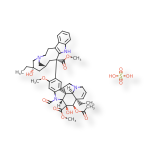
CC[C@]1(O)C[C@@H]2CN(C1)CCC3=C(NC4=C3C=CC=C4)[C@@](C2)(C(=O)OC)C5=C(OC)C=C6N(C=O)[C@@H]7[C@]8(CCN9CC=C[C@](CC)([C@@H]89)[C@@H](OC(C)=O)[C@]7(O)C(=O)OC)C6=C5
InChI
InChIKey=OGWKCGZFUXNPDA-CFWMRBGOSA-N
InChI=1S/C46H56N4O10/c1-7-42(55)22-28-23-45(40(53)58-5,36-30(14-18-48(24-28)25-42)29-12-9-10-13-33(29)47-36)32-20-31-34(21-35(32)57-4)50(26-51)38-44(31)16-19-49-17-11-15-43(8-2,37(44)49)39(60-27(3)52)46(38,56)41(54)59-6/h9-13,15,20-21,26,28,37-39,47,55-56H,7-8,14,16-19,22-25H2,1-6H3/t28-,37-,38+,39+,42-,43+,44+,45-,46-/m0/s1
| Molecular Formula | C46H56N4O10 |
| Molecular Weight | 824.9576 |
| Charge | 0 |
| Count |
|
| Stereochemistry | ABSOLUTE |
| Additional Stereochemistry | No |
| Defined Stereocenters | 9 / 9 |
| E/Z Centers | 0 |
| Optical Activity | UNSPECIFIED |
DescriptionSources: http://www.drugbank.ca/drugs/DB00541Curator's Comment: Description was created based on several sources, including
https://www.drugs.com/pro/vincristine.html
Sources: http://www.drugbank.ca/drugs/DB00541
Curator's Comment: Description was created based on several sources, including
https://www.drugs.com/pro/vincristine.html
Vincristine is a vinca alkaloid antineoplastic agent used as a treatment for various cancers including breast cancer, Hodgkin's disease, Kaposi's sarcoma, and testicular cancer. The vinca alkaloids are structurally similar compounds comprised of 2 multiringed units, vindoline and catharanthine. The vinca alkaloids have become clinically useful since the discovery of their antitumour properties in 1959. Initially, extracts of the periwinkle plant (Catharanthus roseus) were investigated because of putative hypoglycemic properties, but were noted to cause marrow suppression in rats and antileukemic effects in vitro. Vincristine binds to the microtubular proteins of the mitotic spindle, leading to crystallization of the microtubule and mitotic arrest or cell death. Vincristine has some immunosuppressant effect. The vinca alkaloids are considered to be cell cycle phase-specific. The antitumor activity of Vincristine is thought to be due primarily to inhibition of mitosis at metaphase through its interaction with tubulin. Like other vinca alkaloids, Vincristine may also interfere with: 1) amino acid, cyclic AMP, and glutathione metabolism, 2) calmodulin-dependent Ca2+-transport ATPase activity, 3) cellular respiration, and 4) nucleic acid and lipid biosynthesis.Vincristine was marketed under the brand name Oncovin, but was discontinued. In 2012 the FDA approved a Liposomal formulation of Vincristine, named MARQIBO KIT.
CNS Activity
Approval Year
Targets
| Primary Target | Pharmacology | Condition | Potency |
|---|---|---|---|
Target ID: GO:0006927 |
|||
Target ID: P07437 Gene ID: 203068.0 Gene Symbol: TUBB Target Organism: Homo sapiens (Human) Sources: http://www.drugbank.ca/drugs/DB00541 |
|||
Target ID: GO:0046785 |
1.6 µM [IC50] | ||
Target ID: CHEMBL382 |
0.17 nM [IC50] |
Conditions
| Condition | Modality | Targets | Highest Phase | Product |
|---|---|---|---|---|
| Primary | Marqibo Approved UseMarqibo® is indicated for the treatment of adult patients with Philadelphia chromosome-negative (Ph-) acute
lymphoblastic leukemia (ALL) in second or greater relapse or whose disease has progressed following two or
more anti-leukemia therapies. Launch Date2012 |
Cmax
| Value | Dose | Co-administered | Analyte | Population |
|---|---|---|---|---|
1220 ng/mL |
2.25 mg/m² steady-state, intravenous dose: 2.25 mg/m² route of administration: Intravenous experiment type: STEADY-STATE co-administered: |
VINCRISTINE plasma | Homo sapiens population: UNHEALTHY age: ADULT sex: UNKNOWN food status: UNKNOWN |
AUC
| Value | Dose | Co-administered | Analyte | Population |
|---|---|---|---|---|
14566 ng × h/mL |
2.25 mg/m² steady-state, intravenous dose: 2.25 mg/m² route of administration: Intravenous experiment type: STEADY-STATE co-administered: |
VINCRISTINE plasma | Homo sapiens population: UNHEALTHY age: ADULT sex: UNKNOWN food status: UNKNOWN |
Funbound
| Value | Dose | Co-administered | Analyte | Population |
|---|---|---|---|---|
25% |
VINCRISTINE plasma | Homo sapiens population: UNKNOWN age: UNKNOWN sex: UNKNOWN food status: UNKNOWN |
Doses
| Dose | Population | Adverse events |
|---|---|---|
2.25 mg/m2 1 times / week multiple, intravenous MTD Dose: 2.25 mg/m2, 1 times / week Route: intravenous Route: multiple Dose: 2.25 mg/m2, 1 times / week Sources: |
unhealthy, 19-62 |
|
2.4 mg/m2 1 times / week multiple, intravenous Studied dose Dose: 2.4 mg/m2, 1 times / week Route: intravenous Route: multiple Dose: 2.4 mg/m2, 1 times / week Sources: |
unhealthy, 19-62 |
DLT: Motor polyneuropathy, Seizure... Dose limiting toxicities: Motor polyneuropathy (grade 3, 14.3%) Sources: Seizure (grade 4, 14.3%) Hepatotoxicity (grade 4, 14.3%) |
2.8 mg/m2 3 times / week multiple, intravenous Highest studied dose Dose: 2.8 mg/m2, 3 times / week Route: intravenous Route: multiple Dose: 2.8 mg/m2, 3 times / week Sources: |
unhealthy, 32-83 |
DLT: Neutropenia, Thrombocytopenia... Dose limiting toxicities: Neutropenia (grade 4, 33.3%) Sources: Thrombocytopenia (grade 4, 33.3%) Obstipation Myalgia (grade 3, 33.3%) |
2.4 mg/m2 3 times / week multiple, intravenous MTD Dose: 2.4 mg/m2, 3 times / week Route: intravenous Route: multiple Dose: 2.4 mg/m2, 3 times / week Sources: |
unhealthy, 32-83 |
|
2.25 mg/m2 1 times / week multiple, intravenous Recommended Dose: 2.25 mg/m2, 1 times / week Route: intravenous Route: multiple Dose: 2.25 mg/m2, 1 times / week Sources: |
unhealthy Health Status: unhealthy Sources: |
Disc. AE: Peripheral neuropathy, Tumor lysis syndrome... AEs leading to discontinuation/dose reduction: Peripheral neuropathy (10%) Sources: Tumor lysis syndrome (2%) |
AEs
| AE | Significance | Dose | Population |
|---|---|---|---|
| Motor polyneuropathy | grade 3, 14.3% DLT |
2.4 mg/m2 1 times / week multiple, intravenous Studied dose Dose: 2.4 mg/m2, 1 times / week Route: intravenous Route: multiple Dose: 2.4 mg/m2, 1 times / week Sources: |
unhealthy, 19-62 |
| Hepatotoxicity | grade 4, 14.3% DLT |
2.4 mg/m2 1 times / week multiple, intravenous Studied dose Dose: 2.4 mg/m2, 1 times / week Route: intravenous Route: multiple Dose: 2.4 mg/m2, 1 times / week Sources: |
unhealthy, 19-62 |
| Seizure | grade 4, 14.3% DLT |
2.4 mg/m2 1 times / week multiple, intravenous Studied dose Dose: 2.4 mg/m2, 1 times / week Route: intravenous Route: multiple Dose: 2.4 mg/m2, 1 times / week Sources: |
unhealthy, 19-62 |
| Obstipation | DLT | 2.8 mg/m2 3 times / week multiple, intravenous Highest studied dose Dose: 2.8 mg/m2, 3 times / week Route: intravenous Route: multiple Dose: 2.8 mg/m2, 3 times / week Sources: |
unhealthy, 32-83 |
| Myalgia | grade 3, 33.3% DLT |
2.8 mg/m2 3 times / week multiple, intravenous Highest studied dose Dose: 2.8 mg/m2, 3 times / week Route: intravenous Route: multiple Dose: 2.8 mg/m2, 3 times / week Sources: |
unhealthy, 32-83 |
| Neutropenia | grade 4, 33.3% DLT |
2.8 mg/m2 3 times / week multiple, intravenous Highest studied dose Dose: 2.8 mg/m2, 3 times / week Route: intravenous Route: multiple Dose: 2.8 mg/m2, 3 times / week Sources: |
unhealthy, 32-83 |
| Thrombocytopenia | grade 4, 33.3% DLT |
2.8 mg/m2 3 times / week multiple, intravenous Highest studied dose Dose: 2.8 mg/m2, 3 times / week Route: intravenous Route: multiple Dose: 2.8 mg/m2, 3 times / week Sources: |
unhealthy, 32-83 |
| Peripheral neuropathy | 10% Disc. AE |
2.25 mg/m2 1 times / week multiple, intravenous Recommended Dose: 2.25 mg/m2, 1 times / week Route: intravenous Route: multiple Dose: 2.25 mg/m2, 1 times / week Sources: |
unhealthy Health Status: unhealthy Sources: |
| Tumor lysis syndrome | 2% Disc. AE |
2.25 mg/m2 1 times / week multiple, intravenous Recommended Dose: 2.25 mg/m2, 1 times / week Route: intravenous Route: multiple Dose: 2.25 mg/m2, 1 times / week Sources: |
unhealthy Health Status: unhealthy Sources: |
Overview
| CYP3A4 | CYP2C9 | CYP2D6 | hERG |
|---|---|---|---|
OverviewOther
| Other Inhibitor | Other Substrate | Other Inducer |
|---|---|---|
Drug as victim
| Target | Modality | Activity | Metabolite | Clinical evidence |
|---|---|---|---|---|
| likely | ||||
| likely | ||||
| yes | ||||
| yes | yes (co-administration study) Comment: the total area under the plasma concentration-time curve was 43% smaller in patients who were receiving carbamazepine or phenytoin than in the control group; the concomitant use of strong CYP3A inhibitors should be avoided (e.g., ketoconazole, itraconazole, voriconazole, posaconazole, clarithromycin, atazanavir, indinavir, nefazodone, nelfinavir, ritonavir, saquinavir, telithromycin). Similarly, the concomitant use of strong CYP3A inducers should be avoided (e.g., dexamethasone, phenytoin, carbamazepine, rifampin, rifabutin, rifapentine, phenobarbital, St. John’s Wort) Page: 31.0 |
Tox targets
| Target | Modality | Activity | Metabolite | Clinical evidence |
|---|---|---|---|---|
Page: 4.0 |
PubMed
| Title | Date | PubMed |
|---|---|---|
| Polymorphic variation in GSTP1 modulates outcome following therapy for multiple myeloma. | 2003-10-01 |
|
| Functional expression of the multidrug resistance protein 1 in microglia. | 2003-10 |
|
| Evidence for an antihyperalgesic effect of venlafaxine in vincristine-induced neuropathy in rat. | 2003-08-01 |
|
| [Anaphylaxia induced by etoposide--a case report]. | 2003-08 |
|
| Henoch-Schönlein IgA glomerulonephritis complicating myeloma kidneys: case report. | 2003-08 |
|
| Synergistic augmentation of antimicrotubule agent-induced cytotoxicity by a phosphoinositide 3-kinase inhibitor in human malignant glioma cells. | 2003-07-15 |
|
| Spinal sensitization mechanism in vincristine-induced hyperalgesia in mice. | 2003-06-05 |
|
| Bilateral hearing loss during vincristine therapy: a case report. | 2003-06 |
|
| Charcot-Marie-Tooth disease and vincristine. | 2003-05-21 |
|
| The egr-1 gene is induced by DNA-damaging agents and non-genotoxic drugs in both normal and neoplastic human cells. | 2003-05-16 |
|
| Functional and structural consequences of cysteine substitutions in the NH2 proximal region of the human multidrug resistance protein 1 (MRP1/ABCC1). | 2003-05-13 |
|
| Changes in sensory processing in the spinal dorsal horn accompany vincristine-induced hyperalgesia and allodynia. | 2003-05 |
|
| Leiomyosarcoma of urinary bladder following cyclophosphamide therapy: report of two cases. | 2003-05 |
|
| Enteropathy-associated T-cell lymphoma of the jejunum complicated with intestinal perforation. | 2003-04 |
|
| [Clinical analysis of 75 patients with nasopharyngeal non-Hodgkin's lymphoma]. | 2003-04 |
|
| Vincristine-induced neuropathy as the initial presentation of charcot-marie-tooth disease in acute lymphoblastic leukemia: a Pediatric Oncology Group study. | 2003-04 |
|
| Cloning and functional characterization of the multidrug resistance-associated protein (MRP1/ABCC1) from the cynomolgus monkey. | 2003-03 |
|
| Toxic neuropathy in patients with pre-existing neuropathy. | 2003-01-28 |
|
| NOVP chemotherapy for Hodgkin's disease transiently induces sperm aneuploidies associated with the major clinical aneuploidy syndromes involving chromosomes X, Y, 18, and 21. | 2003-01-01 |
|
| The effects of chemotherapeutic agents on the regulation of thrombin on cell surfaces. | 2003-01 |
|
| Vincristine neurotoxicity in the presence of hereditary neuropathy. | 2003-01 |
|
| A novel case of a CAT to AAT transversion in codon 179 of the p53 gene in a supratentorial primitive neuroectodermal tumor harbored by a young girl. Case report and review of the literature. | 2003 |
|
| Sexual dimorphism for protein kinase c epsilon signaling in a rat model of vincristine-induced painful peripheral neuropathy. | 2003 |
|
| Altered temporal pattern of evoked afferent activity in a rat model of vincristine-induced painful peripheral neuropathy. | 2003 |
|
| Posttransplantation lymphoproliferative disorder presenting as a unilateral leg mass 10 years after kidney transplantation. | 2002-12-15 |
|
| Evaluation of a 6-month chemotherapy protocol with no maintenance therapy for dogs with lymphoma. | 2002-12-06 |
|
| Epidemiology of Burkitt's lymphoma in Enugu, Nigeria. | 2002-12 |
|
| Identification and characterization of the canine multidrug resistance-associated protein. | 2002-12 |
|
| Treatment results of aggressive B non-Hodgkin's lymphoma in advanced age considering comorbidity. | 2002-12 |
|
| Hereditary neuropathy with liability to pressure palsies emerging during vincristine treatment. | 2002-11-12 |
|
| Vincristine-itraconazole interaction: cause for increasing concern. | 2002-10 |
|
| Pure red cell aplasia due to parvovirus following treatment with CHOP and rituximab for B-cell lymphoma. | 2002-10 |
|
| Gliomatosis cerebri: molecular pathology and clinical course. | 2002-10 |
|
| A case of treatment-related myelodysplastic syndrome and acute myelogenous leukemia following high-dose chemotherapy with autologous stem cell transplantation for non-Hodgkin's lymphoma. | 2002-08 |
|
| Reversible vincristine-related flaccid paralysis in a child with acute lymphoblastic leukemia. | 2002-08 |
|
| Functional analysis of MRP1 cloned from bovine. | 2002-06-19 |
|
| Hyponatremia and syndrome of inappropriate anti-diuretic hormone reported with the use of Vincristine: an over-representation of Asians? | 2002-06-08 |
|
| A prospective study of P-IMVP-16/CBDCA: a novel salvage chemotherapy for patients with aggressive non-Hodgkin's lymphoma who had previously received CHOP therapy as first-line chemotherapy. | 2002-06 |
|
| High-throughput measurement of the Tp53 response to anticancer drugs and random compounds using a stably integrated Tp53-responsive luciferase reporter. | 2002-06 |
|
| A phase II trial of combination chemotherapy and surgical resection for the treatment of metastatic adrenocortical carcinoma: continuous infusion doxorubicin, vincristine, and etoposide with daily mitotane as a P-glycoprotein antagonist. | 2002-05-01 |
|
| High-dose chemotherapy in poor-prognosis adult small round-cell tumors: clinical and molecular results from a prospective study. | 2002-04-15 |
|
| Massive cell death of cerebellar granule neurons accompanied with caspase-3-like protease activation and subsequent motor discoordination after intracerebroventricular injection of vincristine in mice. | 2002 |
|
| Effect of thiopental, propofol, and etomidate on vincristine toxicity in PC12 cells. | 2002 |
|
| Different peripheral mechanisms mediate enhanced nociception in metabolic/toxic and traumatic painful peripheral neuropathies in the rat. | 2002 |
|
| [An experimental study on the blood vessel sclerosing therapeutic agents for cavernous hemangiomas]. | 2001-08 |
|
| Experience with vincristine--associated neurotoxicity. | 2001-07 |
|
| Vincristine neurotoxicity. | 1992-03 |
|
| Combined intra-arterial and systemic chemotherapy for recurrent malignant brain tumors. | 1992-02 |
|
| Fatal myeloencephalopathy due to intrathecal vincristine administration. | 1992 |
|
| Vincristine-induced myocardial infarction. | 1975-12 |
Patents
Sample Use Guides
Marqibo is liposome-encapsulated vincristine.
2.25 mg/m2 intravenously over 1 hour once every 7 days.
Route of Administration:
Intravenous
| Substance Class |
Chemical
Created
by
admin
on
Edited
Mon Mar 31 17:34:32 GMT 2025
by
admin
on
Mon Mar 31 17:34:32 GMT 2025
|
| Record UNII |
5J49Q6B70F
|
| Record Status |
Validated (UNII)
|
| Record Version |
|
-
Download
| Name | Type | Language | ||
|---|---|---|---|---|
|
Preferred Name | English | ||
|
Official Name | English | ||
|
Common Name | English | ||
|
Common Name | English | ||
|
Common Name | English | ||
|
Common Name | English | ||
|
Brand Name | English | ||
|
Common Name | English | ||
|
Common Name | English | ||
|
Common Name | English | ||
|
Common Name | English | ||
|
Common Name | English | ||
|
Common Name | English | ||
|
Common Name | English | ||
|
Common Name | English | ||
|
Common Name | English |
| Classification Tree | Code System | Code | ||
|---|---|---|---|---|
|
WHO-VATC |
QL01CA02
Created by
admin on Mon Mar 31 17:34:32 GMT 2025 , Edited by admin on Mon Mar 31 17:34:32 GMT 2025
|
||
|
LIVERTOX |
1030
Created by
admin on Mon Mar 31 17:34:32 GMT 2025 , Edited by admin on Mon Mar 31 17:34:32 GMT 2025
|
||
|
NCI_THESAURUS |
C932
Created by
admin on Mon Mar 31 17:34:32 GMT 2025 , Edited by admin on Mon Mar 31 17:34:32 GMT 2025
|
||
|
WHO-ATC |
L01CA02
Created by
admin on Mon Mar 31 17:34:32 GMT 2025 , Edited by admin on Mon Mar 31 17:34:32 GMT 2025
|
||
|
WHO-ESSENTIAL MEDICINES LIST |
8.2
Created by
admin on Mon Mar 31 17:34:32 GMT 2025 , Edited by admin on Mon Mar 31 17:34:32 GMT 2025
|
||
|
NDF-RT |
N0000007780
Created by
admin on Mon Mar 31 17:34:32 GMT 2025 , Edited by admin on Mon Mar 31 17:34:32 GMT 2025
|
||
|
NDF-RT |
N0000007780
Created by
admin on Mon Mar 31 17:34:32 GMT 2025 , Edited by admin on Mon Mar 31 17:34:32 GMT 2025
|
||
|
NCI_THESAURUS |
C67422
Created by
admin on Mon Mar 31 17:34:32 GMT 2025 , Edited by admin on Mon Mar 31 17:34:32 GMT 2025
|
||
|
NDF-RT |
N0000175612
Created by
admin on Mon Mar 31 17:34:32 GMT 2025 , Edited by admin on Mon Mar 31 17:34:32 GMT 2025
|
| Code System | Code | Type | Description | ||
|---|---|---|---|---|---|
|
DB00541
Created by
admin on Mon Mar 31 17:34:32 GMT 2025 , Edited by admin on Mon Mar 31 17:34:32 GMT 2025
|
PRIMARY | |||
|
CHEMBL90555
Created by
admin on Mon Mar 31 17:34:32 GMT 2025 , Edited by admin on Mon Mar 31 17:34:32 GMT 2025
|
PRIMARY | |||
|
SUB00059MIG
Created by
admin on Mon Mar 31 17:34:32 GMT 2025 , Edited by admin on Mon Mar 31 17:34:32 GMT 2025
|
PRIMARY | |||
|
m11453
Created by
admin on Mon Mar 31 17:34:32 GMT 2025 , Edited by admin on Mon Mar 31 17:34:32 GMT 2025
|
PRIMARY | Merck Index | ||
|
DTXSID1032278
Created by
admin on Mon Mar 31 17:34:32 GMT 2025 , Edited by admin on Mon Mar 31 17:34:32 GMT 2025
|
PRIMARY | |||
|
1440
Created by
admin on Mon Mar 31 17:34:32 GMT 2025 , Edited by admin on Mon Mar 31 17:34:32 GMT 2025
|
PRIMARY | |||
|
2825
Created by
admin on Mon Mar 31 17:34:32 GMT 2025 , Edited by admin on Mon Mar 31 17:34:32 GMT 2025
|
PRIMARY | |||
|
200-318-1
Created by
admin on Mon Mar 31 17:34:32 GMT 2025 , Edited by admin on Mon Mar 31 17:34:32 GMT 2025
|
PRIMARY | |||
|
C933
Created by
admin on Mon Mar 31 17:34:32 GMT 2025 , Edited by admin on Mon Mar 31 17:34:32 GMT 2025
|
PRIMARY | |||
|
100000079089
Created by
admin on Mon Mar 31 17:34:32 GMT 2025 , Edited by admin on Mon Mar 31 17:34:32 GMT 2025
|
PRIMARY | |||
|
11202
Created by
admin on Mon Mar 31 17:34:32 GMT 2025 , Edited by admin on Mon Mar 31 17:34:32 GMT 2025
|
PRIMARY | RxNorm | ||
|
5388993
Created by
admin on Mon Mar 31 17:34:32 GMT 2025 , Edited by admin on Mon Mar 31 17:34:32 GMT 2025
|
PRIMARY | |||
|
5J49Q6B70F
Created by
admin on Mon Mar 31 17:34:32 GMT 2025 , Edited by admin on Mon Mar 31 17:34:32 GMT 2025
|
PRIMARY | |||
|
5J49Q6B70F
Created by
admin on Mon Mar 31 17:34:32 GMT 2025 , Edited by admin on Mon Mar 31 17:34:32 GMT 2025
|
PRIMARY | |||
|
57-22-7
Created by
admin on Mon Mar 31 17:34:32 GMT 2025 , Edited by admin on Mon Mar 31 17:34:32 GMT 2025
|
PRIMARY | |||
|
VINCRISTINE
Created by
admin on Mon Mar 31 17:34:32 GMT 2025 , Edited by admin on Mon Mar 31 17:34:32 GMT 2025
|
PRIMARY | |||
|
D014750
Created by
admin on Mon Mar 31 17:34:32 GMT 2025 , Edited by admin on Mon Mar 31 17:34:32 GMT 2025
|
PRIMARY | |||
|
6785
Created by
admin on Mon Mar 31 17:34:32 GMT 2025 , Edited by admin on Mon Mar 31 17:34:32 GMT 2025
|
PRIMARY | |||
|
3199
Created by
admin on Mon Mar 31 17:34:32 GMT 2025 , Edited by admin on Mon Mar 31 17:34:32 GMT 2025
|
PRIMARY | |||
|
143658
Created by
admin on Mon Mar 31 17:34:32 GMT 2025 , Edited by admin on Mon Mar 31 17:34:32 GMT 2025
|
PRIMARY | |||
|
Vincristine
Created by
admin on Mon Mar 31 17:34:32 GMT 2025 , Edited by admin on Mon Mar 31 17:34:32 GMT 2025
|
PRIMARY | |||
|
28445
Created by
admin on Mon Mar 31 17:34:32 GMT 2025 , Edited by admin on Mon Mar 31 17:34:32 GMT 2025
|
PRIMARY |
| Related Record | Type | Details | ||
|---|---|---|---|---|
|
METABOLIC ENZYME -> SUBSTRATE | |||
|
TRANSPORTER -> SUBSTRATE | |||
|
TRANSPORTER -> SUBSTRATE | |||
|
TRANSPORTER -> SUBSTRATE | |||
|
METABOLIC ENZYME -> SUBSTRATE |
CYP3A5 was more efficient in catalyzing the formation of M1 compared with CYP3A4 (9- to 14-fold higher intrinsic clearance for CYP3A5).
|
||
|
TRANSPORTER -> SUBSTRATE | |||
|
TRANSPORTER -> INHIBITOR | |||
|
|
TRANSPORTER -> SUBSTRATE |
Dogs homozygous or heterozygous for the ABCB1-1? mutation are significantly more likely than normal dogs to develop haematological and gastrointestinal toxicity.
|
||
|
TRANSPORTER -> INHIBITOR | |||
|
|
TARGET -> INHIBITOR | |||
|
|
SALT/SOLVATE -> PARENT |

| Related Record | Type | Details | ||
|---|---|---|---|---|
|
|
METABOLITE -> PARENT |
MINOR
|
| Related Record | Type | Details | ||
|---|---|---|---|---|
|
|
ACTIVE MOIETY |
| Name | Property Type | Amount | Referenced Substance | Defining | Parameters | References |
|---|---|---|---|---|---|---|
| Route of Elimination | PHARMACOKINETIC |
|
|
|||
| Route of Elimination | PHARMACOKINETIC |
|
|
|||
| Biological Half-life | PHARMACOKINETIC |
|
|
|||