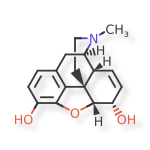
Details
| Stereochemistry | ABSOLUTE |
| Molecular Formula | C17H19NO3 |
| Molecular Weight | 285.3377 |
| Optical Activity | UNSPECIFIED |
| Defined Stereocenters | 5 / 5 |
| E/Z Centers | 0 |
| Charge | 0 |
SHOW SMILES / InChI
SMILES
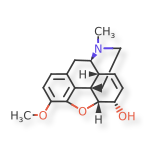
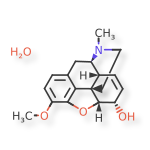
CN1CC[C@@]23[C@H]4OC5=C2C(C[C@@H]1[C@@H]3C=C[C@@H]4O)=CC=C5O
InChI
InChIKey=BQJCRHHNABKAKU-KBQPJGBKSA-N
InChI=1S/C17H19NO3/c1-18-7-6-17-10-3-5-13(20)16(17)21-15-12(19)4-2-9(14(15)17)8-11(10)18/h2-5,10-11,13,16,19-20H,6-8H2,1H3/t10-,11+,13-,16-,17-/m0/s1
| Molecular Formula | C17H19NO3 |
| Molecular Weight | 285.3377 |
| Charge | 0 |
| Count |
|
| Stereochemistry | ABSOLUTE |
| Additional Stereochemistry | No |
| Defined Stereocenters | 5 / 5 |
| E/Z Centers | 0 |
| Optical Activity | UNSPECIFIED |
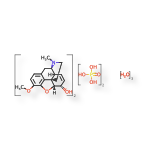
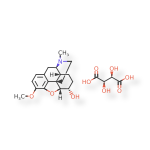
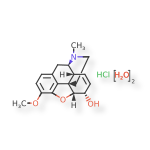
Morphine is one of the most important and widely used opioid for the treatment of chronic and acute pain: the very wide interindividual variability in the patients’ response to the drug may have genetic derivations. Sulphate salt of morphine sold under the many brand names, one of them, DURAMORPH, which is indicated for the management of pain severe enough to require use of an opioid analgesic by intravenous administration, and for which alternative treatments are not expected to be adequate. In addition for the epidural or intrathecal management of pain without attendant loss of motor, sensory, or sympathetic function. Morphine is a full opioid agonist and is relatively selective for the mu-opioid receptor, although it can bind to other opioid receptors at higher doses. The principal therapeutic action of morphine is analgesia. Like all full opioid agonists, there is no ceiling effect for analgesia with morphine. The precise mechanism of the analgesic action is unknown. However, specific CNS opioid receptors for endogenous compounds with opioid-like activity have been identified throughout the brain and spinal cord and are thought to play a role in the analgesic effects of this drug. Morphine has a high potential for addiction and abuse. Common side effects include drowsiness, vomiting, and constipation. Caution is advised when used during pregnancy or breast-feeding, as morphine will affect the baby.
CNS Activity
Originator
Approval Year
Targets
| Primary Target | Pharmacology | Condition | Potency |
|---|---|---|---|
Target ID: CHEMBL233 |
|||
Target ID: P41145 Gene ID: 4986.0 Gene Symbol: OPRK1 Target Organism: Homo sapiens (Human) |
|||
Target ID: P41143 Gene ID: 4985.0 Gene Symbol: OPRD1 Target Organism: Homo sapiens (Human) |
Conditions
| Condition | Modality | Targets | Highest Phase | Product |
|---|---|---|---|---|
| Palliative | DURAMORPH PF Approved UseDURAMORPH is indicated for: the management of pain severe enough to require use of an opioid analgesic by intravenous administration, and for which alternative treatments are not expected to be adequate.For the epidural or intrathecal management of pain without attendant loss of motor, sensory, or sympathetic function. Launch Date1984 |
Cmax
| Value | Dose | Co-administered | Analyte | Population |
|---|---|---|---|---|
63 nM |
2 mg single, intravenous dose: 2 mg route of administration: Intravenous experiment type: SINGLE co-administered: |
MORPHINE plasma | Homo sapiens population: HEALTHY age: ADULT sex: FEMALE / MALE food status: FASTED |
AUC
| Value | Dose | Co-administered | Analyte | Population |
|---|---|---|---|---|
165 nM × h |
2 mg single, intravenous dose: 2 mg route of administration: Intravenous experiment type: SINGLE co-administered: |
MORPHINE plasma | Homo sapiens population: HEALTHY age: ADULT sex: FEMALE / MALE food status: FASTED |
T1/2
| Value | Dose | Co-administered | Analyte | Population |
|---|---|---|---|---|
15.1 h |
2 mg single, intravenous dose: 2 mg route of administration: Intravenous experiment type: SINGLE co-administered: |
MORPHINE plasma | Homo sapiens population: HEALTHY age: ADULT sex: FEMALE / MALE food status: FASTED |
Funbound
| Value | Dose | Co-administered | Analyte | Population |
|---|---|---|---|---|
65% |
2 mg single, intravenous dose: 2 mg route of administration: Intravenous experiment type: SINGLE co-administered: |
MORPHINE plasma | Homo sapiens population: HEALTHY age: ADULT sex: FEMALE / MALE food status: FASTED |
Overview
| CYP3A4 | CYP2C9 | CYP2D6 | hERG |
|---|---|---|---|
Drug as perpetrator
| Target | Modality | Activity | Metabolite | Clinical evidence |
|---|---|---|---|---|
| no | ||||
| no | ||||
| no |
Drug as victim
| Target | Modality | Activity | Metabolite | Clinical evidence |
|---|---|---|---|---|
| no | ||||
| no | ||||
| no | ||||
| no | ||||
| yes [Km 10100 uM] | ||||
Page: - |
yes [Km 12600 uM] | |||
| yes [Km 14150 uM] | ||||
Page: - |
yes [Km 18000 uM] | |||
Page: - |
yes [Km 18700 uM] | |||
| yes [Km 25400 uM] | ||||
Page: - |
yes [Km 2600 uM] | |||
| yes [Km 3.4 uM] | ||||
Page: - |
yes [Km 3200 uM] | |||
Page: - |
yes [Km 37400 uM] | |||
| yes [Km 380 uM] | ||||
| yes [Km 4800 uM] | ||||
| yes [Km 6400 uM] | ||||
| yes | ||||
| yes | ||||
| yes |
PubMed
| Title | Date | PubMed |
|---|---|---|
| Effect of dexmedetomidine on the release of [3H]-noradrenaline from rat kidney cortex slices: characterization of alpha2-adrenoceptor. | 2001-04 |
|
| Multicentre randomised controlled trial of nasal diamorphine for analgesia in children and teenagers with clinical fractures. | 2001-02-03 |
|
| A single nucleotide polymorphic mutation in the human mu-opioid receptor severely impairs receptor signaling. | 2001-02-02 |
|
| Large-dose oral dextromethorphan as an adjunct to patient-controlled analgesia with morphine after knee surgery. | 2001-02 |
|
| Protein kinase C and G(i/o) proteins are involved in adenosine- and ischemic preconditioning-mediated renal protection. | 2001-02 |
|
| Numerical density of mu opioid receptor expressing neurons in the frontal cortex of drug related fatalities. | 2001-01-15 |
|
| Effect of organic cations on the renal tubular secretion of pseudoephedrine in the rat. | 2001-01-12 |
|
| Acute thermal hyperalgesia elicited by low-dose morphine in normal mice is blocked by ultra-low-dose naltrexone, unmasking potent opioid analgesia. | 2001-01-05 |
|
| Occurrence of morphine tolerance and dependence in the nucleus paragigantocellularis neurons. | 2001-01-05 |
|
| Morphine induces short-lived changes in G-protein gene expression in rat prefrontal cortex. | 2001-01-05 |
|
| Tonic descending facilitation from the rostral ventromedial medulla mediates opioid-induced abnormal pain and antinociceptive tolerance. | 2001-01-01 |
|
| Heroin-related deaths in Victoria: a review of cases for 1997 and 1998. | 2001-01-01 |
|
| Knockdown of spinal metabotropic glutamate receptor 1 (mGluR(1)) alleviates pain and restores opioid efficacy after nerve injury in rats. | 2001-01 |
|
| Contralateral but not systemic administration of the kappa-opioid agonist U-50,488H induces anti-nociception in acute hindpaw inflammation in rats. | 2001-01 |
|
| Comparison of three methods to find the vapor activity of a hydration step. | 2001-01 |
|
| Cellular and synaptic adaptations mediating opioid dependence. | 2001-01 |
|
| Circuitry underlying antiopioid actions of cholecystokinin within the rostral ventromedial medulla. | 2001-01 |
|
| Ketorolac reduces postoperative narcotic requirements. | 2001-01 |
|
| Morphine nerve paste. | 2001-01 |
|
| Prehospital management of rapid atrial fibrillation: recommendations for treatment protocols. | 2001-01 |
|
| Early serial EEG in hypoxic ischaemic encephalopathy. | 2001-01 |
|
| Randomized clinical trial of diathermy versus scalpel incision in elective midline laparotomy. | 2001-01 |
|
| Opiates, intracranial pressure, and autoregulation. | 2001-01 |
|
| Buprenorphine substitution ameliorates spontaneous withdrawal in fentanyl-dependent rat pups. | 2001-01 |
|
| Demographic and therapeutic determinants of pain reactivity in very low birth weight neonates at 32 Weeks' postconceptional Age. | 2001-01 |
|
| The combined effects of N-type calcium channel blockers and morphine on A delta versus C fiber mediated nociception. | 2001-01 |
|
| A prospective survey of patients after cessation of patient-controlled analgesia. | 2001-01 |
|
| Clonidine combined with a long acting local anesthetic does not prolong postoperative analgesia after brachial plexus block but does induce hemodynamic changes. | 2001-01 |
|
| Bupivacaine wound instillation via an electronic patient-controlled analgesia device and a double-catheter system does not decrease postoperative pain or opioid requirements after major abdominal surgery. | 2001-01 |
|
| A randomized, double-blinded comparison of intrathecal morphine, sufentanil and their combination versus IV morphine patient-controlled analgesia for postthoracotomy pain. | 2001-01 |
|
| Agmatine enhances the NADPH oxidase activity of neuronal NO synthase and leads to oxidative inactivation of the enzyme. | 2001-01 |
|
| Parental perceptions of comfort during mechanical ventilation. | 2001-01 |
|
| Sublingual morphine may be a suitable alternative for pain control in children in the postoperative period. | 2001-01 |
|
| Morphine with or without a local anaesthetic for postoperative intrathecal pain treatment after selective dorsal rhizotomy in children. | 2001-01 |
|
| Antianalgesic action of nociceptin originating in the brain is mediated by spinal prostaglandin E(2) in mice. | 2001-01 |
|
| Augmented accumbal serotonin levels decrease the preference for a morphine associated environment during withdrawal. | 2001-01 |
|
| mGlu5 receptors and nociceptive function II. mGlu5 receptors functionally expressed on peripheral sensory neurones mediate inflammatory hyperalgesia. | 2001 |
|
| The development of pain-related behaviour and opioid tolerance after neuropathy-inducing surgery and sham surgery. | 2000-12-01 |
|
| Apnoea with intrathecal morphine. | 2000-12 |
|
| Systemic naloxone enhances cerebral blood flow in anesthetized morphine-dependent rats. | 2000-11-24 |
|
| Enhanced spinal nociceptin receptor expression develops morphine tolerance and dependence. | 2000-10-15 |
|
| Inhaled morphine to relieve dyspnea in advanced cystic fibrosis lung disease. | 2000-09 |
|
| Downbeat nystagmus associated with intravenous patient-controlled administration of morphine. | 2000-09 |
|
| Advantages of intrathecal nalbuphine, compared with intrathecal morphine, after cesarean delivery: an evaluation of postoperative analgesia and adverse effects. | 2000-09 |
|
| The effects of intrathecal morphine encapsulated in L- and D-dipalmitoylphosphatidyl choline liposomes on acute nociception in rats. | 2000-08 |
|
| The effect of spinal ibuprofen on opioid withdrawal in the rat. | 2000-08 |
|
| Comparison of intravenous patient-controlled analgesia with tramadol versus morphine after microvascular breast reconstruction. | 2000-07 |
|
| Morphine inhibits human microglial cell production of, and migration towards, RANTES. | 2000 |
|
| Butorphanol agonist effects and acute physical dependence in opioid abusers: comparison with morphine. | 1998-12-01 |
|
| [Regulation of the central opioidergic nervous system on the emotional state of anxiety and its possible mechanisms]. | 1997-01 |
Patents
Sample Use Guides
Dosage for Intravenous Administration: Adult Dosage: The initial dose of morphine should be 2 mg to 10 mg/70 kg of body weight.
Dosage for Epidural Administration: Adult Dosage: Initial injection of 5 mg in the lumbar region may provide satisfactory pain relief for up to 24 hours. If adequate pain relief is not achieved within one hour, careful administration of incremental doses of 1 to 2 mg at intervals sufficient to assess effectiveness may be given. Do not administer more than 10 mg per 24 hours.
Dosage for Intrathecal Administration: Adult Dosage: Intrathecal dosage is usually 1/10 that of epidural dosage. A single injection of 0.2 to 1 mg may provide satisfactory pain relief for up to 24 hours. (Caution: this is only 0.4 to 2 mL of the 5 mg/10 mL ampul or 0.2 to 1 mL of the 10 mg/10 mL ampul of DURAMORPH). Do not inject intrathecally more than 2 mL of the 5 mg/10 mL ampul or 1 mL of the 10 mg/10 mLampul. Repeated intrathecal injections of DURAMORPH are not recommended. If pain recurs, consider consider alternative routes of administration.
Route of Administration:
Other
It was evaluated the effect of morphine on the proangiogenic interaction taking place between macrophages and breast cancer cells in vitro. It was shown, that morphine prevents, in part via modulating VEGF-A expression, the pro-angiogenic interaction between macrophages and breast cancer cells. The conditioned medium (CM) from breast cancer cells co-cultured with macrophages elicited endothelial cell proliferation and tube formation. This effect was inhibited if the co-culture occurred in the presence of morphine (20 uM). Using a mouse antibody array, it was identified several angiogenesis-regulating factors differentially expressed in the CM of co-cultured cells prepared in the presence or absence of morphine (o, 10, 20 uM), amongst which interleukin (IL)-6, tumour necrosis factor (TNF)-α and vascular endothelial growth factor (VEGF)-A. VEGF was induced in both cell types by the co-culture and this was prevented by morphine in a non-naloxone reversible fashion. The effect of CM from co-cultured cells on endothelial tube formation, but not proliferation, was prevented by anti-VEGF neutralizing antibody
| Substance Class |
Chemical
Created
by
admin
on
Edited
Mon Mar 31 18:32:09 GMT 2025
by
admin
on
Mon Mar 31 18:32:09 GMT 2025
|
| Record UNII |
76I7G6D29C
|
| Record Status |
Validated (UNII)
|
| Record Version |
|
-
Download
| Related Record | Type |
|---|
| Name | Type | Language | ||
|---|---|---|---|---|
|
Common Name | English | ||
|
Preferred Name | English | ||
|
Common Name | English | ||
|
Common Name | English | ||
|
Common Name | English | ||
|
Common Name | English | ||
|
Common Name | English | ||
|
Common Name | English | ||
|
Common Name | English | ||
|
Common Name | English | ||
|
Common Name | English | ||
|
Common Name | English | ||
|
Common Name | English | ||
|
Common Name | English | ||
|
Common Name | English | ||
|
Common Name | English | ||
|
Common Name | English | ||
|
Common Name | English | ||
|
Systematic Name | English | ||
|
Systematic Name | English | ||
|
Systematic Name | English | ||
|
Common Name | English | ||
|
Common Name | English | ||
|
Systematic Name | English | ||
|
Common Name | English | ||
|
Common Name | English | ||
|
Common Name | English | ||
|
Common Name | English | ||
|
Common Name | English | ||
|
Code | English | ||
|
Common Name | English | ||
|
Common Name | English | ||
|
Common Name | English |
| Classification Tree | Code System | Code | ||
|---|---|---|---|---|
|
WHO-ESSENTIAL MEDICINES LIST |
8.4
Created by
admin on Mon Mar 31 18:32:10 GMT 2025 , Edited by admin on Mon Mar 31 18:32:10 GMT 2025
|
||
|
CFR |
21 CFR 862.3640
Created by
admin on Mon Mar 31 18:32:10 GMT 2025 , Edited by admin on Mon Mar 31 18:32:10 GMT 2025
|
||
|
WHO-ATC |
N02AA51
Created by
admin on Mon Mar 31 18:32:10 GMT 2025 , Edited by admin on Mon Mar 31 18:32:10 GMT 2025
|
||
|
WHO-VATC |
QN02AA01
Created by
admin on Mon Mar 31 18:32:10 GMT 2025 , Edited by admin on Mon Mar 31 18:32:10 GMT 2025
|
||
|
DEA NO. |
9300
Created by
admin on Mon Mar 31 18:32:10 GMT 2025 , Edited by admin on Mon Mar 31 18:32:10 GMT 2025
|
||
|
NDF-RT |
N0000175684
Created by
admin on Mon Mar 31 18:32:10 GMT 2025 , Edited by admin on Mon Mar 31 18:32:10 GMT 2025
|
||
|
LIVERTOX |
NBK548230
Created by
admin on Mon Mar 31 18:32:10 GMT 2025 , Edited by admin on Mon Mar 31 18:32:10 GMT 2025
|
||
|
WHO-VATC |
QA07DA52
Created by
admin on Mon Mar 31 18:32:10 GMT 2025 , Edited by admin on Mon Mar 31 18:32:10 GMT 2025
|
||
|
NDF-RT |
N0000175690
Created by
admin on Mon Mar 31 18:32:10 GMT 2025 , Edited by admin on Mon Mar 31 18:32:10 GMT 2025
|
||
|
WHO-ESSENTIAL MEDICINES LIST |
2.2
Created by
admin on Mon Mar 31 18:32:10 GMT 2025 , Edited by admin on Mon Mar 31 18:32:10 GMT 2025
|
||
|
WHO-ESSENTIAL MEDICINES LIST |
1.3
Created by
admin on Mon Mar 31 18:32:10 GMT 2025 , Edited by admin on Mon Mar 31 18:32:10 GMT 2025
|
||
|
WHO-VATC |
QN02AA51
Created by
admin on Mon Mar 31 18:32:10 GMT 2025 , Edited by admin on Mon Mar 31 18:32:10 GMT 2025
|
||
|
WHO-VATC |
QN02AG01
Created by
admin on Mon Mar 31 18:32:10 GMT 2025 , Edited by admin on Mon Mar 31 18:32:10 GMT 2025
|
||
|
WHO-ATC |
N02AA01
Created by
admin on Mon Mar 31 18:32:10 GMT 2025 , Edited by admin on Mon Mar 31 18:32:10 GMT 2025
|
||
|
WHO-VATC |
QR05DA05
Created by
admin on Mon Mar 31 18:32:10 GMT 2025 , Edited by admin on Mon Mar 31 18:32:10 GMT 2025
|
||
|
WHO-ATC |
N02AG01
Created by
admin on Mon Mar 31 18:32:10 GMT 2025 , Edited by admin on Mon Mar 31 18:32:10 GMT 2025
|
||
|
WHO-ATC |
R05DA05
Created by
admin on Mon Mar 31 18:32:10 GMT 2025 , Edited by admin on Mon Mar 31 18:32:10 GMT 2025
|
||
|
NCI_THESAURUS |
C1657
Created by
admin on Mon Mar 31 18:32:10 GMT 2025 , Edited by admin on Mon Mar 31 18:32:10 GMT 2025
|
||
|
WHO-ATC |
A07DA52
Created by
admin on Mon Mar 31 18:32:10 GMT 2025 , Edited by admin on Mon Mar 31 18:32:10 GMT 2025
|
| Code System | Code | Type | Description | ||
|---|---|---|---|---|---|
|
CHEMBL70
Created by
admin on Mon Mar 31 18:32:10 GMT 2025 , Edited by admin on Mon Mar 31 18:32:10 GMT 2025
|
PRIMARY | |||
|
1627
Created by
admin on Mon Mar 31 18:32:10 GMT 2025 , Edited by admin on Mon Mar 31 18:32:10 GMT 2025
|
PRIMARY | |||
|
2134
Created by
admin on Mon Mar 31 18:32:10 GMT 2025 , Edited by admin on Mon Mar 31 18:32:10 GMT 2025
|
PRIMARY | |||
|
D009020
Created by
admin on Mon Mar 31 18:32:10 GMT 2025 , Edited by admin on Mon Mar 31 18:32:10 GMT 2025
|
PRIMARY | |||
|
1845
Created by
admin on Mon Mar 31 18:32:10 GMT 2025 , Edited by admin on Mon Mar 31 18:32:10 GMT 2025
|
PRIMARY | |||
|
DB00295
Created by
admin on Mon Mar 31 18:32:10 GMT 2025 , Edited by admin on Mon Mar 31 18:32:10 GMT 2025
|
PRIMARY | |||
|
C62051
Created by
admin on Mon Mar 31 18:32:10 GMT 2025 , Edited by admin on Mon Mar 31 18:32:10 GMT 2025
|
PRIMARY | |||
|
SUB03332MIG
Created by
admin on Mon Mar 31 18:32:10 GMT 2025 , Edited by admin on Mon Mar 31 18:32:10 GMT 2025
|
PRIMARY | |||
|
7052
Created by
admin on Mon Mar 31 18:32:10 GMT 2025 , Edited by admin on Mon Mar 31 18:32:10 GMT 2025
|
PRIMARY | RxNorm | ||
|
200-320-2
Created by
admin on Mon Mar 31 18:32:10 GMT 2025 , Edited by admin on Mon Mar 31 18:32:10 GMT 2025
|
PRIMARY | |||
|
57-27-2
Created by
admin on Mon Mar 31 18:32:10 GMT 2025 , Edited by admin on Mon Mar 31 18:32:10 GMT 2025
|
PRIMARY | |||
|
m7631
Created by
admin on Mon Mar 31 18:32:10 GMT 2025 , Edited by admin on Mon Mar 31 18:32:10 GMT 2025
|
PRIMARY | Merck Index | ||
|
Morphine
Created by
admin on Mon Mar 31 18:32:10 GMT 2025 , Edited by admin on Mon Mar 31 18:32:10 GMT 2025
|
PRIMARY | |||
|
100000091372
Created by
admin on Mon Mar 31 18:32:10 GMT 2025 , Edited by admin on Mon Mar 31 18:32:10 GMT 2025
|
PRIMARY | |||
|
5288826
Created by
admin on Mon Mar 31 18:32:10 GMT 2025 , Edited by admin on Mon Mar 31 18:32:10 GMT 2025
|
PRIMARY | |||
|
58097
Created by
admin on Mon Mar 31 18:32:10 GMT 2025 , Edited by admin on Mon Mar 31 18:32:10 GMT 2025
|
PRIMARY | |||
|
17303
Created by
admin on Mon Mar 31 18:32:10 GMT 2025 , Edited by admin on Mon Mar 31 18:32:10 GMT 2025
|
PRIMARY | |||
|
SUB121757
Created by
admin on Mon Mar 31 18:32:10 GMT 2025 , Edited by admin on Mon Mar 31 18:32:10 GMT 2025
|
PRIMARY | |||
|
DTXSID9023336
Created by
admin on Mon Mar 31 18:32:10 GMT 2025 , Edited by admin on Mon Mar 31 18:32:10 GMT 2025
|
PRIMARY | |||
|
MORPHINE
Created by
admin on Mon Mar 31 18:32:10 GMT 2025 , Edited by admin on Mon Mar 31 18:32:10 GMT 2025
|
PRIMARY | |||
|
76I7G6D29C
Created by
admin on Mon Mar 31 18:32:10 GMT 2025 , Edited by admin on Mon Mar 31 18:32:10 GMT 2025
|
PRIMARY | |||
|
76I7G6D29C
Created by
admin on Mon Mar 31 18:32:10 GMT 2025 , Edited by admin on Mon Mar 31 18:32:10 GMT 2025
|
PRIMARY |
| Related Record | Type | Details | ||
|---|---|---|---|---|
|
TARGET -> AGONIST |
Ki
|
||
|
|
SALT/SOLVATE -> PARENT |
|
||
|
|
SUB_CONCEPT->SUBSTANCE |
|
||
|
SALT/SOLVATE -> PARENT |
APPROXIMATE PURE ANHYDROUS DRUG CONTENT (IN PERCENT)
|
||
|
|
SALT/SOLVATE -> PARENT |
|
||
|
SALT/SOLVATE -> PARENT |
APPROXIMATE PURE ANHYDROUS DRUG CONTENT (IN PERCENT)
|
||
|
|
SALT/SOLVATE -> PARENT |
|
||
|
DERIVATIVE -> PARENT |
APPROXIMATE PURE ANHYDROUS DRUG CONTENT (IN PERCENT)
|
||
|
SALT/SOLVATE -> PARENT |
APPROXIMATE PURE ANHYDROUS DRUG CONTENT (IN PERCENT)
|
||
|
|
SALT/SOLVATE -> PARENT |
|
||
|
DERIVATIVE -> PARENT |
APPROXIMATE PURE ANHYDROUS DRUG CONTENT (IN PERCENT)
|
||
|
|
SALT/SOLVATE -> PARENT |
|
||
|
DERIVATIVE -> PARENT |
|
||
|
|
SALT/SOLVATE -> PARENT |
|
||
|
SALT/SOLVATE -> PARENT |
APPROXIMATE PURE ANHYDROUS DRUG CONTENT (IN PERCENT)
|
||
|
DERIVATIVE -> PARENT |
|
||
|
|
TARGET -> AGONIST |
Ki
|
||
|
DERIVATIVE -> PARENT |
|
||
|
DERIVATIVE -> PARENT |
APPROXIMATE PURE ANHYDROUS DRUG CONTENT (IN PERCENT)
|
||
|
TRANSPORTER -> SUBSTRATE | |||
|
|
SALT/SOLVATE -> PARENT |
|
||
|
SOLVATE->ANHYDROUS |
|
||
|
DERIVATIVE -> PARENT | |||
|
SALT/SOLVATE -> PARENT |
APPROXIMATE PURE ANHYDROUS DRUG CONTENT (IN PERCENT)
|
||
|
|
SALT/SOLVATE -> PARENT |
|
||
|
|
SALT/SOLVATE -> PARENT |
|
||
|
BINDER->LIGAND |
|
||
|
DERIVATIVE -> PARENT | |||
|
|
SALT/SOLVATE -> PARENT |
|
||
|
|
SALT/SOLVATE -> PARENT |
|
||
|
SALT/SOLVATE -> PARENT |
APPROXIMATE PURE ANHYDROUS DRUG CONTENT (IN PERCENT)
|
||
|
|
SALT/SOLVATE -> PARENT |
|
||
|
|
SALT/SOLVATE -> PARENT |
|
||
|
TARGET -> AGONIST |
Ki
|
||
|
|
PARENT -> SALT/SOLVATE |
|
||
|
DERIVATIVE -> PARENT |
APPROXIMATE PURE ANHYDROUS DRUG CONTENT (IN PERCENT)
|

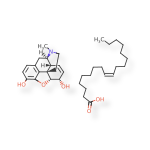

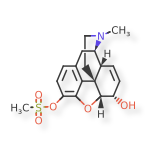
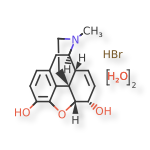
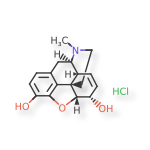
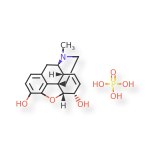
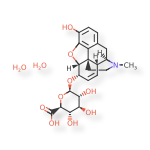
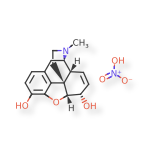
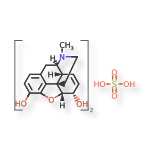
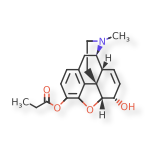
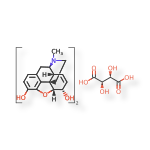
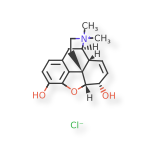

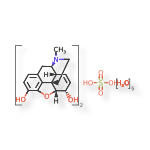
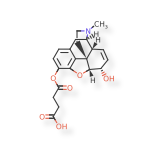
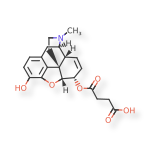
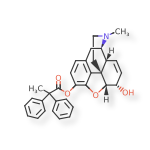

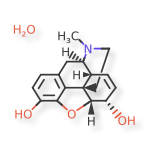
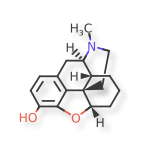
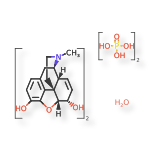
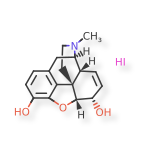
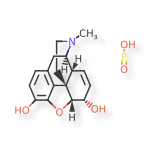

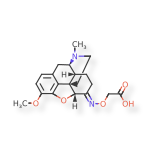
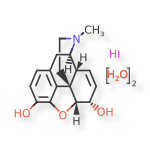

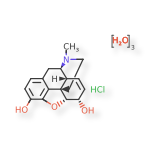
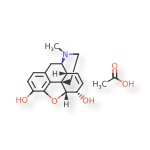
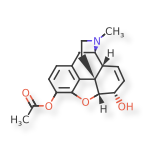
| Related Record | Type | Details | ||
|---|---|---|---|---|
|
METABOLITE INACTIVE -> PARENT |
MAJOR
|
||
|
METABOLITE INACTIVE -> PARENT |
APPROXIMATE PURE ANHYDROUS DRUG CONTENT (IN PERCENT)
|
||
|
PRODRUG -> METABOLITE ACTIVE |
|
||
|
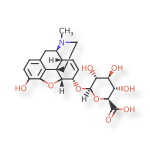
METABOLITE ACTIVE -> PARENT |
Approximately 10% of morphine is
metabolized to M6G.
MAJOR
|
||
|
PRODRUG -> METABOLITE ACTIVE |
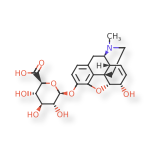
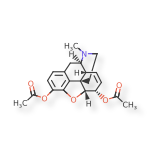
| Related Record | Type | Details | ||
|---|---|---|---|---|
|
PARENT -> IMPURITY | |||
|
PARENT -> IMPURITY |
CHROMATOGRAPHIC PURITY (HPLC/UV)
EP
|
||
|
PARENT -> IMPURITY |
CHROMATOGRAPHIC PURITY (HPLC/UV)
EP
|
||
|
PARENT -> IMPURITY | |||
|
PARENT -> IMPURITY |
CHROMATOGRAPHIC PURITY (HPLC/UV)
EP
|
||
|
PARENT -> IMPURITY | |||
|
PARENT -> IMPURITY |
|
||
|
PARENT -> IMPURITY |
CHROMATOGRAPHIC PURITY (HPLC/UV)
USP
|
||
|
PARENT -> IMPURITY |
CHROMATOGRAPHIC PURITY (HPLC/UV)
EP
|
||
|
PARENT -> IMPURITY |
|

| Related Record | Type | Details | ||
|---|---|---|---|---|
|
ACTIVE MOIETY |
ED50-PO(mg/kg) = 0.33, LD50-PO(mg/kg) = 470, Potency ratio to morphine = 1, Potency ratio to fentanyl = 0.02
|