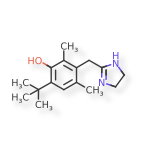
Details
| Stereochemistry | ACHIRAL |
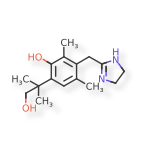
| Molecular Formula | C16H24N2O |
| Molecular Weight | 260.3746 |
| Optical Activity | NONE |
| Defined Stereocenters | 0 / 0 |
| E/Z Centers | 0 |
| Charge | 0 |
SHOW SMILES / InChI
SMILES
CC1=C(CC2=NCCN2)C(C)=C(O)C(=C1)C(C)(C)C
InChI
InChIKey=WYWIFABBXFUGLM-UHFFFAOYSA-N
InChI=1S/C16H24N2O/c1-10-8-13(16(3,4)5)15(19)11(2)12(10)9-14-17-6-7-18-14/h8,19H,6-7,9H2,1-5H3,(H,17,18)
| Molecular Formula | C16H24N2O |
| Molecular Weight | 260.3746 |
| Charge | 0 |
| Count |
|
| Stereochemistry | ACHIRAL |
| Additional Stereochemistry | No |
| Defined Stereocenters | 0 / 0 |
| E/Z Centers | 0 |
| Optical Activity | NONE |
DescriptionCurator's Comment: Description was created based on several sources, including
https://www.drugs.com/monograph/oxymetazoline-hydrochloride.html
Curator's Comment: Description was created based on several sources, including
https://www.drugs.com/monograph/oxymetazoline-hydrochloride.html
Oxymetazoline is an adrenergic alpha-agonist, direct acting sympathomimetic, used as a vasoconstrictor to relieve nasal congestion The sympathomimetic action of oxymetazoline constricts the smaller arterioles of the nasal passages, producing a prolonged (up to 12 hours), gentle and decongesting effect. Oxymetazoline elicits relief of conjunctival hyperemia by causing vasoconstriction of superficial conjunctival blood vessels. The drug's action has been demonstrated in acute allergic conjunctivitis and in chemical (chloride) conjunctivitis. Oxymetazoline is self-medication for temporary relief of nasal congestion associated with the common cold, hay fever, or other upper respiratory allergies. Oxymetazoline is available over-the-counter as a topical decongestant in the form of oxymetazoline hydrochloride in nasal sprays such as Afrin, Operil, Dristan, Dimetapp, oxyspray, Facimin, Nasivin, Nostrilla, Sudafed OM, Vicks Sinex, Zicam, SinuFrin, and Mucinex Full Force. Due to its vasoconstricting properties, oxymetazoline is also used to treat nose bleeds and eye redness.
Approval Year
Targets
| Primary Target | Pharmacology | Condition | Potency |
|---|---|---|---|
| 4.96 null [pEC50] | |||
| 0.29 nM [Ki] | |||
Target ID: CHEMBL214 |
7.73 null [pEC50] | ||
Target ID: CHEMBL1983 |
7.35 null [pEC50] |
Conditions
| Condition | Modality | Targets | Highest Phase | Product |
|---|---|---|---|---|
| Palliative | Oxymetazoline Hydrochloride Approved UseTemporary relief of nasal congestion (due to a cold, hay fever, or other upper respiratory allergies) and sinus congestion/pressure. Launch Date1989 |
|||
| Primary | OCUCLEAR Approved UseRelief of redness of eye due to minor eye irritations Launch Date1986 |
Cmax
| Value | Dose | Co-administered | Analyte | Population |
|---|---|---|---|---|
60.5 pg/mL |
3 mg single, topical dose: 3 mg route of administration: Topical experiment type: SINGLE co-administered: |
OXYMETAZOLINE plasma | Homo sapiens population: UNHEALTHY age: ADULT sex: UNKNOWN food status: UNKNOWN |
|
1.78 ng/mL DRUG LABEL https://www.fda.gov/media/98992/download |
0.3 mg single, nasal dose: 0.3 mg route of administration: Nasal experiment type: SINGLE co-administered: Tetracaine |
OXYMETAZOLINE plasma | Homo sapiens population: HEALTHY age: ADULT sex: FEMALE / MALE food status: UNKNOWN |
AUC
| Value | Dose | Co-administered | Analyte | Population |
|---|---|---|---|---|
895 pg × h/mL |
3 mg single, topical dose: 3 mg route of administration: Topical experiment type: SINGLE co-administered: |
OXYMETAZOLINE plasma | Homo sapiens population: UNHEALTHY age: ADULT sex: UNKNOWN food status: UNKNOWN |
|
4.24 ng × h/mL DRUG LABEL https://www.fda.gov/media/98992/download |
0.3 mg single, nasal dose: 0.3 mg route of administration: Nasal experiment type: SINGLE co-administered: Tetracaine |
OXYMETAZOLINE plasma | Homo sapiens population: HEALTHY age: ADULT sex: FEMALE / MALE food status: UNKNOWN |
T1/2
| Value | Dose | Co-administered | Analyte | Population |
|---|---|---|---|---|
5.23 h DRUG LABEL https://www.fda.gov/media/98992/download |
0.3 mg single, nasal dose: 0.3 mg route of administration: Nasal experiment type: SINGLE co-administered: Tetracaine |
OXYMETAZOLINE plasma | Homo sapiens population: HEALTHY age: ADULT sex: FEMALE / MALE food status: UNKNOWN |
Doses
| Dose | Population | Adverse events |
|---|---|---|
0.05 % single, intranasal Dose: 0.05 % Route: intranasal Route: single Dose: 0.05 % Sources: |
unhealthy, 4 years |
Other AEs: Hypertensive crisis... |
1 % 1 times / day multiple, topical Dose: 1 %, 1 times / day Route: topical Route: multiple Dose: 1 %, 1 times / day Sources: |
unhealthy, 53.1 years (range: 19–81 years) Health Status: unhealthy Age Group: 53.1 years (range: 19–81 years) Sex: M+F Sources: |
Disc. AE: Application site dermatitis, Application site erythema... AEs leading to discontinuation/dose reduction: Application site dermatitis (1.4%) Sources: Application site erythema (0.5%) Application site pain (0.5%) Application site dryness (0.2%) Hypoesthesia (0.2%) Paresthesia (0.2%) Rash (0.2%) Urticaria (0.2%) Photosensitivity reaction (0.2%) |
1.5 % 2 times / day multiple, topical Highest studied dose Dose: 1.5 %, 2 times / day Route: topical Route: multiple Dose: 1.5 %, 2 times / day Sources: |
unhealthy, adult |
AEs
| AE | Significance | Dose | Population |
|---|---|---|---|
| Hypertensive crisis | 1 patient | 0.05 % single, intranasal Dose: 0.05 % Route: intranasal Route: single Dose: 0.05 % Sources: |
unhealthy, 4 years |
| Application site dryness | 0.2% Disc. AE |
1 % 1 times / day multiple, topical Dose: 1 %, 1 times / day Route: topical Route: multiple Dose: 1 %, 1 times / day Sources: |
unhealthy, 53.1 years (range: 19–81 years) Health Status: unhealthy Age Group: 53.1 years (range: 19–81 years) Sex: M+F Sources: |
| Hypoesthesia | 0.2% Disc. AE |
1 % 1 times / day multiple, topical Dose: 1 %, 1 times / day Route: topical Route: multiple Dose: 1 %, 1 times / day Sources: |
unhealthy, 53.1 years (range: 19–81 years) Health Status: unhealthy Age Group: 53.1 years (range: 19–81 years) Sex: M+F Sources: |
| Paresthesia | 0.2% Disc. AE |
1 % 1 times / day multiple, topical Dose: 1 %, 1 times / day Route: topical Route: multiple Dose: 1 %, 1 times / day Sources: |
unhealthy, 53.1 years (range: 19–81 years) Health Status: unhealthy Age Group: 53.1 years (range: 19–81 years) Sex: M+F Sources: |
| Photosensitivity reaction | 0.2% Disc. AE |
1 % 1 times / day multiple, topical Dose: 1 %, 1 times / day Route: topical Route: multiple Dose: 1 %, 1 times / day Sources: |
unhealthy, 53.1 years (range: 19–81 years) Health Status: unhealthy Age Group: 53.1 years (range: 19–81 years) Sex: M+F Sources: |
| Rash | 0.2% Disc. AE |
1 % 1 times / day multiple, topical Dose: 1 %, 1 times / day Route: topical Route: multiple Dose: 1 %, 1 times / day Sources: |
unhealthy, 53.1 years (range: 19–81 years) Health Status: unhealthy Age Group: 53.1 years (range: 19–81 years) Sex: M+F Sources: |
| Urticaria | 0.2% Disc. AE |
1 % 1 times / day multiple, topical Dose: 1 %, 1 times / day Route: topical Route: multiple Dose: 1 %, 1 times / day Sources: |
unhealthy, 53.1 years (range: 19–81 years) Health Status: unhealthy Age Group: 53.1 years (range: 19–81 years) Sex: M+F Sources: |
| Application site erythema | 0.5% Disc. AE |
1 % 1 times / day multiple, topical Dose: 1 %, 1 times / day Route: topical Route: multiple Dose: 1 %, 1 times / day Sources: |
unhealthy, 53.1 years (range: 19–81 years) Health Status: unhealthy Age Group: 53.1 years (range: 19–81 years) Sex: M+F Sources: |
| Application site pain | 0.5% Disc. AE |
1 % 1 times / day multiple, topical Dose: 1 %, 1 times / day Route: topical Route: multiple Dose: 1 %, 1 times / day Sources: |
unhealthy, 53.1 years (range: 19–81 years) Health Status: unhealthy Age Group: 53.1 years (range: 19–81 years) Sex: M+F Sources: |
| Application site dermatitis | 1.4% Disc. AE |
1 % 1 times / day multiple, topical Dose: 1 %, 1 times / day Route: topical Route: multiple Dose: 1 %, 1 times / day Sources: |
unhealthy, 53.1 years (range: 19–81 years) Health Status: unhealthy Age Group: 53.1 years (range: 19–81 years) Sex: M+F Sources: |
Overview
| CYP3A4 | CYP2C9 | CYP2D6 | hERG |
|---|---|---|---|
OverviewOther
Drug as perpetrator
| Target | Modality | Activity | Metabolite | Clinical evidence |
|---|---|---|---|---|
| no | ||||
| no | ||||
| no | ||||
| no | ||||
| no | ||||
| no | ||||
| no | ||||
| no | ||||
| no | ||||
| no |
Drug as victim
| Target | Modality | Activity | Metabolite | Clinical evidence |
|---|---|---|---|---|
Page: 7.0 |
no | |||
Page: 7.0 |
no | |||
Page: 7.0 |
no | |||
Page: 7.0 |
no | |||
Page: 7.0 |
no | |||
Page: 7.0 |
no | |||
Page: 7.0 |
no | |||
Page: 7.0 |
no | |||
| no | ||||
| no | ||||
| no | ||||
| no | ||||
| no | ||||
| no | ||||
| no | ||||
| no | ||||
| no | ||||
| no | ||||
| yes | ||||
Page: 7.0 |
yes | no (co-administration study) Comment: concomitant oral moderate CYP2C19 inhibitors (e.g., esomeprazole, fluoxetine, and omeprazole): the results did not indicate an increase in oxymetazoline exposure associated with coadministration of oral moderate CYP2C19 inhibitors Page: 7.0 |
Tox targets
| Target | Modality | Activity | Metabolite | Clinical evidence |
|---|---|---|---|---|
PubMed
| Title | Date | PubMed |
|---|---|---|
| Human breast cell lines exhibit functional alpha2-adrenoceptors. | 2006-07 |
|
| Simultaneous determination of triamcinolone acetonide and oxymetazoline hydrochloride in nasal spray formulations by HPLC. | 2006-03-18 |
|
| Oxymetazoline inhibits proinflammatory reactions: effect on arachidonic acid-derived metabolites. | 2006-02 |
|
| In situ gelling, bioadhesive nasal inserts for extended drug delivery: in vitro characterization of a new nasal dosage form. | 2006-01 |
|
| Nasal wall compliance in vasomotor rhinitis. | 2006-01 |
|
| Characterisation of alpha2-adrenoceptor subtypes involved in gastric emptying, gastric motility and gastric mucosal defence. | 2005-12-28 |
|
| Pharmacological characterization of postjunctional alpha-adrenoceptors in human nasal mucosa. | 2005-11-08 |
|
| [Investigation of the effect of oxymetazoline on the duration of rhinitis]. | 2005-10-13 |
|
| [Investigation of the effect of oxymetazoline on the duration of rhinitis. results of a placebo-controlled double-blind study in patients with acute rhinitis]. | 2005-10-06 |
|
| Clinical images: Afrin-induced central nervous system vasospasm and thunderclap headache. | 2005-10 |
|
| [The observation of the ciliotoxicity of nasal mucosa with nasal decongestant]. | 2005-09 |
|
| Oxymetazoline solutions inhibit middle ear pathogens and are not ototoxic. | 2005-08 |
|
| Differential distribution of functional alph}1-adrenergic receptor subtypes along the rat tail artery. | 2005-08 |
|
| Is oxymetazoline really safe for middle ear use. | 2005-07 |
|
| [Usefulness of fenspiride in the treatment of acute otitis media in children]. | 2005-06 |
|
| Otic barotrauma from air travel. | 2005-05 |
|
| Pulmonary edema following phenylephrine intranasal spray administration during the induction of general anesthesia in a child. | 2005-04-30 |
|
| Use of mometasone furoate aqueous nasal spray in the treatment of rhinitis medicamentosa: an experimental study. | 2005-04 |
|
| An assessment for the presence of bacterial contamination of Venturi principle atomizers in a clinical setting. | 2005-03-30 |
|
| Oxymetazoline is equivalent to ciprofloxacin in preventing postoperative otorrhea or tympanostomy tube obstruction. | 2005-02 |
|
| Early changes in insulin secretion and action induced by high-fat diet are related to a decreased sympathetic tone. | 2005-01 |
|
| Behavioral effects of serotonin and serotonin agonists in two crayfish species, Procambarus clarkii and Orconectes rusticus. | 2004-12 |
|
| The Janus faces of adrenoceptors: factors controlling the coupling of adrenoceptors to multiple signal transduction pathways. | 2004-11 |
|
| Controlling bleeding from superficial wounds by the use of topical alpha adrenoreceptor agonists spray. A randomized, masked, controlled study. | 2004-11 |
|
| Allosteric modulation of semicarbazide-sensitive amine oxidase activities in vitro by imidazoline receptor ligands. | 2004-10 |
|
| Thunderclap headache and reversible segmental cerebral vasoconstriction associated with use of oxymetazoline nasal spray. | 2004-09-14 |
|
| [Ethyl-3H]RS-79948-197 alpha2-adrenoceptor autoradiography validation in alpha2-adrenoceptor knockout mice. | 2004-08-30 |
|
| Chromatography studies on bio-affinity of nine ligands of alpha1-adrenoceptor to alpha1D subtypes overexpressed in cell membrane. | 2004-08 |
|
| Antimuscarinic action of oxymetazoline on human intraocular muscles. | 2004-08 |
|
| Human alpha1D-adrenoceptor phosphorylation and desensitization. | 2004-05-15 |
|
| Intranasal drug delivery: an alternative to intravenous administration in selected emergency cases. | 2004-04 |
|
| Construction and analytical applications of plastic membrane electrode for oxymetazoline hydrochloride. | 2004-02 |
|
| Safety review of benzalkonium chloride used as a preservative in intranasal solutions: an overview of conflicting data and opinions. | 2004-01 |
|
| Sympathomimetic drug allergy: cross-reactivity study by patch test. | 2004 |
|
| Bulk is a determinant of oxymetazoline affinity for the alpha1A-adrenergic receptor. | 2004 |
|
| Synthesis and identification of two potential oxidation degradants of oxymetazoline. | 2004 |
|
| Chronic rhinosinusitis: management for optimal outcomes. | 2004 |
|
| [Acute exposure to imidazoline derivatives in children]. | 2003-12-20 |
|
| Evidence for nonadrenoceptor responses to imidazoline derivatives in the porcine isolated rectal artery. | 2003-12 |
|
| Alpha(2A)-adrenergic versus imidazoline receptor controversy in rilmenidine's action: alpha(2A)-antagonism in humans versus alpha(2A)-agonism in rabbits. | 2003-12 |
|
| Effects of acute, repeated and chronic variable stress on in vivo tyrosine hydroxylase activity and on alpha(2)-adrenoceptor sensitivity in the rat brain. | 2003-12 |
|
| Oligomerization of the alpha 1a- and alpha 1b-adrenergic receptor subtypes. Potential implications in receptor internalization. | 2003-10-10 |
|
| [Tolerance and effectiveness of oxymetazoline and xylometazoline in treatment of acute rhinitis]. | 2003-10 |
|
| Oxymetazoline nasal spray three times daily for four weeks in normal subjects is not associated with rebound congestion or tachyphylaxis. | 2003-09 |
|
| Alpha 2-adrenoceptors in the basal ganglia have a role in memory consolidation and reinforcement. | 2003-09 |
|
| alpha 2B-Adrenoceptor levels govern agonist and inverse agonist responses in PC12 cells. | 2003-08-15 |
|
| Pharmacological characterization of alpha 2-adrenoceptor-mediated responses in pig nasal mucosa. | 2003-08 |
|
| Functional characterisation of alpha(1)-adrenoceptors in denervated rat vas deferens. | 2003-07 |
|
| [The use of oxymetazoline in nasal endoscopic sinus surgery]. | 2003-05 |
|
| Renal actions of the alpha2-adrenoceptor agonist, xylazine, in the anaesthetised rat. | 2001-10 |
Sample Use Guides
In Vivo Use Guide
Curator's Comment: Ophthalmic use or intranasal:
Intranasal Administration
Administer nasal solution intranasally as sprays or nasal pumps.
Prior to initial use of metered sprays, prime nasal inhaler by depressing the pump firmly several times.
Administer nasal spray or pump into each nostril while head is erect.
Ophthalmic Administration
Administer ophthalmic solution topically to the conjunctiva.
Pediatric Patients
Nasal Congestion
Intranasal
For self-medication in children ≥6 years of age: 2 or 3 sprays of a 0.05% nasal solution in each nostril every 10–12 hours (usually in the morning and evening), up to 2 times daily.
Conjunctival Congestion
Ophthalmic
For self-medication in children ≥6 years of age: 1 or 2 drops of a 0.025% ophthalmic solution in the affected eye(s) every 6 hours as needed.
Adults
Nasal Congestion
Intranasal
For self-medication: 2 or 3 sprays of a 0.05% nasal solution in each nostril every 10–12 hours (usually in the morning and evening), up to 2 times daily.
Conjunctival Congestion
Ophthalmic
For self-medication: 1 or 2 drops of a 0.025% ophthalmic solution in the affected eye(s) every 6 hours as needed.
Route of Administration:
Nasal
| Substance Class |
Chemical
Created
by
admin
on
Edited
Wed Apr 02 08:25:58 GMT 2025
by
admin
on
Wed Apr 02 08:25:58 GMT 2025
|
| Record UNII |
8VLN5B44ZY
|
| Record Status |
Validated (UNII)
|
| Record Version |
|
-
Download
| Name | Type | Language | ||
|---|---|---|---|---|
|
Official Name | English | ||
|
Preferred Name | English | ||
|
Brand Name | English | ||
|
Brand Name | English | ||
|
Common Name | English | ||
|
Common Name | English | ||
|
Common Name | English | ||
|
Systematic Name | English | ||
|
Common Name | English | ||
|
Systematic Name | English | ||
|
Common Name | English |
| Classification Tree | Code System | Code | ||
|---|---|---|---|---|
|
WHO-VATC |
QR01AA05
Created by
admin on Wed Apr 02 08:25:58 GMT 2025 , Edited by admin on Wed Apr 02 08:25:58 GMT 2025
|
||
|
WHO-ATC |
S01GA04
Created by
admin on Wed Apr 02 08:25:58 GMT 2025 , Edited by admin on Wed Apr 02 08:25:58 GMT 2025
|
||
|
WHO-ATC |
R01AB07
Created by
admin on Wed Apr 02 08:25:58 GMT 2025 , Edited by admin on Wed Apr 02 08:25:58 GMT 2025
|
||
|
NDF-RT |
N0000192562
Created by
admin on Wed Apr 02 08:25:58 GMT 2025 , Edited by admin on Wed Apr 02 08:25:58 GMT 2025
|
||
|
WHO-VATC |
QR01AB07
Created by
admin on Wed Apr 02 08:25:58 GMT 2025 , Edited by admin on Wed Apr 02 08:25:58 GMT 2025
|
||
|
NCI_THESAURUS |
C29709
Created by
admin on Wed Apr 02 08:25:58 GMT 2025 , Edited by admin on Wed Apr 02 08:25:58 GMT 2025
|
||
|
WHO-ATC |
R01AA05
Created by
admin on Wed Apr 02 08:25:58 GMT 2025 , Edited by admin on Wed Apr 02 08:25:58 GMT 2025
|
||
|
WHO-VATC |
QS01GA04
Created by
admin on Wed Apr 02 08:25:58 GMT 2025 , Edited by admin on Wed Apr 02 08:25:58 GMT 2025
|
| Code System | Code | Type | Description | ||
|---|---|---|---|---|---|
|
216-079-1
Created by
admin on Wed Apr 02 08:25:58 GMT 2025 , Edited by admin on Wed Apr 02 08:25:58 GMT 2025
|
PRIMARY | |||
|
2032
Created by
admin on Wed Apr 02 08:25:58 GMT 2025 , Edited by admin on Wed Apr 02 08:25:58 GMT 2025
|
PRIMARY | |||
|
CHEMBL762
Created by
admin on Wed Apr 02 08:25:58 GMT 2025 , Edited by admin on Wed Apr 02 08:25:58 GMT 2025
|
PRIMARY | |||
|
C61871
Created by
admin on Wed Apr 02 08:25:58 GMT 2025 , Edited by admin on Wed Apr 02 08:25:58 GMT 2025
|
PRIMARY | |||
|
3143
Created by
admin on Wed Apr 02 08:25:58 GMT 2025 , Edited by admin on Wed Apr 02 08:25:58 GMT 2025
|
PRIMARY | |||
|
m8335
Created by
admin on Wed Apr 02 08:25:58 GMT 2025 , Edited by admin on Wed Apr 02 08:25:58 GMT 2025
|
PRIMARY | Merck Index | ||
|
D010109
Created by
admin on Wed Apr 02 08:25:58 GMT 2025 , Edited by admin on Wed Apr 02 08:25:58 GMT 2025
|
PRIMARY | |||
|
7862
Created by
admin on Wed Apr 02 08:25:58 GMT 2025 , Edited by admin on Wed Apr 02 08:25:58 GMT 2025
|
PRIMARY | |||
|
7812
Created by
admin on Wed Apr 02 08:25:58 GMT 2025 , Edited by admin on Wed Apr 02 08:25:58 GMT 2025
|
PRIMARY | RxNorm | ||
|
DB00935
Created by
admin on Wed Apr 02 08:25:58 GMT 2025 , Edited by admin on Wed Apr 02 08:25:58 GMT 2025
|
PRIMARY | |||
|
100000083285
Created by
admin on Wed Apr 02 08:25:58 GMT 2025 , Edited by admin on Wed Apr 02 08:25:58 GMT 2025
|
PRIMARY | |||
|
DTXSID3040691
Created by
admin on Wed Apr 02 08:25:58 GMT 2025 , Edited by admin on Wed Apr 02 08:25:58 GMT 2025
|
PRIMARY | |||
|
SUB09567MIG
Created by
admin on Wed Apr 02 08:25:58 GMT 2025 , Edited by admin on Wed Apr 02 08:25:58 GMT 2025
|
PRIMARY | |||
|
124
Created by
admin on Wed Apr 02 08:25:58 GMT 2025 , Edited by admin on Wed Apr 02 08:25:58 GMT 2025
|
PRIMARY | |||
|
8VLN5B44ZY
Created by
admin on Wed Apr 02 08:25:58 GMT 2025 , Edited by admin on Wed Apr 02 08:25:58 GMT 2025
|
PRIMARY | |||
|
N0000011304
Created by
admin on Wed Apr 02 08:25:58 GMT 2025 , Edited by admin on Wed Apr 02 08:25:58 GMT 2025
|
PRIMARY | Imidazolines [Chemical/Ingredient] | ||
|
4636
Created by
admin on Wed Apr 02 08:25:58 GMT 2025 , Edited by admin on Wed Apr 02 08:25:58 GMT 2025
|
PRIMARY | |||
|
Oxymetazoline
Created by
admin on Wed Apr 02 08:25:58 GMT 2025 , Edited by admin on Wed Apr 02 08:25:58 GMT 2025
|
PRIMARY | |||
|
8VLN5B44ZY
Created by
admin on Wed Apr 02 08:25:58 GMT 2025 , Edited by admin on Wed Apr 02 08:25:58 GMT 2025
|
PRIMARY | |||
|
N0000009908
Created by
admin on Wed Apr 02 08:25:58 GMT 2025 , Edited by admin on Wed Apr 02 08:25:58 GMT 2025
|
PRIMARY | Vasoconstriction [PE] | ||
|
1400
Created by
admin on Wed Apr 02 08:25:58 GMT 2025 , Edited by admin on Wed Apr 02 08:25:58 GMT 2025
|
PRIMARY | |||
|
1491-59-4
Created by
admin on Wed Apr 02 08:25:58 GMT 2025 , Edited by admin on Wed Apr 02 08:25:58 GMT 2025
|
PRIMARY | |||
|
OXYMETAZOLINE
Created by
admin on Wed Apr 02 08:25:58 GMT 2025 , Edited by admin on Wed Apr 02 08:25:58 GMT 2025
|
PRIMARY |
| Related Record | Type | Details | ||
|---|---|---|---|---|
|
METABOLIC ENZYME -> NON-SUBSTRATE |
|
||
|
TARGET -> AGONIST |
Binding Assay
IC50
|
||
|
METABOLIC ENZYME -> NON-SUBSTRATE |
|
||
|
|
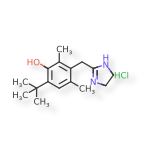
SALT/SOLVATE -> PARENT |
|
||
|
METABOLIC ENZYME -> NON-SUBSTRATE |
|
||
|
METABOLIC ENZYME -> NON-SUBSTRATE |
|
||
|
METABOLIC ENZYME -> NON-SUBSTRATE |
|
||
|
TARGET -> AGONIST | |||
|
METABOLIC ENZYME -> SUBSTRATE |
|
||
|
METABOLIC ENZYME -> NON-SUBSTRATE |
|
||
|
TARGET -> AGONIST |
Binding Assay
IC50
|
||
|
METABOLIC ENZYME -> NON-SUBSTRATE |
|
||
|
TARGET -> AGONIST |
IC50
|
||
|
TARGET -> AGONIST |

| Related Record | Type | Details | ||
|---|---|---|---|---|
|
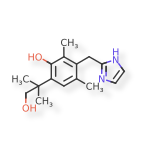
METABOLITE -> PARENT |
IN VITRO
|
||
|
METABOLITE -> PARENT |
IN VITRO
|
||
|
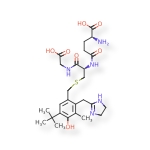
METABOLITE REACTIVE TYPE->PARENT |
|
||
|
METABOLITE -> PARENT |
IN VITRO
|

| Related Record | Type | Details | ||
|---|---|---|---|---|
|
|
ACTIVE MOIETY |
|