


Details
| Stereochemistry | ABSOLUTE |
| Molecular Formula | C43H58N4O12 |
| Molecular Weight | 822.9402 |
| Optical Activity | UNSPECIFIED |
| Defined Stereocenters | 9 / 9 |
| E/Z Centers | 1 |
| Charge | 0 |
SHOW SMILES / InChI
SMILES
CO[C@H]1\C=C\O[C@@]2(C)OC3=C(C2=O)C4=C(O)C(\C=N\N5CCN(C)CC5)=C(NC(=O)C(C)=C\C=C\[C@H](C)[C@H](O)[C@@H](C)[C@@H](O)[C@@H](C)[C@H](OC(C)=O)[C@@H]1C)C(O)=C4C(O)=C3C
InChI
InChIKey=JQXXHWHPUNPDRT-WLSIYKJHSA-N
InChI=1S/C43H58N4O12/c1-21-12-11-13-22(2)42(55)45-33-28(20-44-47-17-15-46(9)16-18-47)37(52)30-31(38(33)53)36(51)26(6)40-32(30)41(54)43(8,59-40)57-19-14-29(56-10)23(3)39(58-27(7)48)25(5)35(50)24(4)34(21)49/h11-14,19-21,23-25,29,34-35,39,49-53H,15-18H2,1-10H3,(H,45,55)/b12-11+,19-14+,22-13-,44-20+/t21-,23+,24+,25+,29-,34-,35+,39+,43-/m0/s1
| Molecular Formula | C43H58N4O12 |
| Molecular Weight | 822.9402 |
| Charge | 0 |
| Count |
|
| Stereochemistry | ABSOLUTE |
| Additional Stereochemistry | No |
| Defined Stereocenters | 9 / 9 |
| E/Z Centers | 1 |
| Optical Activity | UNSPECIFIED |
DescriptionCurator's Comment: description was created based on several sources, including:
http://www.rxlist.com/rifadin-drug.htm
http://www.wikidoc.org/index.php/Rifampin_(oral)
Curator's Comment: description was created based on several sources, including:
http://www.rxlist.com/rifadin-drug.htm
http://www.wikidoc.org/index.php/Rifampin_(oral)
Rifampin is an antibiotic that inhibits DNA-dependent RNA polymerase activity in susceptible cells. Specifically, it interacts with bacterial RNA polymerase but does not inhibit the mammalian enzyme. It is bactericidal and has a very broad spectrum of activity against most gram-positive and gram-negative organisms (including Pseudomonas aeruginosa) and specifically Mycobacterium tuberculosis. It is FDA approved for the treatment of tuberculosis, meningococcal carrier state. Healthy subjects who received rifampin 600 mg once daily concomitantly with saquinavir 1000 mg/ritonavir 100 mg twice daily (ritonavir-boosted saquinavir) developed severe hepatocellular toxicity. Rifampin has been reported to substantially decrease the plasma concentrations of the following antiviral drugs: atazanavir, darunavir, fosamprenavir, saquinavir, and tipranavir. These antiviral drugs must not be co-administered with rifampin. Common adverse reactions include heartburn, epigastric distress, anorexia, nausea, vomiting, jaundice, flatulence, cramps.
Originator
Approval Year
Targets
| Primary Target | Pharmacology | Condition | Potency |
|---|---|---|---|
Target ID: P0A8V2 Gene ID: 948488.0 Gene Symbol: rpoB Target Organism: Escherichia coli (strain K12) |
|||
Target ID: CHEMBL340 |
18.5 µM [Ki] | ||
Target ID: CHEMBL3721 |
30.2 µM [Ki] |
Conditions
| Condition | Modality | Targets | Highest Phase | Product |
|---|---|---|---|---|
| Primary | RIFADIN Approved UseIn the treatment of both tuberculosis and the meningococcal carrier state, the small number of resistant cells present within large populations of susceptible cells can rapidly become the predominant type. Bacteriologic cultures should be obtained before the start of therapy to confirm the susceptibility of the organism to rifampin and they should be repeated throughout therapy to monitor the response to treatment. Since resistance can emerge rapidly, susceptibility tests should be performed in the event of persistent positive cultures during the course of treatment. If test results show resistance to rifampin and the patient is not responding to therapy, the drug regimen should be modified. Tuberculosis Rifampin is indicated in the treatment of all forms of tuberculosis. A three-drug regimen consisting of rifampin, isoniazid, and pyrazinamide (e.g., RIFATER®) is recommended in the initial phase of short-course therapy which is usually continued for 2 months. The Advisory Council for the Elimination of Tuberculosis, the American Thoracic Society, and Centers for Disease Control and Prevention recommend that either streptomycin or ethambutol be added as a fourth drug in a regimen containing isoniazid (INH), rifampin, and pyrazinamide for initial treatment of tuberculosis unless the likelihood of INH resistance is very low. The need for a fourth drug should be reassessed when the results of susceptibility testing are known. If community rates of INH resistance are currently less than 4%, an initial treatment regimen with less than four drugs may be considered. Following the initial phase, treatment should be continued with rifampin and isoniazid (e.g., RIFAMATE®) for at least 4 months. Treatment should be continued for longer if the patient is still sputum or culture positive, if resistant organisms are present, or if the patient is HIV positive. RIFADIN IV is indicated for the initial treatment and retreatment of tuberculosis when the drug cannot be taken by mouth. Meningococcal Carriers Rifampin is indicated for the treatment of asymptomatic carriers of Neisseria meningitidis to eliminate meningococci from the nasopharynx. Rifampin is not indicated for the treatment of meningococcal infection because of the possibility of the rapid emergence of resistant organisms. (See WARNINGS.) Rifampin should not be used indiscriminately, and therefore, diagnostic laboratory procedures, including serotyping and susceptibility testing, should be performed for establishment of the carrier state and the correct treatment. So that the usefulness of rifampin in the treatment of asymptomatic meningococcal carriers is preserved, the drug should be used only when the risk of meningococcal disease is high. To reduce the development of drug-resistant bacteria and maintain the effectiveness of rifampin and other antibacterial drugs, rifampin should be used only to treat or prevent infections that are proven or strongly suspected to be caused by susceptible bacteria. When culture and susceptibility information are available, they should be considered in selecting or modifying antibacterial therapy. In the absence of such data, local epidemiology and susceptibility patterns may contribute to the empiric selection of therapy. Launch Date1971 |
|||
| Curative | RIFADIN Approved UseIn the treatment of both tuberculosis and the meningococcal carrier state, the small number of resistant cells present within large populations of susceptible cells can rapidly become the predominant type. Bacteriologic cultures should be obtained before the start of therapy to confirm the susceptibility of the organism to rifampin and they should be repeated throughout therapy to monitor the response to treatment. Since resistance can emerge rapidly, susceptibility tests should be performed in the event of persistent positive cultures during the course of treatment. If test results show resistance to rifampin and the patient is not responding to therapy, the drug regimen should be modified. Tuberculosis Rifampin is indicated in the treatment of all forms of tuberculosis. A three-drug regimen consisting of rifampin, isoniazid, and pyrazinamide (e.g., RIFATER®) is recommended in the initial phase of short-course therapy which is usually continued for 2 months. The Advisory Council for the Elimination of Tuberculosis, the American Thoracic Society, and Centers for Disease Control and Prevention recommend that either streptomycin or ethambutol be added as a fourth drug in a regimen containing isoniazid (INH), rifampin, and pyrazinamide for initial treatment of tuberculosis unless the likelihood of INH resistance is very low. The need for a fourth drug should be reassessed when the results of susceptibility testing are known. If community rates of INH resistance are currently less than 4%, an initial treatment regimen with less than four drugs may be considered. Following the initial phase, treatment should be continued with rifampin and isoniazid (e.g., RIFAMATE®) for at least 4 months. Treatment should be continued for longer if the patient is still sputum or culture positive, if resistant organisms are present, or if the patient is HIV positive. RIFADIN IV is indicated for the initial treatment and retreatment of tuberculosis when the drug cannot be taken by mouth. Meningococcal Carriers Rifampin is indicated for the treatment of asymptomatic carriers of Neisseria meningitidis to eliminate meningococci from the nasopharynx. Rifampin is not indicated for the treatment of meningococcal infection because of the possibility of the rapid emergence of resistant organisms. (See WARNINGS.) Rifampin should not be used indiscriminately, and therefore, diagnostic laboratory procedures, including serotyping and susceptibility testing, should be performed for establishment of the carrier state and the correct treatment. So that the usefulness of rifampin in the treatment of asymptomatic meningococcal carriers is preserved, the drug should be used only when the risk of meningococcal disease is high. To reduce the development of drug-resistant bacteria and maintain the effectiveness of rifampin and other antibacterial drugs, rifampin should be used only to treat or prevent infections that are proven or strongly suspected to be caused by susceptible bacteria. When culture and susceptibility information are available, they should be considered in selecting or modifying antibacterial therapy. In the absence of such data, local epidemiology and susceptibility patterns may contribute to the empiric selection of therapy. Launch Date1971 |
Cmax
| Value | Dose | Co-administered | Analyte | Population |
|---|---|---|---|---|
6.3 mg/L EXPERIMENT https://pubmed.ncbi.nlm.nih.gov/22330931/ |
10 mg/kg 1 times / day steady-state, oral dose: 10 mg/kg route of administration: Oral experiment type: STEADY-STATE co-administered: |
RIFAMPIN serum | Homo sapiens population: UNHEALTHY age: ADULT sex: FEMALE food status: UNKNOWN |
|
3.3 mg/L EXPERIMENT https://pubmed.ncbi.nlm.nih.gov/22330931/ |
10 mg/kg 1 times / day steady-state, oral dose: 10 mg/kg route of administration: Oral experiment type: STEADY-STATE co-administered: |
RIFAMPIN serum | Homo sapiens population: UNHEALTHY age: ADULT sex: MALE food status: UNKNOWN |
|
7.4 mg/L EXPERIMENT https://pubmed.ncbi.nlm.nih.gov/25654354/ |
10 mg/kg 1 times / day steady-state, oral dose: 10 mg/kg route of administration: Oral experiment type: STEADY-STATE co-administered: ISONIAZID |
RIFAMPIN serum | Homo sapiens population: UNHEALTHY age: ADULT sex: UNKNOWN food status: UNKNOWN |
|
21.6 mg/L EXPERIMENT https://pubmed.ncbi.nlm.nih.gov/25654354/ |
20 mg/kg 1 times / day steady-state, oral dose: 20 mg/kg route of administration: Oral experiment type: STEADY-STATE co-administered: ISONIAZID |
RIFAMPIN serum | Homo sapiens population: UNHEALTHY age: ADULT sex: UNKNOWN food status: UNKNOWN |
|
25.1 mg/L EXPERIMENT https://pubmed.ncbi.nlm.nih.gov/25654354/ |
25 mg/kg 1 times / day steady-state, oral dose: 25 mg/kg route of administration: Oral experiment type: STEADY-STATE co-administered: ISONIAZID |
RIFAMPIN serum | Homo sapiens population: UNHEALTHY age: ADULT sex: UNKNOWN food status: UNKNOWN |
|
33.1 mg/L EXPERIMENT https://pubmed.ncbi.nlm.nih.gov/25654354/ |
30 mg/kg 1 times / day steady-state, oral dose: 30 mg/kg route of administration: Oral experiment type: STEADY-STATE co-administered: ISONIAZID |
RIFAMPIN serum | Homo sapiens population: UNHEALTHY age: ADULT sex: UNKNOWN food status: UNKNOWN |
|
35.2 mg/L EXPERIMENT https://pubmed.ncbi.nlm.nih.gov/25654354/ |
35 mg/kg 1 times / day steady-state, oral dose: 35 mg/kg route of administration: Oral experiment type: STEADY-STATE co-administered: ISONIAZID |
RIFAMPIN serum | Homo sapiens population: UNHEALTHY age: ADULT sex: UNKNOWN food status: UNKNOWN |
AUC
| Value | Dose | Co-administered | Analyte | Population |
|---|---|---|---|---|
26.3 mg × h/L EXPERIMENT https://pubmed.ncbi.nlm.nih.gov/25654354/ |
10 mg/kg 1 times / day steady-state, oral dose: 10 mg/kg route of administration: Oral experiment type: STEADY-STATE co-administered: ISONIAZID |
RIFAMPIN serum | Homo sapiens population: UNHEALTHY age: ADULT sex: UNKNOWN food status: UNKNOWN |
|
113 mg × h/L EXPERIMENT https://pubmed.ncbi.nlm.nih.gov/25654354/ |
20 mg/kg 1 times / day steady-state, oral dose: 20 mg/kg route of administration: Oral experiment type: STEADY-STATE co-administered: ISONIAZID |
RIFAMPIN serum | Homo sapiens population: UNHEALTHY age: ADULT sex: UNKNOWN food status: UNKNOWN |
|
135 mg × h/L EXPERIMENT https://pubmed.ncbi.nlm.nih.gov/25654354/ |
25 mg/kg 1 times / day steady-state, oral dose: 25 mg/kg route of administration: Oral experiment type: STEADY-STATE co-administered: ISONIAZID |
RIFAMPIN serum | Homo sapiens population: UNHEALTHY age: ADULT sex: UNKNOWN food status: UNKNOWN |
|
190 mg × h/L EXPERIMENT https://pubmed.ncbi.nlm.nih.gov/25654354/ |
30 mg/kg 1 times / day steady-state, oral dose: 30 mg/kg route of administration: Oral experiment type: STEADY-STATE co-administered: ISONIAZID |
RIFAMPIN serum | Homo sapiens population: UNHEALTHY age: ADULT sex: UNKNOWN food status: UNKNOWN |
|
235 mg × h/L EXPERIMENT https://pubmed.ncbi.nlm.nih.gov/25654354/ |
35 mg/kg 1 times / day steady-state, oral dose: 35 mg/kg route of administration: Oral experiment type: STEADY-STATE co-administered: ISONIAZID |
RIFAMPIN serum | Homo sapiens population: UNHEALTHY age: ADULT sex: UNKNOWN food status: UNKNOWN |
|
325 μg × h/mL EXPERIMENT https://pubmed.ncbi.nlm.nih.gov/9773393/ |
600 mg single, oral dose: 600 mg route of administration: Oral experiment type: SINGLE co-administered: |
RIFAMPIN plasma | Homo sapiens population: HEALTHY age: ADULT sex: FEMALE food status: UNKNOWN |
T1/2
| Value | Dose | Co-administered | Analyte | Population |
|---|---|---|---|---|
16.3 h EXPERIMENT https://pubmed.ncbi.nlm.nih.gov/9773393/ |
600 mg single, oral dose: 600 mg route of administration: Oral experiment type: SINGLE co-administered: |
RIFAMPIN plasma | Homo sapiens population: HEALTHY age: ADULT sex: FEMALE food status: UNKNOWN |
|
17.3 h EXPERIMENT https://pubmed.ncbi.nlm.nih.gov/9773393/ |
600 mg single, oral dose: 600 mg route of administration: Oral experiment type: SINGLE co-administered: |
25-DESACETYLRIFAMPIN plasma | Homo sapiens population: HEALTHY age: ADULT sex: FEMALE food status: UNKNOWN |
Doses
| Dose | Population | Adverse events |
|---|---|---|
60 g single, oral Overdose |
unknown, 26 years |
Other AEs: Pruritus... |
1200 mg 1 times / day multiple, oral Highest studied dose Dose: 1200 mg, 1 times / day Route: oral Route: multiple Dose: 1200 mg, 1 times / day Sources: |
unhealthy, adult |
|
1200 mg single, intravenous Highest studied dose Dose: 1200 mg Route: intravenous Route: single Dose: 1200 mg Sources: |
unknown, adult |
AEs
| AE | Significance | Dose | Population |
|---|---|---|---|
| Pruritus | grade 5, 1 patient | 60 g single, oral Overdose |
unknown, 26 years |
Overview
| CYP3A4 | CYP2C9 | CYP2D6 | hERG |
|---|---|---|---|
OverviewOther
| Other Inhibitor | Other Substrate | Other Inducer |
|---|---|---|
Drug as perpetrator
| Target | Modality | Activity | Metabolite | Clinical evidence |
|---|---|---|---|---|
| no | ||||
| no | ||||
| no | ||||
| no | ||||
| no | ||||
| yes [IC50 79.1 uM] | ||||
| yes [Ki 18.5 uM] | ||||
| yes [Ki 30.2 uM] | ||||
| yes | ||||
| yes | ||||
| yes | ||||
| yes | ||||
| yes | yes (co-administration study) Comment: induced levels of CYP1C19 apoprotein to 330% of control; coadministration with simvastatin: decrease exposure of simvastatin; coadministration with irinotecan: decrease irinotecan and active metabolite exposure; rifampicin reduced AUC of repaglinide by 57%; Page: 12.0 |
|||
| yes | yes (co-administration study) Comment: Coadministration of ertugliflozin with rifampin decreased ertugliflozin AUC0-∞ and Cmax by 39% and 15%, respectively |
PubMed
| Title | Date | PubMed |
|---|---|---|
| Glucocorticoid receptor enhancement of pregnane X receptor-mediated CYP2B6 regulation in primary human hepatocytes. | 2003-05 |
|
| Regulation of CYP3A4 expression in human hepatocytes by pharmaceuticals and natural products. | 2003-05 |
|
| A novel distal enhancer module regulated by pregnane X receptor/constitutive androstane receptor is essential for the maximal induction of CYP2B6 gene expression. | 2003-04-18 |
|
| Induction of CYP3As in HepG2 cells by several drugs. Association between induction of CYP3A4 and expression of glucocorticoid receptor. | 2003-04 |
|
| Synergic activity of fluoroquinolones and linezolid against Mycobacterium tuberculosis. | 2003-04 |
|
| Comparative effects of thiazolidinediones on in vitro P450 enzyme induction and inhibition. | 2003-04 |
|
| Induction of cytochrome P450 enzymes in cultured precision-cut human liver slices. | 2003-03 |
|
| Molecular basis of rifampicin-induced inhibition of anti-CD95-induced apoptosis of peripheral blood T lymphocytes: the role of CD95 ligand and FLIPs. | 2003-01 |
|
| Activities of moxifloxacin alone and in combination with other antimicrobial agents against multidrug-resistant Mycobacterium tuberculosis infection in BALB/c mice. | 2003-01 |
|
| Receptor-dependent regulation of the CYP3A4 gene. | 2002-12-27 |
|
| PXR-dependent induction of human CYP3A4 gene expression by organochlorine pesticides. | 2002-11-15 |
|
| 3-[4'-bromo-(1,1'-biphenyl)-4-yl]-N, N-dimethyl-3-(2-thienyl)-2-propen-1-amine: synthesis, cytotoxicity, and leishmanicidal, trypanocidal and antimycobacterial activities. | 2002-11 |
|
| Regulation of a xenobiotic sulfonation cascade by nuclear pregnane X receptor (PXR). | 2002-10-15 |
|
| Endocarditis caused by methicillin-resistant Staphylococcus aureus: treatment failure with linezolid. | 2002-10-15 |
|
| Acute renal failure due to rifampicin: a study of 25 patients. | 2002-10 |
|
| A cell-based reporter gene assay for determining induction of CYP3A4 in a high-volume system. | 2002-10 |
|
| Simple fibroblast-based assay for screening of new antimicrobial drugs against Mycobacterium tuberculosis. | 2002-08 |
|
| Functional analysis of the rat bile salt export pump gene promoter. | 2002-07 |
|
| CYP3A4 induction by drugs: correlation between a pregnane X receptor reporter gene assay and CYP3A4 expression in human hepatocytes. | 2002-07 |
|
| [Specific features of acute renal failure in patients treated with rifampicin]. | 2002-06-05 |
|
| Paraquat detoxicative system in the mouse liver postmitochondrial fraction. | 2002-06-01 |
|
| Diffuse glomerulonephritis associated with rifampicin treatment for tuberculosis. | 2002-06 |
|
| Evaluation of gene induction of drug-metabolizing enzymes and transporters in primary culture of human hepatocytes using high-sensitivity real-time reverse transcription PCR. | 2002-05 |
|
| Death associated with rifampin and pyrazinamide 2-month treatment of latent mycobacterium tuberculosis. | 2002-05 |
|
| [Post-rifampicin acute renal failure--serious, but seldom recognized complication of the anti-tuberculosis treatment]. | 2002-04-30 |
|
| Limitations in the use of rifampicin-gelatin grafts against virulent organisms. | 2002-04 |
|
| Influence of redox-active compounds and PXR-activators on human MRP1 and MRP2 gene expression. | 2002-02-28 |
|
| Comparative inhibitory effects of different compounds on rat oatpl (slc21a1)- and Oatp2 (Slc21a5)-mediated transport. | 2002-02 |
|
| In vitro activity of 11 antimicrobial agents, including gatifloxacin and GAR936, tested against clinical isolates of Mycobacterium marinum. | 2002-02 |
|
| Antimicrobial activities of clarithromycin, gatifloxacin and sitafloxacin, in combination with various antimycobacterial drugs against extracellular and intramacrophage Mycobacterium avium complex. | 2002-02 |
|
| Rifampicin inhibits CD95-mediated apoptosis of Jurkat T cells via glucocorticoid receptors by modifying the expression of molecules regulating apoptosis. | 2002-01 |
|
| Rapidly progressive glomerulonephritis due to rifampicin therapy. | 2002-01 |
|
| Induction of multidrug resistance-1 and cytochrome P450 mRNAs in human mononuclear cells by rifampin. | 2002-01 |
|
| The drug efflux pump MRP2: regulation of expression in physiopathological situations and by endogenous and exogenous compounds. | 2002 |
|
| Bactericidal activities of commonly used antiseptics against multidrug-resistant mycobacterium tuberculosis. | 2002 |
|
| Postantibiotic effects of antituberculosis agents alone and in combination. | 2001-12 |
|
| Acute renal failure caused by rifampicin re-exposure with 10-year of interval. | 2001-11 |
|
| Retrospective analysis of drug-induced urticaria and angioedema: a survey of 2287 patients. | 2001-11 |
|
| Antimycobacterial plant terpenoids. | 2001-11 |
|
| Rifampicin-induced erythema nodosum leprosum-like eruption in borderline lepromatous leprosy. | 2001-10-03 |
|
| Bisphenol-A, an environmental estrogen, activates the human orphan nuclear receptor, steroid and xenobiotic receptor-mediated transcription. | 2001-10 |
|
| Acute renal failure complicating rifampicin therapy. | 2001-09 |
|
| Optic neuropathy after treatment with anti-tuberculous drugs in a subject with Leber's hereditary optic neuropathy mutation. | 2001-09 |
|
| [Clinico-pathological features and possible pathogenesis of rifampicin-induced acute renal failure]. | 2001-06 |
|
| CYP3A inductive potential of the rifamycins, rifabutin and rifampin, in the rabbit. | 2001-05 |
|
| Antibacterials for the prophylaxis and treatment of bacterial endocarditis in children. | 2001 |
|
| Rifampin-induced methadone withdrawal. | 1976-05-13 |
|
| [Tolerance of rifampicin in long-term treatment of patients with pulmonary tuberculosis]. | 1976-02 |
|
| [A new case of acute renal failure, with high hemolysis, after rifampicin (author's transl)]. | 1975-11-01 |
|
| [Letter: Acute renal failure caused by rifampicin]. | 1975-04-19 |
Patents
Sample Use Guides
Tuberculosis: 10 mg/kg, in a single daily administration, not to exceed 600 mg/day, oral or intravenous. It is recommended that oral rifampin be administered once daily, either 1 hour before or 2 hours after a meal with a full glass of water.
Meningococcal Carriers: it is recommended that 600 mg rifampin be administered twice daily for two days.
Route of Administration:
Other
| Substance Class |
Chemical
Created
by
admin
on
Edited
Wed Apr 02 06:52:05 GMT 2025
by
admin
on
Wed Apr 02 06:52:05 GMT 2025
|
| Record UNII |
VJT6J7R4TR
|
| Record Status |
Validated (UNII)
|
| Record Version |
|
-
Download
| Name | Type | Language | ||
|---|---|---|---|---|
|
Preferred Name | English | ||
|
Official Name | English | ||
|
Common Name | English | ||
|
Common Name | English | ||
|
Code | English | ||
|
Brand Name | English | ||
|
Common Name | English | ||
|
Code | English | ||
|
Code | English | ||
|
Brand Name | English | ||
|
Common Name | English | ||
|
Brand Name | English | ||
|
Code | English | ||
|
Common Name | English | ||
|
Systematic Name | English | ||
|
Brand Name | English | ||
|
Common Name | English | ||
|
Common Name | English | ||
|
Common Name | English | ||
|
Code | English | ||
|
Brand Name | English | ||
|
Common Name | English | ||
|
Common Name | English | ||
|
Code | English | ||
|
Brand Name | English | ||
|
Common Name | English | ||
|
Brand Name | English | ||
|
Common Name | English | ||
|
Common Name | English | ||
|
Code | English | ||
|
Common Name | English | ||
|
Code | English | ||
|
Common Name | English | ||
|
Common Name | English | ||
|
Common Name | English | ||
|
Systematic Name | English | ||
|
Brand Name | English | ||
|
Common Name | English | ||
|
Brand Name | English | ||
|
Brand Name | English | ||
|
Common Name | English | ||
|
Common Name | English | ||
|
Common Name | English | ||
|
Brand Name | English | ||
|
Common Name | English |
| Classification Tree | Code System | Code | ||
|---|---|---|---|---|
|
FDA ORPHAN DRUG |
6585
Created by
admin on Wed Apr 02 06:52:05 GMT 2025 , Edited by admin on Wed Apr 02 06:52:05 GMT 2025
|
||
|
WHO-ESSENTIAL MEDICINES LIST |
6.2.4 (ETH/ISO/PYR/RIF)
Created by
admin on Wed Apr 02 06:52:05 GMT 2025 , Edited by admin on Wed Apr 02 06:52:05 GMT 2025
|
||
|
NDF-RT |
N0000175500
Created by
admin on Wed Apr 02 06:52:05 GMT 2025 , Edited by admin on Wed Apr 02 06:52:05 GMT 2025
|
||
|
WHO-ESSENTIAL MEDICINES LIST |
6.2.4 (ISO/RIF)
Created by
admin on Wed Apr 02 06:52:05 GMT 2025 , Edited by admin on Wed Apr 02 06:52:05 GMT 2025
|
||
|
WHO-ESSENTIAL MEDICINES LIST |
6.2.4 (ISO/PYR/RIF)
Created by
admin on Wed Apr 02 06:52:05 GMT 2025 , Edited by admin on Wed Apr 02 06:52:05 GMT 2025
|
||
|
FDA ORPHAN DRUG |
7685
Created by
admin on Wed Apr 02 06:52:05 GMT 2025 , Edited by admin on Wed Apr 02 06:52:05 GMT 2025
|
||
|
WHO-ESSENTIAL MEDICINES LIST |
6.2.3
Created by
admin on Wed Apr 02 06:52:05 GMT 2025 , Edited by admin on Wed Apr 02 06:52:05 GMT 2025
|
||
|
NDF-RT |
N0000007911
Created by
admin on Wed Apr 02 06:52:05 GMT 2025 , Edited by admin on Wed Apr 02 06:52:05 GMT 2025
|
||
|
NDF-RT |
N0000007911
Created by
admin on Wed Apr 02 06:52:05 GMT 2025 , Edited by admin on Wed Apr 02 06:52:05 GMT 2025
|
||
|
WHO-VATC |
QJ04AM05
Created by
admin on Wed Apr 02 06:52:05 GMT 2025 , Edited by admin on Wed Apr 02 06:52:05 GMT 2025
|
||
|
WHO-ATC |
J04AB02
Created by
admin on Wed Apr 02 06:52:05 GMT 2025 , Edited by admin on Wed Apr 02 06:52:05 GMT 2025
|
||
|
WHO-ATC |
J04AM07
Created by
admin on Wed Apr 02 06:52:05 GMT 2025 , Edited by admin on Wed Apr 02 06:52:05 GMT 2025
|
||
|
WHO-ATC |
J04AM02
Created by
admin on Wed Apr 02 06:52:05 GMT 2025 , Edited by admin on Wed Apr 02 06:52:05 GMT 2025
|
||
|
WHO-ATC |
J04AM05
Created by
admin on Wed Apr 02 06:52:05 GMT 2025 , Edited by admin on Wed Apr 02 06:52:05 GMT 2025
|
||
|
NCI_THESAURUS |
C280
Created by
admin on Wed Apr 02 06:52:05 GMT 2025 , Edited by admin on Wed Apr 02 06:52:05 GMT 2025
|
||
|
FDA ORPHAN DRUG |
928022
Created by
admin on Wed Apr 02 06:52:05 GMT 2025 , Edited by admin on Wed Apr 02 06:52:05 GMT 2025
|
||
|
WHO-VATC |
QJ04AB02
Created by
admin on Wed Apr 02 06:52:05 GMT 2025 , Edited by admin on Wed Apr 02 06:52:05 GMT 2025
|
||
|
NDF-RT |
N0000007911
Created by
admin on Wed Apr 02 06:52:05 GMT 2025 , Edited by admin on Wed Apr 02 06:52:05 GMT 2025
|
||
|
WHO-ESSENTIAL MEDICINES LIST |
6.2.4
Created by
admin on Wed Apr 02 06:52:05 GMT 2025 , Edited by admin on Wed Apr 02 06:52:05 GMT 2025
|
||
|
WHO-VATC |
QJ04AM02
Created by
admin on Wed Apr 02 06:52:05 GMT 2025 , Edited by admin on Wed Apr 02 06:52:05 GMT 2025
|
||
|
WHO-ATC |
J04AM06
Created by
admin on Wed Apr 02 06:52:05 GMT 2025 , Edited by admin on Wed Apr 02 06:52:05 GMT 2025
|
||
|
WHO-ESSENTIAL MEDICINES LIST |
6.2.4 (ETH/ISO/RIF)
Created by
admin on Wed Apr 02 06:52:05 GMT 2025 , Edited by admin on Wed Apr 02 06:52:05 GMT 2025
|
||
|
WHO-VATC |
QJ04AM06
Created by
admin on Wed Apr 02 06:52:05 GMT 2025 , Edited by admin on Wed Apr 02 06:52:05 GMT 2025
|
||
|
NDF-RT |
N0000007911
Created by
admin on Wed Apr 02 06:52:05 GMT 2025 , Edited by admin on Wed Apr 02 06:52:05 GMT 2025
|
||
|
NCI_THESAURUS |
C25995
Created by
admin on Wed Apr 02 06:52:05 GMT 2025 , Edited by admin on Wed Apr 02 06:52:05 GMT 2025
|
||
|
WHO-VATC |
QJ54AB02
Created by
admin on Wed Apr 02 06:52:05 GMT 2025 , Edited by admin on Wed Apr 02 06:52:05 GMT 2025
|
||
|
LIVERTOX |
NBK548314
Created by
admin on Wed Apr 02 06:52:05 GMT 2025 , Edited by admin on Wed Apr 02 06:52:05 GMT 2025
|
| Code System | Code | Type | Description | ||
|---|---|---|---|---|---|
|
28077
Created by
admin on Wed Apr 02 06:52:05 GMT 2025 , Edited by admin on Wed Apr 02 06:52:05 GMT 2025
|
PRIMARY | |||
|
71365
Created by
admin on Wed Apr 02 06:52:05 GMT 2025 , Edited by admin on Wed Apr 02 06:52:05 GMT 2025
|
PRIMARY | |||
|
CHEMBL374478
Created by
admin on Wed Apr 02 06:52:05 GMT 2025 , Edited by admin on Wed Apr 02 06:52:05 GMT 2025
|
PRIMARY | |||
|
RIFAMPICIN
Created by
admin on Wed Apr 02 06:52:05 GMT 2025 , Edited by admin on Wed Apr 02 06:52:05 GMT 2025
|
PRIMARY | |||
|
RIFAMPIN
Created by
admin on Wed Apr 02 06:52:05 GMT 2025 , Edited by admin on Wed Apr 02 06:52:05 GMT 2025
|
PRIMARY | Description: A brick red to red-brown, crystalline powder. Solubility: Very slightly to slightly soluble in water; soluble in methanol R; slightly soluble in acetone R, ethanol (~750 g/l) TS, and ether R. Category: Antileprosy drug; antituberculosis drug. Storage: Rifampicin should be kept in a tightly closed container or in an atmosphere of nitrogen, protected from light. Additional information: Rifampicin exhibits polymorphism. Definition: Rifampicin contains not less than 97.0% and not more than 102.0% of C43H58N4O12, calculated with reference to the dried substance. | ||
|
100000080561
Created by
admin on Wed Apr 02 06:52:05 GMT 2025 , Edited by admin on Wed Apr 02 06:52:05 GMT 2025
|
PRIMARY | |||
|
VJT6J7R4TR
Created by
admin on Wed Apr 02 06:52:05 GMT 2025 , Edited by admin on Wed Apr 02 06:52:05 GMT 2025
|
PRIMARY | |||
|
DTXSID6021244
Created by
admin on Wed Apr 02 06:52:05 GMT 2025 , Edited by admin on Wed Apr 02 06:52:05 GMT 2025
|
PRIMARY | |||
|
9384
Created by
admin on Wed Apr 02 06:52:05 GMT 2025 , Edited by admin on Wed Apr 02 06:52:05 GMT 2025
|
PRIMARY | RxNorm | ||
|
2323
Created by
admin on Wed Apr 02 06:52:05 GMT 2025 , Edited by admin on Wed Apr 02 06:52:05 GMT 2025
|
PRIMARY | |||
|
3181
Created by
admin on Wed Apr 02 06:52:05 GMT 2025 , Edited by admin on Wed Apr 02 06:52:05 GMT 2025
|
PRIMARY | |||
|
135398735
Created by
admin on Wed Apr 02 06:52:05 GMT 2025 , Edited by admin on Wed Apr 02 06:52:05 GMT 2025
|
PRIMARY | |||
|
Rifampin
Created by
admin on Wed Apr 02 06:52:05 GMT 2025 , Edited by admin on Wed Apr 02 06:52:05 GMT 2025
|
PRIMARY | |||
|
1604009
Created by
admin on Wed Apr 02 06:52:05 GMT 2025 , Edited by admin on Wed Apr 02 06:52:05 GMT 2025
|
PRIMARY | |||
|
845504-52-1
Created by
admin on Wed Apr 02 06:52:05 GMT 2025 , Edited by admin on Wed Apr 02 06:52:05 GMT 2025
|
ALTERNATIVE | |||
|
D012293
Created by
admin on Wed Apr 02 06:52:05 GMT 2025 , Edited by admin on Wed Apr 02 06:52:05 GMT 2025
|
PRIMARY | |||
|
2765
Created by
admin on Wed Apr 02 06:52:05 GMT 2025 , Edited by admin on Wed Apr 02 06:52:05 GMT 2025
|
PRIMARY | |||
|
236-312-0
Created by
admin on Wed Apr 02 06:52:05 GMT 2025 , Edited by admin on Wed Apr 02 06:52:05 GMT 2025
|
PRIMARY | |||
|
C811
Created by
admin on Wed Apr 02 06:52:05 GMT 2025 , Edited by admin on Wed Apr 02 06:52:05 GMT 2025
|
PRIMARY | |||
|
SUB10309MIG
Created by
admin on Wed Apr 02 06:52:05 GMT 2025 , Edited by admin on Wed Apr 02 06:52:05 GMT 2025
|
PRIMARY | |||
|
m9611
Created by
admin on Wed Apr 02 06:52:05 GMT 2025 , Edited by admin on Wed Apr 02 06:52:05 GMT 2025
|
PRIMARY | Merck Index | ||
|
2377
Created by
admin on Wed Apr 02 06:52:05 GMT 2025 , Edited by admin on Wed Apr 02 06:52:05 GMT 2025
|
PRIMARY | |||
|
DB01045
Created by
admin on Wed Apr 02 06:52:05 GMT 2025 , Edited by admin on Wed Apr 02 06:52:05 GMT 2025
|
PRIMARY | |||
|
13292-46-1
Created by
admin on Wed Apr 02 06:52:05 GMT 2025 , Edited by admin on Wed Apr 02 06:52:05 GMT 2025
|
PRIMARY | |||
|
113926
Created by
admin on Wed Apr 02 06:52:05 GMT 2025 , Edited by admin on Wed Apr 02 06:52:05 GMT 2025
|
PRIMARY | |||
|
VJT6J7R4TR
Created by
admin on Wed Apr 02 06:52:05 GMT 2025 , Edited by admin on Wed Apr 02 06:52:05 GMT 2025
|
PRIMARY |
| Related Record | Type | Details | ||
|---|---|---|---|---|
|
TRANSPORTER -> SUBSTRATE | |||
|
METABOLIC ENZYME -> INDUCER | |||
|
TRANSPORTER -> SUBSTRATE | |||
|
TRANSPORTER -> INDUCER | |||
|
BINDER->LIGAND |
BINDING
|
||
|
METABOLIC ENZYME -> INDUCER | |||
|
METABOLIC ENZYME -> INDUCER | |||
|
METABOLIC ENZYME -> INDUCER | |||
|
TRANSPORTER -> INHIBITOR | |||
|
TRANSPORTER -> INHIBITOR | |||
|
METABOLIC ENZYME -> INDUCER | |||
|
TRANSPORTER -> INHIBITOR | |||
|
TRANSPORTER -> INHIBITOR | |||
|
TRANSPORTER -> INHIBITOR | |||
|
TRANSPORTER -> INHIBITOR | |||
|
TRANSPORTER -> INHIBITOR | |||
|
TARGET -> INHIBITOR |
|
||
|
TRANSPORTER -> INHIBITOR | |||
|
METABOLIC ENZYME -> INDUCER | |||
|
METABOLIC ENZYME -> INDUCER |


| Related Record | Type | Details | ||
|---|---|---|---|---|
|
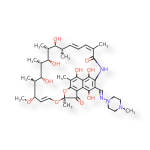
METABOLITE -> PARENT |
|
| Related Record | Type | Details | ||
|---|---|---|---|---|
|
|
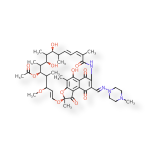
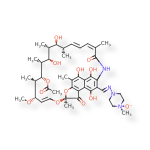
IMPURITY -> PARENT |
|
||
|
IMPURITY -> PARENT |
| Related Record | Type | Details | ||
|---|---|---|---|---|
|
|
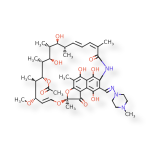
ACTIVE MOIETY |
|
| Name | Property Type | Amount | Referenced Substance | Defining | Parameters | References |
|---|---|---|---|---|---|---|
| Duration of Action | PHARMACOKINETIC |
|
ROUTE OF ADMINISTRATION: ORAL |
|
||
| MIC | BIOLOGICAL |
|
SUSCEPTIBILITY: RESISTANT |
|
||
| Biological Half-life | PHARMACOKINETIC |
|
|
|||
| Biological Half-life | PHARMACOKINETIC |
|
POPULATION: END-STAGE RENAL DISEASE |
|
||
| Tmax | PHARMACOKINETIC |
|
POPULATION: PEDIATRICS |
|
||
| Cmax | PHARMACOKINETIC |
|
POPULATION: PEDIATRICS |
|
||
| Biological Half-life | PHARMACOKINETIC |
|
ROUTE OF ADMINISTRATION: ORAL |
|
||
| Biological Half-life | PHARMACOKINETIC |
|
POPULATION: HEPATIC IMPAIRMENT |
|
||
| Biological Half-life | PHARMACOKINETIC |
|
ROUTE OF ADMINISTRATION: IV |
|
||
| Cmax | PHARMACOKINETIC |
|
POPULATION: PEDIATRICS |
|
||
| MIC | BIOLOGICAL |
|
PATHOGEN: N. MENINGIDITIS |
|
||
| Tmax | PHARMACOKINETIC |
|
ROUTE OF ADMINISTRATION: ORAL |
|
||
| MIC | BIOLOGICAL |
|
PATHOGEN: N. MENINGIDITIS |
|
||