


Details
| Stereochemistry | ABSOLUTE |
| Molecular Formula | C51H79NO13 |
| Molecular Weight | 914.1719 |
| Optical Activity | ( - ) |
| Defined Stereocenters | 15 / 15 |
| E/Z Centers | 0 |
| Charge | 0 |
SHOW SMILES / InChI
SMILES
CO[C@@H]1C[C@H](C[C@@H](C)[C@@H]2CC(=O)[C@H](C)\C=C(C)\[C@@H](O)[C@@H](OC)C(=O)[C@H](C)C[C@H](C)\C=C\C=C\C=C(C)\[C@H](C[C@@H]3CC[C@@H](C)[C@@](O)(O3)C(=O)C(=O)N4CCCC[C@H]4C(=O)O2)OC)CC[C@H]1O
InChI
InChIKey=QFJCIRLUMZQUOT-HPLJOQBZSA-N
InChI=1S/C51H79NO13/c1-30-16-12-11-13-17-31(2)42(61-8)28-38-21-19-36(7)51(60,65-38)48(57)49(58)52-23-15-14-18-39(52)50(59)64-43(33(4)26-37-20-22-40(53)44(27-37)62-9)29-41(54)32(3)25-35(6)46(56)47(63-10)45(55)34(5)24-30/h11-13,16-17,25,30,32-34,36-40,42-44,46-47,53,56,60H,14-15,18-24,26-29H2,1-10H3/b13-11+,16-12+,31-17+,35-25+/t30-,32-,33-,34-,36-,37+,38+,39+,40-,42+,43+,44-,46-,47+,51-/m1/s1
| Molecular Formula | C51H79NO13 |
| Molecular Weight | 914.1719 |
| Charge | 0 |
| Count |
|
| Stereochemistry | ABSOLUTE |
| Additional Stereochemistry | No |
| Defined Stereocenters | 15 / 15 |
| E/Z Centers | 0 |
| Optical Activity | UNSPECIFIED |
DescriptionCurator's Comment: description was created based on several sources, including
https://www.ncbi.nlm.nih.gov/pubmed/12742462
https://www.ncbi.nlm.nih.gov/pubmed/20005306
Curator's Comment: description was created based on several sources, including
https://www.ncbi.nlm.nih.gov/pubmed/12742462
https://www.ncbi.nlm.nih.gov/pubmed/20005306
Sirolimus is the USAN-assigned generic name for the natural product rapamycin. Sirolimus is produced by a strain of Streptomyces hygroscopicus, isolated from a soil sample collected from Rapa Nui commonly known as Easter Island. Although sirolimus was isolated as an antifungal agent with potent anticandida activity, subsequent studies revealed impressive antitumor and immunosuppressive activities. Sirolimus demonstrates activity against several murine tumors, such as B16 43 melanocarcinoma, Colon 26 tumor, EM ependymoblastoma, and mammary and colon 38 solid tumors. Demonstration of the potent immunosuppressive activity of sirolimus in animal models of organ transplantation led to clinical trials and subsequent approval by regulatory authorities for prophylaxis of renal graft rejection. Interest in sirolimus as an immunosuppressive therapy in organ transplantation derives from its unique mechanism of action, its unique side-effect profile, and its ability to synergize with other immunosuppressive agents. It is used in medicine to prevent organ transplant rejection and to treat lymphangioleiomyomatosis. Sirolimus inhibits T-lymphocyte activation and proliferation that occurs in response to antigenic and cytokine (Interleukin [IL]-2, IL-4, and IL-15) stimulation by a mechanism that is distinct from that of other immunosuppressants. Sirolimus also inhibits antibody production. In cells, sirolimus binds to the immunophilin, FK Binding Protein-12 (FKBP-12), to generate an immunosuppressive complex. This complex blocks the activation of the cell-cycle-specific kinase, TOR. The downstream events that follow the inactivation of TOR result in the blockage of cell-cycle progression at the juncture of G1 and S phase. Rapamycin/FKBP12 efficiently inhibit some, but not all, functions of mTOR and hence much interest has been placed in the development of drugs that target the kinase activity of mTOR directly. Studies in experimental models show that sirolimus prolongs allograft (kidney, heart, skin, islet, small bowel, pancreatico-duodenal, and bone marrow) survival in mice, rats, pigs, and/or primates. Sirolimus reverses acute rejection of heart and kidney allografts in rats and prolongs the graft survival in presensitized rats. In some studies, the immunosuppressive effect of sirolimus lasts up to 6 months after discontinuation of therapy. This tolerization effect is alloantigen-specific. In rodent models of autoimmune disease, sirolimus suppresses immune-mediated events associated with systemic lupus erythematosus, collagen-induced arthritis, autoimmune type I diabetes, autoimmune myocarditis, experimental allergic encephalomyelitis, graft-versus-host disease, and autoimmune uveoretinitis. Lymphangioleiomyomatosis involves lung tissue infiltration with smooth muscle-like cells that harbor inactivating mutations of the tuberous sclerosis complex (TSC) gene (LAM cells). Loss of TSC gene function activates the mTOR signaling pathway, resulting in cellular proliferation and release of lymphangiogenic growth factors. Sirolimus inhibits the activated mTOR pathway and thus the proliferation of LAM cells.
Approval Year
Targets
| Primary Target | Pharmacology | Condition | Potency |
|---|---|---|---|
Target ID: CHEMBL1902 |
Conditions
| Condition | Modality | Targets | Highest Phase | Product |
|---|---|---|---|---|
| Palliative | RAPAMUNE Approved UseRapamune is an immunosuppressive agent indicated for the prophylaxis of organ rejection in patients aged ≥13 years receiving renal transplants. Patients at low- to moderate-immunologic risk: Use initially with cyclosporine (CsA) and corticosteroids. CsA withdrawal is recommended 2-4 months after transplantation ( 1.1 ). Patients at high-immunologic risk: Use in combination with cyclosporine and corticosteroids for the first 12 months following transplantation ( 1.1 ). Safety and efficacy of CsA withdrawal has not been established in high risk patients ( 1.1 , 1.2 , 14.3 ). Therapeutic drug monitoring is recommended for all patients ( 2.3 , 5.14 ). 1.1 Prophylaxis of Organ Rejection in Renal Transplantation Rapamune (sirolimus) is indicated for the prophylaxis of organ rejection in patients aged 13 years or older receiving renal transplants. Therapeutic drug monitoring is recommended for all patients receiving Rapamune [see Dosage and Administration (2.3), Warnings and Precautions (5.14) Launch Date1999 |
Cmax
| Value | Dose | Co-administered | Analyte | Population |
|---|---|---|---|---|
33.6 ng/mL EXPERIMENT https://pubmed.ncbi.nlm.nih.gov/9129559/ |
5 mg single, oral dose: 5 mg route of administration: Oral experiment type: SINGLE co-administered: CYCLOSPORINE |
SIROLIMUS plasma | Homo sapiens population: UNHEALTHY age: ADULT sex: UNKNOWN food status: UNKNOWN |
|
78.2 ng/mL |
15 mg single, oral dose: 15 mg route of administration: Oral experiment type: SINGLE co-administered: |
SIROLIMUS plasma | Homo sapiens population: HEALTHY age: ADULT sex: FEMALE / MALE food status: UNKNOWN |
AUC
| Value | Dose | Co-administered | Analyte | Population |
|---|---|---|---|---|
607 ng × h/mL EXPERIMENT https://pubmed.ncbi.nlm.nih.gov/9129559/ |
5 mg single, oral dose: 5 mg route of administration: Oral experiment type: SINGLE co-administered: CYCLOSPORINE |
SIROLIMUS plasma | Homo sapiens population: UNHEALTHY age: ADULT sex: UNKNOWN food status: UNKNOWN |
|
970 ng × h/mL |
15 mg single, oral dose: 15 mg route of administration: Oral experiment type: SINGLE co-administered: |
SIROLIMUS plasma | Homo sapiens population: HEALTHY age: ADULT sex: FEMALE / MALE food status: UNKNOWN |
T1/2
| Value | Dose | Co-administered | Analyte | Population |
|---|---|---|---|---|
62 h |
5 mg 1 times / day steady-state, oral dose: 5 mg route of administration: Oral experiment type: STEADY-STATE co-administered: |
SIROLIMUS plasma | Homo sapiens population: UNKNOWN age: UNKNOWN sex: UNKNOWN food status: UNKNOWN |
|
79 h |
15 mg single, oral dose: 15 mg route of administration: Oral experiment type: SINGLE co-administered: |
SIROLIMUS plasma | Homo sapiens population: HEALTHY age: ADULT sex: FEMALE / MALE food status: UNKNOWN |
Funbound
| Value | Dose | Co-administered | Analyte | Population |
|---|---|---|---|---|
8% |
5 mg 1 times / day steady-state, oral dose: 5 mg route of administration: Oral experiment type: STEADY-STATE co-administered: |
SIROLIMUS plasma | Homo sapiens population: UNKNOWN age: UNKNOWN sex: UNKNOWN food status: UNKNOWN |
|
6% |
15 mg single, oral dose: 15 mg route of administration: Oral experiment type: SINGLE co-administered: |
SIROLIMUS plasma | Homo sapiens population: HEALTHY age: ADULT sex: FEMALE / MALE food status: UNKNOWN |
Overview
| CYP3A4 | CYP2C9 | CYP2D6 | hERG |
|---|---|---|---|
OverviewOther
| Other Inhibitor | Other Substrate | Other Inducer |
|---|---|---|
Drug as perpetrator
| Target | Modality | Activity | Metabolite | Clinical evidence |
|---|---|---|---|---|
Page: 5.0 |
no | |||
Page: 1.0 |
yes [EC50 3.6 uM] | |||
| yes [IC50 1.3 uM] | ||||
| yes [IC50 11.2 uM] | ||||
| yes [IC50 9.8 uM] | ||||
| yes | ||||
| yes | ||||
| yes | ||||
| yes |
Drug as victim
| Target | Modality | Activity | Metabolite | Clinical evidence |
|---|---|---|---|---|
Page: 1.0 |
no | |||
| yes | yes (co-administration study) Comment: administered with cyclosporine: mean Cmax and AUC were increased by 512% and 148%, respectively, relative to administration of sirolimus alone. However, when given 4 hours after cyclosporine administration, sirolimus Cmax and AUC were both increased by only 33% compared with administration of sirolimus alone; administered with diltiazem: Sirolimus Cmax, tmax, and AUC were increased 1.4-, 1.3-, and 1.6-fold, respectively. Sirolimus did not affect the pharmacokinetics of either diltiazem or its metabolites; administered with erythromycin: Sirolimus Cmax and AUC were increased 4.4- and 4.2-fold respectively and tmax was increased by 0.4 hr. Sirolimus did not affect the pharmacokinetics of either diltiazem or its metabolites; administered with ketoconazole; increases in sirolimus Cmax, tmax, and AUC of 4.3-fold, 38%, and 10.9-fold. Single-dose sirolimus did not affect steady-state 12-hour plasma ketoconazole concentrations; administered with rifampin; decreased sirolimus AUC and Cmax by about 82% and 71%, respectively; administered with verapamil: l. Sirolimus Cmax and AUC were increased 2.3- and 2.2-fold, respectively. Cmax and AUC of the pharmacologically active S(-) enantiomer of verapamil were both increased 1.5-fold and tmax was decreased by 1.2 hr; Sources: https://www.accessdata.fda.gov/drugsatfda_docs/label/2020/021083s067,021110s085lbl.pdf#page=27 Page: 19, 27-29 |
|||
| yes | yes (co-administration study) Comment: administered with cyclosporine: mean Cmax and AUC were increased by 512% and 148%, respectively, relative to administration of sirolimus alone. However, when given 4 hours after cyclosporine administration, sirolimus Cmax and AUC were both increased by only 33% compared with administration of sirolimus alone; administered with diltiazem: Sirolimus Cmax, tmax, and AUC were increased 1.4-, 1.3-, and 1.6-fold, respectively. Sirolimus did not affect the pharmacokinetics of either diltiazem or its metabolites; administered with erythromycin: Sirolimus Cmax and AUC were increased 4.4- and 4.2-fold respectively and tmax was increased by 0.4 hr. Sirolimus did not affect the pharmacokinetics of either diltiazem or its metabolites; administered with ketoconazole; increases in sirolimus Cmax, tmax, and AUC of 4.3-fold, 38%, and 10.9-fold. Single-dose sirolimus did not affect steady-state 12-hour plasma ketoconazole concentrations; administered with rifampin; decreased sirolimus AUC and Cmax by about 82% and 71%, respectively; administered with verapamil: l. Sirolimus Cmax and AUC were increased 2.3- and 2.2-fold, respectively. Cmax and AUC of the pharmacologically active S(-) enantiomer of verapamil were both increased 1.5-fold and tmax was decreased by 1.2 hr; Sources: https://www.accessdata.fda.gov/drugsatfda_docs/label/2020/021083s067,021110s085lbl.pdf#page=27 Page: 19, 27-29 |
PubMed
| Title | Date | PubMed |
|---|---|---|
| Hormonally active vitamin D3 (1alpha,25-dihydroxycholecalciferol) triggers autophagy in human macrophages that inhibits HIV-1 infection. | 2011-05-27 |
|
| Rapamycin reduces CCR5 density levels on CD4 T cells, and this effect results in potentiation of enfuvirtide (T-20) against R5 strains of human immunodeficiency virus type 1 in vitro. | 2007-07 |
|
| In silico prediction of pregnane X receptor activators by machine learning approaches. | 2007-01 |
|
| Helicobacter pylori VacA toxin inhibits human immunodeficiency virus infection of primary human T cells. | 2006-12 |
|
| Rapamycin causes down-regulation of CCR5 and accumulation of anti-HIV beta-chemokines: an approach to suppress R5 strains of HIV-1. | 2003-09-02 |
|
| The immunosuppressant rapamycin represses human immunodeficiency virus type 1 replication. | 2002-11 |
|
| Rapamycin and less immunosuppressive analogs are toxic to Candida albicans and Cryptococcus neoformans via FKBP12-dependent inhibition of TOR. | 2001-11 |
|
| Antifungal rapamycin analogues with reduced immunosuppressive activity. | 2000-07-03 |
|
| Antifungal activities of rapamycin and its derivatives, prolylrapamycin, 32-desmethylrapamycin, and 32-desmethoxyrapamycin. | 1998-05 |
|
| Novel anti-Pneumocystis carinii effects of the immunosuppressant mycophenolate mofetil in contrast to provocative effects of tacrolimus, sirolimus, and dexamethasone. | 1997-04 |
Patents
Sample Use Guides
For de novo renal transplant patients, it is recommended that Rapamune (Sirolimus) Oral Solution and Tablets be used initially in a regimen with cyclosporine and corticosteroids. A loading dose of Rapamune equivalent to 3 times the maintenance dose should be given, i.e. a daily maintenance dose of 2 mg should be preceded with a loading dose of 6 mg.
For patients receiving Rapamune with cyclosporine, Rapamune therapy should be initiated with a loading dose of up to 15 mg on day 1 post-transplantation. Beginning on day 2, an initial maintenance dose of 5 mg/day should be given. A trough level should be obtained between days 5 and 7, and the daily dose of Rapamune should thereafter be adjusted.
Route of Administration:
Oral
Mutant patient cell line with the heterozygous R155H mutation was obtained from the Muscle Tissue Culture Collection. Cells were seeded onto 6-well plates and treated with either 0, 1, 10, or 100 μM concentrations of rapamycin for varying time points either 24 or 48 hours. Rapamycin treatment showed an improvement in the autophagy markers p62/SQSTM1 and LC3-I/II. Targeting the mTOR pathway ameliorates an increasing list of disorders, and these findings suggest that valosin containing protein (VCP) disease and related neurodegenerative multisystem proteinopathies can now be included as disorders that can potentially be ameliorated by rapalogs.
| Substance Class |
Chemical
Created
by
admin
on
Edited
Mon Mar 31 18:05:45 GMT 2025
by
admin
on
Mon Mar 31 18:05:45 GMT 2025
|
| Record UNII |
W36ZG6FT64
|
| Record Status |
Validated (UNII)
|
| Record Version |
|
-
Download
| Name | Type | Language | ||
|---|---|---|---|---|
|
Official Name | English | ||
|
Preferred Name | English | ||
|
Common Name | English | ||
|
Common Name | English | ||
|
Code | English | ||
|
Code | English | ||
|
Common Name | English | ||
|
Common Name | English | ||
|
Code | English | ||
|
Common Name | English | ||
|
Common Name | English | ||
|
Code | English | ||
|
Common Name | English | ||
|
Common Name | English | ||
|
Common Name | English | ||
|
Systematic Name | English | ||
|
Code | English | ||
|
Common Name | English | ||
|
Common Name | English | ||
|
Common Name | English | ||
|
Common Name | English | ||
|
Brand Name | English | ||
|
Common Name | English | ||
|
Brand Name | English | ||
|
Common Name | English | ||
|
Brand Name | English | ||
|
Common Name | English | ||
|
Brand Name | English | ||
|
Common Name | English |
| Classification Tree | Code System | Code | ||
|---|---|---|---|---|
|
FDA ORPHAN DRUG |
434114
Created by
admin on Mon Mar 31 18:05:46 GMT 2025 , Edited by admin on Mon Mar 31 18:05:46 GMT 2025
|
||
|
FDA ORPHAN DRUG |
568416
Created by
admin on Mon Mar 31 18:05:46 GMT 2025 , Edited by admin on Mon Mar 31 18:05:46 GMT 2025
|
||
|
FDA ORPHAN DRUG |
524916
Created by
admin on Mon Mar 31 18:05:46 GMT 2025 , Edited by admin on Mon Mar 31 18:05:46 GMT 2025
|
||
|
FDA ORPHAN DRUG |
616217
Created by
admin on Mon Mar 31 18:05:46 GMT 2025 , Edited by admin on Mon Mar 31 18:05:46 GMT 2025
|
||
|
FDA ORPHAN DRUG |
453114
Created by
admin on Mon Mar 31 18:05:46 GMT 2025 , Edited by admin on Mon Mar 31 18:05:46 GMT 2025
|
||
|
WHO-VATC |
QL04AA10
Created by
admin on Mon Mar 31 18:05:46 GMT 2025 , Edited by admin on Mon Mar 31 18:05:46 GMT 2025
|
||
|
FDA ORPHAN DRUG |
327210
Created by
admin on Mon Mar 31 18:05:46 GMT 2025 , Edited by admin on Mon Mar 31 18:05:46 GMT 2025
|
||
|
NCI_THESAURUS |
C261
Created by
admin on Mon Mar 31 18:05:46 GMT 2025 , Edited by admin on Mon Mar 31 18:05:46 GMT 2025
|
||
|
FDA ORPHAN DRUG |
698619
Created by
admin on Mon Mar 31 18:05:46 GMT 2025 , Edited by admin on Mon Mar 31 18:05:46 GMT 2025
|
||
|
FDA ORPHAN DRUG |
379312
Created by
admin on Mon Mar 31 18:05:46 GMT 2025 , Edited by admin on Mon Mar 31 18:05:46 GMT 2025
|
||
|
NDF-RT |
N0000175624
Created by
admin on Mon Mar 31 18:05:46 GMT 2025 , Edited by admin on Mon Mar 31 18:05:46 GMT 2025
|
||
|
NCI_THESAURUS |
C574
Created by
admin on Mon Mar 31 18:05:46 GMT 2025 , Edited by admin on Mon Mar 31 18:05:46 GMT 2025
|
||
|
FDA ORPHAN DRUG |
828521
Created by
admin on Mon Mar 31 18:05:46 GMT 2025 , Edited by admin on Mon Mar 31 18:05:46 GMT 2025
|
||
|
FDA ORPHAN DRUG |
184304
Created by
admin on Mon Mar 31 18:05:46 GMT 2025 , Edited by admin on Mon Mar 31 18:05:46 GMT 2025
|
||
|
EU-Orphan Drug |
EU/3/17/1910
Created by
admin on Mon Mar 31 18:05:46 GMT 2025 , Edited by admin on Mon Mar 31 18:05:46 GMT 2025
|
||
|
FDA ORPHAN DRUG |
237007
Created by
admin on Mon Mar 31 18:05:46 GMT 2025 , Edited by admin on Mon Mar 31 18:05:46 GMT 2025
|
||
|
NDF-RT |
N0000175605
Created by
admin on Mon Mar 31 18:05:46 GMT 2025 , Edited by admin on Mon Mar 31 18:05:46 GMT 2025
|
||
|
FDA ORPHAN DRUG |
391013
Created by
admin on Mon Mar 31 18:05:46 GMT 2025 , Edited by admin on Mon Mar 31 18:05:46 GMT 2025
|
||
|
LIVERTOX |
NBK548028
Created by
admin on Mon Mar 31 18:05:46 GMT 2025 , Edited by admin on Mon Mar 31 18:05:46 GMT 2025
|
||
|
FDA ORPHAN DRUG |
540516
Created by
admin on Mon Mar 31 18:05:46 GMT 2025 , Edited by admin on Mon Mar 31 18:05:46 GMT 2025
|
||
|
NDF-RT |
N0000175550
Created by
admin on Mon Mar 31 18:05:46 GMT 2025 , Edited by admin on Mon Mar 31 18:05:46 GMT 2025
|
||
|
FDA ORPHAN DRUG |
678319
Created by
admin on Mon Mar 31 18:05:46 GMT 2025 , Edited by admin on Mon Mar 31 18:05:46 GMT 2025
|
||
|
FDA ORPHAN DRUG |
469915
Created by
admin on Mon Mar 31 18:05:46 GMT 2025 , Edited by admin on Mon Mar 31 18:05:46 GMT 2025
|
||
|
FDA ORPHAN DRUG |
628918
Created by
admin on Mon Mar 31 18:05:46 GMT 2025 , Edited by admin on Mon Mar 31 18:05:46 GMT 2025
|
||
|
FDA ORPHAN DRUG |
508515
Created by
admin on Mon Mar 31 18:05:46 GMT 2025 , Edited by admin on Mon Mar 31 18:05:46 GMT 2025
|
||
|
FDA ORPHAN DRUG |
833821
Created by
admin on Mon Mar 31 18:05:46 GMT 2025 , Edited by admin on Mon Mar 31 18:05:46 GMT 2025
|
||
|
EMA ASSESSMENT REPORTS |
RAPAMUNE (AUTHORIZED: GRAFT REJECTION)
Created by
admin on Mon Mar 31 18:05:46 GMT 2025 , Edited by admin on Mon Mar 31 18:05:46 GMT 2025
|
||
|
FDA ORPHAN DRUG |
829421
Created by
admin on Mon Mar 31 18:05:46 GMT 2025 , Edited by admin on Mon Mar 31 18:05:46 GMT 2025
|
||
|
NDF-RT |
N0000175625
Created by
admin on Mon Mar 31 18:05:46 GMT 2025 , Edited by admin on Mon Mar 31 18:05:46 GMT 2025
|
||
|
WHO-ATC |
S01XA23
Created by
admin on Mon Mar 31 18:05:46 GMT 2025 , Edited by admin on Mon Mar 31 18:05:46 GMT 2025
|
||
|
CFR |
21 CFR 862.3840
Created by
admin on Mon Mar 31 18:05:46 GMT 2025 , Edited by admin on Mon Mar 31 18:05:46 GMT 2025
|
||
|
EMA ASSESSMENT REPORTS |
RAPAMUNE (AUTHORIZED: KINDEY TRANSPLANTATION)
Created by
admin on Mon Mar 31 18:05:46 GMT 2025 , Edited by admin on Mon Mar 31 18:05:46 GMT 2025
|
||
|
FDA ORPHAN DRUG |
555516
Created by
admin on Mon Mar 31 18:05:46 GMT 2025 , Edited by admin on Mon Mar 31 18:05:46 GMT 2025
|
||
|
WHO-ATC |
L04AA10
Created by
admin on Mon Mar 31 18:05:46 GMT 2025 , Edited by admin on Mon Mar 31 18:05:46 GMT 2025
|
| Code System | Code | Type | Description | ||
|---|---|---|---|---|---|
|
D020123
Created by
admin on Mon Mar 31 18:05:46 GMT 2025 , Edited by admin on Mon Mar 31 18:05:46 GMT 2025
|
PRIMARY | |||
|
m9502
Created by
admin on Mon Mar 31 18:05:46 GMT 2025 , Edited by admin on Mon Mar 31 18:05:46 GMT 2025
|
PRIMARY | Merck Index | ||
|
W36ZG6FT64
Created by
admin on Mon Mar 31 18:05:46 GMT 2025 , Edited by admin on Mon Mar 31 18:05:46 GMT 2025
|
PRIMARY | |||
|
6031
Created by
admin on Mon Mar 31 18:05:46 GMT 2025 , Edited by admin on Mon Mar 31 18:05:46 GMT 2025
|
PRIMARY | |||
|
226080
Created by
admin on Mon Mar 31 18:05:46 GMT 2025 , Edited by admin on Mon Mar 31 18:05:46 GMT 2025
|
PRIMARY | |||
|
1612765
Created by
admin on Mon Mar 31 18:05:46 GMT 2025 , Edited by admin on Mon Mar 31 18:05:46 GMT 2025
|
PRIMARY | |||
|
DD-70
Created by
admin on Mon Mar 31 18:05:46 GMT 2025 , Edited by admin on Mon Mar 31 18:05:46 GMT 2025
|
PRIMARY | |||
|
100000089170
Created by
admin on Mon Mar 31 18:05:46 GMT 2025 , Edited by admin on Mon Mar 31 18:05:46 GMT 2025
|
PRIMARY | |||
|
SUB10537MIG
Created by
admin on Mon Mar 31 18:05:46 GMT 2025 , Edited by admin on Mon Mar 31 18:05:46 GMT 2025
|
PRIMARY | |||
|
7104
Created by
admin on Mon Mar 31 18:05:46 GMT 2025 , Edited by admin on Mon Mar 31 18:05:46 GMT 2025
|
PRIMARY | |||
|
C1212
Created by
admin on Mon Mar 31 18:05:46 GMT 2025 , Edited by admin on Mon Mar 31 18:05:46 GMT 2025
|
PRIMARY | |||
|
9168
Created by
admin on Mon Mar 31 18:05:46 GMT 2025 , Edited by admin on Mon Mar 31 18:05:46 GMT 2025
|
PRIMARY | |||
|
CHEMBL413
Created by
admin on Mon Mar 31 18:05:46 GMT 2025 , Edited by admin on Mon Mar 31 18:05:46 GMT 2025
|
PRIMARY | |||
|
35302
Created by
admin on Mon Mar 31 18:05:46 GMT 2025 , Edited by admin on Mon Mar 31 18:05:46 GMT 2025
|
PRIMARY | RxNorm | ||
|
7284
Created by
admin on Mon Mar 31 18:05:46 GMT 2025 , Edited by admin on Mon Mar 31 18:05:46 GMT 2025
|
PRIMARY | |||
|
Sirolimus
Created by
admin on Mon Mar 31 18:05:46 GMT 2025 , Edited by admin on Mon Mar 31 18:05:46 GMT 2025
|
PRIMARY | |||
|
5284616
Created by
admin on Mon Mar 31 18:05:46 GMT 2025 , Edited by admin on Mon Mar 31 18:05:46 GMT 2025
|
PRIMARY | |||
|
W36ZG6FT64
Created by
admin on Mon Mar 31 18:05:46 GMT 2025 , Edited by admin on Mon Mar 31 18:05:46 GMT 2025
|
PRIMARY | |||
|
SIROLIMUS
Created by
admin on Mon Mar 31 18:05:46 GMT 2025 , Edited by admin on Mon Mar 31 18:05:46 GMT 2025
|
PRIMARY | |||
|
DB00877
Created by
admin on Mon Mar 31 18:05:46 GMT 2025 , Edited by admin on Mon Mar 31 18:05:46 GMT 2025
|
PRIMARY | |||
|
RAPALIMUS
Created by
admin on Mon Mar 31 18:05:46 GMT 2025 , Edited by admin on Mon Mar 31 18:05:46 GMT 2025
|
PRIMARY | APPROVED JULY 2014 | ||
|
2446
Created by
admin on Mon Mar 31 18:05:46 GMT 2025 , Edited by admin on Mon Mar 31 18:05:46 GMT 2025
|
PRIMARY | |||
|
53123-88-9
Created by
admin on Mon Mar 31 18:05:46 GMT 2025 , Edited by admin on Mon Mar 31 18:05:46 GMT 2025
|
PRIMARY | |||
|
DTXSID5023582
Created by
admin on Mon Mar 31 18:05:46 GMT 2025 , Edited by admin on Mon Mar 31 18:05:46 GMT 2025
|
PRIMARY |
| Related Record | Type | Details | ||
|---|---|---|---|---|
|
METABOLIC ENZYME -> SUBSTRATE |
|
||
|
TRANSPORTER -> INHIBITOR | |||
|
BINDER->LIGAND |
Sirolimus is extensively bound (approximately 92%) to human plasma proteins, mainly serum albumin (97%), ?1-acid glycoprotein, and lipoproteins.
BINDING
|
||
|
EXCRETED UNCHANGED |
URINE
|
||
|
TARGET -> INHIBITOR |
|
||
|
DERIVATIVE -> PARENT |
|
||
|
TARGET -> INHIBITOR |
|
||
|
TARGET -> INHIBITOR |
|
||
|
TARGET -> INHIBITOR |
|
||
|
|
DERIVATIVE -> PARENT |
|
||
|
TRANSPORTER -> SUBSTRATE |
|


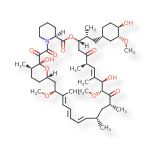
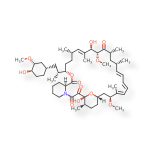
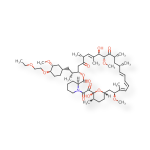
| Related Record | Type | Details | ||
|---|---|---|---|---|
|
|
METABOLITE ACTIVE -> PARENT |
|
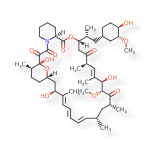
| Related Record | Type | Details | ||
|---|---|---|---|---|
|
|
IMPURITY -> PARENT |
|
||
|
PARENT -> IMPURITY |
|
| Related Record | Type | Details | ||
|---|---|---|---|---|
|
|
ACTIVE MOIETY |
|
| Name | Property Type | Amount | Referenced Substance | Defining | Parameters | References |
|---|---|---|---|---|---|---|
| Volume of Distribution | PHARMACOKINETIC |
|
|
|||
| Biological Half-life | PHARMACOKINETIC |
|
|
|||
| Tmax | PHARMACOKINETIC |
|
ORAL ADMINISTRATION |
|
||