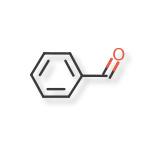
Details
| Stereochemistry | ACHIRAL |
| Molecular Formula | C7H6O |
| Molecular Weight | 106.1219 |
| Optical Activity | NONE |
| Defined Stereocenters | 0 / 0 |
| E/Z Centers | 0 |
| Charge | 0 |
SHOW SMILES / InChI
SMILES
O=CC1=CC=CC=C1
InChI
InChIKey=HUMNYLRZRPPJDN-UHFFFAOYSA-N
InChI=1S/C7H6O/c8-6-7-4-2-1-3-5-7/h1-6H
| Molecular Formula | C7H6O |
| Molecular Weight | 106.1219 |
| Charge | 0 |
| Count |
|
| Stereochemistry | ACHIRAL |
| Additional Stereochemistry | No |
| Defined Stereocenters | 0 / 0 |
| E/Z Centers | 0 |
| Optical Activity | NONE |
Benzaldehyde is the simplest and possibly the most industrially useful member of the family of aromatic aldehydes. Benzaldehyde exists in nature, primarily in combined forms such as a glycoside in almond, apricot, cherry, and peach seeds. The characteristic benzaldehyde odor of oil of bitter almond occurs because of trace amounts of free benzaldehyde formed by hydrolysis of the glycoside amygdalin. Benzaldehyde is a versatile intermediate because of its reactive aldehyde hydrogen, its carbonyl group, and the benzene ring. Benzaldehyde is formed from phenylpyruvic acid, derived by the aminotransferase activity on phenylalanine, in the presence of high levels of Mn2+, and contributes to the generation of flavor compound during cheese ripening. Benzaldehyde is a synthetic flavoring substance, sanctioned by the U.S. Food and Drug Administration (FDA) to be generally recognized as safe (GRAS) for foods. Benzaldehyde is also recognized as safe for use as a bee repellant in the harvesting of honey. Benzaldehyde's most important use is in organic synthesis, where it is the raw material utilized to produce various aldehydes. Because Benzaldehyde rapidly metabolizes to Benzoic Acid in the skin, the available dermal irritation and sensitization data demonstrating no adverse reactions to Benzoic Acid were considered supportive of the safety of Benzaldehyde.
Approval Year
PubMed
| Title | Date | PubMed |
|---|---|---|
| Structural basis for pterin antagonism in nitric-oxide synthase. Development of novel 4-oxo-pteridine antagonists of (6R)-5,6,7,8-tetrahydrobiopterin. | 2001-12-28 |
|
| Dynamic structures of horse liver alcohol dehydrogenase (HLADH): results of molecular dynamics simulations of HLADH-NAD(+)-PhCH(2)OH, HLADH-NAD(+)-PhCH(2)O(-), and HLADH-NADH-PhCHO. | 2001-12-05 |
|
| Inhibition of ALDH3A1-catalyzed oxidation by chlorpropamide analogues. | 2001-11-28 |
|
| Identification of sites in the second exomembrane loop and ninth transmembrane helix of the mammalian Na+/H+ exchanger important for drug recognition and cation translocation. | 2001-11-23 |
|
| Representation of odorants by receptor neuron input to the mouse olfactory bulb. | 2001-11-20 |
|
| Histidine 90 function in 4-chlorobenzoyl-coenzyme a dehalogenase catalysis. | 2001-11-13 |
|
| Hydrogen peroxide triggers the formation of a disulfide dimer of muscle acylphosphatase and modifies some functional properties of the enzyme. | 2001-11-09 |
|
| On-road measurement of carbonyls in California light-duty vehicle emissions. | 2001-11-01 |
|
| Study of glycosylation with N-trichloroacetyl-D-glucosamine derivatives in the syntheses of the spacer-armed pentasaccharides sialyl lacto-N-neotetraose and sialyl lacto-N-tetraose, their fragments, and analogues. | 2001-11-01 |
|
| Antibodies directed to drug epitopes to investigate the structure of drug-protein photoadducts. Recognition of a common photobound substructure in tiaprofenic acid/ketoprofen cross-photoreactivity. | 2001-11 |
|
| Synthetic routes to fluorenone, indenopyirdine, 4h-naphtho[2,1-b]pyrans and pyridine derivatives. | 2001-10-30 |
|
| Contributions of valine-292 in the nicotinamide binding site of liver alcohol dehydrogenase and dynamics to catalysis. | 2001-10-23 |
|
| The [2+2]-photocycloaddition of aromatic aldehydes and ketones to 3,4-dihydro-2-pyridones: regioselectivity, diastereoselectivity, and reductive ring opening of the product oxetanes. | 2001-10-15 |
|
| Volatile compounds from Salix spp. varieties differing in susceptibility to three willow beetle species. | 2001-10 |
|
| Analysis of the S(2) subsite specificities of the recombinant cysteine proteinases CPB of Leishmania mexicana, and cruzain of Trypanosoma cruzi, using fluorescent substrates containing non-natural basic amino acids. | 2001-10 |
|
| Ozone reaction with n-aldehydes (n=4-10), benzaldehyde, ethanol, isopropanol, and n-propanol adsorbed on a dual-bed graphitized carbon-carbon molecular sieve adsorbent cartridge. | 2001-09-21 |
|
| Solution structures of the mixed aggregates derived from lithium acetylides and a camphor-derived amino alkoxide. | 2001-09-21 |
|
| EMDee: an enzymatic method for determining enantiomeric excess. | 2001-09-19 |
|
| Chemical composition and behavioral responses of the marine insect Halobates hawaiiensis (Heteroptera: Gerridae). | 2001-09-04 |
|
| Synthesis and receptor docking studies of N-substituted indole-2-carboxylic acid esters as a search for COX-2 selective enzyme inhibitors. | 2001-09 |
|
| Aldehyde and monocyclic aromatic hydrocarbon mixing ratios at an urban site in Las Vegas, Nevada. | 2001-09 |
|
| SPME/GC-MS characterization of volatiles associated with methamphetamine: toward the development of a pseudomethamphetamine training material. | 2001-09 |
|
| The relationship between Taxol and (+)-discodermolide: synthetic analogs and modeling studies. | 2001-09 |
|
| Quantitative structure-activity studies of insect growth regulators: XVIII. Effects of substituents on the aromatic moiety of dibenzoylhydrazines on larvicidal activity against the Colorado potato beetle Leptinotarsa decemlineata. | 2001-09 |
|
| Conversion of amino acids into aroma compounds by cell-free extracts of Lactobacillus helveticus. | 2001-09 |
|
| Effects of beta-naphthoflavone on the cytochrome P450 system, and phase II enzymes in gilthead seabream (Sparus aurata). | 2001-09 |
|
| Reinvestigation of the reactions of camphorketene: structural evidence for pseudopericyclic pathways. | 2001-08-24 |
|
| The application of chiral aminonaphthols in the enantioselective addition of diethylzinc to aryl aldehydes. | 2001-08-23 |
|
| Solution structures and reactivities of the mixed aggregates derived from n-butyllithium and vicinal amino alkoxides. | 2001-08-22 |
|
| Odor exposure causes central adaptation and morphological changes in selected olfactory glomeruli in Drosophila. | 2001-08-15 |
|
| Increasing the number of synapses modifies olfactory perception in Drosophila. | 2001-08-15 |
|
| Synthesis, structure, and redox and catalytic properties of a new family of ruthenium complexes containing the tridentate bpea ligand. | 2001-08-13 |
|
| Immobilization of chiral ligands on polymer fibers by electron beam induced grafting and applications in enantioselective catalysis. | 2001-08-09 |
|
| PNA synthesis using a novel Boc/acyl protecting group strategy. | 2001-08 |
|
| Competitive inhibition of mushroom tyrosinase by 4-substituted benzaldehydes. | 2001-08 |
|
| Determination of aldehydes and ketones in air samples using cryotrapping sampling. | 2001-08 |
|
| Catalyzed asymmetric dialkylzinc addition to benzaldehyde in the presence of new chiral ligands--delta-(1-phenethyl)aminoalcohols. | 2001-08 |
|
| Functional analysis of an olfactory receptor in Drosophila melanogaster. | 2001-07-31 |
|
| Kinetics of the thiazolium ion-catalyzed benzoin condensation. | 2001-07-27 |
|
| Production of a cyanogenic secretion by a thyridid caterpillar (Calindoea trifascialis, Thyrididae, Lepidoptera). | 2001-07 |
|
| Determination of carbonyl compounds in air by electrochromatography. | 2001-07 |
|
| Extremely high drug-reductase activity based on aldehyde oxidase in monkey liver. | 2001-07 |
|
| 4-(Benzoylindolizinyl)butyric acids; novel nonsteroidal inhibitors of steroid 5alpha-reductase. III. | 2001-07 |
|
| Mutations affecting the cAMP transduction pathway modify olfaction in Drosophila. | 2001-06 |
|
| Electrophysiological and behavioral responses of female Helicoverpa armigera to compounds identified in flowers of African marigold, Tagetes erecta. | 2001-06 |
|
| [The sonochemical-degradation mechanism of toluene in aqueous solution]. | 2001-05 |
|
| Individual variation in hepatic aldehyde oxidase activity. | 2001-04 |
|
| Catalytic asymmetric organozinc additions to carbonyl compounds. | 2001-03 |
|
| Photopolymerization of liquid carbon disulfide produces nanoscale polythiene films. | 2001-02-14 |
|
| N-terminal derivatization and fragmentation of neutral peptides via ion--molecule reactions with acylium ions: toward gas-phase Edman degradation? | 2001-02-14 |
| Substance Class |
Chemical
Created
by
admin
on
Edited
Mon Mar 31 17:55:26 GMT 2025
by
admin
on
Mon Mar 31 17:55:26 GMT 2025
|
| Record UNII |
TA269SD04T
|
| Record Status |
Validated (UNII)
|
| Record Version |
|
-
Download
| Name | Type | Language | ||
|---|---|---|---|---|
|
Preferred Name | English | ||
|
Official Name | English | ||
|
Common Name | English | ||
|
Common Name | English | ||
|
Common Name | English | ||
|
Common Name | English | ||
|
Common Name | English | ||
|
Systematic Name | English | ||
|
Common Name | English | ||
|
Common Name | English | ||
|
Common Name | English | ||
|
Common Name | English | ||
|
Common Name | English | ||
|
Common Name | English | ||
|
Code | English | ||
|
Common Name | English | ||
|
Common Name | English | ||
|
Common Name | English | ||
|
Common Name | English | ||
|
Common Name | English | ||
|
Common Name | English | ||
|
Systematic Name | English | ||
|
Common Name | English | ||
|
Common Name | English | ||
|
Common Name | English | ||
|
Systematic Name | English | ||
|
Common Name | English | ||
|
Common Name | English | ||
|
Common Name | English |
| Classification Tree | Code System | Code | ||
|---|---|---|---|---|
|
JECFA EVALUATION |
BENZALDEHYDE
Created by
admin on Mon Mar 31 17:55:26 GMT 2025 , Edited by admin on Mon Mar 31 17:55:26 GMT 2025
|
||
|
EPA PESTICIDE CODE |
8601
Created by
admin on Mon Mar 31 17:55:26 GMT 2025 , Edited by admin on Mon Mar 31 17:55:26 GMT 2025
|
||
|
EC SCIENTIFIC COMMITTEE ON CONSUMER SAFETY OPINION |
SCCS/1459/11
Created by
admin on Mon Mar 31 17:55:26 GMT 2025 , Edited by admin on Mon Mar 31 17:55:26 GMT 2025
|
||
|
DEA NO. |
8256
Created by
admin on Mon Mar 31 17:55:26 GMT 2025 , Edited by admin on Mon Mar 31 17:55:26 GMT 2025
|
| Code System | Code | Type | Description | ||
|---|---|---|---|---|---|
|
TA269SD04T
Created by
admin on Mon Mar 31 17:55:26 GMT 2025 , Edited by admin on Mon Mar 31 17:55:26 GMT 2025
|
PRIMARY | |||
|
202-860-4
Created by
admin on Mon Mar 31 17:55:26 GMT 2025 , Edited by admin on Mon Mar 31 17:55:26 GMT 2025
|
PRIMARY | |||
|
7917
Created by
admin on Mon Mar 31 17:55:26 GMT 2025 , Edited by admin on Mon Mar 31 17:55:26 GMT 2025
|
PRIMARY | |||
|
17169
Created by
admin on Mon Mar 31 17:55:26 GMT 2025 , Edited by admin on Mon Mar 31 17:55:26 GMT 2025
|
PRIMARY | |||
|
100000129170
Created by
admin on Mon Mar 31 17:55:26 GMT 2025 , Edited by admin on Mon Mar 31 17:55:26 GMT 2025
|
PRIMARY | |||
|
TA269SD04T
Created by
admin on Mon Mar 31 17:55:26 GMT 2025 , Edited by admin on Mon Mar 31 17:55:26 GMT 2025
|
PRIMARY | |||
|
DTXSID8039241
Created by
admin on Mon Mar 31 17:55:26 GMT 2025 , Edited by admin on Mon Mar 31 17:55:26 GMT 2025
|
PRIMARY | |||
|
C2591
Created by
admin on Mon Mar 31 17:55:26 GMT 2025 , Edited by admin on Mon Mar 31 17:55:26 GMT 2025
|
PRIMARY | |||
|
m2330
Created by
admin on Mon Mar 31 17:55:26 GMT 2025 , Edited by admin on Mon Mar 31 17:55:26 GMT 2025
|
PRIMARY | Merck Index | ||
|
1314334
Created by
admin on Mon Mar 31 17:55:26 GMT 2025 , Edited by admin on Mon Mar 31 17:55:26 GMT 2025
|
PRIMARY | RxNorm | ||
|
CHEMBL15972
Created by
admin on Mon Mar 31 17:55:26 GMT 2025 , Edited by admin on Mon Mar 31 17:55:26 GMT 2025
|
PRIMARY | |||
|
SUB37594
Created by
admin on Mon Mar 31 17:55:26 GMT 2025 , Edited by admin on Mon Mar 31 17:55:26 GMT 2025
|
PRIMARY | |||
|
240
Created by
admin on Mon Mar 31 17:55:26 GMT 2025 , Edited by admin on Mon Mar 31 17:55:26 GMT 2025
|
PRIMARY | |||
|
1050905
Created by
admin on Mon Mar 31 17:55:26 GMT 2025 , Edited by admin on Mon Mar 31 17:55:26 GMT 2025
|
PRIMARY | |||
|
100-52-7
Created by
admin on Mon Mar 31 17:55:26 GMT 2025 , Edited by admin on Mon Mar 31 17:55:26 GMT 2025
|
PRIMARY | |||
|
388
Created by
admin on Mon Mar 31 17:55:26 GMT 2025 , Edited by admin on Mon Mar 31 17:55:26 GMT 2025
|
PRIMARY | |||
|
C45678
Created by
admin on Mon Mar 31 17:55:26 GMT 2025 , Edited by admin on Mon Mar 31 17:55:26 GMT 2025
|
CONCEPT | Industrial Aid | ||
|
321
Created by
admin on Mon Mar 31 17:55:26 GMT 2025 , Edited by admin on Mon Mar 31 17:55:26 GMT 2025
|
PRIMARY | |||
|
BENZALDEHYDE
Created by
admin on Mon Mar 31 17:55:26 GMT 2025 , Edited by admin on Mon Mar 31 17:55:26 GMT 2025
|
PRIMARY | |||
|
C032175
Created by
admin on Mon Mar 31 17:55:26 GMT 2025 , Edited by admin on Mon Mar 31 17:55:26 GMT 2025
|
PRIMARY |
| Related Record | Type | Details | ||
|---|---|---|---|---|
|
PARENT -> CONSTITUENT ALWAYS PRESENT |
|
||
|
PARENT -> CONSTITUENT ALWAYS PRESENT |
|
||
|
PARENT -> CONSTITUENT ALWAYS PRESENT |
|

| Related Record | Type | Details | ||
|---|---|---|---|---|
|
PARENT -> IMPURITY |
|
||
|
|
PARENT -> IMPURITY |
|
||
|
PARENT -> IMPURITY |
|
||
|
|
PARENT -> IMPURITY |
|
||
|
PARENT -> IMPURITY |
CHROMATOGRAPHIC PURITY (HPLC/UV)
EP
|
||
|
|
PARENT -> IMPURITY |
CHROMATOGRAPHIC PURITY (HPLC/UV)
EP
|
||
|
PARENT -> IMPURITY |
impurity C: not more than twice the area of the corresponding peak in the chromatogram obtained with reference solution (a) (0.5 per cent); if the area of the peak due to impurity C in the chromatogram obtained with the test solution is greater than the area of the corresponding peak in the chromatogram obtained with reference solution (a) (0.25 per cent), dilute the test solution to obtain an area equal to or smaller than the area of the peak in the chromatogram obtained with reference solution (a); calculate the content of impurity C taking into account the dilution factor;
CHROMATOGRAPHIC PURITY (HPLC/UV)
EP
|
||
|
PARENT -> IMPURITY |
0.05% FOR PARENTERAL
CHROMATOGRAPHIC PURITY (HPLC/UV)
EP
|
||
|
PARENT -> IMPURITY |
CHROMATOGRAPHIC PURITY (HPLC/UV)
EP
|
||
|
PARENT -> IMPURITY |
CHROMATOGRAPHIC PURITY (HPLC/UV)
USP
|
||
|
PARENT -> IMPURITY |
CHROMATOGRAPHIC PURITY (HPLC/UV)
USP
|
||
|
PARENT -> IMPURITY |
CHROMATOGRAPHIC PURITY (HPLC/UV)
EP
|
||
|
PARENT -> IMPURITY |
CHROMATOGRAPHIC PURITY (HPLC/UV)
EP
|

| Related Record | Type | Details | ||
|---|---|---|---|---|
|
|
ACTIVE MOIETY |
|