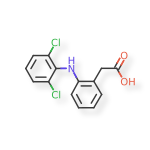
Details
| Stereochemistry | ACHIRAL |
| Molecular Formula | C14H11Cl2NO2 |
| Molecular Weight | 296.149 |
| Optical Activity | NONE |
| Defined Stereocenters | 0 / 0 |
| E/Z Centers | 0 |
| Charge | 0 |
SHOW SMILES / InChI
SMILES
OC(=O)CC1=CC=CC=C1NC2=C(Cl)C=CC=C2Cl
InChI
InChIKey=DCOPUUMXTXDBNB-UHFFFAOYSA-N
InChI=1S/C14H11Cl2NO2/c15-10-5-3-6-11(16)14(10)17-12-7-2-1-4-9(12)8-13(18)19/h1-7,17H,8H2,(H,18,19)
| Molecular Formula | C14H11Cl2NO2 |
| Molecular Weight | 296.149 |
| Charge | 0 |
| Count |
|
| Stereochemistry | ACHIRAL |
| Additional Stereochemistry | No |
| Defined Stereocenters | 0 / 0 |
| E/Z Centers | 0 |
| Optical Activity | NONE |
DescriptionCurator's Comment: Description was created based on several sources, including
https://www.ncbi.nlm.nih.gov/pubmed/25963327 | https://www.ncbi.nlm.nih.gov/pubmed/20470236 | http://www.pharmaceutical-journal.com/news-and-analysis/news/diclofenac-a-useful-drug-that-may-now-be-entering-its-twilight-years/11121261.article
Curator's Comment: Description was created based on several sources, including
https://www.ncbi.nlm.nih.gov/pubmed/25963327 | https://www.ncbi.nlm.nih.gov/pubmed/20470236 | http://www.pharmaceutical-journal.com/news-and-analysis/news/diclofenac-a-useful-drug-that-may-now-be-entering-its-twilight-years/11121261.article
Diclofenac is a nonsteroidal anti-inflammatory drug (NSAID) of the phenylacetic acid class with anti-inflammatory, analgesic, and antipyretic properties. Contrary to the action of many traditional NSAIDs, diclofenac inhibits cyclooxygenase (COX)-2 enzyme with greater potency than it does COX-1. In addition diclofenac can inhibit the thromboxane-prostanoid receptor, affect arachidonic acid release and uptake, inhibit lipoxygenase enzymes, and activate the nitric oxide-cGMP antinociceptive pathway. Other novel mechanisms of action may include the inhibition of substrate P, inhibition of peroxisome proliferator activated receptor gamma (PPARgamma), blockage of acid-sensing ion channels, alteration of interleukin-6 production, and inhibition of N-methyl-D-aspartate (NMDA) receptor hyperalgesia. Similar to other NSAIDs, diclofenac is associated with serious dose-dependent gastrointestinal, cardiovascular, and renal adverse effects. Since its introduction in 1973, a number of different diclofenac-containing drug products have been developed with the goal of improving efficacy, tolerability, and patient convenience. Delayed- and extended-release forms of diclofenac sodium were initially developed with the goal of improving the safety profile of diclofenac and providing convenient, once-daily dosing for the treatment of patients with chronic pain. New drug products consisting of diclofenac potassium salt were associated with faster absorption and rapid onset of pain relief. These include diclofenac potassium immediate-release tablets, diclofenac potassium liquid-filled soft gel capsules, and diclofenac potassium powder for oral solution. The advent of topical formulations of diclofenac enabled local treatment of pain and inflammation while minimizing systemic absorption of diclofenac. SoluMatrix diclofenac, consisting of submicron particles of diclofenac free acid and a proprietary combination of excipients, was developed to provide analgesic efficacy at reduced doses associated with lower systemic absorption. The drug's likely impact on the Asian vulture population was widely reported. The dramatic mortality was attributed largely to renal failure caused by exposure to diclofenac in livestock carcasses on which the birds fed. Although not the most endearing species, vultures are important environmental scavengers and, since veterinary use of diclofenac was stopped in the region in 2006, the decline in vulture numbers has slowed.
Approval Year
Targets
| Primary Target | Pharmacology | Condition | Potency |
|---|---|---|---|
| 0.97 nM [IC50] | |||
| 0.037 µM [IC50] |
Conditions
| Condition | Modality | Targets | Highest Phase | Product |
|---|---|---|---|---|
| Primary | DICLOFENAC SODIUM Approved UseDiclofenac Sodium Extended-release Tablets are indicated:
•For relief of the signs and symptoms of osteoarthritis
•For relief of the signs and symptoms of rheumatoid arthritis |
|||
| Primary | DICLOFENAC SODIUM Approved UseDiclofenac Sodium Extended-release Tablets are indicated:
•For relief of the signs and symptoms of osteoarthritis
•For relief of the signs and symptoms of rheumatoid arthritis |
Cmax
| Value | Dose | Co-administered | Analyte | Population |
|---|---|---|---|---|
902 ng/mL EXPERIMENT https://pubmed.ncbi.nlm.nih.gov/19531931 |
50 mg 3 times / day steady-state, oral dose: 50 mg route of administration: Oral experiment type: STEADY-STATE co-administered: |
DICLOFENAC plasma | Homo sapiens population: HEALTHY age: ADULT sex: FEMALE / MALE food status: UNKNOWN |
|
302 ng/mL EXPERIMENT https://pubmed.ncbi.nlm.nih.gov/19531931 |
12.5 mg 3 times / day steady-state, oral dose: 12.5 mg route of administration: Oral experiment type: STEADY-STATE co-administered: |
DICLOFENAC plasma | Homo sapiens population: HEALTHY age: ADULT sex: FEMALE / MALE food status: UNKNOWN |
|
749 ng/mL EXPERIMENT https://pubmed.ncbi.nlm.nih.gov/19531931 |
25 mg 3 times / day steady-state, oral dose: 25 mg route of administration: Oral experiment type: STEADY-STATE co-administered: |
DICLOFENAC plasma | Homo sapiens population: HEALTHY age: ADULT sex: FEMALE food status: UNKNOWN |
AUC
| Value | Dose | Co-administered | Analyte | Population |
|---|---|---|---|---|
1208 ng × h/mL EXPERIMENT https://pubmed.ncbi.nlm.nih.gov/19531931 |
50 mg 3 times / day steady-state, oral dose: 50 mg route of administration: Oral experiment type: STEADY-STATE co-administered: |
DICLOFENAC plasma | Homo sapiens population: HEALTHY age: ADULT sex: FEMALE / MALE food status: UNKNOWN |
|
319 ng × h/mL EXPERIMENT https://pubmed.ncbi.nlm.nih.gov/19531931 |
12.5 mg 3 times / day steady-state, oral dose: 12.5 mg route of administration: Oral experiment type: STEADY-STATE co-administered: |
DICLOFENAC plasma | Homo sapiens population: HEALTHY age: ADULT sex: FEMALE / MALE food status: UNKNOWN |
|
609 ng × h/mL EXPERIMENT https://pubmed.ncbi.nlm.nih.gov/19531931 |
25 mg 3 times / day steady-state, oral dose: 25 mg route of administration: Oral experiment type: STEADY-STATE co-administered: |
DICLOFENAC plasma | Homo sapiens population: HEALTHY age: ADULT sex: FEMALE food status: UNKNOWN |
T1/2
| Value | Dose | Co-administered | Analyte | Population |
|---|---|---|---|---|
1.64 h EXPERIMENT https://pubmed.ncbi.nlm.nih.gov/19531931 |
50 mg 3 times / day steady-state, oral dose: 50 mg route of administration: Oral experiment type: STEADY-STATE co-administered: |
DICLOFENAC plasma | Homo sapiens population: HEALTHY age: ADULT sex: FEMALE / MALE food status: UNKNOWN |
|
1.19 h EXPERIMENT https://pubmed.ncbi.nlm.nih.gov/19531931 |
12.5 mg 3 times / day steady-state, oral dose: 12.5 mg route of administration: Oral experiment type: STEADY-STATE co-administered: |
DICLOFENAC plasma | Homo sapiens population: HEALTHY age: ADULT sex: FEMALE / MALE food status: UNKNOWN |
|
1.87 h EXPERIMENT https://pubmed.ncbi.nlm.nih.gov/19531931 |
25 mg 3 times / day steady-state, oral dose: 25 mg route of administration: Oral experiment type: STEADY-STATE co-administered: |
DICLOFENAC plasma | Homo sapiens population: HEALTHY age: ADULT sex: FEMALE food status: UNKNOWN |
|
2.3 h |
unknown, oral |
DICLOFENAC serum | Homo sapiens population: HEALTHY age: ADULT sex: UNKNOWN food status: UNKNOWN |
Funbound
| Value | Dose | Co-administered | Analyte | Population |
|---|---|---|---|---|
1% |
unknown, oral |
DICLOFENAC serum | Homo sapiens population: HEALTHY age: ADULT sex: UNKNOWN food status: UNKNOWN |
Doses
| Dose | Population | Adverse events |
|---|---|---|
75 mg/mL single, intravenous Dose: 75 mg/mL Route: intravenous Route: single Dose: 75 mg/mL Sources: |
healthy, 18 - 53 years Health Status: healthy Age Group: 18 - 53 years Sex: M+F Sources: |
|
50 mg single, oral |
healthy, 21-51 years Health Status: healthy Age Group: 21-51 years Sex: M+F Sources: |
Other AEs: Nephrotoxicity... |
500 mg single, oral Overdose Dose: 500 mg Route: oral Route: single Dose: 500 mg Sources: |
unknown, adult Health Status: unknown Age Group: adult Sex: unknown Sources: |
Disc. AE: Drowsiness, Lethargy... AEs leading to discontinuation/dose reduction: Drowsiness Sources: Lethargy Nausea Vomiting Epigastric pain |
AEs
| AE | Significance | Dose | Population |
|---|---|---|---|
| Nephrotoxicity | 50 mg single, oral |
healthy, 21-51 years Health Status: healthy Age Group: 21-51 years Sex: M+F Sources: |
|
| Drowsiness | Disc. AE | 500 mg single, oral Overdose Dose: 500 mg Route: oral Route: single Dose: 500 mg Sources: |
unknown, adult Health Status: unknown Age Group: adult Sex: unknown Sources: |
| Epigastric pain | Disc. AE | 500 mg single, oral Overdose Dose: 500 mg Route: oral Route: single Dose: 500 mg Sources: |
unknown, adult Health Status: unknown Age Group: adult Sex: unknown Sources: |
| Lethargy | Disc. AE | 500 mg single, oral Overdose Dose: 500 mg Route: oral Route: single Dose: 500 mg Sources: |
unknown, adult Health Status: unknown Age Group: adult Sex: unknown Sources: |
| Nausea | Disc. AE | 500 mg single, oral Overdose Dose: 500 mg Route: oral Route: single Dose: 500 mg Sources: |
unknown, adult Health Status: unknown Age Group: adult Sex: unknown Sources: |
| Vomiting | Disc. AE | 500 mg single, oral Overdose Dose: 500 mg Route: oral Route: single Dose: 500 mg Sources: |
unknown, adult Health Status: unknown Age Group: adult Sex: unknown Sources: |
Overview
| CYP3A4 | CYP2C9 | CYP2D6 | hERG |
|---|---|---|---|
OverviewOther
| Other Inhibitor | Other Substrate | Other Inducer |
|---|---|---|
Drug as perpetrator
| Target | Modality | Activity | Metabolite | Clinical evidence |
|---|---|---|---|---|
| moderate | ||||
| no | ||||
| no | ||||
| no | ||||
| no | ||||
| strong | ||||
| weak | ||||
| weak | ||||
| weak | ||||
| yes [Ki 11 uM] | ||||
| yes [Ki 19 uM] | ||||
| yes [Ki 28 uM] | ||||
| yes [Ki 52 uM] | ||||
| yes [Ki 60 uM] | ||||
| yes | ||||
| yes | ||||
| yes | ||||
| yes | ||||
| yes | ||||
| yes | ||||
| yes | ||||
| yes | ||||
| yes | ||||
| yes | ||||
| yes | ||||
| yes | ||||
| yes |
Drug as victim
| Target | Modality | Activity | Metabolite | Clinical evidence |
|---|---|---|---|---|
| major | ||||
| minor | ||||
| minor | ||||
| minor | ||||
| moderate | ||||
| no | ||||
| no | ||||
| no | ||||
| no | ||||
| no | ||||
| no | ||||
| no | ||||
| no | ||||
| no | ||||
| no | ||||
| no | ||||
| yes | ||||
| yes | ||||
| yes | ||||
| yes | ||||
| yes | ||||
| yes | ||||
| yes | ||||
| yes | ||||
| yes | ||||
| yes | ||||
| yes | ||||
| yes | ||||
| yes | ||||
| yes | ||||
| yes | ||||
| yes |
Tox targets
| Target | Modality | Activity | Metabolite | Clinical evidence |
|---|---|---|---|---|
PubMed
| Title | Date | PubMed |
|---|---|---|
| Keratitis, ulceration, and perforation associated with topical nonsteroidal anti-inflammatory drugs. | 2001-05 |
|
| Identification and characterization of human organic anion transporter 3 expressing predominantly in the kidney. | 2001-05 |
|
| Structure-hepatic disposition relationships for cationic drugs in isolated perfused rat livers: transmembrane exchange and cytoplasmic binding process. | 2001-05 |
|
| Characterization of rat and human UDP-glucuronosyltransferases responsible for the in vitro glucuronidation of diclofenac. | 2001-05 |
|
| Diclofenac sodium injection sterilized by autoclave and the occurrence of cyclic reaction producing a small amount of impurity. | 2001-05 |
|
| Oil components modulate physical characteristics and function of the natural oil emulsions as drug or gene delivery system. | 2001-04-28 |
|
| [Liver damage and nonsteroidal anti-inflammatory drugs: case non-case study in the French Pharmacovigilance Database]. | 2001-04-27 |
|
| HPLC evaluation of diclofenac in transdermal therapeutic preparations. | 2001-04-17 |
|
| Is diclofenac a valuable CYP2C9 probe in humans? | 2001-04-11 |
|
| Equivalence of generic and brand-name ophthalmic products. | 2001-04-01 |
|
| Review: uveitis and immunosuppressive drugs. | 2001-04 |
|
| Cataflam-induced esophageal ulceration. | 2001-04 |
|
| Anti-inflammatory drugs. IX. Hydrated diethylammonium (2-(2,6-dichlorophenylamino)phenyl)acetate (HDEA.D.H2O). | 2001-04 |
|
| Efficacy of peripheral morphine analgesia in inflamed, non-inflamed and perineural tissue of dental surgery patients. | 2001-04 |
|
| Corneal complications associated with topical ophthalmic use of nonsteroidal antiinflammatory drugs. | 2001-04 |
|
| Influence of electrical and chemical factors on transdermal iontophoretic delivery of three diclofenac salts. | 2001-04 |
|
| The role of matrix metalloproteinases in ulcerative keratolysis associated with perioperative diclofenac use. | 2001-04 |
|
| Tramadol vs. diclofenac for posttonsillectomy analgesia. | 2001-04 |
|
| Treatment of elderly patients with nabumetone or diclofenac: gastrointestinal safety profile. | 2001-04 |
|
| The epithelial flap for photorefractive keratectomy. | 2001-04 |
|
| Inhibition of phenytoin hydroxylation in human liver microsomes by several selective serotonin re-uptake inhibitors. | 2001-04 |
|
| Decreased flow-dependent dilation in carotid arteries of tissue kallikrein-knockout mice. | 2001-03-30 |
|
| Use of ion-exchange resins to prepare 100 microm-sized microcapsules with prolonged drug-release by the Wurster process. | 2001-03-23 |
|
| Simultaneous quantification of neutral and acidic pharmaceuticals and pesticides at the low-ng/l level in surface and waste water. | 2001-03-16 |
|
| Analgesic effect of epidural neostigmine after abdominal hysterectomy. | 2001-03 |
|
| Perioperative intravenous flurbiprofen reduces postoperative pain after abdominal hysterectomy. | 2001-03 |
|
| Docetaxel extravasation. | 2001-03 |
|
| [Effect of tobramycin with topical diclofenac on arachidonic acid in endotoxin-induced uveitis]. | 2001-03 |
|
| Age-related changes in skin permeability of hydrophilic and lipophilic compounds in rats. | 2001-03 |
|
| An assessment of the clinical efficacy of intranasal desmopressin spray in the treatment of renal colic. | 2001-03 |
|
| Physical incompatibility between atracurium and intravenous diclofenac. | 2001-03 |
|
| Role of the epithelium in opposing H(2)O(2)-induced modulation of acetylcholine-induced contractions in rabbit intrapulmonary bronchiole. | 2001-03 |
|
| Pharmacokinetics of oral diclofenac and acetaminophen in children after surgery. | 2001-03 |
|
| Cytochrome P450 expression and related metabolism in human buccal mucosa. | 2001-03 |
|
| Enhanced disruption of the blood-aqueous barrier and the incidence of angiographic cystoid macular edema by topical timolol and its preservative in early postoperative pseudophakia. | 2001-03 |
|
| Determination of drug residues in water by the combination of liquid chromatography or capillary electrophoresis with electrospray mass spectrometry. | 2001-02-23 |
|
| [Topical administration is better than oral administration]. | 2001-02-01 |
|
| Inhibition of COX in ocular tissues: an in vitro model to identify selective COX-2 inhibitors. | 2001-02 |
|
| Comparative study of diclofenac sodium and paracetamol for treatment of pain after adenotonsillectomy in children. | 2001-02 |
|
| Diclofenac-induced gastric mucosal fluorescence in rats. | 2001-02 |
|
| Determination of diclofenac sodium, flufenamic acid, indomethacin and ketoprofen by LC-APCI-MS. | 2001-02 |
|
| Bioequivalence of two aceclofenac tablet formulations after a single oral dose to healthy male Korean volunteers. | 2001-02 |
|
| When should diclofenac be given in ambulatory surgery: preoperatively or postoperatively? | 2001-02 |
|
| [Concentrations of diclofenac in aqueous humor and in plasma after i.v. injection in 59 patients undergoing cataract surgery--a prospective study]. | 2001-02 |
|
| Minocycline inhibits the production of inducible nitric oxide synthase in articular chondrocytes. | 2001-02 |
|
| Using evidence from different sources: an example using paracetamol 1000 mg plus codeine 60 mg. | 2001-01-10 |
|
| A comparative experimental study of the effects of diclofenac and ketoprofen on the small-bowel mucosa of canines. | 2001-01 |
|
| Nimesulide, a balanced drug for the treatment of osteoarthritis. | 2001 |
|
| Tolerability profiles of rofecoxib (Vioxx) and Arthrotec. A comparison of six weeks treatment in patients with osteoarthritis. | 2001 |
|
| Celecoxib versus diclofenac in the management of osteoarthritis of the knee. | 2001 |
Patents
Sample Use Guides
For topical dosage form (gel):
For actinic keratosis using Solaraze® 3% gel:
Adults—Apply to affected skin area two times a day.
Children—Use and dose must be determined by your doctor.
For osteoarthritis of the hands, elbows, or wrists using Voltaren® 1% gel:
Adults—Apply 2 grams to the affected skin areas four times a day (a total of 8 grams each day). However, the total dose should not exceed 32 grams per day over all affected joints. Use the enclosed dosing card to measure the appropriate dose.
Children—Use and dose must be determined by your doctor.
For osteoarthritis of the knees, ankles, or feet using Voltaren® 1% gel:
Adults—Apply 4 grams to the affected skin areas four times a day (a total of 16 grams each day). However, the total dose should not exceed 32 grams per day over all affected joints. Use the enclosed dosing card to measure the appropriate dose.
Children—Use and dose must be determined by your doctor.
For topical dosage form (solution):
For osteoarthritis of the knee:
Adults—40 drops (10 drops at a time) on each affected knee four times a day.
Children—Use and dose must be determined by your doctor.
For transdermal dosage form (skin patch):
For acute pain:
Adults—One patch applied to the painful area two times a day.
Children—Use and dose must be determined by your doctor.
For oral dosage form (capsules):
For acute pain:
Adults—18 or 35 milligrams (mg) three times a day.
Children—Use and dose must be determined by your doctor.
For osteoarthritis:
Adults—35 milligrams (mg) three times a day.
Children—Use and dose must be determined by your doctor.
For oral dosage forms (delayed-release tablets, enteric-coated tablets):
For ankylosing spondylitis:
Adults—25 milligrams (mg) four times a day, with an extra 25 mg dose at bedtime if necessary.
Children—Use and dose must be determined by your doctor.
For osteoarthritis:
Adults—50 milligrams (mg) two or three times a day, or 75 mg two times a day.
Children—Use and dose must be determined by your doctor.
For rheumatoid arthritis:
Adults—50 milligrams (mg) three or four times a day, or 75 mg two times a day.
Children—Use and dose must be determined by your doctor.
For oral dosage form (immediate-release tablets):
For osteoarthritis:
Adults—50 milligrams (mg) two or three times a day.
Children—Use and dose must be determined by your doctor.
For pain or menstrual cramps:
Adults—50 milligrams (mg) three times a day. Your doctor may direct you to take 100 mg for the first dose only.
Children—Use and dose must be determined by your doctor.
For rheumatoid arthritis:
Adults—50 milligrams (mg) three or four times a day.
Children—Use and dose must be determined by your doctor.
For oral dosage form (solution):
For migraine headaches:
Adults—One packet (50 milligrams) as a single, one time dose.
Children—Use and dose must be determined by your doctor.
Route of Administration:
Other
Acute (24 h) diclofenac toxicity in a range of (10-1000 μM) concentrations was assesed in primary human hepatocytes. The chronic (9 repeated doses) toxicity at one clinically relevant and another higher concentration (6.4 and 100 μM) was also tested. Acute 24 h assessment revealed toxicity only for the highest tested concentration (1 mM). Upon repeated dose exposure, toxic effects were observed even at a low, clinically relevant concentration (6.4 μM).
| Substance Class |
Chemical
Created
by
admin
on
Edited
Mon Mar 31 18:06:26 GMT 2025
by
admin
on
Mon Mar 31 18:06:26 GMT 2025
|
| Record UNII |
144O8QL0L1
|
| Record Status |
Validated (UNII)
|
| Record Version |
|
-
Download
| Name | Type | Language | ||
|---|---|---|---|---|
|
Preferred Name | English | ||
|
Official Name | English | ||
|
Common Name | English | ||
|
Common Name | English | ||
|
Common Name | English | ||
|
Common Name | English | ||
|
Common Name | English | ||
|
Common Name | English | ||
|
Common Name | English | ||
|
Common Name | English | ||
|
Code | English | ||
|
Systematic Name | English | ||
|
Common Name | English | ||
|
Systematic Name | English | ||
|
Common Name | English | ||
|
Common Name | English | ||
|
Common Name | English |
| Classification Tree | Code System | Code | ||
|---|---|---|---|---|
|
WHO-ATC |
M01AB05
Created by
admin on Mon Mar 31 18:06:26 GMT 2025 , Edited by admin on Mon Mar 31 18:06:26 GMT 2025
|
||
|
WHO-ATC |
S01BC03
Created by
admin on Mon Mar 31 18:06:26 GMT 2025 , Edited by admin on Mon Mar 31 18:06:26 GMT 2025
|
||
|
WHO-ATC |
S01CC01
Created by
admin on Mon Mar 31 18:06:26 GMT 2025 , Edited by admin on Mon Mar 31 18:06:26 GMT 2025
|
||
|
CFR |
21 CFR 524.590
Created by
admin on Mon Mar 31 18:06:26 GMT 2025 , Edited by admin on Mon Mar 31 18:06:26 GMT 2025
|
||
|
WHO-ATC |
D11AX18
Created by
admin on Mon Mar 31 18:06:26 GMT 2025 , Edited by admin on Mon Mar 31 18:06:26 GMT 2025
|
||
|
WHO-VATC |
QD11AX18
Created by
admin on Mon Mar 31 18:06:26 GMT 2025 , Edited by admin on Mon Mar 31 18:06:26 GMT 2025
|
||
|
NDF-RT |
N0000175722
Created by
admin on Mon Mar 31 18:06:26 GMT 2025 , Edited by admin on Mon Mar 31 18:06:26 GMT 2025
|
||
|
WHO-ATC |
M01AB55
Created by
admin on Mon Mar 31 18:06:26 GMT 2025 , Edited by admin on Mon Mar 31 18:06:26 GMT 2025
|
||
|
LIVERTOX |
NBK547953
Created by
admin on Mon Mar 31 18:06:26 GMT 2025 , Edited by admin on Mon Mar 31 18:06:26 GMT 2025
|
||
|
WHO-VATC |
QM02AA15
Created by
admin on Mon Mar 31 18:06:26 GMT 2025 , Edited by admin on Mon Mar 31 18:06:26 GMT 2025
|
||
|
WHO-VATC |
QS01CC01
Created by
admin on Mon Mar 31 18:06:26 GMT 2025 , Edited by admin on Mon Mar 31 18:06:26 GMT 2025
|
||
|
WHO-ATC |
M02AA15
Created by
admin on Mon Mar 31 18:06:26 GMT 2025 , Edited by admin on Mon Mar 31 18:06:26 GMT 2025
|
||
|
WHO-VATC |
QM01AB05
Created by
admin on Mon Mar 31 18:06:26 GMT 2025 , Edited by admin on Mon Mar 31 18:06:26 GMT 2025
|
||
|
WHO-VATC |
QS01BC03
Created by
admin on Mon Mar 31 18:06:26 GMT 2025 , Edited by admin on Mon Mar 31 18:06:26 GMT 2025
|
||
|
NCI_THESAURUS |
C1323
Created by
admin on Mon Mar 31 18:06:26 GMT 2025 , Edited by admin on Mon Mar 31 18:06:26 GMT 2025
|
| Code System | Code | Type | Description | ||
|---|---|---|---|---|---|
|
DB00586
Created by
admin on Mon Mar 31 18:06:26 GMT 2025 , Edited by admin on Mon Mar 31 18:06:26 GMT 2025
|
PRIMARY | |||
|
865
Created by
admin on Mon Mar 31 18:06:26 GMT 2025 , Edited by admin on Mon Mar 31 18:06:26 GMT 2025
|
PRIMARY | |||
|
7234
Created by
admin on Mon Mar 31 18:06:26 GMT 2025 , Edited by admin on Mon Mar 31 18:06:26 GMT 2025
|
PRIMARY | |||
|
3355
Created by
admin on Mon Mar 31 18:06:26 GMT 2025 , Edited by admin on Mon Mar 31 18:06:26 GMT 2025
|
PRIMARY | RxNorm | ||
|
3270
Created by
admin on Mon Mar 31 18:06:26 GMT 2025 , Edited by admin on Mon Mar 31 18:06:26 GMT 2025
|
PRIMARY | |||
|
Diclofenac
Created by
admin on Mon Mar 31 18:06:26 GMT 2025 , Edited by admin on Mon Mar 31 18:06:26 GMT 2025
|
PRIMARY | |||
|
D004008
Created by
admin on Mon Mar 31 18:06:26 GMT 2025 , Edited by admin on Mon Mar 31 18:06:26 GMT 2025
|
PRIMARY | |||
|
144O8QL0L1
Created by
admin on Mon Mar 31 18:06:26 GMT 2025 , Edited by admin on Mon Mar 31 18:06:26 GMT 2025
|
PRIMARY | |||
|
DTXSID6022923
Created by
admin on Mon Mar 31 18:06:26 GMT 2025 , Edited by admin on Mon Mar 31 18:06:26 GMT 2025
|
PRIMARY | |||
|
15307-86-5
Created by
admin on Mon Mar 31 18:06:26 GMT 2025 , Edited by admin on Mon Mar 31 18:06:26 GMT 2025
|
PRIMARY | |||
|
AB-122
Created by
admin on Mon Mar 31 18:06:26 GMT 2025 , Edited by admin on Mon Mar 31 18:06:26 GMT 2025
|
PRIMARY | |||
|
CHEMBL139
Created by
admin on Mon Mar 31 18:06:26 GMT 2025 , Edited by admin on Mon Mar 31 18:06:26 GMT 2025
|
PRIMARY | |||
|
100000092798
Created by
admin on Mon Mar 31 18:06:26 GMT 2025 , Edited by admin on Mon Mar 31 18:06:26 GMT 2025
|
PRIMARY | |||
|
144O8QL0L1
Created by
admin on Mon Mar 31 18:06:26 GMT 2025 , Edited by admin on Mon Mar 31 18:06:26 GMT 2025
|
PRIMARY | |||
|
DICLOFENAC
Created by
admin on Mon Mar 31 18:06:26 GMT 2025 , Edited by admin on Mon Mar 31 18:06:26 GMT 2025
|
PRIMARY | |||
|
m4361
Created by
admin on Mon Mar 31 18:06:26 GMT 2025 , Edited by admin on Mon Mar 31 18:06:26 GMT 2025
|
PRIMARY | Merck Index | ||
|
SUB07092MIG
Created by
admin on Mon Mar 31 18:06:26 GMT 2025 , Edited by admin on Mon Mar 31 18:06:26 GMT 2025
|
PRIMARY | |||
|
239-348-5
Created by
admin on Mon Mar 31 18:06:26 GMT 2025 , Edited by admin on Mon Mar 31 18:06:26 GMT 2025
|
PRIMARY | |||
|
3033
Created by
admin on Mon Mar 31 18:06:26 GMT 2025 , Edited by admin on Mon Mar 31 18:06:26 GMT 2025
|
PRIMARY | |||
|
47381
Created by
admin on Mon Mar 31 18:06:26 GMT 2025 , Edited by admin on Mon Mar 31 18:06:26 GMT 2025
|
PRIMARY | |||
|
2714
Created by
admin on Mon Mar 31 18:06:26 GMT 2025 , Edited by admin on Mon Mar 31 18:06:26 GMT 2025
|
PRIMARY | |||
|
C28985
Created by
admin on Mon Mar 31 18:06:26 GMT 2025 , Edited by admin on Mon Mar 31 18:06:26 GMT 2025
|
PRIMARY |
| Related Record | Type | Details | ||
|---|---|---|---|---|
|
TARGET -> INHIBITOR |
IC50
|
||
|
TARGET -> INHIBITOR |
IC50
|
||
|
METABOLIC ENZYME -> SUBSTRATE | |||
|
|
SALT/SOLVATE -> PARENT |
|
||
|
|
SALT/SOLVATE -> PARENT |
|
||
|
TRANSPORTER -> INHIBITOR | |||
|
METABOLIC ENZYME -> SUBSTRATE |
Highly polymorphic enzyme responsible for differential response. Gene is deleted in 90% of Japanese patients leading to a dose reduction.
|
||
|
TRANSPORTER -> INHIBITOR | |||
|
METABOLIC ENZYME -> INHIBITOR | |||
|
|
SALT/SOLVATE -> PARENT |
|
||
|
|
SALT/SOLVATE -> PARENT |
|
||
|
TRANSPORTER -> INHIBITOR | |||
|
TRANSPORTER -> INHIBITOR | |||
|
|
SALT/SOLVATE -> PARENT |
|

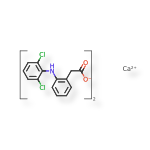
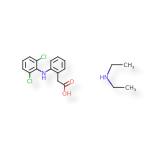
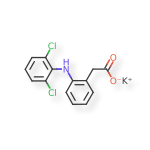
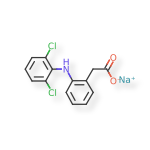
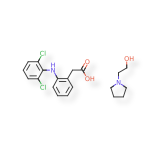
| Related Record | Type | Details | ||
|---|---|---|---|---|
|
METABOLITE -> PARENT |
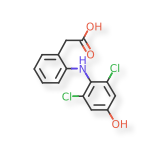
MINOR
|
||
|
METABOLITE -> PARENT |
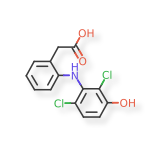
CYP3A4 is responsible for the formation of minor metabolites, 5-hydroxy and 3'-hydroxy-diclofenac
MINOR
|
||
|
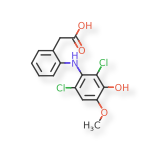
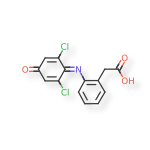
METABOLITE TOXIC -> PARENT |
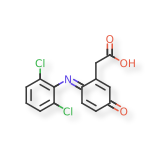
Bioactivation of DF via 5-hydroxylation might be
toxicologically more important than that via 40-hydroxylation, based on the fact that 5-OH-DF and DF-2,5-QI appeared to stimulate immune reactions. Not isolated but inferred from GSH reaction.
MINOR
|
||
|
METABOLITE -> PARENT |
CYP3A4 is responsible for the formation of minor metabolites, 5-hydroxy and 3'-hydroxy-diclofenac
MINOR
|
||
|
|
PRODRUG -> METABOLITE ACTIVE |
|
||
|
METABOLITE -> PARENT |
|
||
|
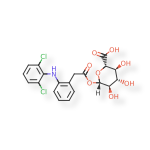
METABOLITE LESS ACTIVE -> PARENT |
MAJOR
|
||
|
METABOLITE -> PARENT |
MINOR
|
||
|
METABOLITE -> PARENT |
|
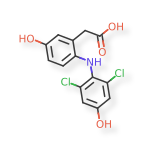
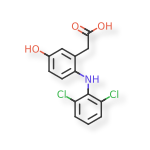

| Related Record | Type | Details | ||
|---|---|---|---|---|
|
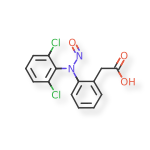
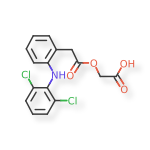
IMPURITY -> PARENT |
|
||
|
|
PARENT -> IMPURITY |
CHROMATOGRAPHIC PURITY (HPLC/UV)
EP
|
| Related Record | Type | Details | ||
|---|---|---|---|---|
|
|
ACTIVE MOIETY |
|