


Details
| Stereochemistry | RACEMIC |
| Molecular Formula | C27H38N2O4 |
| Molecular Weight | 454.6016 |
| Optical Activity | ( + / - ) |
| Defined Stereocenters | 0 / 1 |
| E/Z Centers | 0 |
| Charge | 0 |
SHOW SMILES / InChI
SMILES
COC1=CC=C(CCN(C)CCCC(C#N)(C(C)C)C2=CC=C(OC)C(OC)=C2)C=C1OC
InChI
InChIKey=SGTNSNPWRIOYBX-UHFFFAOYSA-N
InChI=1S/C27H38N2O4/c1-20(2)27(19-28,22-10-12-24(31-5)26(18-22)33-7)14-8-15-29(3)16-13-21-9-11-23(30-4)25(17-21)32-6/h9-12,17-18,20H,8,13-16H2,1-7H3
| Molecular Formula | C27H38N2O4 |
| Molecular Weight | 454.6016 |
| Charge | 0 |
| Count |
|
| Stereochemistry | RACEMIC |
| Additional Stereochemistry | No |
| Defined Stereocenters | 0 / 1 |
| E/Z Centers | 0 |
| Optical Activity | ( + / - ) |
DescriptionCurator's Comment: Description was created based on several sources, including https://www.drugbank.ca/drugs/DB00661
Curator's Comment: Description was created based on several sources, including https://www.drugbank.ca/drugs/DB00661
Verapamil is a FDA approved drug used to treat high blood pressure and to control chest pain. Verapamil is an L-type calcium channel blocker that also has antiarrythmic activity. The R-enantiomer is more effective at reducing blood pressure compared to the S-enantiomer. However, the S-enantiomer is 20 times more potent than the R-enantiomer at prolonging the PR interval in treating arrhythmias. Verapamil inhibits voltage-dependent calcium channels. Specifically, its effect on L-type calcium channels in the heart causes a reduction in ionotropy and chronotropy, thuis reducing heart rate and blood pressure. Verapamil's mechanism of effect in cluster headache is thought to be linked to its calcium-channel blocker effect, but which channel subtypes are involved is presently not known.
CNS Activity
Curator's Comment: As a lipophilic substance, verapamil easily crosses
the blood–brain barrier. Verapamil is, however, a
substrate for the efflux transporter P-glycoprotein
(P-gp) in the blood–brain barrier. The P-pg restricts
net brain uptake of verapamil by immediately transporting
it out of the brain.
Originator
Approval Year
Targets
| Primary Target | Pharmacology | Condition | Potency |
|---|---|---|---|
| 3.4 µM [IC50] | |||
Conditions
| Condition | Modality | Targets | Highest Phase | Product |
|---|---|---|---|---|
| Primary | CALAN Approved UseCALAN tablets are indicated for the treatment of the following:
Angina
1. Angina at rest including:
— Vasospastic (Prinzmetal’s variant) angina
— Unstable (crescendo, pre-infarction) angina
2. Chronic stable angina (classic effort-associated angina)
Arrhythmias
1. In association with digitalis for the control of ventricular rate at rest and during
stress in patients with chronic atrial flutter and/or atrial fibrillation (see
WARNINGS: Accessory bypass tract)
2. Prophylaxis of repetitive paroxysmal supraventricular tachycardia
Essential hypertension
CALAN is indicated for the treatment of hypertension, to lower blood pressure. Lowering
blood pressure reduces the risk of fatal and nonfatal cardiovascular events, primarily
strokes and myocardial infarctions. These benefits have been seen in controlled trials of
antihypertensive drugs from a wide variety of pharmacologic classes including this drug. Launch Date1981 |
|||
| Primary | CALAN Approved UseCALAN tablets are indicated for the treatment of the following:
Angina
1. Angina at rest including:
— Vasospastic (Prinzmetal’s variant) angina
— Unstable (crescendo, pre-infarction) angina
2. Chronic stable angina (classic effort-associated angina)
Arrhythmias
1. In association with digitalis for the control of ventricular rate at rest and during
stress in patients with chronic atrial flutter and/or atrial fibrillation (see
WARNINGS: Accessory bypass tract)
2. Prophylaxis of repetitive paroxysmal supraventricular tachycardia
Essential hypertension
CALAN is indicated for the treatment of hypertension, to lower blood pressure. Lowering
blood pressure reduces the risk of fatal and nonfatal cardiovascular events, primarily
strokes and myocardial infarctions. These benefits have been seen in controlled trials of
antihypertensive drugs from a wide variety of pharmacologic classes including this drug. Launch Date1981 |
|||
| Primary | CALAN Approved UseCALAN tablets are indicated for the treatment of the following:
Angina
1. Angina at rest including:
— Vasospastic (Prinzmetal’s variant) angina
— Unstable (crescendo, pre-infarction) angina
2. Chronic stable angina (classic effort-associated angina)
Arrhythmias
1. In association with digitalis for the control of ventricular rate at rest and during
stress in patients with chronic atrial flutter and/or atrial fibrillation (see
WARNINGS: Accessory bypass tract)
2. Prophylaxis of repetitive paroxysmal supraventricular tachycardia
Essential hypertension
CALAN is indicated for the treatment of hypertension, to lower blood pressure. Lowering
blood pressure reduces the risk of fatal and nonfatal cardiovascular events, primarily
strokes and myocardial infarctions. These benefits have been seen in controlled trials of
antihypertensive drugs from a wide variety of pharmacologic classes including this drug. Launch Date1981 |
Cmax
| Value | Dose | Co-administered | Analyte | Population |
|---|---|---|---|---|
139.28 ng/mL EXPERIMENT https://www.ncbi.nlm.nih.gov/pubmed/16892180 |
80 mg single, oral dose: 80 mg route of administration: Oral experiment type: SINGLE co-administered: |
VERAPAMIL plasma | Homo sapiens population: HEALTHY age: ADULT sex: FEMALE / MALE food status: FASTED |
AUC
| Value | Dose | Co-administered | Analyte | Population |
|---|---|---|---|---|
367.05 ng × h/mL EXPERIMENT https://www.ncbi.nlm.nih.gov/pubmed/16892180 |
80 mg single, oral dose: 80 mg route of administration: Oral experiment type: SINGLE co-administered: |
VERAPAMIL plasma | Homo sapiens population: HEALTHY age: ADULT sex: FEMALE / MALE food status: FASTED |
T1/2
| Value | Dose | Co-administered | Analyte | Population |
|---|---|---|---|---|
7.15 h EXPERIMENT https://www.ncbi.nlm.nih.gov/pubmed/16892180 |
80 mg single, oral dose: 80 mg route of administration: Oral experiment type: SINGLE co-administered: |
VERAPAMIL plasma | Homo sapiens population: HEALTHY age: ADULT sex: FEMALE / MALE food status: FASTED |
Funbound
| Value | Dose | Co-administered | Analyte | Population |
|---|---|---|---|---|
9.9% EXPERIMENT https://www.ncbi.nlm.nih.gov/pubmed/6209501 |
VERAPAMIL plasma | Homo sapiens population: HEALTHY age: ADULT sex: FEMALE / MALE food status: UNKNOWN |
Overview
| CYP3A4 | CYP2C9 | CYP2D6 | hERG |
|---|---|---|---|
OverviewOther
| Other Inhibitor | Other Substrate | Other Inducer |
|---|---|---|
Drug as perpetrator
| Target | Modality | Activity | Metabolite | Clinical evidence |
|---|---|---|---|---|
Page: 146.0 |
likely | |||
| moderate [IC50 23 uM] | ||||
Page: 99.0 |
weak | |||
| yes [IC50 1.23 uM] |
Drug as victim
| Target | Modality | Activity | Metabolite | Clinical evidence |
|---|---|---|---|---|
| yes | ||||
| yes | ||||
| yes | ||||
| yes | ||||
| yes | yes (co-administration study) Comment: Co-administration of multiple doses of 10 mg of verapamil with 80 mg simvastatin resulted in exposure to simvastatin 2.5-fold that following simvastatin alone; Clinically significant interactions have been reported with inhibitors of CYP3A4 (e.g., erythromycin, ritonavir) causing elevation of plasma levels of verapamil while inducers of CYP3A4 (e.g., rifampin) have caused a lowering of plasma levels of verapamil Page: 7.0 |
Tox targets
| Target | Modality | Activity | Metabolite | Clinical evidence |
|---|---|---|---|---|
PubMed
| Title | Date | PubMed |
|---|---|---|
| Requirement of neural activity for the maintenance of dopaminergic neurons in rat midbrain slice cultures. | 2001-03-16 |
|
| The effect of cardiac arrest on the blood-testis barrier to albumin, tumor necrosis factor-alpha, pituitary adenylate cyclase activating polypeptide, sucrose, and verapamil in the mouse. | 2001-03-07 |
|
| PSA-specific and non-PSA-specific conversion of a PSA-targeted peptide conjugate of doxorubicin to its active metabolites. | 2001-03 |
|
| The stimulation of MAP kinase by 1,25(OH)(2)-vitamin D(3) in skeletal muscle cells is mediated by protein kinase C and calcium. | 2001-02-28 |
|
| Cardiogenic shock following a single therapeutic oral dose of verapamil. | 2001-02-24 |
|
| Verapamil SR and trandolapril combination therapy is safe and effective in hypertensive patients with metabolic disorders. | 2001-02-24 |
|
| hKv4.3 channel characterization and regulation by calcium channel antagonists. | 2001-02-23 |
|
| Cardiovascular action of a cardioselective Ca(2+)channel blocker AH-1058 in conscious dogs assessed by telemetry. | 2001-02-09 |
|
| Multidrug resistance protein (MRP) activity in normal mature leukocytes and CD34-positive hematopoietic cells from peripheral blood. | 2001-02-02 |
|
| Mechanisms of hydrogen peroxide-induced relaxation in rabbit mesenteric small artery. | 2001-02-02 |
|
| Mechanisms of the increased pressor response to vasopressors in the mesenteric bed of nitric oxide-deficient hypertensive rats. | 2001-02-02 |
|
| Activating transcription factor 2-derived peptides alter resistance of human tumor cell lines to ultraviolet irradiation and chemical treatment. | 2001-02 |
|
| [Treatment of cluster headache]. | 2001-02 |
|
| Pretreatment with potent P-glycoprotein ligands may increase intestinal secretion in rats. | 2001-02 |
|
| Oxidized-LDL enhances coronary vasoconstriction by increasing the activity of protein kinase C isoforms alpha and epsilon. | 2001-02 |
|
| Refractory no-reflow successfully treated with local infusion of high-dose adenosine and verapamil--a case report. | 2001-02 |
|
| Selective drug resistant human osteosarcoma cell lines. | 2001-02 |
|
| Model organisms: new insights into ion channel and transporter function. L-type calcium channels regulate epithelial fluid transport in Drosophila melanogaster. | 2001-02 |
|
| Idiopathic sustained left ventricular tachycardia in pediatric patients. | 2001-02 |
|
| A bioreversible prodrug approach designed to shift mechanism of brain uptake for amino-acid-containing anticancer agents. | 2001-02 |
|
| Inward calcium currents in cultured and freshly isolated detrusor muscle cells: evidence of a T-type calcium current. | 2001-02 |
|
| Pharmacologic management of atrial fibrillation: current therapeutic strategies. | 2001-02 |
|
| Dysfunction of polymorphonuclear leukocytes in uremia: role of parathyroid hormone. | 2001-02 |
|
| Intra- and intercellular Ca(2+)-transient propagation in normal and high glucose solutions in ROS cells during mechanical stimulation. | 2001-02 |
|
| L-type calcium channel blockers and EGTA enhance superoxide production in cardiac fibroblasts. | 2001-02 |
|
| Kinetic profiling of P-glycoprotein-mediated drug efflux in rat and human intestinal epithelia. | 2001-02 |
|
| Signaling mechanisms for the selective vasoconstrictor effect of norbormide on the rat small arteries. | 2001-02 |
|
| Characterization of a novel cationic drug transporter in human retinal pigment epithelial cells. | 2001-02 |
|
| Pre- or post-ischemic treatment with a novel Na+/Ca2+ exchange inhibitor, KB-R7943, shows renal protective effects in rats with ischemic acute renal failure. | 2001-02 |
|
| Pharmacokinetic interaction of cytochrome P450 3A-related compounds with rhodamine 123, a P-glycoprotein substrate, in rats pretreated with dexamethasone. | 2001-02 |
|
| A flow cell assay for evaluation of whole cell drug efflux kinetics: analysis of paclitaxel efflux in CCRF-CEM leukemia cells overexpressing P-glycoprotein. | 2001-02 |
|
| Effect of intraovarian factors on porcine follicular cells: cumulus expansion, granulosa and cumulus cell progesterone production. | 2001-01-31 |
|
| Improved intestinal absorption of sulpiride in rats with synchronized oral delivery systems. | 2001-01-29 |
|
| Behavioural and anti-psychotic effects of Ca2+ channel blockers in rhesus monkey. | 2001-01-26 |
|
| Verapamil block of large-conductance Ca-activated K channels in rat aortic myocytes. | 2001-01-15 |
|
| In vitro and in vivo reversal of P-glycoprotein-mediated multidrug resistance by a novel potent modulator, XR9576. | 2001-01-15 |
|
| Involvement of cyclic GMP in nitric-oxide-induced gastric relaxation Comparison of the actions of cyclic GMP and cyclic AMP. | 2001-01 |
|
| Volume-weighted mean nuclear volume and numerical nuclear density in the cardiomyocyte following enalapril and verapamil treatment. | 2001-01 |
|
| Identification of an organic anion transport system in the human colon carcinoma cell line HT29 clone 19A. | 2001-01 |
|
| The effects of vasopressin in isolated rat hearts. | 2001-01 |
|
| Penetration of verapamil hydrochloride in the presence of sodium glycocholate as penetration enhancer through mucous membrane. | 2001-01 |
|
| A new chronotherapeutic oral drug absorption system for verapamil optimizes blood pressure control in the morning. | 2001-01 |
|
| Verapamil prevents stretch-induced shortening of atrial effective refractory period in langendorff-perfused rabbit heart. | 2001-01 |
|
| Effects of simultaneous atrioventricular pacing on atrial refractoriness and atrial fibrillation inducibility: role of atrial mechanoelectrical feedback. | 2001-01 |
|
| Transport of [3H]MPP+ in an immortalized rat brain microvessel endothelial cell line (RBE 4). | 2001-01 |
|
| Ionized magnesium in the homeostasis of cells: intracellular threshold for Mg(2+) in human platelets. | 2001-01 |
|
| Prevention of cardiomyopathy in mouse models lacking the smooth muscle sarcoglycan-sarcospan complex. | 2001-01 |
|
| Sarcoglycan, the heart, and skeletal muscles: new treatment, old drug? | 2001-01 |
|
| How to manage atrial fibrillation: an update on recent clinical trials. | 2000-10-27 |
|
| Motor and electrographic response of refractory experimental status epilepticus in rats and effect of calcium channel blockers. | 2000-02 |
Sample Use Guides
Angina: Clinical trials show that the usual dose is 80 mg to 120 mg three times a day.
However, 40 mg three times a day may be warranted in patients who may have an
increased response to verapamil (eg, decreased hepatic function, elderly, etc). Upward
titration should be based on therapeutic efficacy and safety evaluated approximately eight
hours after dosing. Dosage may be increased at daily (eg, patients with unstable angina)
or weekly intervals until optimum clinical response is obtained.
Arrhythmias: The dosage in digitalized patients with chronic atrial fibrillation (see
PRECAUTIONS) ranges from 240 to 320 mg/day in divided (t.i.d. or q.i.d.) doses. The
dosage for prophylaxis of PSVT (non-digitalized patients) ranges from 240 to
480 mg/day in divided (t.i.d. or q.i.d.) doses. In general, maximum effects for any given
dosage will be apparent during the first 48 hours of therapy.
Essential hypertension: Dose should be individualized by titration. The usual initial
monotherapy dose in clinical trials was 80 mg three times a day (240 mg/day). Daily
dosages of 360 and 480 mg have been used but there is no evidence that dosages beyond
360 mg provided added effect. Consideration should be given to beginning titration at
40 mg three times per day in patients who might respond to lower doses, such as the
elderly or people of small stature. The antihypertensive effects of CALAN are evident
within the first week of therapy. Upward titration should be based on therapeutic
efficacy, assessed at the end of the dosing interval.
Route of Administration:
Other
| Substance Class |
Chemical
Created
by
admin
on
Edited
Wed Apr 02 09:28:50 GMT 2025
by
admin
on
Wed Apr 02 09:28:50 GMT 2025
|
| Record UNII |
CJ0O37KU29
|
| Record Status |
Validated (UNII)
|
| Record Version |
|
-
Download
| Name | Type | Language | ||
|---|---|---|---|---|
|
Preferred Name | English | ||
|
Official Name | English | ||
|
Common Name | English | ||
|
Common Name | English | ||
|
Code | English | ||
|
Common Name | English | ||
|
Common Name | English | ||
|
Code | English | ||
|
Common Name | English | ||
|
Common Name | English | ||
|
Systematic Name | English |
| Classification Tree | Code System | Code | ||
|---|---|---|---|---|
|
NDF-RT |
N0000175566
Created by
admin on Wed Apr 02 09:28:50 GMT 2025 , Edited by admin on Wed Apr 02 09:28:50 GMT 2025
|
||
|
WHO-VATC |
QC09BB10
Created by
admin on Wed Apr 02 09:28:50 GMT 2025 , Edited by admin on Wed Apr 02 09:28:50 GMT 2025
|
||
|
WHO-VATC |
QC08DA01
Created by
admin on Wed Apr 02 09:28:50 GMT 2025 , Edited by admin on Wed Apr 02 09:28:50 GMT 2025
|
||
|
WHO-ATC |
C08DA51
Created by
admin on Wed Apr 02 09:28:50 GMT 2025 , Edited by admin on Wed Apr 02 09:28:50 GMT 2025
|
||
|
NCI_THESAURUS |
C333
Created by
admin on Wed Apr 02 09:28:50 GMT 2025 , Edited by admin on Wed Apr 02 09:28:50 GMT 2025
|
||
|
WHO-ESSENTIAL MEDICINES LIST |
12.2
Created by
admin on Wed Apr 02 09:28:50 GMT 2025 , Edited by admin on Wed Apr 02 09:28:50 GMT 2025
|
||
|
WHO-ESSENTIAL MEDICINES LIST |
12.1
Created by
admin on Wed Apr 02 09:28:50 GMT 2025 , Edited by admin on Wed Apr 02 09:28:50 GMT 2025
|
||
|
WHO-VATC |
QC08DA51
Created by
admin on Wed Apr 02 09:28:50 GMT 2025 , Edited by admin on Wed Apr 02 09:28:50 GMT 2025
|
||
|
NDF-RT |
N0000000069
Created by
admin on Wed Apr 02 09:28:50 GMT 2025 , Edited by admin on Wed Apr 02 09:28:50 GMT 2025
|
||
|
WHO-ATC |
C09BB10
Created by
admin on Wed Apr 02 09:28:50 GMT 2025 , Edited by admin on Wed Apr 02 09:28:50 GMT 2025
|
||
|
LIVERTOX |
NBK548362
Created by
admin on Wed Apr 02 09:28:50 GMT 2025 , Edited by admin on Wed Apr 02 09:28:50 GMT 2025
|
||
|
WHO-ATC |
C08DA01
Created by
admin on Wed Apr 02 09:28:50 GMT 2025 , Edited by admin on Wed Apr 02 09:28:50 GMT 2025
|
| Code System | Code | Type | Description | ||
|---|---|---|---|---|---|
|
200-145-1
Created by
admin on Wed Apr 02 09:28:50 GMT 2025 , Edited by admin on Wed Apr 02 09:28:50 GMT 2025
|
PRIMARY | |||
|
9948
Created by
admin on Wed Apr 02 09:28:50 GMT 2025 , Edited by admin on Wed Apr 02 09:28:50 GMT 2025
|
PRIMARY | |||
|
2520
Created by
admin on Wed Apr 02 09:28:50 GMT 2025 , Edited by admin on Wed Apr 02 09:28:50 GMT 2025
|
PRIMARY | |||
|
2406
Created by
admin on Wed Apr 02 09:28:50 GMT 2025 , Edited by admin on Wed Apr 02 09:28:50 GMT 2025
|
PRIMARY | |||
|
CJ0O37KU29
Created by
admin on Wed Apr 02 09:28:50 GMT 2025 , Edited by admin on Wed Apr 02 09:28:50 GMT 2025
|
PRIMARY | |||
|
2122
Created by
admin on Wed Apr 02 09:28:50 GMT 2025 , Edited by admin on Wed Apr 02 09:28:50 GMT 2025
|
PRIMARY | |||
|
N0000182141
Created by
admin on Wed Apr 02 09:28:50 GMT 2025 , Edited by admin on Wed Apr 02 09:28:50 GMT 2025
|
PRIMARY | Cytochrome P450 3A4 Inhibitors [MoA] | ||
|
11170
Created by
admin on Wed Apr 02 09:28:50 GMT 2025 , Edited by admin on Wed Apr 02 09:28:50 GMT 2025
|
PRIMARY | RxNorm | ||
|
100000079099
Created by
admin on Wed Apr 02 09:28:50 GMT 2025 , Edited by admin on Wed Apr 02 09:28:50 GMT 2025
|
PRIMARY | |||
|
52-53-9
Created by
admin on Wed Apr 02 09:28:50 GMT 2025 , Edited by admin on Wed Apr 02 09:28:50 GMT 2025
|
PRIMARY | |||
|
VERAPAMIL
Created by
admin on Wed Apr 02 09:28:50 GMT 2025 , Edited by admin on Wed Apr 02 09:28:50 GMT 2025
|
PRIMARY | |||
|
Verapamil
Created by
admin on Wed Apr 02 09:28:50 GMT 2025 , Edited by admin on Wed Apr 02 09:28:50 GMT 2025
|
PRIMARY | |||
|
DB00661
Created by
admin on Wed Apr 02 09:28:50 GMT 2025 , Edited by admin on Wed Apr 02 09:28:50 GMT 2025
|
PRIMARY | |||
|
D014700
Created by
admin on Wed Apr 02 09:28:50 GMT 2025 , Edited by admin on Wed Apr 02 09:28:50 GMT 2025
|
PRIMARY | |||
|
2815
Created by
admin on Wed Apr 02 09:28:50 GMT 2025 , Edited by admin on Wed Apr 02 09:28:50 GMT 2025
|
PRIMARY | |||
|
N0000185503
Created by
admin on Wed Apr 02 09:28:50 GMT 2025 , Edited by admin on Wed Apr 02 09:28:50 GMT 2025
|
PRIMARY | P-Glycoprotein Inhibitors [MoA] | ||
|
C928
Created by
admin on Wed Apr 02 09:28:50 GMT 2025 , Edited by admin on Wed Apr 02 09:28:50 GMT 2025
|
PRIMARY | |||
|
CJ0O37KU29
Created by
admin on Wed Apr 02 09:28:50 GMT 2025 , Edited by admin on Wed Apr 02 09:28:50 GMT 2025
|
PRIMARY | |||
|
m11414
Created by
admin on Wed Apr 02 09:28:50 GMT 2025 , Edited by admin on Wed Apr 02 09:28:50 GMT 2025
|
PRIMARY | Merck Index | ||
|
DTXSID9041152
Created by
admin on Wed Apr 02 09:28:50 GMT 2025 , Edited by admin on Wed Apr 02 09:28:50 GMT 2025
|
PRIMARY | |||
|
SUB00038MIG
Created by
admin on Wed Apr 02 09:28:50 GMT 2025 , Edited by admin on Wed Apr 02 09:28:50 GMT 2025
|
PRIMARY | |||
|
CHEMBL6966
Created by
admin on Wed Apr 02 09:28:50 GMT 2025 , Edited by admin on Wed Apr 02 09:28:50 GMT 2025
|
PRIMARY | |||
|
N0000190114
Created by
admin on Wed Apr 02 09:28:50 GMT 2025 , Edited by admin on Wed Apr 02 09:28:50 GMT 2025
|
PRIMARY | Cytochrome P450 3A Inhibitors [MoA] |
| Related Record | Type | Details | ||
|---|---|---|---|---|
|
BINDER->LIGAND |
|
||
|
TRANSPORTER -> INHIBITOR | |||
|
METABOLIC ENZYME -> SUBSTRATE | |||
|
TRANSPORTER -> INHIBITOR | |||
|
TRANSPORTER -> INHIBITOR | |||
|
TRANSPORTER -> SUBSTRATE | |||
|
TRANSPORTER -> INHIBITOR | |||
|
METABOLIC ENZYME -> INHIBITOR |
IC50
|
||
|
TRANSPORTER -> INHIBITOR | |||
|
TRANSPORTER -> SUBSTRATE | |||
|
|
SALT/SOLVATE -> PARENT | |||
|
TRANSPORTER -> INHIBITOR | |||
|
METABOLIC ENZYME -> INHIBITOR | |||
|
TRANSPORTER -> INHIBITOR | |||
|
METABOLIC ENZYME -> SUBSTRATE | |||
|
TRANSPORTER -> SUBSTRATE | |||
|
TRANSPORTER -> INHIBITOR |


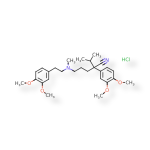
| Related Record | Type | Details | ||
|---|---|---|---|---|
|
METABOLITE -> PARENT |
22% 0f dose
MAJOR
URINE
|
||
|
METABOLITE ACTIVE -> PARENT |
|
||
|
METABOLITE ACTIVE -> PARENT |
MAJOR
PLASMA
|
||
|
METABOLITE -> PARENT |
3-4% of dose
MINOR
URINE
|
||
|
METABOLITE -> PARENT |
3-4% of dose
MINOR
URINE
|
||
|
METABOLITE -> PARENT |
7% of dose
URINE
|
||
|
METABOLITE -> PARENT |
6% of dose
MINOR
URINE
|
||
|
METABOLITE ACTIVE -> PARENT |
6% of dose
MINOR
URINE
|
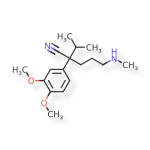
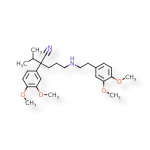
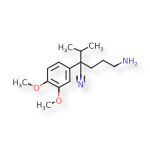
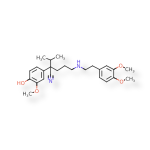
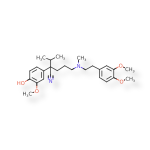
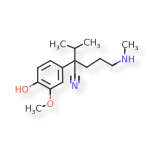
| Related Record | Type | Details | ||
|---|---|---|---|---|
|
|
ACTIVE MOIETY |
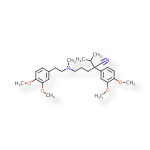
| Name | Property Type | Amount | Referenced Substance | Defining | Parameters | References |
|---|---|---|---|---|---|---|
| Volume of Distribution | PHARMACOKINETIC |
|
Populations PHARMACOKINETIC |
|
||
| Duration of Action | PHARMACOKINETIC |
|
|
|||
| Volume of Distribution | PHARMACOKINETIC |
|
Populations PHARMACOKINETIC |
|
||
| Duration of Action | PHARMACOKINETIC |
|
|
|||